
A Farm Class 1 is the fifth chapter of the NCERT English book Mridang — a short, nine-page chapter built around a farm rhyme, a reading passage about the animals and birds near a house, and speaking games. The official PDF of the chapter, for the current academic session, is right below.
Download the NCERT Class 1 English Mridang Chapter 5 A Farm PDF
Here is the official NCERT PDF for this chapter, from ncert.nic.in: NCERT Class 1 English Mridang Chapter 5 A Farm PDF.
A Farm Class 1 Chapter 5: what the PDF contains
| What the chapter holds | Count | Where it is used |
|---|---|---|
| Printed pages | 9 | |
| Figures with NCERT captions | 3 | |
| Activities | 1 | |
| Official NCERT PDF | Download the chapter PDF | the chapter exactly as NCERT publishes it |
The table above lists how much this chapter holds. The work itself is oral and visual — rhyme, colouring, speaking in pairs, looking at pictures — rather than written. A child meets six parts in order:
- the opening rhyme A Farm with its animal-sound game;
- Let us do, a colouring task with a help box (cat, cow, goat, pig, hen, cock, sparrow);
- Let us read, the passage Animals and Birds;
- the New words list;
- Let us speak, covering jungle animals, final sounds and pair talk;
- Fun time, the elephant hunt.
What A Farm covers, section by section
This walkthrough follows the order a child meets the chapter, so a parent knows what happens on the page before opening the book. Short notes to the teacher sit beside the activities throughout.
The rhyme: A Farm
The chapter opens with the rhyme My dear grandpa had a farm, E-I-E-I-O. The first verse gives a cow with a moo-moo here and a moo-moo there; the second gives a hen with cluck-cluck in the same pattern.
The task is to replace the animals with their sounds and continue the rhyme; the book’s own example is cat – miaon-miaon.
Let us do: colour the farm
The first activity asks the child to colour the farm and name the animals in it, using the help box: cat, cow, goat, pig, hen, cock, sparrow. Have the child say each name out loud before colouring — the naming is the lesson, the colouring is the reward.
Let us read: Animals and Birds
The reading passage introduces Jaggu, who lives in Nagpur, and walks past the animals and birds near his house. Each is given a single detail — colour, size or where it lives — so the child pairs the English name with that detail.
| Name | What the book says | Detail the book leaves open |
|---|---|---|
| dog | lives near the gate | colour and size are not given |
| cats | jump up and down in the verandah | colour is not given |
| cow | eats grass | colour is not given |
| rat | very small; the cat chases it | colour is not given — and the pair talk later asks it |
| monkeys | swing and jump in the trees | nothing else is given |
| snakes | a few live in the field; walk carefully | colour is not given |
| crow | black in colour | size is not given |
| pigeon | grey in colour | size is not given |
| sparrow | a small bird | colour is not given |
| parrot | green, with a red beak | size is not given |
| peacock | has many colours | size is not given |
Notice the details the book leaves open: the rat is described only as very small, never by colour, and the sparrow only as a small bird. Those gaps become questions in the pair talk later. The passage ends with Jaggu’s line I love animals and birds.
New words
After the reading comes a list of ten New words taken from the passage: verandah, cow, rat, sparrow, crow, pigeon, snake, fields, peacock, beak. A note to the teacher beside the list asks adults to talk about the animals, birds and insects around them, and to reinforce the English names through frequent and regular repetition.
Let us speak
Three tasks build speaking confidence:
- Name jungle animals — tiger, lion, elephant — by looking at pictures.
- Hear the last sound — say rat, say it again, and notice that the last sound is t.
- Talk in pairs — ask and answer What is the colour of a parrot?, with blanks for parrot, crow and rat, and the ready answer Oh! It has many colours for the peacock.
Fun time
The chapter closes with a picture puzzle: Can you see the elephants? Where can you see them? Elephants are hidden at different places in one scene, and the book’s teacher note asks adults to help children say where each elephant is, using prepositions such as in, on, behind.
Key ideas in A Farm: what the chapter actually teaches
The chapter builds a child’s first English vocabulary for animals and birds through repetition, sound play and simple conversation. The skill map below shows which activity does which job.
| Skill | Where it appears | What the child does |
|---|---|---|
| English names of animals and birds | the whole chapter | says the name and points at the animal or bird |
| animal sounds and the rhyme pattern | the opening rhyme | replaces cow and hen with new animals and their sounds |
| describing words of colour and size | the reading passage | hears black crow, grey pigeon, small sparrow, green parrot with a red beak, many-coloured peacock, very small rat |
| last sounds of words | Let us speak B | notices that the last sound of rat is t |
| farm animals versus jungle animals | rhyme and help box (farm); Let us speak A (jungle) | separates cow, hen, goat, pig from tiger, lion, elephant |
| prepositions in, on, behind | Fun time | says where each hidden elephant is |
| a sentence frame for conversation | Let us speak C | asks and answers “What is the colour of …?” |
A note to the teacher in the book makes the method explicit: the English names of animals, birds and insects are reinforced through frequent and regular repetition. The chapter never asks for a written answer — the same names return in the rhyme, the reading, the pair talk and the picture games.
The E-I-E-I-O rhyme and the animal-sound game
Every verse of the opening rhyme follows one pattern: name an animal, give its sound, repeat the sound here and there, then close with the refrain E-I-E-I-O. The book supplies two verses — a cow with moo-moo and a hen with cluck-cluck — and asks the child to continue with new animals.
The book’s example is cat – miaon-miaon. A goat verse in the same pattern goes: With a maa-maa here and a maa-maa there, here a maa, there a maa, everywhere a maa-maa.
Any clear animal sound is acceptable. The book says to use the sounds of animals from your language, so a child who offers oink-oink for a pig or a home-language sound is following the instruction, not making a mistake. To play: an adult names an animal, the child supplies the sound, and together they sing the verse.
The pictures in A Farm and how to use them
Three activities are built around pictures. The book gives these pictures no captions, so the descriptions below come only from what the surrounding text says.
- Let us do (the farm scene to colour): the picture shows a farm with the help-box animals — cat, cow, goat, pig, hen, cock, sparrow. Adult move: the child names each animal before colouring it.
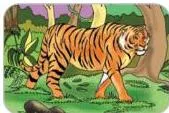
- Let us speak A (jungle animals): pictures of a tiger, a lion and an elephant. Adult move: say each name slowly, let the child repeat it, then say the three together.
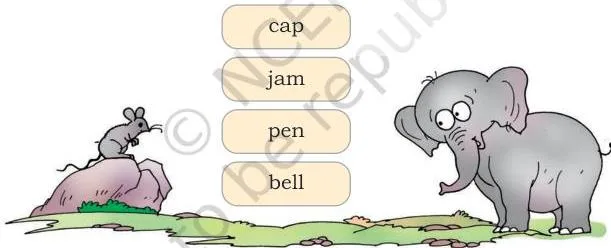
- Fun time (hidden elephants): elephants sit at different places in the scene. Adult move: ask “Where is the elephant?” and model the answer with in, on or behind, as the book’s teacher note suggests.
New words in A Farm, with simple meanings
The chapter’s New words list gives ten words without definitions. The meanings below match how each word is used in the passage, in words a Class 1 child can follow.
| Word | What it means |
|---|---|
| verandah | a covered area along the side of a house — the cats jump there |
| cow | a farm animal that eats grass |
| rat | a very small animal that the cat chases |
| sparrow | a small bird |
| crow | a black bird |
| pigeon | a grey bird |
| snake | a long animal with no legs, found in the field — walk carefully |
| fields | open ground, like the field beside Jaggu’s house |
| peacock | a big bird with many colours |
| beak | a bird’s mouth — the parrot has a red beak |
The passage uses more animal words than the New words list holds — dog, cat, goat, pig, hen, cock, monkey and parrot appear too. The New words list is the core set to focus on, not every word in the chapter.
Mistakes young readers make with A Farm
None of these are wrong answers to punish. They are the normal bumps of learning English sounds and names, and the chapter’s activities exist to smooth them. Each fix is something an adult can do at home.
| Mistake | Correct rule | How to check your answer |
|---|---|---|
| Dropping the ending sound — saying “ra” for “rat” | The last sound of rat is t, and it must be heard | Extend the game with the chapter’s own words: cat ends with t, hen with n, pig with g, dog with g |
| Guessing the rat’s colour | The book gives the rat’s size (very small) but never its colour | Answer from real life, or say the chapter does not say — do not invent a book answer |
| Mixing farm and jungle animals | Cow, hen, goat and pig belong on a farm; tiger, lion and elephant live in the jungle | The book’s teacher note asks adults to help children separate domestic and wild animals |
| Using the wrong preposition in the elephant hunt — “elephant in tree” for “behind the tree” | Say where the elephant really is, using in, on or behind | Model each word with real objects first — a toy in a box, on a table, behind a chair — then return to the picture |
How A Farm is used in Class 1 classroom work
There is no board exam for Class 1, so this chapter’s check is oral and activity based: can the child say the animal and bird names, answer “What is the colour of …?”, hear the last sound of a word, and follow the rhyme pattern? Practice means speaking out loud and doing the activities — not writing answers.
The notes to the teacher printed beside the activities set the expectation for classroom time:
- talk about the animals, birds and insects in the surroundings;
- repeat the English names often, through frequent and regular repetition;
- help children understand domestic and wild animals;
- help them notice the final sounds of words;
- encourage conversation using the given sentence structure;
- use prepositions such as in, on, behind while finding the elephants.
At home, the same sequence works: sing the rhyme, colour and name the help box animals, read Jaggu’s passage aloud together, play the sound game, do the pair talk, then find the elephants and say where each one is.
One honest note: textbook contents and the examinable syllabus are not always identical — check the current official syllabus on cbse.gov.in.
A Farm: quick recap for a last-minute run-through
The chapter has no printed summary section, so here is the whole of it in five lines:
- The rhyme is My dear grandpa had a farm, E-I-E-I-O — a cow says moo-moo, a hen says cluck-cluck, and children keep the pattern with new animals and sounds from their own language.
- The colouring task uses the help-box animals: cat, cow, goat, pig, hen, cock, sparrow.
- Jaggu from Nagpur shows the animals near his house — dog, cats, cow, rat, monkeys, snakes — and the birds — crow, pigeon, sparrow, parrot, peacock.
- Let us speak adds tiger, lion and elephant as jungle animals, trains the last sound of rat (t), and practises colour questions in pairs.
- Fun time hides elephants for children to find and describe with in, on, behind.
Related NCERT Class 1 English resources
This listing is maintained for the 2026-27 academic session using the NCERT textbook information available to us. NCERT remains the authority for confirming the latest edition.
To move around the book or the class, start from these pages — and the main CBSE notes index covers other classes and subjects.
- NCERT Class 1 English book page (Mridang) — every chapter of the book.
- Class 1 NCERT books hub — the other Class 1 subjects.
- Class 1 English Mridang Chapter 4 — the chapter before A Farm.
- Class 1 English Mridang Chapter 6 — the chapter after A Farm.
The official textbook gateway at ncert.nic.in holds the full Mridang edition.
Sources and data verification
- The chapter description on this page follows the NCERT Class 1 English textbook Mridang, Chapter 5, A Farm, in the official edition on ncert.nic.in.
- This page covers the single chapter A Farm; it does not cover the rest of Mridang or other Class 1 books.
- The page is maintained for the current academic session.
- NCERT settles textbooks, editions and PDFs; CBSE settles curriculum, syllabus and examinations.
Reference: NCERT Class 1 English (Mridang) textbook, chapter 5 (A Farm), official edition on ncert.nic.in.
Common questions about A Farm, answered
Where can I download the NCERT Class 1 English Mridang Chapter 5 A Farm PDF?
From the official NCERT textbook portal at ncert.nic.in — the download link at the top of this page opens it directly. The PDF is the chapter as it appears in the current Mridang edition, and no third-party mirror is needed.
Which animals and birds appear in the A Farm chapter?
The help box lists the farm animals cat, cow, goat, pig, hen, cock and sparrow. Jaggu’s reading passage adds dog, rat, monkeys and snakes, then the birds crow, pigeon, sparrow, parrot and peacock. Let us speak adds the jungle animals tiger, lion and elephant.
What is the A Farm rhyme and how is the sound game played?
The rhyme is My dear grandpa had a farm, E-I-E-I-O. One verse gives a cow with moo-moo and the next a hen with cluck-cluck, each sound repeated here and there. To play, an adult names an animal, the child supplies its sound, and together they sing the verse — cat – miaon-miaon is the book’s example.
What does the Let us speak section in A Farm ask children to do?
Three things: name the jungle animals tiger, lion and elephant; notice that the last sound of rat is t; and ask and answer colour questions in pairs — What is the colour of a parrot? A parrot is __________.
What colours does the A Farm chapter give for the birds?
The crow is black and the pigeon is grey; the parrot is green with a red beak, and the peacock has many colours. The sparrow is described only as small — the chapter gives no colour for it.
How can I help my child with the A Farm chapter at home?
Follow the six-step sequence in the classroom section above: sing the rhyme, colour and name the help box animals, read Jaggu’s passage together, play the sound game, do the pair talk, then find the elephants. Keep sessions to a few minutes, and let the child choose the animal sounds — the book invites sounds from the child’s own language.
Explore Class 1 English Books
Related chapters: