
This page gives you the official My Family and Me Class 1 NCERT English (Mridang) Chapter 1 — a 14-page chapter that opens with the poem Two Little Hands, moves through body-part activities, sense sentences, the alphabet song and letter sounds, and has its official PDF right here.
The official NCERT Class 1 English Mridang Chapter 1 My Family and Me PDF is hosted on ncert.nic.in, so any child or parent who opens it gets the whole chapter — poem, activities, alphabet, phonics and letter sounds — exactly as it appears in the print edition.
My Family and Me at a glance
| What the chapter holds | Count | Where it is used |
|---|---|---|
| Printed pages | 14 | |
| Figures with NCERT captions | 7 | |
| Tables | 1 | |
| Activities | 2 | |
| Official NCERT PDF | Download the chapter PDF | the chapter exactly as NCERT publishes it |
Use the table above for the chapter’s totals; the list below names each part in the order the book prints it. A short note to the teacher sits between most activities, telling how to run each one.
- Two Little Hands — the opening “Let us sing” poem that teaches body parts as children clap, tap and touch.
- Let us speak, A. Repeat after the teacher — one full sentence said aloud, with every child taking a turn.
- Let us speak, B. Talk in pairs — asking and answering about body parts with a partner.
- Match the parts of the body with their pictures — eleven body-part labels to pair with pictures.
- Let us read — five sense sentences that connect each body part to its job.
- My Hand — a palm-tracing craft, decorated and compared with a friend’s drawing.
- Washing Hands — a four-step hand-washing sequence done in order.
- Alphabet song — the A–Z song under “Let us sing”.
- Write the letters — tracing Aa, Bb, Cc, Dd, Ee and Ff under “Let us write”.
- Phonics song — a picture word for every letter, from “a is for ant” to “z is for zebra”.
- Letter sounds — a letter grid of picture words, closing with an odd-one-out listening task.
What this chapter covers, from poem to letter sounds
Why this order? The chapter starts with the body a six-year-old already knows and moves step by step toward the sounds that make words. By the last page, the child is listening for the first sound of a word — the beginning of reading.
Phase 1: Body words and full sentences
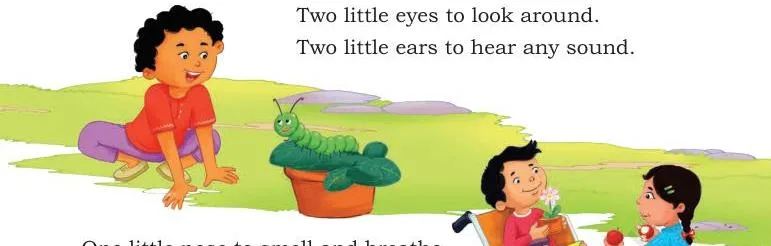
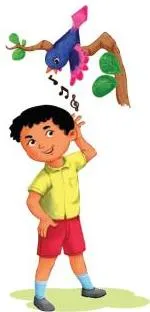
- The Two Little Hands poem (NCERT, Let us sing) pairs each body part with an action: hands clap, legs tap, eyes look, ears hear, nose smells and breathes, mouth eats. The teacher note says children touch the part named as they sing, and the song may be repeated until the words are learned.
- Repeat after the teacher (NCERT, Let us speak) turns the poem’s words into complete sentences — I clap with my hands, I tap with my feet, I look with my eyes, I walk with my legs. The note asks that every child in the class gets a turn to say one sentence aloud.
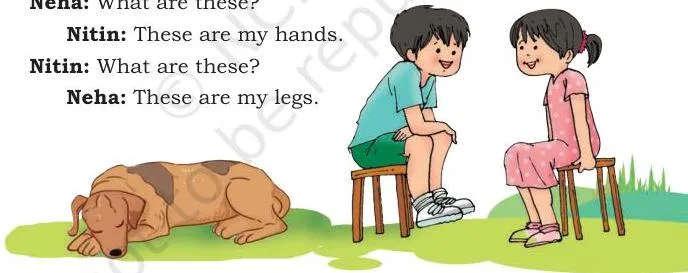
- Talk in pairs (NCERT, Let us speak) practises asking and answering. “What is this?” draws the answer “This is my nose”, while “What are these?” draws “These are my ears” — one thing versus two things.
- Match the parts of the body with their pictures (NCERT, matching activity) fixes word-to-picture links. The note says to point at each picture, say the word aloud, and let children repeat while pointing at the same part on themselves.
- Let us read (NCERT, Let us read) links each body part to its sense verb: eyes see, ears hear, nose smells, mouth eats, skin feels.
Phase 2: Do it with your hands
- My Hand (NCERT, Let us do) — place one palm in the centre of the box, draw its outline with the other hand, decorate it with colours, coloured paper bits or bindis, then compare your drawing with a friend’s.
- Washing Hands (NCERT, Let us do) — a four-step sequence: wet the hands, rub soap, wash between the fingers, rinse. The note says to give the instructions one by one and let the child act after each.
Phase 3: Letters and sounds
- Alphabet song (NCERT, Let us sing) — names the letters from A to Z and closes with a rhyme about learning the ABC.
- Write the letters (NCERT, Let us write) — tracing Aa, Bb, Cc, Dd, Ee and Ff. The note recommends letter flash cards that show the tracing direction.
- Phonics song (NCERT, Let us sing) — a picture word for every letter, from a is for ant and b is for bag to z is for zebra. The note asks the teacher to draw attention to the initial sound of each word.
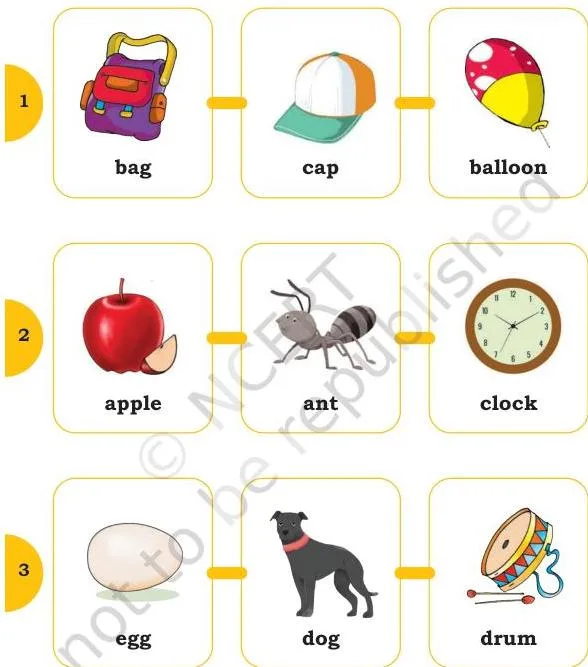
- Letter sounds (NCERT, Letter sounds) — a letter grid of picture words grouped by starting sound. The closing task reads, “Notice the initial sounds of the words in each row. Find the odd one out.”
The learning goals hidden in the poem
The poem page carries two small word boxes that are easy to skip, and they do different jobs. Sight words are for recognising by sight; new words are the body vocabulary the chapter teaches.
- New words: hand, leg, head, eye, ear, nose, mouth (NCERT, poem page) — the seven body-part words of the chapter. A child should be able to say each one and point to it.
- Sight words: one, to (NCERT, poem page) — words a beginning reader learns as whole shapes, not by sounding them out. The note says to write both lists on the board.
- Full-sentence speech — the repeat-after-the-teacher lines turn single words into whole sentences such as “I clap with my hands”, and every child gets a turn to speak.
- Question forms — Talk in pairs practises “What is this?” for one thing and “What are these?” for more than one. This is the this and these rule: this is for one thing, these are for two or more.
- The five senses — “Let us read” connects each body part to its job through five short sentences, set out in the table below.
- First sounds — the phonics pages teach the child to say a word and listen to its first sound, the skill that later becomes decoding printed words.
The five senses table from “Let us read”
The five sentences in “Let us read” pair a body part with the sense it serves (NCERT, Let us read).
| Sentence in the chapter | Body part | Sense it teaches |
|---|---|---|
| I see with my eyes. | eyes | sight |
| I hear with my ears. | ears | hearing |
| I smell with my nose. | nose | smell |
| I eat with my mouth. | mouth | taste |
| I feel with my skin. | skin | touch |
Skin is the one body part in this list that the poem never sings about — the chapter deliberately widens its vocabulary beyond the song.
First-sound walkthroughs: s, k and r
Here is the chapter’s listening method in action — say the word, then listen to its first sound (NCERT, phonics song and letter sounds). Read each line with the child, stretching the first sound.
- s is for sun — say “sun” slowly: s-s-sun. Its first sound is /s/. Sun and sock share it; rat does not.
- k is for kite — say “kite”: k-k-kite. Its first sound is /k/. Kite and king share it; bag does not.
- r is for rat — say “rat”: r-r-rat. Its first sound is /r/. Rat and run share it; sun does not.
Each activity and the skill it builds
This chapter is activity-based on purpose. A six-year-old learns language by doing and saying it, not by writing it down, so nearly every page is a small task with a clear goal.
| Activity (as named in the book) | What the child does | Skill it practises |
|---|---|---|
| Repeat after the teacher | Says one sentence aloud after the teacher, each child in turn | Full-sentence speech and the confidence to speak |
| Talk in pairs | Asks and answers with a partner using “What is this?” and “What are these?” | Question forms and the this and these rule |
| Match the parts of the body with their pictures | Pairs eleven body-part labels with their pictures | Word-picture recognition and body vocabulary |
| Let us read | Reads each sense word, then the full sentence that carries it | Sight-word reading and the five sense verbs |
| My Hand | Traces a palm, decorates it, compares it with a friend’s drawing | Fine motor control and following instructions |
| Washing Hands | Listens to the four steps one by one and acts after each | Instruction-following and sequencing |
The picture pages and what to do with each one
Most of this chapter is picture-led: the child reads a word next to an image rather than a block of text. Three picture tasks carry the weight.
The matching page
The matching activity lists eleven body-part words: head, nose, eye, ear, cheek, hand, tongue, arm, mouth, foot and leg (NCERT, Match the parts of the body). Run it as the note says: point at each picture, say the word aloud, and let the child repeat it while pointing at the same part on their own body.
The “My Hand” page
The “My Hand” task is a craft with a rule: place one palm in the centre of the box, draw its outline with the other hand, then decorate it with colours, coloured paper bits, bindis or anything else (NCERT, My Hand). The last step is comparing drawings with a friend, which turns a private craft into talking practice.
The alphabet and phonics pages
Each letter is paired with a picture word — a is for ant, b is for bag, and the pattern runs through z is for zebra (NCERT, phonics song). The picture is a hook for the sound: the child says the word, stretches it, and hears the first sound.
Words the chapter introduces, explained simply
These are the words and terms the chapter itself uses, explained for a parent who is not teaching the book day to day.
| Word or term | What it means | Where it appears |
|---|---|---|
| one, to | Sight words — words to recognise by sight, not to sound out | poem page (NCERT, sight words) |
| hand, leg, head, eye, ear, nose, mouth | New words — the seven body-part words of the chapter | poem page (NCERT, new words) |
| cheek, tongue, arm, foot | Extra body-part words used in the matching activity | matching page (NCERT, matching activity) |
| see, hear, smell, eat, feel | The five sense verbs in the reading sentences | Let us read |
| initial sound | The first sound of a word, as in “a is for ant” | phonics song and letter sounds |
The vocabulary difference that surprises most parents: cheek, tongue, arm and foot appear in the matching activity even though the poem never names them, so the chapter’s full body-word list runs to eleven.
Where children usually stumble in this chapter
The teacher notes in the chapter name exactly where young learners slip. Most stumbles here are listening or pointing errors, so the fix is oral too.
| Mistake | Correct rule | How to check your answer |
|---|---|---|
| “This is my ears” | Use “this is” with one thing (this is my nose, this is my mouth), and “these are” with two or more (these are my ears, hands, legs) | Point and count first: one thing → this is; two or more → these are (NCERT, Talk in pairs) |
| Choosing the odd one out by looking at the picture | Judge by ear, not by eye — say each word and listen to its first sound | Say the whole group aloud; the odd word is the one whose first sound does not match — find it by listening to the first sound, not by judging the picture (NCERT, Letter sounds) |
| Tracing letters in the wrong direction | Follow the direction shown on the letter flash cards when tracing Aa to Ff | Watch where each letter starts and which way the stroke moves (NCERT, Write the letters note) |
| Doing the washing-hands steps out of order | Listen to one instruction at a time and act after each one | Say the four steps in order before doing them (NCERT, Washing Hands note) |
| Singing the poem but touching the wrong body part | Touch the part named in the line as the word is sung | Sing slowly and point before the word arrives (NCERT, poem note) |
If the child slips, go back to the oral step — say it aloud, point, listen. That is how this chapter is designed to be fixed.
What this chapter is really for: reading readiness
This is a Class 1 chapter: there is no board exam and no marks to chase, so nothing on this page claims weightage or guarantees. It also has no numbered exercise questions — only activities, from the poem to the letter-sounds grid.
The chapter’s real job is reading readiness — oral language, body vocabulary, sight words, letter names and first sounds that later Mridang chapters build on. Textbook contents and the examinable syllabus are not always identical, so the current official syllabus is the final check.
Quick revision summary of Chapter 1
The chapter has no printed summary section, so this recap is ours, built from the book’s arc. Tick each item against your own copy.
- Seven body-part words from the poem: hand, leg, head, eye, ear, nose, mouth.
- Sight words one and to.
- Five sense sentences: eyes see, ears hear, nose smells, mouth eats, skin feels.
- This is for one thing; these are for two or more.
- Eleven body words on the matching page, including cheek, tongue, arm and foot.
- Letters Aa–Ff traced, alphabet song sung, and first sounds heard in the phonics song, letter-sounds grid and odd-one-out task.
A five-minute revision routine
- Minute 1: sing and clap through Two Little Hands, touching each body part as it is named.
- Minute 2: say the point and say sentences — I clap with my hands, I tap with my feet, I look with my eyes, I walk with my legs.
- Minute 3: open the matching page and name all eleven body parts, pointing at each on yourself.
- Minute 4: sing the alphabet song once, then trace Aa to Ff.
- Minute 5: play the first-sound game with s, k and r — say the word, stretch it, find the sound.
That is the whole chapter in one sitting: poem → sentences → matching → alphabet → sounds.
Related resources for Class 1 English
This listing is maintained for the 2026-27 academic session using the NCERT textbook information available to us. NCERT remains the authority for confirming the latest edition.
Keep moving through the book with the Class 1 English (Mridang) notes hub, or step back to the Class 1 NCERT books hub to see the other subjects in this class. The wider CBSE notes index organises notes class by class, and the Mridang Class 1 Chapter 2 page covers the chapter that follows in the book.
Reference: NCERT Class 1 English textbook, chapter 1, official edition on ncert.nic.in.
Sources and data verification
Where the information on this page comes from, stated plainly:
- The activity descriptions on this page follow the NCERT Mridang Class 1 English textbook, current edition, as published on ncert.nic.in.
- This page covers Chapter 1, “My Family and Me”, as it is published in that book.
- The page is maintained for the current academic session using the NCERT information available to us.
- NCERT settles textbooks, editions and official PDFs; CBSE settles the curriculum, syllabus and examinations.
FAQs about Mridang Class 1 Chapter 1
What is “Two Little Hands” in the Class 1 Mridang book?
It is the opening poem of Chapter 1, “My Family and Me”. Children sing it while touching each body part named, and it teaches the chapter’s seven new body-part words — hand, leg, head, eye, ear, nose and mouth — along with the sight words one and to.
Is the chapter called “My Family and Me” or “Two Little Hands”?
The chapter is “My Family and Me”. “Two Little Hands” is the name of the poem that opens it, so the chapter page carries both names.
What should a child be able to do after finishing this chapter?
Say and recognise seven body-part words (plus four more from the matching page), use “this is” and “these are” correctly, read the five sense sentences, recognise “one” and “to”, trace Aa to Ff, and listen for the first sound of a word.
Does Mridang Class 1 Chapter 1 have exercise questions?
No numbered exercise questions. The chapter is made of activities — sing, speak, match, read, do, write and listen — and every one of them is oral or hands-on.
How does the letter sounds table with the odd one out work?
Each group of words in the table shares the same starting sound. Say each word aloud and listen to its first sound; the odd word is the one whose first sound does not match the rest. The note tells the teacher to focus on the initial sound of each word, not on what the picture shows.
Where can I download the official Mridang Class 1 English chapter 1 PDF?
The official PDF is on the NCERT website (ncert.nic.in), and the download card at the top of this page opens it directly. It carries the whole chapter — poem, activities, alphabet, phonics and letter sounds — exactly as printed in the book.
Explore Class 1 English Books
Related chapters: