
Outcomes of Democracy is Chapter 5 of the NCERT Class 10 Democratic Politics–II textbook. It runs from printed pages 63 to 74 and asks one question: what can we reasonably expect democracy to deliver, and does it actually deliver it? The official NCERT chapter PDF is right below.
Download the official NCERT Class 10 Democratic Politics Chapter 5 Outcomes of Democracy PDF from the NCERT textbook portal at ncert.nic.in — this is the official edition of Democratic Politics–II, the same text your school follows.
Chapter 5 at a glance
The table above lists what this chapter holds — its sections, figures, tables and exercises — so you can see the size of the file before you open it. This is a text-and-data chapter: it builds its argument mainly through prose, two data tables on economic growth and income inequality, survey evidence from South Asia, and political cartoons.
It has no formulas and no worked numerical examples, so the reading is about following an argument rather than solving problems.
What this chapter covers (and the order to read it in)
The whole chapter is one assessment applied to four areas of government. For each area, the chapter sets out what we are entitled to expect from democracy, then checks the actual record, and finally sorts out what the evidence really proves. Use the table below as your map.
| Chapter section | NCERT pages | What you should take from it |
|---|---|---|
| How do we assess democracy’s outcomes? | 63–64 | The guiding idea: democracy is only a form of government — it creates conditions; citizens must use them. |
| Accountable, responsive and legitimate government | 64–66 | The procedural list, the substantive list, and why legitimacy is democracy’s strongest result. |
| Economic growth and development | 67–68 | Growth averages for democracies vs dictatorships, and why the poor-country comparison matters. |
| Reduction of inequality and poverty | 68–69 | Political equality coexisting with growing economic inequality — the “poor are the majority” puzzle. |
| Accommodation of social diversity | 69–70 | Belgium vs Sri Lanka and the two conditions for success. |
| Dignity and freedom of citizens | 71–72 | Women’s and caste struggles, and why complaints prove democracy is working. |
| Exercises | 73–74 | Eight questions that test the expected-vs-actual framework, including the Nannu case study. |
Recommended reading order: read the assessment question first (pages 63–64), because every later section uses its “expected vs actual” framework. Then read the four outcome sections in order — government, economy, inequality, diversity — and finish with dignity and freedom, which carries the chapter’s conclusion. Do the exercises last, after you can quote one piece of evidence from each section.
Key concepts: what democracy delivers, and what it does not
This section is the chapter’s answer to “what does democracy do?”, arranged as promise against record. Each sub-section below pairs what we expect with what the evidence shows.
The guiding idea: democracy creates conditions, not miracles
The chapter opens by recalling the Class IX discussion of why democracy is better than any alternative: it promotes equality among citizens, enhances the dignity of the individual, improves the quality of decision-making, provides a method to resolve conflicts, and allows room to correct mistakes (NCERT, p. 63).
But people who support democracy in principle are often dissatisfied with it in practice — the “good in principle, not so good in practice” dilemma. The chapter’s first step is to separate moral reasons for supporting democracy (democracy is the right thing) from prudential reasons (democracy works better) (NCERT, p. 63).
The key caution: democracy is just a form of government. It can only create conditions for achieving something — the citizens have to use those conditions to reach the goals (NCERT, p. 64). Expecting democracy to solve every socio-economic and political problem is the mistake the whole chapter warns against.
Accountable, responsive and legitimate government
The most basic expectation is a government that is accountable to citizens and responsive to their needs (NCERT, p. 64). The chapter splits this into two sets of expectations:
- Procedural expectations (p. 65): regular, free and fair elections; open public debate on major policies; and citizens’ right to information about the government.
- Substantive expectations (p. 66): a government attentive to people’s needs and largely free of corruption.
The record is mixed on procedure, weak on substance. Democracies have done well at setting up regular elections and conditions for public debate, but fall short on elections that give everyone a fair chance and on subjecting every decision to debate. Their record on sharing information is poor.
Substantively, democracies often frustrate people’s needs and are not free of corruption — though there is nothing to show non-democracies are less corrupt (NCERT, p. 66).
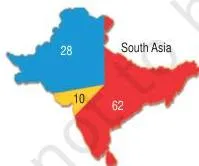
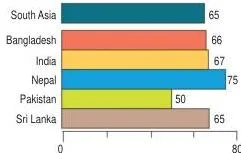
Where democracy is clearly better is legitimacy: a democratic government is people’s own government. It may be slow and imperfect, but people accept it. That is why the South Asia survey shows overwhelming support for democracy even in countries where democratic governments perform poorly (NCERT, p. 66).
The chapter also answers the “democracy is inefficient” charge. Non-democratic rulers can decide and implement fast because they ignore deliberation and public opinion. Democracy is based on deliberation and negotiation, so delay is built in. But a quick decision that people do not accept can fail; a slow decision that follows procedures is more acceptable and more effective.
The cost of time is worth it (NCERT, p. 64).
Economic growth and development
If democracy produces good government, should it not also produce development? The chapter reports the evidence honestly: for the fifty years between 1950 and 2000, all democratic regimes averaged 3.95% growth against 4.42% for all dictatorial regimes. A slightly higher dictatorship average sounds damning — until you compare only poor countries: 4.28% for democracies and 4.34% for dictatorships. The gap nearly disappears (NCERT, p. 67).
So the chapter’s conclusion is careful: we cannot say democracy is a guarantee of economic development, but we can expect democracy not to lag behind dictatorships. Development depends on several factors — population size, global situation, cooperation from other countries and the economic priorities a country adopts — not on regime type alone (NCERT, p. 67).
Reduction of inequality and poverty
Democracies are built on political equality — every person has equal weight in electing representatives. Yet the chapter shows growing economic inequality running parallel to that political equality: a small number of ultra-rich hold a disproportionate and increasing share of wealth, while those at the bottom see their incomes decline (NCERT, p. 69).
The chapter then poses the puzzle: the poor are a large proportion of voters, and no party wants to lose their votes — so why are democratically elected governments not keener to address poverty? The honest answer is that democracies have not been very successful at reducing economic inequalities (NCERT, p. 69).
Accommodation of social diversity
Here the chapter is more positive. Democracies develop procedures to conduct competition between groups, which reduces the chance of tensions becoming explosive. The first chapter’s example of Belgium shows how ethnic differences can be successfully negotiated, while Sri Lanka shows what happens when they are not (NCERT, p. 70).
Two conditions must be fulfilled for democracy to accommodate diversity (NCERT, pp. 69–70):
- The majority must always work with the minority, so that governments represent the general view rather than just one opinion.
- Rule by majority must not become rule by the majority community — in terms of religion, race or language. In a true democracy, every citizen must have a chance of being in the majority at some point; birth cannot bar anyone from that chance.
Dignity and freedom of citizens
Democracy stands superior to other forms of government in promoting dignity and freedom. Long struggles by women have created the recognition that equal treatment of women is a necessary ingredient of a democratic society — and once the principle is recognised, struggles against injustice gain legal and moral force (NCERT, p. 71).
The same logic applies to caste: democracy in India has strengthened the claims of disadvantaged and discriminated castes for equal status and equal opportunity, even though caste-based inequalities and atrocities still occur.
The chapter’s most distinctive claim is its closing one: democracy’s examination never gets over. As democracy passes one test, it produces another. People always have more expectations and more complaints — and that fact is a testimony to success, because it shows people have become aware citizens who can look critically at power holders.
Democracy transforms people from the status of subjects into citizens (NCERT, p. 72).
Figure walkthrough: reading the cartoons, tables and survey charts
The cartoons in this chapter are not decoration — each one is making an argument that the text states in words. Learn to read them and you can cite the point in an answer even when you forget the prose.
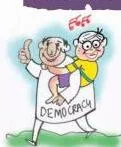
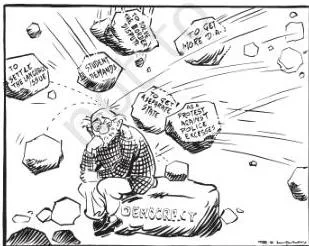
This cartoon (NCERT, p. 66) is the chapter mocking itself. The procedural outcomes — elections, debate, information — can seem like an underwhelming list. “After all this mental gymnastics, the best you can say is that democracy is a democracy?” The cartoon introduces the gap between procedural outcomes (the machinery works) and substantive ones (the government still frustrates people).
Use it in an answer to show you understand why procedural achievements feel thin.
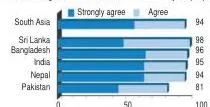
This chart (NCERT, p. 66) is the evidence for legitimacy. The percentages of people who agree with rule by elected leaders: India 70, Bangladesh 69, Nepal 62, Sri Lanka 71, Pakistan 37. The striking feature is that support is high even in countries whose democratic record is mixed — and even in Pakistan, only 37% agree, yet that is still far more than any dictatorship’s support.
People want to be ruled by representatives they elect. That support, the chapter says, is itself an outcome.
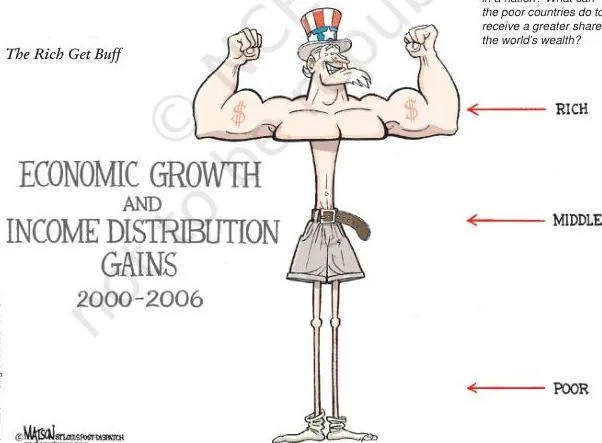
“The Rich Get Buff” (NCERT, p. 67) makes the inequality point visually: economic growth strengthens the rich while the poor gain little. It pairs with Table 2 — growth happens, but its fruits are not evenly distributed. The surrounding questions ask: should the gains of growth be evenly distributed, and how can the poor get a voice for a better share?

These two images (NCERT, p. 71) show the two possible effects of democratic politics on social divisions. In Greeting, people across a dividing line meet cordially — differences are negotiated, as in Belgium. In Enemies, the same line becomes a battleground — divisions turn hostile, as in Sri Lanka. The chapter’s exercise asks you to write a paragraph on each.
Map one image to each country and you have the answer.
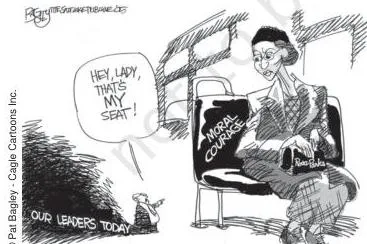
“Rosa Parks Still Inspires” (NCERT, p. 72) connects to the dignity section. Rosa Parks refused to give up her bus seat — an individual act that challenged a system of subordination. The chapter’s point is that democracy gives such struggles legal and moral force that non-democratic systems lack.
The exercise asks you to underline the section’s sentences that connect to this cartoon; the sentences about women’s struggles and recognition of equal status are your targets.
Also on page 72 is the survey heading “Those who say that their vote makes a difference…” — the chapter reports that most individuals today believe their vote matters to how the government is run. This is the citizen-side evidence for legitimacy and for the “subjects into citizens” claim.
Finally, do not skip the two data tables on page 68 — they are the most quotable evidence in the chapter. Table 1 (growth rates 1950–2000) gives you: all democratic regimes 3.95%, all dictatorial regimes 4.42%, poor countries under democracy 4.28%, poor countries under dictatorship 4.34%.
Table 2 (income inequality) gives you: in South Africa the top 20% take 64.8% of national income and the bottom 20% get 2.9%; in Brazil it is 63.0% against 2.6%; in Denmark 34.5% against 9.6%; in Hungary 34.4% against 10.0%. One number from each table, quoted with its meaning, lifts an answer above mere opinion.
Definitions: the terms a 5-mark answer needs
These are the working definitions the chapter itself uses. Learn the term, the meaning, and the page — the page reference lets you show the examiner where the idea lives.
| Term | Chapter meaning | NCERT page |
|---|---|---|
| Accountable government | Citizens choose their rulers and keep control over them; citizens can hold the government responsible for its decisions. | p. 64 |
| Responsive government | A government attentive to the needs and expectations of the people. | p. 66 |
| Legitimate government | People’s own government — accepted and supported even when it is slow, imperfect or inefficient. | p. 66 |
| Transparency | The citizen’s right and means to examine the process of decision-making — to check whether decisions followed correct procedures. | p. 65 |
| Procedural expectations | Regular, free and fair elections; open public debate on major policies; citizens’ right to information. | p. 65 |
| Substantive expectations | A government that is attentive to people’s needs and largely free of corruption. | p. 66 |
| Moral vs prudential reasons | Moral: democracy is right in itself. Prudential: democracy works better than the alternatives. | p. 63 |
| Two conditions for accommodating diversity | Majority must work with minority; majority rule must never become rule by the majority community, because every citizen must have a chance of being in the majority at some point. | pp. 69–70 |
| “Subjects into citizens” | Democracy gives people the awareness and ability to expect, complain and judge power holders — turning passive subjects into active citizens. | p. 72 |
Common mistakes students make in this chapter
This chapter is short, so examiners reward precision. These five mistakes cost students marks every year — the chapter’s own text warns against each one.
| Mistake | Correct rule | How to check your answer |
|---|---|---|
| “Democracy guarantees economic growth.” | The chapter says we cannot say democracy is a guarantee of development — the poor-country growth rates are nearly identical (4.28% vs 4.34%). | Quote the poor-country figures and add “so other factors matter”. |
| “Dictatorship is faster, so it is more efficient, so it is better.” | Speed without acceptance can produce ineffective decisions. Deliberation costs time but earns acceptability and legitimacy. | Use the cost-of-time argument: ask, “acceptable to whom?” |
| “The poor are the majority, so democracy must reduce poverty.” | The chapter flags this as a live question, not a fact — then shows political equality coexisting with growing economic inequality. | Write “democracies have not been very successful at reducing inequality” and cite Table 2. |
| “Majority rule means the majority community rules.” | Majority rule means different persons and groups can form a majority in different decisions or elections. Birth cannot bar anyone from being in the majority. | Test with Sri Lanka: majority community rule broke accommodation; Belgium’s power-sharing worked. |
| Treating complaints about democracy as proof it failed. | The chapter calls dissatisfaction a testimony to success — it shows citizens, not subjects, who can look critically at power holders. | Quote the “subjects into citizens” line (p. 72). |
Exam application notes: using the chapter’s evidence in answers
This chapter rewards answers that cite its evidence, not just its conclusions. A student who can quote one number from each table and one survey figure will outscore a student who merely summarises.
A worked analytical model. Suppose two countries, A and B, both under dictatorship for a decade. Country A grows at 4.0% overall, but its poor regions grow at 4.2%. Country B grows at 4.5% overall, but its poor regions grow at 4.3%. Which country’s growth is more pro-poor?
Country A — a slower overall average with faster poor-region growth means the poor are sharing in the gains. Now reverse it: if you only quoted the national averages (4.0% vs 4.5%), you would conclude the opposite.
That is exactly the lesson of the NCERT table on page 67: the aggregate figure for all democracies (3.95%) looks worse than the figure for all dictatorships (4.42%), but when you isolate poor countries the gap almost vanishes. One average number cannot settle whether democracy works — you have to look at which countries and which people the number hides.
Mapping the exercises to the concepts they test. The chapter’s exercises mostly test whether you can apply the expected-vs-actual framework rather than recall facts:
- Q1 (how democracy produces an accountable, responsive and legitimate government) tests the procedural list from p. 65 plus the legitimacy argument from p. 66 — a full answer needs all three qualities named and defined.
- Q2 (conditions for accommodating social diversity) tests the two conditions from pp. 69–70 — name both, and support with the Belgium/Sri Lanka contrast.
- Q3 gives four assertions to support or oppose. The first — “industrialised countries can afford democracy but the poor need dictatorship” — is answered directly by the poor-country growth figures (p. 67): poor democracies and poor dictatorships grew at almost the same rate, so the assertion’s premise fails. The second (democracy can’t reduce inequality) needs Table 2 and the “not very successful” conclusion (p. 68). The third (spend less on poverty, health and education) is a values question — answer it with the chapter’s argument that democracies must be responsive to people’s needs. The fourth (one vote per citizen means no domination or conflict) is wrong: political equality in voting coexists with economic inequality and social conflict.
- Q4 (challenges to democracy: temple entry doors for dalits, farmer suicides, the fake-encounter enquiry) tests whether democracy addresses inequality, poverty and accountability. For each, name the challenge and suggest a mechanism — the enquiry itself shows how accountability procedures work.
- Q5 and Q7 are concept-check MCQs: the correct answers are the ones that match the chapter’s careful conclusions — inequalities exist in democracies; democracy has not eliminated conflict or inequality.
- Q6 asks which option is the odd one out (free and fair elections, dignity of the individual, majority rule, equal treatment before law). The answer is majority rule — democracy’s need is not majority rule (which can become majority-community rule) but the two diversity conditions.
- Q8 (the Nannu passage) is the chapter’s working example of Right to Information — see below.
The Nannu case study (Q8). Nannu, a daily wage earner in East Delhi, lost his ration card and applied for a duplicate in January 2004. For three months, clerks at the Food and Civil Supplies office ignored him.
He then filed an application under the Right to Information Act asking for the daily progress on his application, the names of the officials supposed to act on it, and what action would be taken against them for inaction.
Within a week, an inspector visited him to say the card was ready — and when he collected it, the Food and Supply Officer offered him tea and asked him to withdraw the RTI application since his work was done. The example shows transparency in action: the right to information turned an unresponsive official into a responsive one.
It also shows the chapter’s definition of transparency (p. 65) — the citizen’s right and means to examine the decision-making process — working in real life.
One caution before you rely on this chapter for exam preparation: textbook contents and the examinable syllabus are not always identical — check the current official CBSE syllabus to confirm what is examinable this session.
Revision summary: democracy’s report card
This table is the night-before revision asset. It distils the chapter’s conclusions into one screen.
| Expected outcome | What the chapter’s evidence shows | NCERT pages |
|---|---|---|
| Accountable, responsive and legitimate government | Mixed on procedure (elections yes, fair chance and open debate incomplete), weak on substance (corruption, unresponsive), but clearly legitimate — South Asia survey shows 70% support in India, 71% in Sri Lanka, 37% in Pakistan. | pp. 64–66 |
| Economic growth and development | All democracies 3.95% vs all dictatorships 4.42% (1950–2000), but poor democracies 4.28% vs poor dictatorships 4.34% — nearly equal, so democracy is not a guarantee of development and is not a laggard either. | pp. 67–68 |
| Reduction of inequality and poverty | Not very successful — political equality coexists with growing economic inequality; top vs bottom income shares: South Africa 64.8% vs 2.9%, Brazil 63.0% vs 2.6%, Denmark 34.5% vs 9.6%. | pp. 68–69 |
| Accommodation of social diversity | Democracy’s definite plus point — Belgium succeeded, Sri Lanka shows the two conditions: majority works with minority; majority rule never becomes rule by majority community. | pp. 69–70 |
| Dignity and freedom of citizens | Democracy stands superior — women’s and caste struggles gain legal and moral force; complaints show citizens, not subjects; people believe their vote makes a difference. | pp. 71–72 |
Bottom line: democracy is slow, imperfect, and does not eliminate inequality — but it is legitimate, it accommodates diversity, and it turns subjects into citizens. That is why support for it stays high (NCERT, p. 72).
| What the chapter holds | Count | Where it is used |
|---|---|---|
| Printed pages | 12 | |
| Figures with NCERT captions | 11 | |
| Tables | 3 | |
| Exercise questions | not fully captured | our text of this chapter is incomplete; the printed book has more |
| Official NCERT PDF | Download the chapter PDF | the chapter exactly as NCERT publishes it |



Reference: NCERT Class 10 Democratic Politics textbook, chapter 5, official edition on ncert.nic.in.
Related resources
This listing is maintained for the 2026-27 academic session using the NCERT textbook information available to us. NCERT remains the authority for confirming the latest edition.
Stay inside the same book and the same argument:
- The Class 10 Social Science notes hub, where this chapter sits alongside the other Democratic Politics chapters.
- Globalisation and the Indian Economy — the economics chapter that explains the “several factors behind development” argument from page 67.
- Manufacturing Industries — geography’s contribution to understanding why economic priorities vary between countries.
- The Class 10 hub for all NCERT Class 10 books.
Two background reads help before you start. The chapter recalls the Class IX argument about why democracy is better (NCERT, p. 63), and it returns to the Belgium example first introduced in Class X Chapter 1 (NCERT, p. 70). Opening those two pages first makes this chapter’s argument land faster.
Sources and data verification
- This page describes the NCERT Class 10 Democratic Politics–II textbook, Chapter 5 (Outcomes of Democracy), in its current NCERT edition as published on ncert.nic.in.
- It covers only the NCERT textbook chapter — not the full CBSE scheme of studies and not the other Class 10 social science books (History, Geography, Economics).
- The listing is maintained for the current academic session using the NCERT information available to us.
- NCERT settles textbooks, editions and PDFs; CBSE settles the curriculum, syllabus and examinations — and textbook contents and the examinable syllabus are not always identical.
Frequently asked questions about Outcomes of Democracy
Why does the chapter call democracy a legitimate government even though it is slow and sometimes corrupt?
Because legitimacy rests on ownership, not performance. A democratic government is people’s own government — chosen by them — so people accept it even when it is slow or imperfect (NCERT, p. 66). The South Asia survey backs this: 70% in India, 71% in Sri Lanka and 69% in Bangladesh agree with rule by leaders elected by the people; even in Pakistan 37% do.
Support exists in countries with democratic regimes and in countries without them.
Does democracy produce faster economic growth than dictatorship?
No — and the chapter says so plainly. Over 1950–2000, all democratic regimes grew at 3.95% against 4.42% for all dictatorial regimes (NCERT, p. 67). But among poor countries the gap almost disappears: 4.28% for democracies and 4.34% for dictatorships.
So the chapter concludes we cannot say democracy is a guarantee of development — development depends on population size, global situation, cooperation from other countries and economic priorities, not regime type alone.
Does democracy reduce economic inequality?
The chapter’s answer is that democracies have not been very successful at it (NCERT, p. 69). The evidence is Table 2 on page 68: in South Africa the top 20% take 64.8% of national income while the bottom 20% get 2.9%; Brazil is similar at 63.0% vs 2.6%. Countries like Denmark (34.5% vs 9.6%) and Hungary (34.4% vs 10.0%) do much better — so the degree of inequality varies widely across democracies.
What two conditions must democracy fulfil to accommodate social diversity?
First, the majority must always work with the minority, so governments represent the general view rather than one fixed opinion. Second, rule by majority must never become rule by the majority community — every citizen must have a chance of being in the majority at some point, and birth cannot bar anyone from that chance (NCERT, pp. 69–70).
Belgium fulfils these conditions; Sri Lanka shows the failure when they are ignored.
Why does the chapter say that public complaints about democracy show it is succeeding?
Because complaints are a sign of citizenship, not failure. The fact that people complain shows they have developed the awareness and the ability to expect, and to look critically at power holders (NCERT, p. 72). A public expression of dissatisfaction shows the democratic project working: it transforms people from the status of a subject into that of a citizen.
Explore Class 10 Social Science Books
Related chapters: