
This is the NCERT Class 10 Social Science (History) chapter The Age of Industrialisation, from the book India and the Contemporary World II — Chapter 4 of the NCERT edition in use for the current academic session.
The chapter’s printed pages run from page 80 to page 102, with the opening spread carrying Figs. 1 and 2 just before page 80; the official PDF is right below. If you have not opened the book yet, take the file first — the sections after it explain what the chapter argues, piece by piece.
Download the official NCERT PDF
For the chapter exactly as it is printed, take the Class 10 Social Science Chapter 4 The Age of Industrialisation NCERT PDF — the official file NCERT publishes, with all six numbered sections on Britain and colonial India, the activities and source boxes, and the Write in brief, Discuss and Project work exercises that close the chapter.
If you prefer reading in the browser, the same file is on the NCERT textbook page for Class 10 Social Science.
Chapter at a glance: structure, figures and exercises
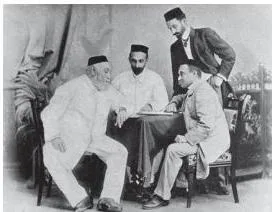
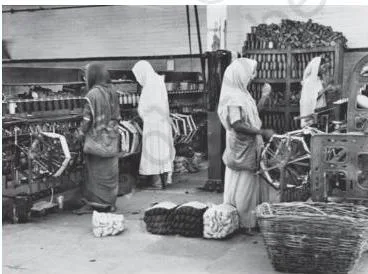
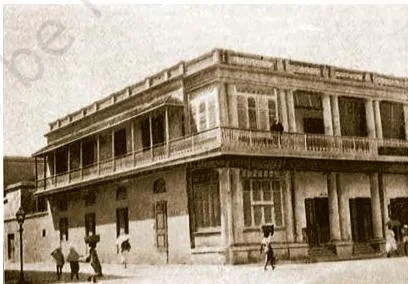
The table on this page lists what the chapter holds — sections, figures, activities and exercise blocks — so you can see the size of the file before opening it. The argument is carried by six numbered parts, listed after the table.
- Before the Industrial Revolution (p. 81) — proto-industrialisation and the coming of the factory.
- Hand Labour and Steam Power (p. 85) — why machines did not sweep hand work away.
- Industrialisation in the Colonies (p. 89) — Indian textiles, the Company and Manchester.
- Factories Come Up (p. 94) — early entrepreneurs and the workers.
- The Peculiarities of Industrial Growth (p. 97) — swadeshi, war and small-scale industry.
- Market for Goods (p. 100) — how advertising created new consumers.
The chapter closes with a short Conclusion (p. 101) and three exercise blocks — Write in brief, Discuss and Project work — on p. 102.
What this chapter covers: the argument in one sweep
This section gives the whole argument of the chapter in a few minutes, so every detail that follows has somewhere to attach. The chapter’s question is simple: what did industrialisation actually mean — in Britain, the first industrial nation, and in India, where colonial rule shaped the process?
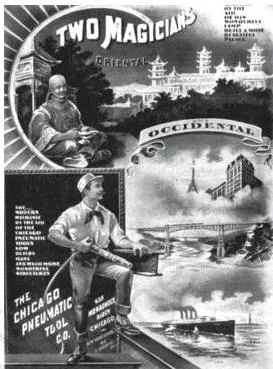
The chapter opens with two images from 1900-1901 that glorify machines and technology: E.T. Paull’s music-book cover Dawn of the Century and a trade-magazine picture called Two Magicians. Both present industrialisation as a triumphant story of progress, with rapid technological change as the driving force (NCERT, pp. 80-81).
The opening questions then ask what such images leave out — whether industrialisation always meant fast technological change, and what it did to people’s lives. To answer, the chapter looks first at Britain, the first industrial nation, then at India, where the pattern of industrial change was conditioned by colonial rule (NCERT, p. 81).
Before any factory existed, there was already large-scale production for an international market, run by town merchants who gave advances to peasant households in the countryside. Historians call this phase proto-industrialisation. The factory, led by cotton, then brought every stage of production under one roof and one management (NCERT, pp. 81-83).
But the pace of change was slow. Cotton was the leading sector into the 1840s, then iron and steel with the spread of railways. Even at the end of the nineteenth century under 20 per cent of Britain’s workforce was in technologically advanced industry, and only 321 steam engines existed in all England at the start of the 1800s (NCERT, pp. 83-84).
Hand labour survived because labour was cheap, demand was often seasonal, and intricate designs needed human skill. The lives of workers were hard: an abundance of job-seekers kept wages low, and women hand spinners attacked the Spinning Jenny, which threatened their work (NCERT, pp. 85-87).
The Indian half of the chapter follows the weaver. Indian fine textiles dominated world markets before British rule; after the East India Company gained political power in Bengal and Carnatic in the 1760s-70s, it controlled weavers through gomasthas and the system of advances, and exports first grew.
The ruin came with Manchester’s machine-made imports in the early 1800s (NCERT, pp. 89-92).
Factories came late to India — the first Bombay cotton mill in 1854, the first jute mill in Bengal in 1855 — started by entrepreneurs whose capital came from the China trade, with workers recruited through jobbers.
Growth stayed peculiar: European Managing Agencies invested mainly in export goods, the swadeshi movement turned mills from yarn to cloth, and the First World War created a great boom (NCERT, pp. 94-98).
Yet in 1911 only 5 per cent of India’s industrial labour force worked in registered factories; small workshops and handlooms continued to predominate, adopting small innovations such as the fly shuttle. The final section shows how advertising created new consumers, and the chapter ends by asking you to look again at Figs. 1 and 2 and decide whether their images still convince (NCERT, pp. 98-101).
Key concepts: the ideas that carry the chapter
These are the analytical ideas you will reuse in answers. Each row ties the concept to the NCERT page where the book explains it.
| Concept | What it means | NCERT page |
|---|---|---|
| Proto-industrialisation | Production for an international market organised by town merchants, who paid advances to peasant households in the countryside — before factories existed | p. 81 |
| The factory system | Richard Arkwright’s cotton mill brought carding, twisting, spinning and rolling under one roof and one management, allowing close supervision of quality and labour | p. 82 |
| Leading sectors | Cotton led British industrialisation into the 1840s; iron and steel then took over as railways expanded, and by 1873 iron and steel exports were worth double cotton’s | p. 83 |
| Technological caution | New machines were expensive, broke down often and were not as effective as claimed — only 321 steam engines existed in England at the start of the 1800s | p. 84 |
| Hand labour’s survival | Cheap abundant labour, seasonal demand and intricate designs needing human skill kept hand work alive; the upper classes preferred handmade goods | p. 85 |
| Gomastha and advances | The Company’s paid supervisor who collected cloth and checked quality; loans advanced to weavers bound them to sell only to the Company | pp. 90-91 |
| The jobber | An old trusted worker who recruited from his village, settled newcomers and lent money in crises — gaining authority and demanding gifts in return | pp. 95-96 |
| European Managing Agencies | European firms such as Bird Heiglers & Co. that mobilised capital, floated and managed joint-stock companies, investing mainly in export goods | pp. 94, 97 |
| Small-scale predominance | Only 5 per cent of India’s industrial labour force in 1911, and 10 per cent in 1931, worked in registered factories; the rest worked in small workshops and homes | p. 98 |
| Advertising | Labels, images of gods and calendars created new consumers by making products desirable, familiar and divinely approved | p. 100 |
These are the ideas the “explain” questions in Write in brief and the long answers in Discuss are really testing.
Reading the pictures: how the chapter turns images into evidence
This chapter repeatedly asks you to treat pictures as historical evidence, not decoration. Each image below is an argument — about progress, about work, about the market — and the Discuss exercise at the end is answered after the walkthrough.
The chapter opens with two celebrations of machinery. Fig. 1, Dawn of the Century from E.T. Paull’s 1900 music book, is described in the text: at the centre the angel of progress, perched on a winged wheel symbolising time, carries railway, camera, machines, printing press and factory behind her (NCERT, p. 80).
The opening activity asks for two examples of modern development that have led to problems — the chapter’s first step away from this glorification of progress.
Fig. 2 is the chapter’s warning about how we picture progress. Aladdin from the Orient, who built a beautiful palace with his magic lamp, stands at the top; the modern mechanic, who with his tools builds bridges, ships, towers and high-rise buildings, stands below.
The picture maps the East onto the past and the West onto modernity — exactly the equation the chapter later asks you to question (NCERT, p. 80).
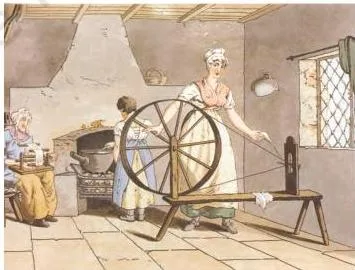
Fig. 3 gives the baseline that machines broke. Every member of the family is involved in spinning, and one wheel moves only one spindle — a whole household’s labour for a little yarn. Keep this image in mind for the Discuss answer below: the Spinning Jenny would let one worker do the work of many hands (NCERT, p. 81).
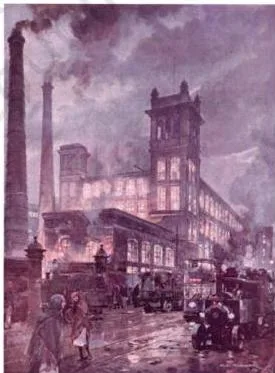
Figs. 4 and 5 are meant to be compared in the activity on NCERT page 83. Fig. 4, a Lancashire cotton mill painted in 1925, shows the mill aglow with electricity in the twilight — an “impressive sight” to its artist. No image file is available here, so read its description in the book.
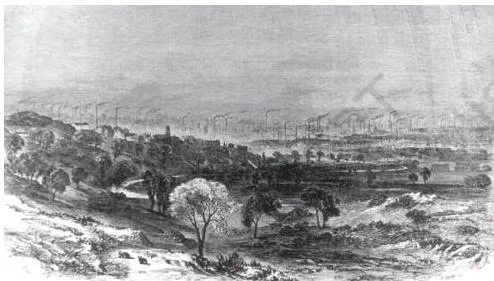
Fig. 5 shows Industrial Manchester in 1857, its skyline dense with chimneys billowing smoke. Set side by side, the two images show the same process from different angles: the mill appears beautiful and almost magical, the city is defined by smoke. Noticing what each image chooses to show is the skill the chapter is teaching (NCERT, p. 83).
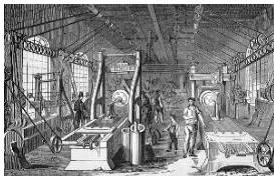
Fig. 6 takes you inside a fitting shop at an English railway works in 1849, where new locomotive engines were completed and old ones repaired. The railways were why iron and steel overtook cotton as Britain’s leading sector — and this shop is the new kind of factory work they created (NCERT, p. 84).
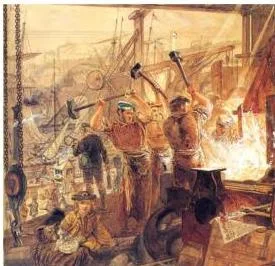
Figs. 9 and 10 make the chapter’s sharpest contrast. Fig. 9, William Bell Scott’s painting of an iron works in 1861, belongs to a trend: artists from the late nineteenth century began idealising workers, showing them bearing hardship and pain for the nation.
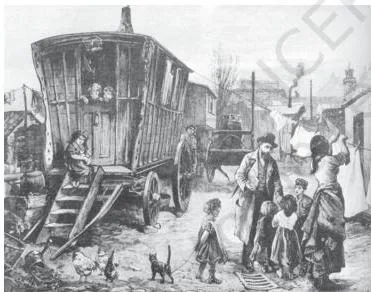
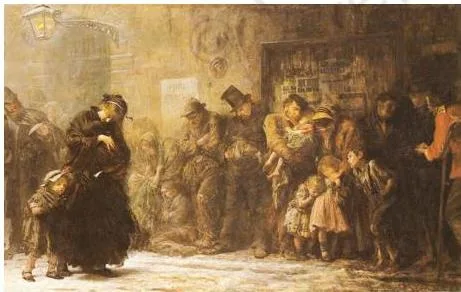
Now set it beside Fig. 10, Houseless and Hungry by Samuel Luke Fildes (1874), described in the text rather than reproduced: homeless Londoners queue for workhouse tickets, then face humiliating medical checks, cleansing and hard labour. Heroic pain versus daily humiliation — that contrast is the chapter’s lesson in reading images (NCERT, pp. 86-87).
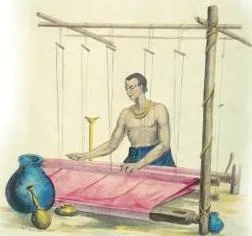
Fig. 14 returns to the centre of the Indian story: the weaver at work in Gujarat. Everything in the Indian sections happens to this figure — the gomastha and the advance, the flood of Manchester imports, the fly shuttle that helped handlooms survive. The chapter keeps the weaver, not the mill, at the centre of Indian industrial history (NCERT, p. 90).
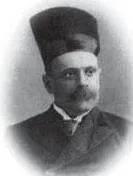
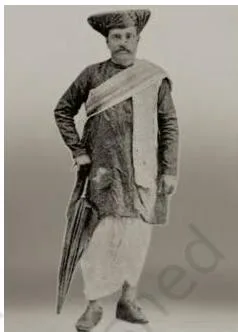
Fig. 16 shows Jamsetjee Jeejeebhoy, the son of a Parsi weaver who, like many of his time, was involved in the China trade and shipping. He owned a large fleet of ships, but competition from English and American shippers forced him to sell them by the 1850s — an early entrepreneur whose capital came from trade, not from factories (NCERT, p. 94).
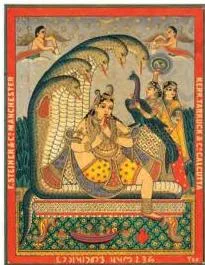
Fig. 25, a Gripe Water calendar of 1928 by M.V. Dhurandhar, uses the image of baby Krishna to sell a baby product. The chapter explains why gods appeared in advertising: the association gave divine approval to the goods and made a foreign product feel familiar (NCERT, p. 100).
Calendars worked harder than newspapers. They were hung in tea shops, offices, middle-class apartments and poor homes, and people who could not read still saw them day after day through the year.
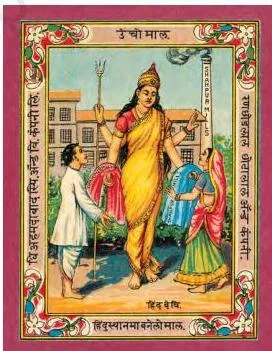
Fig. 27, the Sunlight soap calendar of 1934, shows God Vishnu bringing sunlight from across the skies — a divine figure endorsing a household product.
The chapter pairs it with Fig. 28, an Indian mill cloth label described in the text: a goddess offers cloth produced in an Ahmedabad mill and asks people to use things made in India. Swadeshi advertising used the same visual language as the British labels, for the opposite purpose (NCERT, p. 101).
Answering the Discuss exercise: why did workers oppose the Spinning Jenny?
The Discuss box on NCERT page 87 asks you to look at Figs. 3, 7 and 11, reread Source B, and explain why many workers opposed the Spinning Jenny. You already have Fig. 3 above; here are the other two pieces of evidence.
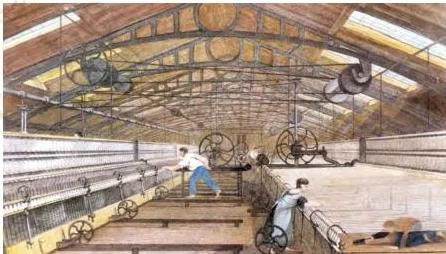
- Fig. 7 — a spinning factory of 1830, in which giant wheels moved by steam power set hundreds of spindles in motion to manufacture thread (NCERT, p. 84).
- Fig. 11 — a Spinning Jenny drawn by T.E. Nicholson in 1835; one wheel operates many spindles at once (NCERT, p. 87).
Source B records a magistrate’s report of 1790: the wives of colliers had already lost their work to spinning engines, and a crowd threatened to cut a newly introduced machine to pieces because it would, they believed, “lessen the demand for manual labour”. The answer follows directly.
The jenny multiplied what one worker could spin, so fewer hands were needed; for women who survived on hand spinning, the machine meant unemployment. That is why they attacked it, and why the fear of unemployment generally made workers hostile to new technology (NCERT, pp. 86-87).
Key terms and definitions, explained simply
A quick lookup for every term the chapter glosses. Each definition is in plain words, with the NCERT page where the term appears.
| Term | What it means | NCERT page |
|---|---|---|
| Orient | The countries east of the Mediterranean, usually Asia — a western term that treats the region as pre-modern, traditional and mysterious | p. 80 |
| Proto- | Prefix meaning the first or early form of something — hence proto-industrialisation | p. 81 |
| Guilds | Associations of producers that trained craftspeople, controlled production, regulated competition and prices, and restricted entry of new people into a trade | p. 81 |
| Stapler | A person who sorts wool according to its fibre | p. 82 |
| Fuller | A person who gathers (fulls) cloth by pleating it | p. 82 |
| Carding | The process of preparing fibres such as cotton or wool before spinning | p. 82 |
| Spinning Jenny | A machine devised by James Hargreaves in 1764 that speeded up spinning and reduced labour demand — one wheel could set many spindles working at once | p. 87 |
| Sepoy | The British pronunciation of sipahi — an Indian soldier in the service of the British | p. 91 |
| Gomastha | A paid servant of the Company who supervised weavers, collected supplies and examined cloth quality | pp. 90-91 |
| Jobber | An old and trusted worker used by industrialists to recruit new hands, who gained power over workers’ lives | pp. 95-96 |
| Fly shuttle | A mechanical weaving device worked by ropes and pulleys that places the weft into the warp; it let weavers operate large looms and weave wide cloth | p. 98 |
| Managing Agency | A European firm that mobilised capital, set up joint-stock companies and managed them — Indian financiers supplied capital, Europeans made the decisions | pp. 94, 97 |
Common mistakes in this chapter — and the correct reading
This chapter quietly overturns six common assumptions. Each row names the mistake, the chapter’s correction, and a quick way to check your answer.
| The mistake | What the chapter shows | How to check your answer |
|---|---|---|
| Factories began industrialisation | Production for international markets already existed through town merchants and peasant households; the factory came later (pp. 81-82). Even at the end of the 1800s under 20 per cent of Britain’s workforce was in technologically advanced industry (p. 84) | Ask yourself: was there industry before factories? The proto-industrial network says yes — put the advance system in your answer |
| Machines quickly replaced hand labour | Only 321 steam engines existed in all England at the start of the 1800s; machines were costly, broke down, and were not as effective as claimed. Seasonal, skilled and upper-class demand kept hand work alive (pp. 84-85) | Quote the 321 figure and one reason for caution — repair cost, or the 500 varieties of hammers that needed human skill |
| Company rule immediately ruined Indian textile exports | Exports actually grew after the 1760s while Indian fine textiles stayed in European demand; the collapse came with Manchester imports in the early 1800s (pp. 90, 92) | Put the piece-goods figures in your answer: 33 per cent of India’s exports in 1811-12, down to 3 per cent by 1850-51 |
| The American Civil War cut India’s cotton trade | It raised raw cotton exports and shot up prices, but starved weavers of raw cotton, which they had to buy at exorbitant rates (pp. 92-93) | The True/False exercise on p. 102 states exactly this as false — read the statement again |
| The First World War weakened Indian industry | It caused a boom: Manchester imports fell while British mills served war needs, and Indian mills supplied jute bags, uniforms, tents, boots and saddles, running multiple shifts (pp. 97-98) | List the war-supply items — that turns a general point into evidence |
| Factory workers dominated India’s industrial labour force | Only 5 per cent (1911) and 10 per cent (1931) of the industrial labour force worked in registered factories; the rest worked in small workshops and households (p. 98) | Quote the 5 and 10 per cent figures — they are the chapter’s own statistics |
Note how the check column works: the True/False exercise on NCERT page 102 tests mistakes 1, 3 and 4 directly — statement (a) checks the workforce figure, statement (b) the export timeline before Company rule, and statement (c) the Civil War’s effect.
Exam notes: mapping the NCERT exercises to the chapter
The chapter’s own exercises are the safest revision plan. Every question maps to a specific part of the chapter.
| NCERT exercise | What it is really asking | Where to find the answer |
|---|---|---|
| Write in brief 1(a) — why women workers attacked the Spinning Jenny | Worker hostility to labour-saving machines, focused on women hand spinners who lost their livelihood | pp. 85-88, with Source B on p. 87 |
| 1(b) — why seventeenth-century town merchants employed peasants and artisans in villages | Proto-industrialisation: guilds in towns barred new merchants, so production moved to the countryside | pp. 81-82 |
| 1(c) — why Surat declined by the end of the eighteenth century | Colonial power shifted trade from old ports (Surat, Hoogly) to Bombay and Calcutta, controlled by European companies | p. 89 |
| 1(d) — why the Company appointed gomasthas | To remove competing traders, control weavers directly, and secure regular supplies through paid supervisors and advances | pp. 90-91 |
| Write in brief 2 — True/False statements | Four fact-checks against the chapter’s statistics and timeline — the 20 per cent workforce figure, India’s textile dominance, the Civil War’s effect, the fly shuttle | pp. 84, 89, 93, 98 |
| Write in brief 3 — explain proto-industrialisation | The chapter’s central definition: large-scale production for international markets before factories, through merchant-financed peasant households | pp. 81-82 |
| Discuss 1 — why some industrialists preferred hand labour over machines | Cheap labour, seasonal demand, intricate designs and upper-class preference for handmade goods | p. 85 |
| Discuss 2 — how the Company procured cotton and silk textiles | Through gomasthas, the system of advances, and preventing weavers from selling to other buyers | pp. 90-91 |
| Discuss 3 — encyclopaedia article on Britain and the history of cotton | The whole chapter in one frame: proto-industry, factory cotton, Manchester and the Indian market | pp. 81-93 |
| Discuss 4 — why Indian production increased during the First World War | War demand and falling Manchester imports: jute bags, uniforms, tents, boots, saddles, multiple shifts, boom | pp. 97-98 |
| Project work — history of a local industry | Technology, workers and advertising in your own region, found by observation and interviews | p. 102 |
Two honest notes. First, this chapter rewards explanation over names: attach at least one number or date to every point you make — the 321 steam engines, the 5 and 10 per cent figures, the 33 to 3 per cent export collapse. Second, textbook contents and the examinable syllabus are not always identical — check the current official syllabus for what is examinable this session.
Chapter recap: the conclusion and the key dates
This section condenses the chapter’s Conclusion (p. 101) together with the evidence it rests on. The conclusion’s point: industrialisation brought major technological change and a new industrial labour force, yet hand technology and small-scale production remained important parts of the industrial landscape.
| Period | Event | NCERT page |
|---|---|---|
| 1730s | Earliest factories came up in England | p. 82 |
| 1760 | Britain imported 2.5 million pounds of raw cotton | p. 82 |
| 1764 | James Hargreaves devised the Spinning Jenny | p. 87 |
| 1781 | James Watt patented his improved steam engine; buyers were slow to appear | p. 84 |
| 1760s-70s | Company gained political power in Bengal and Carnatic; Indian textile exports at first expanded | p. 90 |
| 1811-12 to 1850-51 | Piece-goods fell from 33 per cent of India’s exports to 3 per cent | p. 92 |
| 1854 | First cotton mill in Bombay | p. 94 |
| 1855 | First jute mill in Bengal | p. 94 |
| 1860s | Elgin Mill in Kanpur, first Ahmedabad mill, and the American Civil War cotton crisis | pp. 92-94 |
| 1900-1912 | Indian cotton piece-goods production doubled | p. 97 |
| 1906 | Indian yarn exports to China declined as Chinese and Japanese mills flooded that market | p. 97 |
| 1911 | Only 5 per cent of the industrial labour force worked in registered factories | p. 98 |
| 1914-18 | First World War brought an industrial boom in India | p. 97 |
| 1941 | Over 35 per cent of Indian handlooms were fitted with fly shuttles | p. 98 |
Two take-homes for your own answers. First, industrialisation never meant only factories: hand labour and small workshops stayed central in both Britain and India (NCERT, pp. 98-99). Second, in India the colonial context shaped everything — the ports, the export bias, the Managing Agencies, even the advertisements that carried the swadeshi message (NCERT, pp. 89, 100-101).
Related chapters and resources
This listing is maintained for the 2026-27 academic session using the NCERT textbook information available to us. NCERT remains the authority for confirming the latest edition.
Chapter 4 sits in the middle of the Class 10 History book, between the making of the modern world economy and the coming of print.
- The full book, India and the Contemporary World II, with its chapter list and PDFs — see the NCERT Class 10 Social Science book page.
- The Class 10 hub for every NCERT textbook of the class.
- Previous chapter: The Making of a Global World — the world market and colonial economy this chapter’s textile trade belongs to.
- Next chapter: Print Culture and the Modern World — print, advertising and the labels the final section discusses.
- For revision-style help, the CBSE notes for Class 10 Social Science, the Class 10 notes hub and the main notes index cover the same syllabus chapter by chapter.
- If you are revising Social Science as a whole, the Money and Credit (Economics) notes and Minerals and Energy Resources (Geography) notes sit alongside this History chapter in the usual paper.
| What the chapter holds | Count | Where it is used |
|---|---|---|
| Printed pages | 24 | |
| Sections in the chapter | 9 | |
| Figures with NCERT captions | 22 | |
| Activities | 5 | |
| Official NCERT PDF | Download the chapter PDF | the chapter exactly as NCERT publishes it |
Reference: NCERT Class 10 India and the Contemporary World II textbook, chapter 4, official edition on ncert.nic.in.
Sources and data verification
- Every page reference on this page is to the NCERT Class 10 textbook India and the Contemporary World II (History), Chapter 4, The Age of Industrialisation, NCERT pages 80 to 102, current official edition on ncert.nic.in.
- This page describes the chapter’s contents and its exercises — it does not replace the syllabus. Textbook contents and the examinable syllabus are not always identical, so check the current official syllabus.
- The page is maintained against the NCERT edition NCERT currently publishes for this chapter.
- NCERT settles the textbook, its editions and the official PDF; CBSE settles the curriculum, syllabus and examinations.
Frequently asked questions
What is proto-industrialisation in class 10 history?
Proto-industrialisation is the phase of production for an international market that existed before factories, organised by town merchants who gave advances to peasant and artisan households in the countryside (NCERT, pp. 81-82). The chapter uses the term to show that large-scale industry did not begin with the factory, and that a close town-countryside relationship existed long before the mills.
Why did the East India Company appoint gomasthas?
Once it had political power in Bengal and Carnatic, the Company wanted to eliminate competing traders and control weavers directly, so it appointed gomasthas — paid servants who supervised weavers, collected supplies and examined the quality of cloth (NCERT, pp. 90-91).
The gomastha system, backed by advances of loans, bound weavers to sell only to the Company and removed their power to bargain.
Why did Indian weavers face a crisis in the nineteenth century?
Weavers faced two problems at once: their export market collapsed and the home market was flooded with cheap, machine-made Manchester imports, which they could not compete with (NCERT, p. 92).
By the 1860s they also faced a shortage of raw cotton, whose price shot up when the American Civil War cut US supplies and Britain turned to India — by then weaving often could not pay (NCERT, pp. 92-93).
Why did industrial production in India increase during the First World War?
The war created a boom because British mills were busy with war production, so Manchester imports into India declined steeply (NCERT, p. 97).
Indian factories were called on to supply war needs — jute bags, cloth for army uniforms, tents and leather boots, horse and mule saddles — and new factories came up while old ones ran multiple shifts, employing more workers for longer hours.
Who were the early Indian entrepreneurs in the age of industrialisation?
Many early industrialists made their initial fortunes in the China trade — Dwarkanath Tagore in Bengal, and in Bombay Parsis such as Dinshaw Petit and Jamsetjee Nusserwanjee Tata, whose wealth came partly from exports to China and partly from raw cotton shipments to England (NCERT, p. 94).
Seth Hukumchand set up the first Indian jute mill in Calcutta in 1917, and Jamsetjee Jeejeebhoy built a large shipping fleet before English and American competition forced him to sell his ships by the 1850s.
Where can I download the class 10 social science chapter 4 PDF?
Use the download link at the top of this page — Class 10 Social Science Chapter 4 The Age of Industrialisation NCERT PDF — which points to the official file on ncert.nic.in. The same file is available from the NCERT website’s textbook section for Class 10.
Explore Class 10 Social Science Books
Related chapters: