
This page gives you the official NCERT Class 10 Social Science chapter Forest and Wildlife Resources — Chapter 2 of the geography book Contemporary India II. The chapter runs from printed pages 12 to 18 and covers India’s biodiversity, the laws that protect forests and wildlife, and the communities that conserve them. The official PDF is right below.
Download the official chapter PDF
Below is the file NCERT publishes for this chapter, hosted on the official ncert.nic.in website. Download the Forest and Wildlife Resources Class 10 chapter PDF to read, search, print or annotate the exact chapter text, figures and exercises. To confirm the current edition or find any other textbook, use the NCERT e-textbook portal.
Chapter at a glance: what is inside the PDF
The table below lists what the chapter holds — its sections, figures, activities and exercises — so you can locate what you need before you start reading.
| What the chapter holds | Count |
|---|---|
| Printed pages | 12–18 |
| Sections | 12 |
| Figures | 6 |
| Activities | 3 |
| Exercise questions | 4 |
| Worked examples and formulas | 0 |
What the table does not show: this is a reading-heavy geography chapter with no formulas or worked examples. Revision means mastering the ideas and doing the exercises, not practising calculations.
What this chapter covers: from biodiversity to sacred groves
Think of the chapter as one argument in two halves. The first half (pages 12–15) shows why India’s forests and wildlife are under stress and how the law responded; the second half (pages 16–17) argues that law alone is not enough and that communities must lead conservation.
The chapter opens on page 12 with a Lepcha folk song and the idea that humans are one part of a web of life. It moves to why India’s flora and fauna are under stress, then to the legal response — the Wildlife (Protection) Act 1972, protected species, national parks and species-saving projects.
A short section on how forests are classified as reserved, protected and unclassified (page 15) is followed by a magazine-style case study on the gharial (page 16). Then comes the chapter’s central claim: communities, not just governments, conserve — through Chipko, Beej Bachao Andolan, Navdanya, joint forest management and sacred groves. The chapter closes with exercises on pages 17–18.
Why this order? The first half shows what the law can do; the second half shows its limits. The message is that lasting conservation needs both — protection on paper and people on the ground.
| The chapter’s argument, step by step | Printed page |
|---|---|
| Biodiversity — humans in a web of life | 12 |
| Flora and Fauna in India — species under stress | 12–13 |
| Conservation of Forest and Wildlife in India | 13 |
| Project Tiger and the widening of protection | 13–14 |
| Types and Distribution of Forest and Wildlife Resources | 15 |
| ‘Gharial on the brink’ — case study | 16 |
| Community and Conservation, sacred groves and the conclusion | 16–17 |
| Exercises | 17–18 |
Key concepts: what the chapter is really arguing
These six ideas carry the chapter. If you can explain each in your own words, you can answer almost any question it asks.
- Biodiversity and interdependence. Biodiversity is the immense variety of living beings — wildlife and cultivated species — diverse in form and function but closely integrated through networks of interdependency. Humans are only one part of this web: plants, animals and micro-organisms re-create the air we breathe, the water we drink and the soil that produces our food (NCERT, p. 12).
- Why conservation matters. Conservation preserves ecological diversity, life-support systems such as water, air and soil, and the genetic diversity of plants and animals for better growth and breeding. The practical example: agriculture still depends on traditional crop varieties, and fisheries depend on aquatic biodiversity (NCERT, p. 13).
- The legal framework of 1972. After conservationists demanded a national wildlife protection programme in the 1960s and 1970s, the Indian Wildlife (Protection) Act was implemented in 1972. It banned hunting, gave legal protection to habitats, restricted trade in wildlife and published an all-India list of protected species; national parks and wildlife sanctuaries followed (NCERT, p. 13).
- Flagship species and biotypes. Project Tiger (1973) was never only about saving one animal — the chapter calls it a means of preserving biotypes of sizeable magnitude. Protection later widened beyond mammals to insects (notifications of 1980 and 1986) and finally, for the first time, to plants (1991) (NCERT, pp. 13–14).
- Permanent forest estates. Reserved and protected forests together form permanent forest estates — land maintained for producing timber and other forest produce, and for protective reasons (NCERT, p. 15).
- Community conservation. The chapter’s conclusion is that local communities must be at the centre-stage of decision-making, and only development that is people-centric, environment-friendly and economically rewarding should be accepted (NCERT, p. 17).
Timeline of India’s wildlife protection
The dates matter because they show protection widening from animals to insects to plants. Keep them in order.
| Year | What happened |
|---|---|
| 1972 | Indian Wildlife (Protection) Act implemented; all-India protected species list published |
| 1973 | Project Tiger launched after tiger numbers fell to 1,827 from an estimated 55,000 at the turn of the century |
| 1980 and 1986 | Notifications under the Wildlife Act add several hundred butterflies, moths, beetles and one dragonfly to the protected list |
| 1988 | Odisha passes the first resolution for joint forest management |
| 1991 | Plants added to the protected list for the first time, starting with six species |
Figure walkthrough: Kaziranga and the gharial article
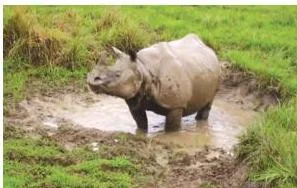


The chapter’s two most instructive images — a park photograph and a river scene from the gharial article — reward a close reading. Both carry the chapter’s argument visually.
Figure 2.2 sits on page 15, right after the Project Tiger passage. The chapter names the one-horned rhinoceros among the gravely threatened species the government moved to protect (NCERT, p. 13).
Kaziranga is the park famous for this animal, so the rhino in the frame is the point of the figure: a national park is a legally protected habitat for a specific endangered species — protection on the ground, not just on paper.
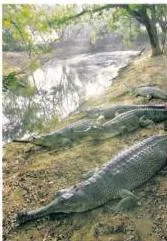
This image belongs to the ‘Gharial on the brink’ article (NCERT, p. 16). Its caption describes mist rising from the water surface at dawn — the scene as a reader approaches the Gowa River on a cold winter morning and hears the clapping call of an adult male gharial advertising his presence.
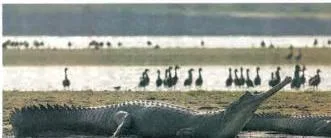
The article makes two things clear. Only three wild breeding sites for the gharial remain in the world, and rescue work pairs the river scene with captive breeding — young gharials hatched, raised to about a metre in length and then released into the wild.
Why does a geography chapter carry a magazine article? Because the gharial is one of the three crocodile types protected under the 1972 Act (NCERT, p. 13), yet it is still critically endangered. Law alone did not save it — which is exactly the chapter’s argument.
Definitions: the terms this chapter expects you to know
These are the terms the exercises ask about, in plain language. Learn each with the page where it appears.
| Term | Meaning | NCERT page |
|---|---|---|
| Biodiversity | The immense variety of wildlife and cultivated species, diverse in form and function but closely integrated through networks of interdependency | 12 |
| Conservation | Preserving ecological diversity, life-support systems (water, air, soil) and the genetic diversity of plants and animals for better growth and breeding | 13 |
| Reserved forests | More than half of India’s total forest land; regarded as the most valuable for conservation of forest and wildlife resources | 15 |
| Protected forests | Almost one-third of the total forest area; protected from any further depletion | 15 |
| Unclassified forests | Other forests and wastelands belonging to both government and private individuals and communities | 15 |
| Permanent forest estates | Reserved and protected forests maintained for producing timber and other forest produce, and for protective reasons | 15 |
| Joint forest management (JFM) | Village institutions protecting degraded forest land managed by the Forest Department; in return, members receive non-timber forest produce and a share of the timber. In formal existence since the 1988 Odisha resolution | 16 |
| Sacred groves | Forest patches left untouched by local people because nature worship holds that all creations of nature must be protected — ‘the forests of God and Goddesses’ | 17 |
Notice what the three forest categories have in common: they describe who owns and manages the land, not which trees grow on it.
Reserved, protected and unclassified forests: keeping the three apart
Reserved, protected and unclassified are ownership and management categories set by the Forest Department. Exercise question 2 tests exactly this, and it is where students most often lose marks.
| Forest type | Share of forest land | Who owns or manages it | Why it matters |
|---|---|---|---|
| Reserved forests | More than half of total forest land | Government through the Forest Department | Regarded as the most valuable for conservation of forest and wildlife resources |
| Protected forests | Almost one-third of total forest area | Forest Department | Protected from any further depletion |
| Unclassified forests | Other forests and wastelands | Government, private individuals and communities | Often managed by local communities; a high share in north-eastern states and parts of Gujarat |
The textbook adds a state-wise pattern worth remembering. Madhya Pradesh has the largest area under permanent forests — 75 per cent of its total forest area. Jammu and Kashmir, Andhra Pradesh, Uttarakhand, Kerala, Tamil Nadu, West Bengal and Maharashtra hold large percentages of reserved forests.
Bihar, Haryana, Punjab, Himachal Pradesh, Odisha and Rajasthan have a bulk of their forest under protected forests, and the north-eastern states and parts of Gujarat have very high percentages of unclassified forests managed by local communities (NCERT, p. 15).
Memory aid: protection strength runs reserved over protected over unclassified. Reserved is the most valuable and most protected category, protected comes next, unclassified is everything else. Say that order and the matching exercise answers itself.
Exercise question 2 on page 18 asks you to match each category to its definition. The correct pairs are:
- Reserved forests — forests regarded as most valuable for conservation of forest and wildlife resources
- Protected forests — forest lands protected from any further depletion
- Unclassified forests — other forests and wastelands belonging to both government and private individuals and communities
Community and conservation: the people in the chapter
The chapter’s lesson is that conservation strategies are not new in India — local communities have often led them, with or without the government (NCERT, p. 16). These are the examples to carry into a 120-word answer.
| Community or movement | Place | What they did |
|---|---|---|
| Chipko movement | Himalayas | Resisted deforestation in several areas and showed that community afforestation with indigenous species can be enormously successful |
| Alwar villagers | Five villages in Alwar district, Rajasthan | Declared 1,200 hectares of forest as the Bhairodev Dakav ‘Sonchuri’, with their own rules that ban hunting and protect wildlife from outside encroachment |
| Sariska villagers | Sariska Tiger Reserve, Rajasthan | Fought against mining by citing the Wildlife Protection Act |
| Beej Bachao Andolan and Navdanya | Tehri and beyond | Farmers’ and citizens’ groups showing that diversified crop production without synthetic chemicals is possible and economically viable |
| Bishnoi villages | Rajasthan | Blackbuck (chinkara), nilgai and peacocks live as an integral part of the community and nobody harms them |
| Joint forest management (JFM) | Formal since 1988; Odisha passed the first resolution | Village institutions restore degraded forest land; members receive non-timber forest produce and a share of the timber |
| Sacred groves | Tribal communities, including Chota Nagpur, Odisha and Bihar | Forest patches left untouched through nature worship; mahua, kadamba, tamarind and mango trees are revered |
Even temple life conserves: troops of macaques and langurs around many temples are fed daily and treated as part of the devotees (NCERT, p. 17).
Keep the gharial article separate — it is a case study of one species, not a community action. This section is what prepares exercise question 4.
The chapter ends with a test for development: accept only activities that are people-centric, environment-friendly and economically rewarding, with local communities at the centre of decision-making (NCERT, p. 17).
Common mistakes in this chapter
Most marks are lost here on small confusions, not on missing facts. Fix these six before the exam.
| Mistake | Correct rule | How to check your answer |
|---|---|---|
| Swapping reserved and protected forests | Reserved forests cover more than half of forest land and are the most valuable for conservation; protected forests cover about one-third and are protected from any further depletion | Say the order aloud: reserved is the bigger and more protected category (NCERT, p. 15) |
| Thinking conservation is only a government job | The chapter’s second half is entirely about community action — Chipko, JFM, Bishnoi villages, sacred groves | If your answer mentions only laws and national parks, you have missed half the chapter (NCERT, pp. 16–17) |
| Muddling the dates | Wildlife (Protection) Act 1972; Project Tiger 1973; insects added 1980 and 1986; plants added 1991; JFM formal since 1988 | Recite the years in order: 1972, 1973, 1980, 1986, 1988, 1991 (NCERT, pp. 13–14, 16) |
| Saying Project Tiger only saves tigers | The chapter calls it a means of preserving biotypes of sizeable magnitude | Quote the biotypes point, not just the tiger (NCERT, p. 14) |
| Assuming sacred groves are only a temple custom | They trace to tribal nature worship — Mundas and Santhals worship mahua and kadamba; Odisha and Bihar tribals worship tamarind and mango | List the communities and trees to prove the point (NCERT, p. 17) |
| Forgetting the gharial is protected yet still endangered | The gharial is one of three protected crocodile types, yet only three wild breeding sites remain | Link the 1972 protection (p. 13) to the page 16 case study to show the limit of law alone |
Exam notes: how the exercises test this chapter
The chapter’s exercise questions check the whole argument, and each maps to the section that answers it. Practise in this order.
| Exercise | What it tests | Where the answer is |
|---|---|---|
| Q1 — multiple choice: which strategy does not directly involve community participation? | Recognising community-led versus government-led conservation | Joint forest management, Chipko and Beej Bachao Andolan are all community-led; demarcation of wildlife sanctuaries is the government action and is the answer (NCERT, pp. 15–17) |
| Q2 — match the forest types | The three ownership and management categories | Definitions on page 15; the correct pairs are worked out in the section above |
| Q3 — biodiversity and depletion of flora and fauna (about 30 words each) | The opening argument and the pressures on species | Biodiversity and its importance: page 12; depletion: pages 13–14 — poaching for trade, shrinking habitat, depletion of prey base |
| Q4 — community conservation and good practices (about 120 words each) | The people-centred half of the chapter | Pages 16–17: Chipko, Alwar’s Sonchuri, Beej Bachao Andolan, Navdanya, JFM, Bishnoi villages, sacred groves |
Beyond the exercises, the chapter also sets project activities: collect regional stories about the harmonious relationship between humans and nature, mark wildlife sanctuaries and national parks on a map of India, and write a short essay on everyday practices that conserve the environment.
For question 4, a full-marks answer names at least three community examples with their places and actions, and ends with the chapter’s conclusion that local communities must sit at the centre of decision-making.
One honest note: textbook contents and the examinable syllabus are not always identical. Check the current official CBSE syllabus to confirm what is examinable this session.
Revision summary: the chapter in one reading
The whole argument in eight points, in the chapter’s own order.
- India’s biodiversity is among the world’s richest, and all life depends on the ecological web — plants, animals and micro-organisms re-create the air, water and soil we need (NCERT, pp. 12–13).
- Conservation preserves ecological diversity, life-support systems and genetic diversity; agriculture and fisheries both depend on it (NCERT, p. 13).
- The Wildlife (Protection) Act 1972 banned hunting, gave legal protection to habitats and restricted wildlife trade; national parks, sanctuaries and species-saving projects followed (NCERT, p. 13).
- Project Tiger (1973) shows how a flagship species preserves whole biotypes; protection later widened to insects (1980, 1986) and plants (1991) (NCERT, pp. 13–14).
- Forests are classified as reserved, protected and unclassified — together the permanent forest estates (NCERT, p. 15).
- The gharial case study shows a protected species can remain critically endangered (NCERT, p. 16).
- Communities conserve through Chipko, the Alwar villagers’ Sonchuri, Beej Bachao Andolan, Navdanya, Bishnoi villages, joint forest management and sacred groves (NCERT, pp. 16–17).
- The conclusion: local communities must sit at the centre of decision-making, and only people-centric, environment-friendly, economically rewarding development should be accepted (NCERT, p. 17).
Related resources for Class 10 Social Science
This listing is maintained for the 2026-27 academic session using the NCERT textbook information available to us. NCERT remains the authority for confirming the latest edition.
This chapter sits in the middle of the geography book. The chapters around it carry the same argument about resources — what they are, who controls them and why they run out.
- Class 10 Social Science notes — the previous chapter, Resources and Development, introduces land, soil and water as resources; this chapter continues with what happens to forest resources and who manages them.
- Water Resources Class 10 notes — the next chapter looks at another shared resource and the same questions of management and conservation.
- Class 10 revision hub — the chapter notes for Class 10 in one place.
- CBSE notes index — find notes for other classes and subjects.
- Notes for teachers on Class 10 Social Science — planning ideas for teaching this book.
Sources and data verification
- This page describes the NCERT Class 10 textbook Contemporary India II, Chapter 2 ‘Forest and Wildlife Resources’, official edition published on ncert.nic.in. Page references follow the printed textbook, pages 12–18.
- It covers this one geography chapter; it does not cover the other Class 10 Social Science books (History, Political Science or Economics).
- The listing is maintained for the current academic session, using the NCERT information available to us.
- NCERT settles textbooks, editions and PDFs; CBSE settles the curriculum and examinations — so confirm the examinable syllabus with the current official CBSE syllabus.
| What the chapter holds | Count | Where it is used |
|---|---|---|
| Printed pages | 6 | |
| Figures with NCERT captions | 6 | |
| Tables | 1 | |
| Exercise questions | 4 | answered in our NCERT Solutions |
| Activities | 3 | |
| Official NCERT PDF | Download the chapter PDF | the chapter exactly as NCERT publishes it |
Reference: NCERT Class 10 Social Science (Contemporary India II) textbook, chapter 2, official edition on ncert.nic.in.
Common questions students ask about this chapter
What is biodiversity and why is it important for human lives?
Biodiversity is the immense variety of living organisms — wildlife and cultivated species — closely integrated through networks of interdependency (NCERT, p. 12). It matters because plants, animals and micro-organisms re-create the air we breathe, the water we drink and the soil that produces our food. Conserving it also preserves genetic diversity, which agriculture and fisheries still depend on (NCERT, p. 13).
What is the difference between reserved forests and protected forests?
Reserved forests cover more than half of India’s total forest land and are regarded as the most valuable for conservation; protected forests cover almost one-third of the forest area and are protected from any further depletion (NCERT, p. 15). Both together are called permanent forest estates.
What is joint forest management and when did it start in India?
Joint forest management (JFM) brings village institutions into the protection of degraded forest land managed by the Forest Department; in return, members receive non-timber forest produce and a share of the timber. It has been in formal existence since 1988, when Odisha passed the first resolution (NCERT, p. 16).
What are sacred groves and which communities protect them?
Sacred groves are patches of forest left untouched because of the tribal belief that all creations of nature must be protected — ‘the forests of God and Goddesses’. The Mundas and Santhals of the Chota Nagpur region worship mahua and kadamba trees, and the tribals of Odisha and Bihar worship tamarind and mango during weddings (NCERT, p. 17).
Which conservation strategies in this chapter involve community participation?
Joint forest management, the Chipko movement, Beej Bachao Andolan, the Alwar villagers’ Bhairodev Dakav ‘Sonchuri’, the Bishnoi villages’ protection of blackbuck and nilgai, and sacred groves all involve communities directly. The strategy that does not — and the answer to exercise question 1 — is the demarcation of wildlife sanctuaries, a government action (NCERT, pp. 13, 15–17).
Why does the chapter include a case study on the gharial?
Because the gharial shows the limits of law. It has been a protected species since the 1972 Act — one of three crocodile types named for protection — yet only three wild breeding sites remain in the world (NCERT, pp. 13, 16).
The article pairs the wild river scene with captive breeding and release, which is exactly the chapter’s point: protection on paper is not enough.
Explore Class 10 Social Science Books
- Previous: Notes for the Teacher
- Next: Water Resources
Related chapters: