
This page gives you the official Planning for Kaushal Mela Class 8 PDF — Chapter 7 of the NCERT Kaushal Bodh (Vocational Education) textbook, a three-page chapter that takes you through planning a Kaushal Mela in seven phases.
The official file is linked right below, followed by this page’s explanation of what the chapter teaches, so you know what you are planning before you open it. This page is maintained for the current academic session.
Get the official Planning for Kaushal Mela Class 8 PDF (NCERT Kaushal Bodh Chapter 7) from the NCERT textbook portal, where the full Kaushal Bodh textbook for Class 8 is published chapter by chapter, free of charge.
Chapter at a glance — what the PDF holds
The table below shows the chapter’s contents at a glance — its sections, figures, worked examples and exercise questions — so you can see the size of the file before you open it.
What this chapter covers: the seven planning phases
The chapter is built around seven planning phases, listed at its very start. It opens from where you are: your projects are done, and you are ready to share what you did and how you did it — with classmates, teachers, school assemblies, and family.
- Brainstorming — generate and share ideas before the plan is fixed.
- Timeline — decide when each task starts and ends.
- Checklist — the tick list: posters, labels, invites.
- Execution of tasks — actually do the listed activities.
- Preparation of displays — arrange the finished work so visitors can see it.
- Event day — run the mela itself.
- Post-event activities — follow-up and clean-up after the event.
Why plan? The key ideas behind the chapter
The chapter gives planning a specific job: it helps you decide how to reach your goal. Planning also prevents wastage of time and resources, and it makes you think about what needs to be done and when, so everything goes smoothly.
The chapter makes this concrete with two examples:
- A presentation on water usage in the community needs a time and place chosen so the maximum number of people can watch it.
- A demonstration of home automation needs all materials in one place, in the correct quantity, before it can start.
Two realities make planning non-optional. Some materials take longer to procure than others, and some activities depend on other activities for completion. The plan must therefore set an order and start dates.
A Kaushal Mela also involves a lot of coordination. Responsibilities must be assigned for each activity, the process for each activity must be discussed, and the team needs a plan to work together.
Table 7.1 decoded: the things a Kaushal Mela plan must cover
Table 7.1 is the chapter’s core tool. It records the event’s basic details, then lets you plan each component with details, a start date, an end date, and a status.
The status column has two actions: tick the box when an activity is completed, and mark it red if it is delayed. You can write the finished plan on a chart or A3-size paper and post it on a notice board so the whole team can track the work.
The table’s 21 rows — five basic details and sixteen components — group naturally into work that happens before, during and after the event:
- Before — event basics: date and time, venue, who will attend, what you will present, additional support required (electricity, tables, chairs, carpet, computer, open space).
- Before — making the work visible: presentation of the work done (project documentation, poster, journey video) and setting up displays, including labelling components.
- Before — venue and guests: stall and decoration, seating arrangements, signboards (toilet, entry, and so on), and inviting guests — designing the invitation, the guest list, and how the invites will be sent.
- During — running the event: anchoring with a prepared script, preparation of the stage with decoration and sound equipment, the schedule for the entire mela, information about the mela (layout, information pamphlets), and registration of guests.
- After — wrapping up: feedback from guests and cleaning up after the mela — returning equipment and removing waste.
- Running across all three: safety precautions, cleanliness and waste management, and the first aid station — its location and what first aid will be available.
Notice the rows that are not tied to one phase. Cleanliness and waste management, safety precautions and the first aid station matter before, during and after the event, so they stay active on the chart the whole time.
A sample three-week plan makes the sequence concrete, and it shows which tasks must finish before others begin:
- Week 1: fix the date, time, venue and guest list; design the invitation; list materials that take time to procure and start procuring them.
- Week 2: collect the materials; make the poster, labels and invites; prepare the project documentation and journey video; build the displays.
- Week 3: send the invites; set up the stall, stage and signboards; rehearse the anchoring; run the event with registration and first aid ready; collect feedback; clean up and return equipment.
The order matters more than the dates: the venue and date come first because invites, stalls and registration all depend on them, and slow materials go first because every display depends on them.
The chapter’s figures: executing tasks and preparing displays
The chapter pairs two of its planning phases with photographs. Each figure belongs to a different phase of the plan, and both sit inside the seven-phase list at the chapter’s start.
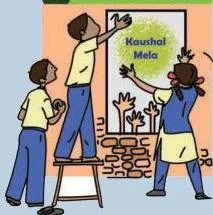
This photograph belongs to phase 4, execution of tasks — the moment the checklist items, posters, labels and invites, are actually produced and finished. In planning terms, execution is where the timeline starts turning plans into completed work.
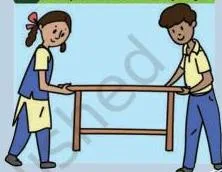
This photograph belongs to phase 5, preparation of displays — arranging the work so visitors can see it. Table 7.1 names what this phase covers in its display rows: presentation of the work done (project documentation, poster, journey video), setting up the stall and displays, and labelling components.
Planning terms in this chapter, defined
The chapter uses a small set of planning words. Here they are in one place, in plain words.
| Term | What it means in this chapter |
|---|---|
| Kaushal Mela | An event where students share what they did and how they did it with classmates, teachers, family and other visitors. |
| Brainstorming | Generating and sharing ideas before the plan is fixed. |
| Timeline | The start and end dates that keep each task on track. |
| Checklist | The tick list of items to complete — in this chapter, posters, labels and invites. |
| Execution of tasks | Doing the activities the checklist lists, not just planning them. |
| Display | How the finished work is shown to visitors — stalls, arranged exhibits, labelled components. |
| First aid station | A fixed place in the venue where basic medical help is available. |
| Anchoring | Hosting the event programme, with a prepared script and named anchors. |
| Feedback | Guests’ answers to planned questions, collected so the next mela improves. |
| Signboard | A label showing directions or facilities — toilet, entry, and similar. |
Four planning mistakes this chapter is built to prevent
The chapter warns directly against planning that stays on paper and never reaches the event. Four errors recur, and each has a clear fix.
| Mistake | Correct rule | How to check your answer |
|---|---|---|
| Planning without dates | Give every component a start date and an end date in Table 7.1. | Check that every row has both dates filled before the chart goes up. |
| Ignoring order and dependencies | Order the timeline so each task starts only after the tasks it depends on. | Ask of each task, “what must finish before this starts?” and confirm it is scheduled earlier. |
| Treating all materials as instantly available | Start procuring slow materials first, at the top of the timeline. | Check that the earliest dates belong to the materials that take the longest to arrive. |
| No owner and no tracking | Assign a responsibility to each activity and put the chart on the notice board. | Check that every row names an owner and shows a tick or a red mark. |
Each mistake appears in real planning. An invitation printed before the venue is confirmed has to be redone; a display finished on the morning of the event leaves no time to arrange it.
A material ordered in event week never arrives in time, and a task with no owner waits until someone finally notices it. The chapter’s answer to all four is the same: dates, order, early procurement and assigned responsibility, all tracked on the chart.
How this chapter is used: the plan is the deliverable
This chapter contains no practice questions and no exercises to solve. The deliverable is the plan itself: complete Table 7.1, tick items as they finish, run the mela, and then — at the end — check whether your preparation was adequate.
The skill is transferable. The chapter closes by making the point: a list of tasks, with the time and resources they require, helps you achieve goals in any activity or project — not just a Kaushal Mela.
Fast revision: the planning routine in six steps
The whole chapter, condensed into the routine it teaches:
- Brainstorm ideas first.
- Fix the basics — date, time, venue, guests, what you will present, support needed.
- Set a timeline with start and end dates for every component.
- Assign owners and execute — work through the checklist and prepare the displays.
- Run the event — anchoring, stage and sound, registration, first aid, cleanliness.
- Wrap up — collect feedback, clean up, return equipment.
Use the same routine for any project: list the tasks, fix the time and resources, assign responsibility, and track progress.
Related resources
This listing is maintained for the 2026-27 academic session using the NCERT textbook information available to us. NCERT remains the authority for confirming the latest edition.
This chapter belongs to the Kaushal Bodh (Vocational Education) book page for Class 8, which lists the book’s chapters so you can move forward or back. The Class 8 hub gathers this class’s resources across subjects, and the main notes index covers every class.
If you are reading the book in order, the Project 6 chapter page is the chapter that comes just before this one.
Sources and data verification
- This page describes Chapter 7, “Planning for Kaushal Mela”, of the NCERT Kaushal Bodh — Vocational Education textbook for Class 8.
- The figures and Table 7.1 described above are taken from the NCERT edition of that book.
- NCERT settles textbooks, editions and official PDFs; CBSE settles the curriculum, syllabus and examinations. Textbook contents and the examinable syllabus are not always identical — check the current official syllabus.
- This page covers only this one chapter; other chapters of the book are listed on the book page linked above.
| What the chapter holds | Count | Where it is used |
|---|---|---|
| Printed pages | 3 | |
| Figures with NCERT captions | 2 | |
| Tables | 2 | |
| Official NCERT PDF | Download the chapter PDF | the chapter exactly as NCERT publishes it |
Reference: NCERT Class 8 Kaushal Bodh textbook, chapter 7, official edition on ncert.nic.in.
FAQs: Planning for Kaushal Mela Class 8
What is a Kaushal Mela?
A Kaushal Mela is an event where students share what they did and how they did it with others — classmates, teachers, school assemblies and family — usually through stalls, displays and demonstrations.
Why is planning necessary before a Kaushal Mela?
Planning helps you decide how to reach your goal and prevents wastage of time and resources. Because some materials take time to procure and some activities depend on others, a plan with dates and assigned responsibilities keeps everything on track.
What are the seven planning phases in this chapter?
Brainstorming, timeline, checklist, execution of tasks, preparation of displays, event day, and post-event activities.
How do I use Table 7.1 to plan the mela?
Record the basic details first, then plan each component with details, a start date and an end date. When an activity finishes, tick it; if it is delayed, mark it red. Put the chart on a notice board so the whole team can track it.
What should I do if a planned task gets delayed?
Mark the task red in Table 7.1 so the delay is visible, then check which other tasks depend on it. Because some activities depend on others, catching a delay early protects every task that comes after it.
Can the planning method in this chapter be used for other projects?
Yes. The chapter says the same method works for any other activity or project: make a list of tasks and the time and resources they require, and track progress against it.
Explore Class 8 Vocational Education Books
Related chapters: