
Project 6 Class 8 — Creating Advertisements — is the hands-on advertising project in the NCERT Kaushal Bodh Grade 8 Vocational Education textbook, running from printed page 134 to page 161. You design and make a real advertisement for a local small business. This page follows the current NCERT edition, and the official PDF is right below.
Download the NCERT Class 8 Kaushal Bodh Project 6 PDF (Creating Advertisements) from the official NCERT textbook portal at ncert.nic.in, where the complete Grade 8 vocational education book is published free for every student.
What the Project Contains at a Glance
This is a build-it project, not a reading chapter. By the end of it you will have produced something a real business owner could actually use: an advertisement for their shop. You will need basic art supplies, a computer or tablet with Internet access, and a camera — a borrowed smartphone works (NCERT p. 138).
The project moves through seven activities, each feeding the next. The roadmap below shows the arc, with the NCERT page where each activity starts.
| Activity | What it asks you to do | NCERT page |
|---|---|---|
| Activity 1: Understanding types of advertisements | Notice the ads around you on an ordinary day and sort them into print, social media, radio/TV and outdoor | p. 140 |
| Activity 2: Elements comprising advertisements | Study what makes an ad work — logo, tagline, visuals, music, emotion, call to action | p. 142 |
| Activity 3: Meeting an expert | Interview a person from advertising or marketing and compare their views with yours | p. 149 |
| Activity 4: Identification of client | Choose a local small business as your client and sign a contract with the owner | p. 150 |
| Activity 5: Understanding the small business | Interview the owner to find what makes the product or service special | p. 152 |
| Activity 6: Designing the advertisement | Make the advertisement as a poster, a digital design or an animation | p. 154 |
| Activity 7: Review | Check your ad for creativity, clarity of the message and visual appeal, then collect the owner’s feedback | p. 159 |
| Think and Answer | Reflect on the project and on the responsibilities of advertisers | p. 161 |
What This Project Asks You to Do
Advertisements are everywhere — on buses, in notebooks, before videos — and they all want the same thing: to persuade you to do something. This project flips the roles. You stop being the audience and become the advertiser.
The book defines an advertisement as a message that persuades people to take a specific action, either for a social cause or to pay for a product or service (NCERT p. 135). Your assignment is to design an advertisement for a local business such as a baker, tailor, diya seller or bamboo craftsman (NCERT p. 138).
The book sets three goals: identify the key elements of an advertisement, identify the key selling points of a product or service, and design and make an advertisement (NCERT p. 138).

Keep that statement on the wall while you design. Every element you choose — the logo, the colours, the words, the music — must serve one purpose: persuasion.
Activity 1 starts with a comic. Ruchi lives with her grandparents, parents and a younger sibling, and she is going to visit her best friend Priti (NCERT p. 140). The comic below walks through her ordinary day, and the book asks you to count the advertisements she met along the way.
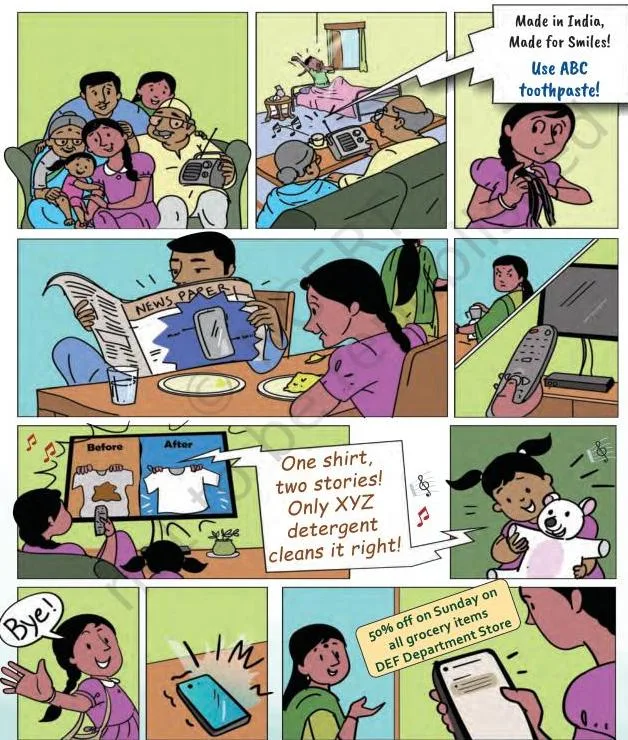
Ruchi’s day proves the point before you make anything: we are surrounded by advertisements, and most of them shape our choices without us noticing (NCERT p. 140). The ads in Table 6.1 fall into four categories — print, social media, radio and television, and outdoor — and you fill the table with examples of each (NCERT p. 140).
From there the project builds in a straight chain:
- Activity 1 — notice and sort the ads in an ordinary day (Table 6.1, p. 140).
- Activity 2 — dissect the elements of an advertisement (p. 142).
- Activity 3 — add an expert’s view (p. 149).
- Activity 4 — pick the client, prepare a questionnaire and sign a contract (pp. 150–151).
- Activity 5 — research the business through an interview (p. 152).
- Activity 6 — design the advertisement in print, digital or animated form (pp. 154–158).
- Activity 7 — review it against set criteria (p. 159).
One early decision shapes everything: advertising comes in two broad varieties — commercial and social (NCERT p. 135). Your group must decide which kind your advertisement is. A poster for a tailor is commercial; a poster urging people to keep their surroundings clean is social. Most local-business ads you will make are commercial, but the same elements do the work in both.
The Elements of an Advertisement: What Every Ad Needs
Before you draw anything, you need to know what every working advertisement combines. The book’s frame is simple: the key elements of advertising are storytelling, creating connections, and making an impact (NCERT p. 139). Inside that frame sit the seven elements you will make decisions about.
| Element | What it is | Why it matters in your ad |
|---|---|---|
| Logo (p. 143) | The visual mark of a brand — a symbol, or words and images combined — that the audience learns to recognise | It is the face of your client’s business |
| Tagline / slogan (p. 143) | A short phrase, easy to remember, that stands for the brand or product | It is the line people repeat; keep it short enough to survive one hearing |
| Branding (p. 143) | Building a unique identity by using the same logo and a similar tagline across every advertisement | Every future ad of the business starts from the identity you build now |
| Visuals (p. 144) | Colour, figures, shapes and layout — with text kept to a minimum and placed with care | The eye meets the visual first; a viewer should read the message at a glance |
| Music and jingles (p. 145) | Short, catchy rhymes; audio-video ads are kept short so the audience does not get bored | A jingle makes people associate a product with a sound |
| Connect to emotions (p. 147) | Designing the ad so it touches feelings — we recall what touches our emotions | A viewer who feels something is a viewer who remembers |
| Call to action (p. 148) | The part that tells the audience what to do after seeing the advertisement | Without it, the ad persuades no one |
Check your own advertisement against all seven rows before you show it to anyone. The most common failure is designing a pretty poster and forgetting the last row.
Figure Walkthrough: What Each NCERT Advertisement Shows
The captioned figures of the chapter follow below in order. Follow them with a finger on your own book — each one freezes one idea about advertising that you will reuse in your own design.
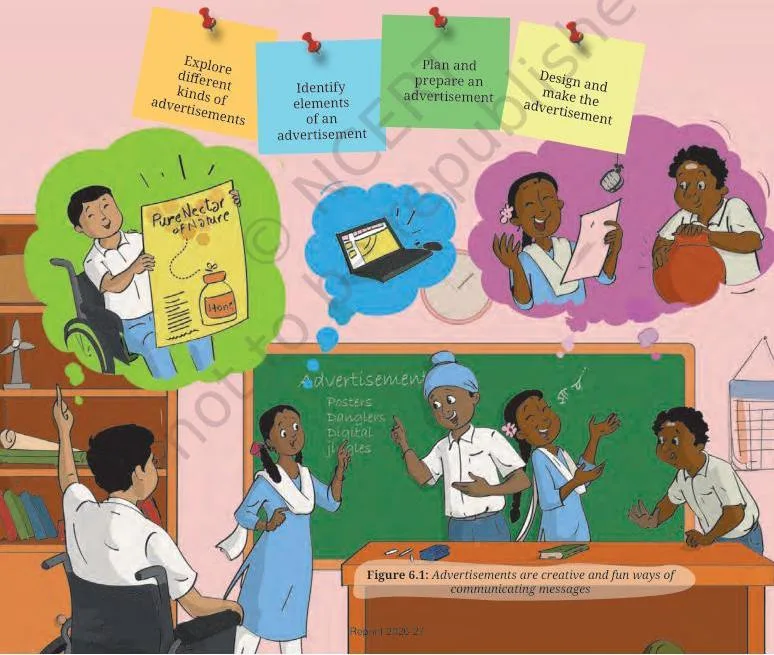
This is the chapter’s opening claim — an advertisement is a message, and the best ones are creative and fun, not just a photograph of a product (NCERT p. 135).
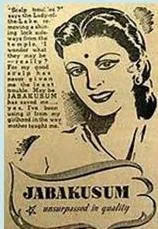
The first newspaper advertisements in India appeared in 1780 in the Bengal Gazette, the first English newspaper in India, published from Kolkata. This Jabakusum hair-oil advertisement is from that paper (NCERT p. 136). Advertising is not a new invention — it only changes medium.
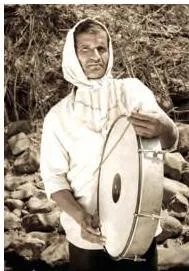
Before print media, town criers beat drums — the dhindora — to announce important messages in villages (NCERT p. 137). The modern version is the person with a loudspeaker on a bike or auto announcing an event.

Hoardings and hand-painted signboards around a marketplace are outdoor advertising (NCERT p. 138). They reach people who are already out shopping — the same audience you will fill into the outdoor column of Table 6.1.
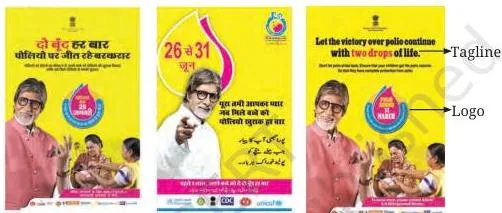
The polio campaign ran in several languages, but the logo stays the same in every version (NCERT p. 143). That is branding: the symbol stays constant so people recognise the campaign instantly, even when the words change.
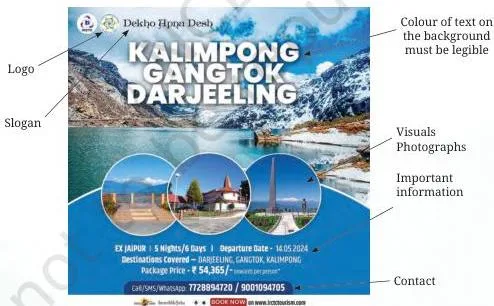
An advertisement’s visual parts are labelled in this figure (NCERT p. 144). Notice the book’s extra rule: text is kept to a minimum, usually limited to taglines and slogans, and placed with care so the visuals stay visible.

An army recruitment advertisement built on inspiration (NCERT p. 147). It makes a young viewer want to belong — an emotional connect, not a list of benefits.
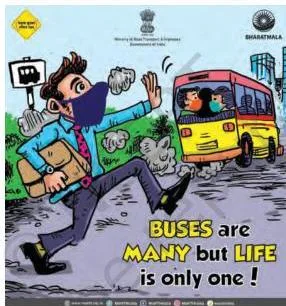
A road-safety advertisement that works by emphasising that life is precious (NCERT p. 147). Different emotion, same technique: the message is remembered because it touches feelings.
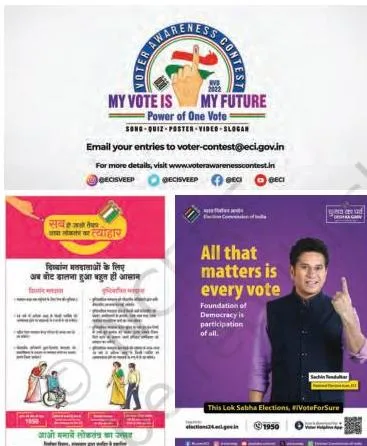
Vote-awareness advertisements tell citizens to go and cast their vote (NCERT p. 148). That instruction — go and vote — is the call to action, the phrase every advertisement of yours needs.
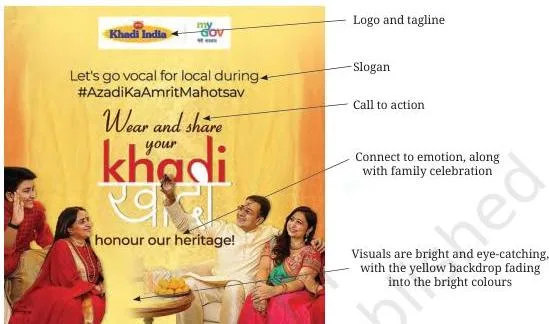
The final figure is a puzzle (NCERT p. 149). The book asks you to label its logo, tagline, visuals, emotional connect and call to action — and then to decide whether you agree with the labelling, and discuss why.
| Figure | NCERT page | What to notice |
|---|---|---|
| 6.1 | p. 135 | Advertising is a creative, fun way of communicating a message |
| 6.2 | p. 136 | An 18th-century Jabakusum ad from the Bengal Gazette (1780) — ads are centuries old |
| 6.3 | p. 137 | The town crier / dhindora: drum-beating as early advertising |
| 6.4 | p. 138 | Hoardings in a marketplace — outdoor advertising around local shops |
| 6.5 | p. 143 | Same logo, different languages — branding at work |
| 6.6 | p. 144 | Visual elements labelled: figures, colour, logo, layout; text kept minimal |
| 6.7 | p. 147 | Army recruitment ad built on inspiration |
| 6.8 | p. 147 | Road-safety ad: life is precious |
| 6.9 | p. 148 | Vote-awareness ads — the call to action: go and vote |
| 6.10 | p. 149 | A mixed ad to label yourself — and disagree with |
Advert Terms: The Definitions You Need for This Project
These are the terms the activities keep using. Learn them in one pass, then check them against any advertisement you see today.
| Term | Plain definition | NCERT page |
|---|---|---|
| Logo | The visual mark of a brand — a symbol, or words and images combined — that represents the brand or product | p. 143 |
| Tagline / slogan | A short, memorable phrase that represents the brand or product | p. 143 |
| Branding | Creating a unique identity by using the same logo and a similar tagline across every advertisement | p. 143 |
| Jingle | A short, catchy rhyme used to describe the brand in an ear-catching way | p. 145 |
| Call to action | The part of an ad that tells the audience what to do after seeing it | p. 148 |
| Storyboard | A frame-by-frame sketch of a video or animated advertisement, recording the action or text in each frame | p. 158 (Table 6.4) |
| Commercial advertising | Advertising that persuades people to pay for a product or service | p. 135 |
| Social advertising | Advertising that communicates important social messages, such as health campaigns | p. 135 |
| Town crier (dhindora) | A person who announced important messages by beating a drum — an early form of advertising | p. 136 |
| Plagiarism | Copying content such as images, music or text without permission or without naming the source | p. 139 |
Mistakes Students Make in This Project (and How to Avoid Them)
The chapter’s safety rules double as its quality rules. The book names three ethical traps outright, and the activities set four more execution traps. Here they all are, so you can name the mistake before you make it.

The figure above is the book’s internet guardrail: use the Internet with a teacher’s help, upload or download nothing without permission, and share no personal information (NCERT p. 139). Before any visit to a business, inform a parent, guardian or teacher, meet in public and well-lit places, and respect the owner’s privacy and consent (NCERT p. 139).
| Mistake | Correct rule | How to check your answer |
|---|---|---|
| Copying images, music or text from the Internet without permission or the source | Use original content, or get permission and name the source — copying as such is plagiarism (p. 139) | Can you say where every image and sound in your ad came from? |
| Claiming features the product does not have | The advertisement must reflect the real features and benefits of the product (p. 139) | Could the owner confirm every claim you made? |
| Using cultural or gender stereotypes, or anything offensive | Avoid stereotypes and offensive content; be mindful of cultural sensitivities (p. 139) | Is every person in your audience shown with respect? |
| Photographing the owner or product without consent | The signed contract must approve the use of photographs (p. 151); respect privacy | Does the contract let you use that photo? |
| An advertisement with no call to action | Every advertisement must tell the audience what to do next (p. 148) | Does your ad end with a clear instruction? |
| Filling the visual with text | Keep text to a minimum and place it with care; the visuals must carry the message (p. 144) | Can a viewer understand your ad in a few seconds? |
| Skipping the emotional connect | Ads are remembered when they touch emotions (p. 147) | What feeling does your ad leave the viewer with? |
Project Checklist: Everything You Produce and Submit
This is what “finished” looks like. Work through the book and you will file the items below; together they are the complete project record you can show the owner and your teacher.
| What you produce | Where it goes | NCERT page |
|---|---|---|
| Examples of ads you noticed, sorted into four kinds | Table 6.1 | p. 140 |
| Your answers on logos, taglines, visuals and audio | Activity 2 response spaces | pp. 143–146 |
| The labelled (or re-labelled) practice advertisement | Figure 6.10 | p. 149 |
| Notes from your meeting with an expert | Activity 3 pages | pp. 149–150 |
| A signed contract with the business owner | Contract box | p. 151 |
| Completed interview with the owner — product and customer questions | Activity 5 pages | pp. 152–153 |
| Your choice of advertising form, with cost and resources | Table 6.2 | p. 154 |
| Design decisions with reasons — logo, tagline, call to action, visuals, jingle, emotion, target audience | Table 6.3 | p. 154 |
| A sketch of the poster layout | Poster activity space | p. 156 |
| A digital version of the poster | Made with tools such as MS-PowerPoint or Canva | p. 156 |
| Key frames of your video or animated ad, frame by frame, with action and text noted | Table 6.4 (storyboard) | p. 158 |
| The owner’s review answers | Activity 7 pages | p. 159 |
| Hours spent on each activity | Time-taken timeline | p. 160 |
| Reflections on the project and the responsibilities of advertisers | Think and Answer | p. 161 |
This is a project chapter, so there is no fixed mark scheme to quote here — and textbook contents and the examinable syllabus are not always identical, so check the current official syllabus for what is assessed.
The Whole Project on One Page
Revision in three moves — the definition, the elements, the chain.
The definition: an advertisement persuades people to take a specific action, either for a social cause or to get them to pay for a product or service (NCERT p. 135).
The elements every ad combines (all inside the book’s frame of storytelling, creating connections and making an impact, p. 139):
- Logo — the visual mark of the brand
- Tagline — a short, memorable phrase
- Visuals — colour, figures, layout, with text kept minimal
- Emotional connect — touch a feeling, get remembered
- Call to action — tell the audience what to do next
The chain: notice ads → learn the elements → meet an expert → pick a business → sign the contract → interview the owner → design → review (pp. 150–159).
Self-test: ask of any advertisement — including your own — What does it show? What does it say? What does it want me to do? If you can answer all three, you have read the ad correctly.
Related Resources: Other Projects in Kaushal Bodh Class 8
This listing is maintained for the 2026-27 academic session using the NCERT textbook information available to us. NCERT remains the authority for confirming the latest edition.
Project 6 is one project in the Kaushal Bodh Class 8 book. To move around the same book, class and notes:
- Kaushal Bodh book page — Kaushal Bodh (Vocational Education) Class 8
- Class 8 Vocational Education hub — Class 8 vocational education projects
- Other projects in the same book — Planning for Kaushal Mela and Work in Human Services
- Broader revision help — Class 8 vocational education notes, Class 8 notes, and the main CBSE notes directory
Sources and Data Verification
- The page numbers and figures on this page describe the NCERT Kaushal Bodh Grade 8 (Vocational Education) textbook, official edition published on ncert.nic.in.
- This page covers Project 6 — Creating Advertisements (pages 134–161) only, not the whole book.
- This listing is maintained for the current academic session using the NCERT edition available to us.
- NCERT settles textbook editions and PDFs; CBSE settles curriculum, syllabus and examinations.
| What the chapter holds | Count | Where it is used |
|---|---|---|
| Printed pages | 27 | |
| Figures with NCERT captions | 19 | |
| Tables | 5 | |
| Official NCERT PDF | Download the chapter PDF | the chapter exactly as NCERT publishes it |



Reference: NCERT Class 8 Kaushal Bodh (Vocational Education) textbook, Project 6, official edition on ncert.nic.in.
Frequently Asked Questions About Project 6 Class 8
What is Project 6 in Class 8 Kaushal Bodh about?
It is the Creating Advertisements project — a hands-on chapter (pages 134–161) in which you design and make an advertisement for a local small business. You work through seven activities, from noticing the ads around you to designing your own advertisement and getting it reviewed by the business owner.
What are the elements of an advertisement in this project?
The elements are the logo, tagline/slogan, visuals, music and jingles, the emotional connect, and the call to action — all working inside the book’s frame of storytelling, creating connections and making an impact (NCERT p. 139).
What is the difference between a logo and a tagline?
A logo is the visual mark of a brand — a symbol, or words and images combined — while a tagline is a short, memorable phrase. The logo tends to stay the same across advertisements, while the tagline can change, as the polio campaign in Figure 6.5 shows.
What are the rules of ethical advertising in this project?
Three, from NCERT p. 139: do not copy content without permission or credit (plagiarism), never make false claims about the product (fake advertising), and avoid cultural and gender stereotypes or anything offensive.
What does call to action mean in an advertisement?
It is the part that tells the audience what to do after seeing the advertisement — buy the product, get vaccinated, or go out and vote, as Figure 6.9 shows. Every advertisement needs one (NCERT p. 148).
Where can I download the Class 8 Kaushal Bodh Project 6 PDF?
From the official NCERT textbook portal at ncert.nic.in. Use the download link near the top of this page — the NCERT Class 8 Kaushal Bodh Project 6 PDF is published there free along with the rest of the Grade 8 vocational education book.
Explore Class 8 Vocational Education Books
Related chapters: