
This page is about Work with Life Forms Class 8 — Chapter 1 of the NCERT Kaushal Bodh Grade 8 vocational education textbook. The chapter runs 30 printed pages and builds one complete school project: growing plants without soil using hydroponics. The official NCERT PDF is right below, with a plain-language walkthrough of the project under it.
Download the Work with Life Forms Class 8 chapter PDF
The chapter is the official opening unit of the Kaushal Bodh vocational education book for Grade 8, published by NCERT on its textbook portal. Open the Work with Life Forms Class 8 chapter PDF when you need the printable version of the chapter — the file keeps every activity table, safety rule and build figure exactly as NCERT printed them.
What is inside the Work with Life Forms chapter
Use the chapter-info table on this page to see the chapter’s size at a glance — the counts of its sections, figures, tables and questions are listed there. What that table cannot show is how the parts are organised, so here is a page-by-page map of the chapter.
| Part of the chapter | What it does | NCERT page |
|---|---|---|
| Project options | Presents two example projects — growing plants without soil, and caring for farm animals — and invites you to design your own with your teacher | p. 1 |
| Project outcomes | Lists the four skills you will have at the end of the hydroponics project | p. 5 |
| Materials | Shows the equipment needed for each system, from PET bottles to pH-adjustment materials | p. 6–7 |
| Safety rules | Covers tools, electrical gadgets and internet safety before you start | p. 8 |
| What plants need | Table 1.1: the conditions for plant growth and how hydroponics can replace soil | p. 8–9 |
| Activities 1–7 | Field visit, microgreens, then three systems — wick, DWC and NFT — followed by compost tea and pH maintenance | p. 10–27 |
| Reflection and career links | Self-reflection questions, a time log, extension ideas and jobs connected to the work | p. 28–30 |
Notice the pattern: this chapter is project-led. It has no exercise set with question numbers. Instead, seven activities build one project, and each activity ends in a recording table or reflection questions. The tables are how you document the plant you are growing.
What this chapter covers: two projects, one developed in full
The chapter opens by defining its subject. Life forms include all living things — human beings, mammals, birds, fish, plants, insects, reptiles, and even bacteria and viruses (NCERT, p. 1).
From there it lists the kind of projects you can take up: growing plants in different ways, recording biodiversity, surveying medicinal plants, caring for domestic and farm animals, or maintaining a nature journal (NCERT, p. 1).
Then it names two example projects: “Hydroponics: Growing Plants without Soil” and “Feeding and Caring for Farm Animals”. You may choose one of these or, with your teacher’s help, design your own.
The rest of the chapter develops the hydroponics project in full. Its four learning outcomes, from NCERT page 5, are:
- Grow healthy microgreens using a basic hydroponics system.
- Establish a hydroponic unit using the wick-based system, Deep Water Culture (DWC) and the Nutrient Film Technique (NFT).
- Prepare organic liquid manure for hydroponics.
- Improve the quality of water by varying pH.
Hydroponics matters here for a real reason. India faces soil degradation across nearly 33% of its Total Geographical Area, with close to 109 million hectares of land losing soil quality (NCERT, p. 4). Farming that does not depend on soil is one answer, and the chapter notes that the Mission for Integrated Development of Horticulture promotes hydroponics and aeroponics.
Two “Did you know?” boxes make the same point at different scales. ISRO has successfully sprouted cowpea seeds in space on its PSLV-C60 POEM-4 mission — a step towards ‘space gardens’ (NCERT, p. 10). And Dal Lake in Srinagar, the Phumdis of Loktak lake and the floating gardens of coastal Odisha are ancient farming methods that work like hydroponics (NCERT, p. 13).
Key concepts: why plants can grow without soil
Hydroponics does not remove the work of growing a plant. It replaces soil with a nutrient-rich water solution, and every other plant need still has to be met. That single idea drives all seven activities.
What plants need, and how hydroponics supplies it
The chapter’s Table 1.1 (NCERT, p. 8–9) compares how soil and hydroponics each meet the same needs:
| Plant need | How soil meets it | How hydroponics meets it |
|---|---|---|
| Germination of seeds | Seeds absorb water and germinate | Seeds are soaked in water, just like making sprouts |
| Physical support for plants | Roots grip the soil | Plants are held on floating sheets or in net pots above the water |
| Sunlight for growth | Leaves absorb sunlight for photosynthesis | Natural sunlight or artificial light is used |
| Nutrients for plant growth | Roots absorb minerals from the soil | Minerals (nutrients) are added to water in the required quantity |
| Any other specific need | Compost or fertilisers are mixed into the soil | Growth media replace soil: coco coir, coco peat, gravel, sand, red-brick or clay, pebbles, rockwool and vermicompost |
Beyond those needs, plants need help from microbes — organisms too small to see without a microscope. Microbes break down complex organic matter into simpler compounds roots can absorb, suppress diseases, and help plants communicate with neighbours. Only helpful microbes should be added to the water (NCERT, p. 9–10).
So the rule of the chapter is simple: any hydroponic unit must fulfil all these needs for healthy growth (NCERT, p. 10).
Three systems in the chapter
All three systems deliver water and nutrients to roots. They differ in how the water moves — and that decides which one needs electricity.
| Feature | Wick method | DWC | NFT |
|---|---|---|---|
| Container | Recycled 2 L PET bottle cut in two | Bucket or tub, 10–15 L | PVC pipe, 3 inch (76 mm), about 1 m long |
| How water reaches roots | A cloth wick pulls water up by capillary action | Roots hang in standing nutrient water | A water pump pushes a thin film of nutrient water through the pipes |
| Water pump? | No | No | Yes |
| Aerator (air pump)? | No | Yes — dissolves oxygen into the water | No — the flowing water carries oxygen |
| Crop the chapter suggests | Seeds or seedlings in growth medium | Spinach or other leafy vegetables | 6–7 plants per metre of pipe |
The wick system is the cheapest to run because it has no pump and no aerator (NCERT, p. 18). DWC uses an aerator because the roots sit in standing water (NCERT, p. 19–20). NFT uses a water pump but no air pump, because a continuously flowing thin film of water carries its own oxygen (NCERT, p. 22).
Water quality and nutrients
Since nutrients travel to the plant through water, water quality decides how well the system works. The chapter names five critical parameters: pH, dissolved oxygen, total dissolved solids, water hardness and electrical conductivity (NCERT, p. 26). For a school unit, two matter most: feeding and pH.
- Feed: compost tea is the organic liquid manure, made by brewing compost in water with microbes (NCERT, p. 25).
- pH: nutrient mobility is best when water pH sits between 6.0 and 7.0. pH 7 is neutral; above 7 the water is alkaline and needs acid to come down (NCERT, p. 26).
The chapter’s figures, explained
These diagrams are build instructions, not decoration. Here is what to look for in each one, in the order the chapter uses them.
Hydroponics at different scales
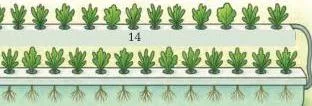
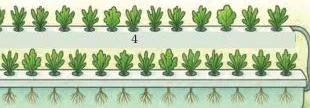
Figure 1.1 shows do-it-yourself hydroponics — the size a school or home can actually manage. Plants sit in water containers instead of soil, which is the whole project in one image.
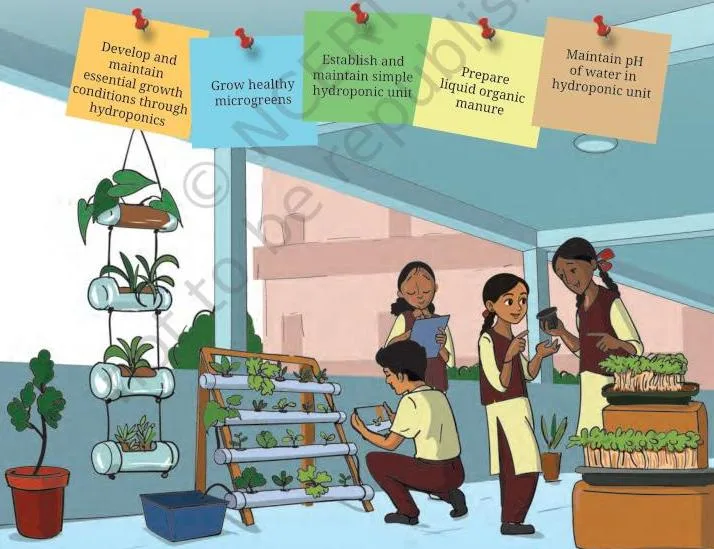
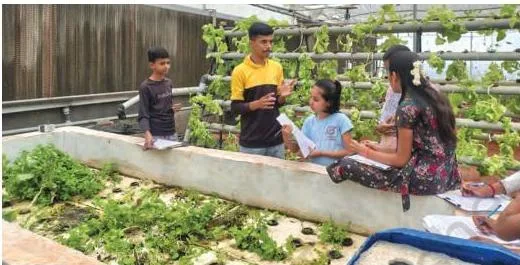
Figure 1.2 shows the same idea at commercial scale: a hydroponic setup inside a polyhouse, where temperature, humidity and light can be controlled to maximise growth (NCERT, p. 4–5).

Materials before you start
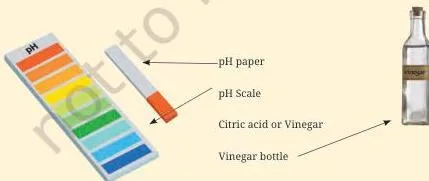
Before any activity, the chapter lists what you will need (NCERT, p. 6–7). Figure 1.3(f) shows the materials required for adjusting the pH — part of a larger figure that also covers DWC and compost tea setups. Notice that the pH materials are listed before you have built a single system: collect them from the start.
An Indian link
Figure 1.4 shows Dal Lake in Srinagar with a floating farm. It is the chapter’s way of connecting hydroponics to Indian tradition: the Phumdis of Loktak lake in Manipur and the floating gardens of coastal Odisha are related ancient methods (NCERT, p. 13).
Microgreens as a first crop
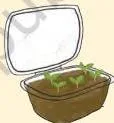
Figure 1.5 is the instruction manual for Activity 2. Read it as six steps: fill a tray about 2 inches deep with soil or cocopeat, moisten it, spread seeds and cover them thinly, and wait 2–3 days for germination in a moist place.
Keep the tray near sunlight or artificial light, then cut the microgreens just above the soil surface when the first true leaves appear — roughly 10 days after planting (NCERT, p. 14). The panel students get wrong is the last one: do not cut at the seed leaves.
Three systems to build
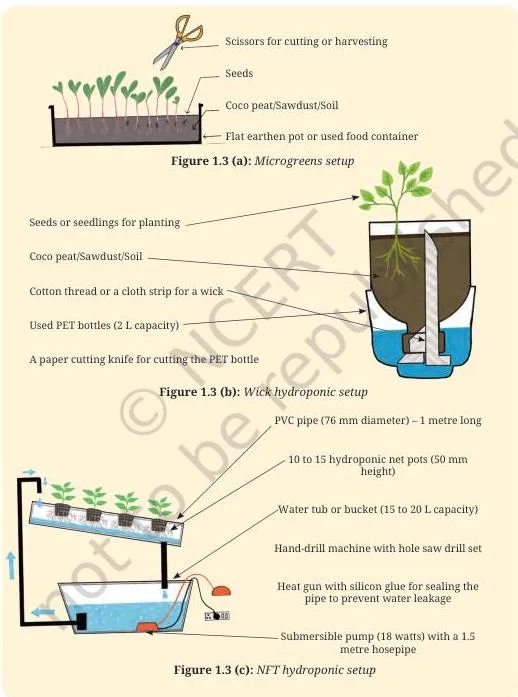
Figures 1.6 to 1.9 are the build plans for the heart of the chapter. Figure 1.6 shows the wick method made from a single recycled PET bottle: the inverted top is the planter, the bottom is the water reservoir, and a cloth wick passes through a hole in the cap (NCERT, p. 16–17).
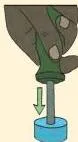
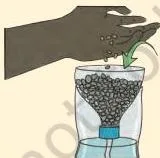
There are no wires and no pump in the diagram — the wick is the only moving part, pulling water up by capillary action (NCERT, p. 18).
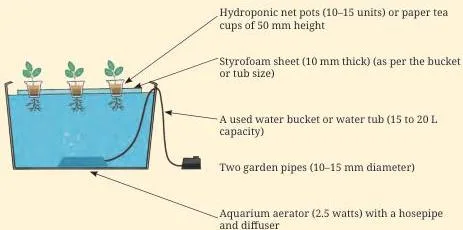
Figure 1.7 shows the DWC hydroponic tub: a float (styrofoam sheet) holds the plants, and their roots hang down into the nutrient water (NCERT, p. 19).

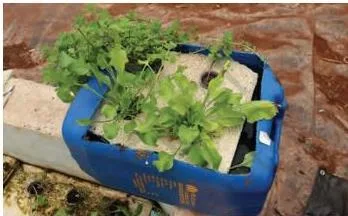
Figure 1.8 then shows the build steps for the DWC system. Look for the aerator placed in the water tub — that is the part that keeps roots white and healthy (NCERT, p. 20).
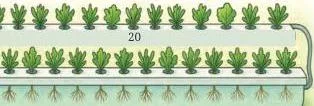
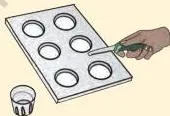
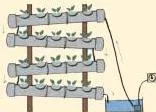
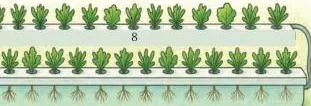
Figure 1.9 shows the NFT system: PVC pipes with plants in net pots and a thin film of flowing water passing over the roots. The drawing has no air pump — the continuous flow carries the oxygen (NCERT, p. 23–24).
Feeding and testing the system
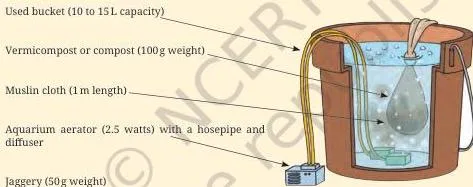
Figure 1.10 walks through compost tea: 100–150 g of compost in a muslin cloth, placed in a bucket with about 10 L of water, 50 g of jaggery or sugar as food for microbes, and an aerator brewing it for 2–3 days (NCERT, p. 25).
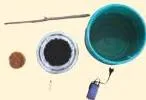
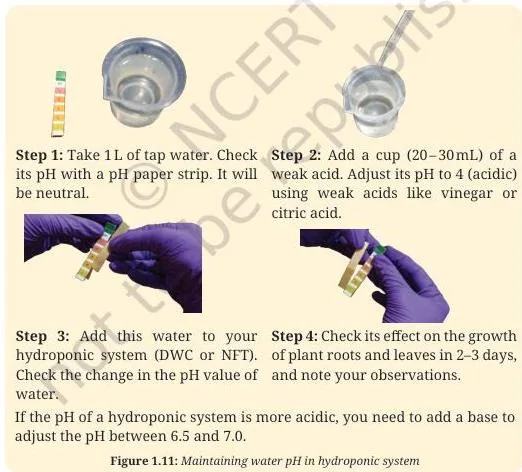
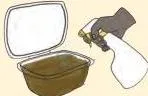
Figure 1.11 shows the pH check: dip pH paper into the water and compare the colour. This is the test that tells you whether the acid you added has brought the water into the 6.0–7.0 range (NCERT, p. 27).
Definitions from the chapter, in plain words
A quick glossary of the terms the activities keep using. Each entry is in plain words, with the NCERT page where the book explains it.
| Term | Meaning in plain words | NCERT page |
|---|---|---|
| Hydroponics | Growing plants in a nutrient-rich water solution instead of soil; from Greek ‘hydro’ (water) and ‘ponos’ (labour) | p. 4 |
| Precision farming technique | A farming method that gives each plant exactly the amount of nutrients it needs | p. 4 |
| Growth media | Materials that replace soil for holding roots — coco coir, coco peat, gravel, sand, red-brick or clay, pebbles, rockwool, vermicompost | p. 9 |
| Microgreens | Young seedlings of vegetables and herbs, harvested after the first 2–4 leaves appear (1–3 inches tall) | p. 13 |
| Seed leaves | The first leaves from the germinated seed, which contain stored food for the young plant | p. 15 |
| True leaves | The leaves that appear after the seed leaves, when the plant can start making its own food | p. 15 |
| Sprouts | Seeds germinated without light, eaten raw with their roots, ready in 2–5 days | p. 15 |
| Capillary action | Movement of liquid through a narrow space, like the fibres of a wick, without external forces like gravity | p. 18 |
| Dissolved oxygen | Oxygen from the air that has dissolved in water; roots and other organisms use it for growth | p. 19 |
| Nutrient film technique | A hydroponic method where roots stand in a thin, continuously flowing stream of nutrient water | p. 22 |
| Compost tea | Liquid manure made by brewing compost in water with microbes; added to hydroponic water as feed | p. 25 |
| Water quality parameters | Measurements that tell whether water is healthy for plants: pH, dissolved oxygen, total dissolved solids, water hardness, electrical conductivity | p. 26 |
A worked example: diluting compost tea for your system
The chapter gives one mixing rule: add 1 L of compost tea to 10 L of hydroponic water (NCERT, p. 25). School reservoirs are rarely exactly 10 L, so here is the same rule scaled to two sizes.
Example 1: your DWC bucket holds 12 L. Keep the same strength by scaling the tea in the same ratio:
\[ \text{tea needed} = \frac{12\ \text{L}}{10} = 1.2\ \text{L} \]
So add 1.2 L of compost tea to the 12 L reservoir. The mix stays exactly one part tea to ten parts water.
Example 2: you have 750 mL of tea and a 10 L NFT reservoir. The mix will be weaker than the recommended ratio:
\[ \frac{10\ \text{L}}{0.75\ \text{L}} \approx 13 \]
The strength is about one part tea to thirteen parts water — weaker, but usable. Record the weaker mix in your observation table instead of adding tea you do not have.
Before you add any tea, use the quality checks from Table 1.10 (NCERT, p. 25): the tea should be dark brown — if it is very dark, dilute it with water in a 1:3 proportion — and it should smell earthy. A foul smell means poor aeration, too much compost or a poor microbial balance — do not use that tea.
Mistakes students make in the hydroponics activities
These are the failures the chapter’s own observation tables warn about. Knowing them in advance is half the battle.
| Mistake | Correct rule | How to check your work |
|---|---|---|
| Harvesting microgreens at the seed-leaf stage | Wait for the first true leaves, about 5–7 cm tall | Count the leaf pairs before cutting; true leaves come after the seed leaves (NCERT, p. 14–15) |
| Treating brown DWC roots as a disease | Brown roots usually mean low dissolved oxygen, not an infection | Check the aerator is running; healthy roots should be white (NCERT, p. 20) |
| Leaving DWC water exposed to sunlight | Cover the water surface so algae cannot grow | Water stays clear instead of turning green; keep the styrofoam lid in place (NCERT, p. 20) |
| Using strong acids to lower pH | Use a weak acid: vinegar (acetic acid) or lime juice (citric acid) | Strong acids work in tiny amounts but are unsafe to handle; test after adding with pH paper (NCERT, p. 27–28) |
| Ignoring a foul-smelling compost tea | Fix the brewing conditions before using the tea | A good tea smells earthy; bad smell means poor aeration, too much compost or poor microbial balance (NCERT, p. 25) |
| Setting the NFT water level too high or too low | Keep the water at about half the pipe diameter | Roots must reach the film, but pipes must not overflow; adjust the pipe slope (NCERT, p. 24) |
How this chapter checks your learning
This chapter has no numerical exercise set, so do not hunt for one. Its checkpoints are the reflection questions, recording tables and safety rules the project asks you to complete.
- Safety rules (p. 8): you are checked on working safely with tools, electrical gadgets like aerators and submersible pumps, and the internet.
- “Reflect on your learnings” (p. 15): after the microgreens activity — its advantages and disadvantages, how you used them, and whether the method can apply to all crops.
- Challenge questions after Activities 3–5 (p. 18, 21, 24): for the wick method, whether you observed the soil getting wet (capillary action); for DWC, three challenges and what you would do differently; for NFT, a DWC-versus-NFT comparison chart and the reason an aerator is used in one but not the other.
- “What did I learn from others?” (p. 28): advanced farming technology in your locality, and three things you learnt while building the system.
- “What did I do and how long did it take?” (p. 29): a time log of periods spent on each of the seven activities.
- “Think and Answer” (p. 30): the final reflection set, including whether it is economical to grow all crops hydroponically, and naming jobs related to the work — gardener, botanist, forest officer, farmer and agricultural scientist.
One honest note: textbook contents and the examinable syllabus are not always identical — check the current official syllabus for what counts this session.
What to take away from Work with Life Forms
If you revise nothing else, remember these points:
- Hydroponics grows plants in a nutrient-rich water solution instead of soil — a precision farming technique (NCERT, p. 4).
- The project has four outcomes: healthy microgreens, three working systems, liquid manure and pH control (NCERT, p. 5).
- Any hydroponic unit must supply what soil used to: germination, support, light, nutrients and helpful microbes (NCERT, p. 8–10).
- The three systems — wick, DWC and NFT — differ mainly in equipment and oxygen supply (NCERT, p. 16–24).
- Microgreens are the quick first crop: about 10 days from seed to harvest at the true-leaf stage (NCERT, p. 13–15).
- Compost tea is the organic feed, brewed for 2–3 days and used at one part tea to ten parts water (NCERT, p. 25).
- pH should sit between 6.0 and 7.0 for best nutrient mobility (NCERT, p. 26).
- The chapter ends by connecting the skills to real jobs: gardener, botanist, forest officer, farmer and agricultural scientist (NCERT, p. 30).
Related resources
This listing is maintained for the 2026-27 academic session using the NCERT textbook information available to us. NCERT remains the authority for confirming the latest edition.
To move beyond this chapter, open the NCERT Class 8 Vocational Education (Kaushal Bodh) book page to see every chapter of the book, or go to the Class 8 NCERT books hub for the full set of Class 8 textbooks. NCERT publishes the original chapter PDFs on its official portal at ncert.nic.in/textbook.php.
For quicker revision support, this site also keeps Class 8 vocational education notes, a Class 8 notes hub, the book’s second project page, and the main CBSE notes index.
| What the chapter holds | Count | Where it is used |
|---|---|---|
| Printed pages | 30 | |
| Figures with NCERT captions | 47 | |
| Tables | 11 | |
| Official NCERT PDF | Download the chapter PDF | the chapter exactly as NCERT publishes it |



Reference: NCERT Class 8 Kaushal Bodh textbook, chapter 1, official edition on ncert.nic.in.
Sources and data verification
- This page describes the NCERT Kaushal Bodh Grade 8 vocational education textbook (English edition), Chapter 1 “Work with Life Forms”, pages 1–30, as published on ncert.nic.in.
- It covers this chapter only; the other chapters of the book have their own pages.
- It is maintained for the current NCERT edition available on ncert.nic.in.
- NCERT settles textbook, edition and PDF matters; CBSE settles curriculum and examinations.
Frequently asked questions
What is work with life forms in Class 8 Kaushal Bodh?
It is Chapter 1 of the NCERT Kaushal Bodh Grade 8 vocational education textbook. The chapter introduces projects for working with living things — human beings, mammals, birds, fish, plants, insects, reptiles, bacteria and viruses (NCERT, p. 1) — then develops one project in full: growing plants without soil using hydroponics.
What is hydroponics and why does this chapter teach it?
Hydroponics is growing plants in a nutrient-rich water solution instead of soil (NCERT, p. 4). The chapter teaches it because it is a precision farming technique that answers a real problem: nearly one-third of India’s total geographical area faces soil degradation.
Farming methods that do not depend on soil are therefore increasingly important — and the chapter even notes that ISRO has sprouted cowpea seeds in space, the same soilless idea.
What are the three hydroponic systems in this chapter?
The three systems are the wick method, Deep Water Culture (DWC) and the Nutrient Film Technique (NFT).
The wick method splits a recycled PET bottle into a planter and a reservoir, with a cloth wick moving water upward by capillary action. DWC suspends roots in a bucket of nutrient water kept oxygenated by an aerator. NFT puts roots in a thin film of water flowing through PVC pipes.
What is the difference between sprouts and microgreens?
Sprouts are germinated without light, eaten raw with their roots, and ready in 2–5 days. Microgreens are grown with light, eaten without roots as a salad or garnish, and harvested 10–15 days after planting — only once the true leaves appear, not at the seed-leaf stage (NCERT, p. 15).
Why does DWC need an aerator but NFT does not?
In DWC, roots sit in standing water, which can lose oxygen — the aerator dissolves air into that water. In NFT, water continuously flows past the roots in a thin film, so it carries oxygen without needing an air pump (NCERT, p. 19, 22).
How do I lower the pH of hydroponic water?
Test the water with pH paper first. If the pH is above 7, add a weak acid — acetic acid (vinegar) or citric acid (lime juice) — a little at a time, aiming for the 6.0–7.0 range. Strong acids work in smaller amounts but are risky to handle (NCERT, p. 27–28).
Explore Class 8 Vocational Education Books
Related chapters: