
This page is about Project 2 of the NCERT Class 8 Kaushal Bodh textbook (vocational education) — the chapter titled Feeding and Caring for Farm Animals. It is a 28-page project chapter, printed on pages 31–58, and its spine is ten field activities, from a farm visit to home remedies for livestock.
The official Project 2 Class 8 PDF is right below, followed by a plain-language walkthrough of every activity, formula and safety rule in the chapter.
The official chapter file lives on the NCERT textbook portal. Project 2 Class 8 Kaushal Bodh PDF — Feeding and Caring for Farm Animals is the exact chapter your school uses, in the official NCERT English-medium edition for Grade 8, with all ten activities, tables and figures in place.
Project 2 at a glance
The table below gives the chapter’s contents at a glance — its sections, figures and tables — before you open the PDF.
Project 2 Class 8: the ten activities, mapped
This is a project chapter, not a theory chapter: NCERT does not ask you to memorise paragraphs. The chapter’s spine is ten activities, and you learn by doing them with a real farmer or animal owner, in a group of 5–6 students (NCERT, p. 42). The table below maps the ten activities and the printed page where each begins.
| Activity | What you do | Starts on NCERT page |
|---|---|---|
| 1. Visit to a farm | Talk to a farmer or animal owner about the daily routine, feeding, water, shelter, health and waste — guided by Table 2.1 | p. 35 |
| 2. Visit to a veterinary clinic | With an expert, record common livestock, local breeds and fodder sources (Tables 2.2 and 2.3) | p. 38 |
| 3. Vaccination or health check-up drive | Join a drive; list common infectious diseases, farmers’ difficulties, and the annual vaccination schedule (Table 2.4) | p. 40 |
| 4. Health record of the selected animal | Choose two animals; do visual health checks and count flank respiration (Table 2.5) | p. 42 |
| 5. Estimating the weight | Measure length and girth; estimate weight with Schaeffle’s formula (Tables 2.6 and 2.7) | p. 45 |
| 6. Preparing a feeding chart | Build the daily ration from weight and dry matter: concentrate, dry fodder and green fodder (Table 2.9) | p. 47 |
| 7. Making silage | Preserve green fodder by anaerobic fermentation and calculate its cost | p. 49 |
| 8. Making a dry fodder mixture | Treat chopped dry fodder with jaggery, salt and minerals | p. 52 |
| 9. Offering feed to the animal | Give the prepared silage and dry fodder, and observe whether the animal accepts them | p. 53 |
| 10. Preparing home remedies | Make remedies for ticks and indigestion; design a livestock first-aid box (Table 2.10) | p. 54 |
After Activity 10 the chapter closes with four reflection sections on pages 56–58: What did I learn from others?, What did I do and how long did it take? (a timeline table), What else can I do?, and Think and Answer. This is where the project file comes together.
Figure 2.4 below lists the tools and materials every activity needs — the measuring tape and stopwatch for health checks, silage bags for Activity 7, and jaggery and herbs for the feed and remedy activities. Gather these before you visit the farm.
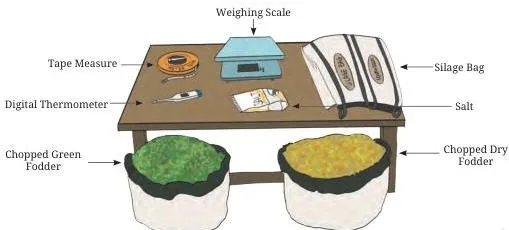
Figure 2.2 — Bhimbetka caves showing humans riding on horses — is the chapter’s proof that the human–animal bond is ancient: decorated bulls, grazing animals and humans riding horses show that domesticated animals have been our companions for more than 10,000 years (NCERT, p. 32).
When you visit the farm in Activity 1, the reflection questions ask you to look for that same bond — does the animal recognise its owner?
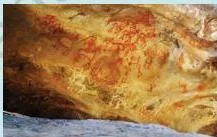
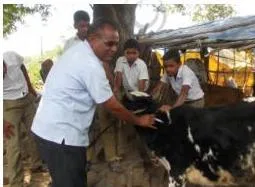
Figure 2.7, the animal vaccination drive in the community, explains why Activity 3 exists. Every year the Department of Animal Husbandry and Dairying (DAHD), under the Ministry of Fisheries, Animal Husbandry and Dairying, organises drives so livestock stay protected against bacterial and viral diseases (NCERT, p. 40).
During the activity you list common infectious diseases, the difficulties farmers face in vaccinating animals, and the yearly vaccination schedule.
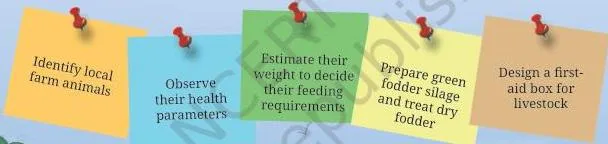
All ten activities build towards the four abilities the chapter promises on page 33:
- Identify important farm animals in your locality and record their health parameters.
- Estimate the weight of an animal from its body measurements to prepare a feeding chart.
- Prepare silage and a healthy, dry fodder mixture for farm animals.
- Design a first-aid box for livestock with homemade Ayurvedic medicines.
Keep that list in your logbook — the closing sections check it. The chapter also rewards curiosity with small facts: scientists have found that playing music in cow sheds has a calming effect and increases milk production, because the music masks the noise of farm machinery (NCERT, p. 38).
Key ideas to understand before starting the activities
These are the concepts the activities assume you already understand. Each one is short, and each one comes back inside the activities — so read them before you go to the farm.
Livestock and animal husbandry (NCERT, p. 33)
Domestic animals kept on a farm are collectively called livestock — cows, buffaloes, bulls, goats, sheep, poultry, yaks, mithun and pigs. The management and care of livestock is animal husbandry, and the chapter includes ethical farming: treating animals with respect and giving them good housing, feed, water and timely medical treatment (NCERT, p. 33).
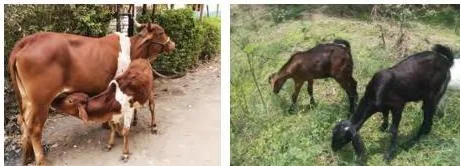
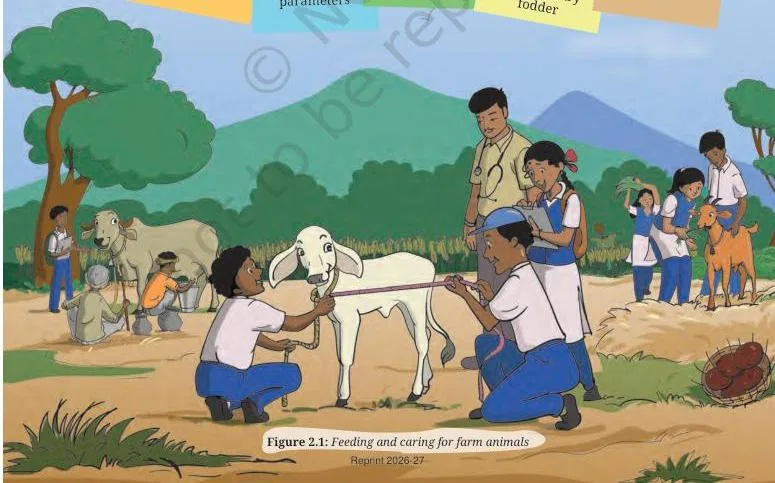
Figure 2.1, the chapter opener, shows the everyday act the whole project is about — feeding and caring for farm animals. Figure 2.3 shows the two animals you will most likely work with: cows and goats, among the most commonly found livestock in India.
The four essentials of animal care (NCERT, p. 35)
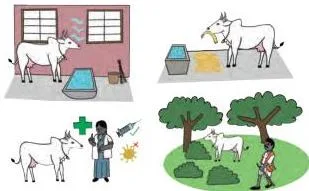
The chapter reduces animal care to four needs: proper housing (cleanliness, ventilation, shelter from weather and predators), feed (clean water and fodder), healthcare (vaccination and medicine), and a safe environment for healthy growth (NCERT, p. 35). Figure 2.5 below is that checklist in picture form — use it while you fill Table 2.1 in Activity 1.
Safety rules before you approach any animal (NCERT, p. 34)
The chapter fixes three rules before any activity, then repeats them:
- Stay calm. Farm animals get disturbed by strangers and may become aggressive — no abrupt gestures; speak to the animal and offer feed to reduce stress.
- Tie animals and keep a safe distance. Never stand behind a large farm animal — it may kick you if disturbed.
- Approach an animal only when a teacher, farmer or veterinary professional is with you, and follow their instructions.
Add internet safety: ask your teacher before uploading or downloading anything, and never share personal information (NCERT, p. 34). All farm, pet and wild animals in India are also protected under the Cruelty to Animals Act, 1960 (NCERT, p. 44).
Vital health parameters: looking without tests (NCERT, p. 43–44)
In Activity 4 you record health with the eyes alone. Check five markers: eyes bright, moist and clean; nostrils clean, wet and without discharge; skin glossy, clean and free of parasites; behaviour alert and inquisitive; appetite good, with no signs of diarrhoea (NCERT, p. 43).
Respiration rate is counted at the flank — the fleshy area between the rear leg and the last rib. Count either the falls or the rises of the flank in one minute, never both. Normal rates are 25–50 breaths per minute for cattle and 12–25 per minute for goats (NCERT, p. 43).
Body temperature is recorded by a veterinary professional only, with a digital thermometer (NCERT, p. 44).
Estimating weight: Schaeffle’s formula (NCERT, p. 45–46)
Body weight decides feed, medicine doses, productivity and selling price. A scale exists for small animals, but not always for cattle or goats — so the chapter estimates weight from body measurements, using the idea that weight = volume × density: the length and girth measurements stand in for volume (NCERT, p. 45).
\[ \text{Weight} = \text{Volume} \times \text{Density} \]
For a goat, the formula is length × girth² ÷ 600; for a cow or buffalo, ÷ 330. Length and girth are measured in inches (1 inch = 2.54 cm) and the weight comes out in kilograms. This is an indirect estimate — the animal is not standing on a scale — so it can carry a 10–15% error (NCERT, p. 45–46).
Worked example — a goat with a body length of 24 inches and a girth of 25 inches:
Step 1: Write the goat formula with the measured values: length = 24 in, girth = 25 in.
\[ \text{Weight} = \frac{24 \times 25^2}{600} \]
Step 2: Square the girth first: \( 25^2 = 625 \).
\[ \text{Weight} = \frac{24 \times 625}{600} = \frac{15000}{600} \]
Step 3: Divide.
\[ \text{Weight} = 25\ \text{kg} \]
Final answer: estimated live weight ≈ 25 kg. Allowing 10–15% error, the goat’s true weight is roughly 21–29 kg — treat the estimate as a range, not an exact value (NCERT, p. 46).
Feed planning: dry matter, concentrate and fodder (NCERT, p. 47–48)
A feeding chart starts from the animal’s type and weight. Ruminants — cow, buffalo, goat and sheep — have four-chambered stomachs and can digest low-quality grass; non-ruminants like horses, pigs and poultry cannot (NCERT, p. 47).
The daily allowance is built on dry matter (DM), the non-water portion of feed. An adult animal needs DM equal to 2–3% of its live body weight every day. That DM is split as 25% protein-rich concentrate and 75% fodder; the fodder is further split into 25% dry and 75% green.
Because green fodder is about 80% water, the green amount is multiplied by 5 — otherwise the animal stays hungry (NCERT, p. 47). Feed is given 2–3 times a day in equal quantities, say at dawn, midday and early evening.
Worked example — continue with the goat estimated at 25 kg:
Step 1: Dry matter = 3% of live weight:
\[ 25\ \text{kg} \times 3\% = 0.75\ \text{kg} = 750\ \text{g DM/day} \]
Step 2: Concentrate = 25% of DM:
\[ 750 \times 25\% = 187.5\ \text{g} \]
Step 3: Total fodder = 75% of DM:
\[ 750 \times 75\% = 562.5\ \text{g} \]
Step 4: Split the fodder — dry fodder 25%, green fodder 75%:
\[ \text{Dry: } 562.5 \times 25\% \approx 141\ \text{g} \qquad \text{Green: } 562.5 \times 75\% \approx 422\ \text{g} \]
Step 5: Actual green fodder = green amount × 5, because green fodder is 80% water:
\[ 422 \times 5 \approx 2109\ \text{g} \approx 2.1\ \text{kg of fresh green fodder} \]
Final answer: this 25 kg goat needs about 750 g DM daily — roughly 188 g concentrate, 141 g dry fodder and 2.1 kg fresh green fodder — split into 2–3 equal feeds. Compare the result with Table 2.9 and with what the animal owner actually gives (NCERT, p. 48).
Mobile apps can do this calculation for you: the Indian Council of Agricultural Research (ICAR) has a feeding chart app for milking cows and buffaloes, developed with the National Institute of Animal Nutrition and Physiology, and the Central Institute for Research on Goats (CIRG) has one for goat farming (NCERT, p. 48).
Silage: the science of preserved green fodder (NCERT, p. 49–50)
Silage is preserved green fodder made by controlled fermentation without oxygen — the book calls it a pickle of green fodder (NCERT, p. 49). Sugar in the fodder is converted into lactic acid by fermentative lactic acid bacteria, which grow only in anaerobic (oxygen-free) conditions.
As they work, the temperature rises during the first 2–8 days and the pH falls to about 4.0–3.8 within 15–20 days.
That acidity preserves the fodder — exactly how vinegar preserves a pickle. This is why every step matters: chopping to 2–3 cm lets you pack it tight, packing removes oxygen, and sealing keeps oxygen out until the lactic acid takes over. If air gets in, mould grows instead, and mouldy silage causes food poisoning, serious illness and even death (NCERT, p. 50).
Only feed the prepared silage after the farmer or animal owner approves it.
Treating dry fodder for better digestion (NCERT, p. 52)
Dry fodder fills the animal’s appetite, helps digestion and supplies minerals, but its digestibility improves when treated. Sprinkle a mix of 3% jaggery (300 g per 10 kg of fodder), 1% common salt (100 g per 10 kg) and an optional 100 g mineral mixture, dissolved in 5 L of water, over chopped straw. Heap it and cover it — the treated feed is ready in 2–3 hours (NCERT, p. 52).
Home remedies for ticks and indigestion (NCERT, p. 54–55)
Ticks and other ectoparasites feed on animal blood and spread diseases — the figure below shows why Activity 10 exists. Farmers use local herbs such as neem, lantana leaves and turmeric to prevent such parasites (NCERT, p. 54).

Another common health problem in cows and goats is indigestion. A farmers’ home remedy uses 10 betel leaves, 20 g ginger, 10 g pepper, 10 g garlic and 50 g rock salt, pounded and mixed in lukewarm water, given every 6 hours to large animals of 200 kg and above (NCERT, p. 55).
ICAR also offers mobile apps that warn of livestock disease outbreaks and identify early signs of disease (NCERT, p. 56).
The chapter’s figures, explained: flank, measurements, silage and fodder
These figures are not decoration — each one is an instruction you will follow with a stopwatch or measuring tape in hand. Work through them once before you visit the farm.
Reading the flank for respiration (Fig. 2.8, NCERT, p. 43)
The flank is the fleshy area on either side of the body, between the rear leg and the last rib. Figure 2.8 marks it on a goat and a cow.
Watch the flank rise and fall, and count only the rises or only the falls for one full minute on a stopwatch — counting both doubles the rate and gives a wrong answer.
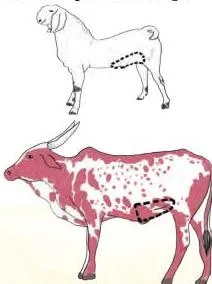
Record the result in Table 2.5. Normal cattle respiration is 25–50 breaths per minute; goats run 12–25 (NCERT, p. 43).
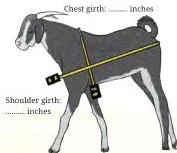
Measuring length and girth for weight (Figs. 2.9 and 2.10, NCERT, p. 45)
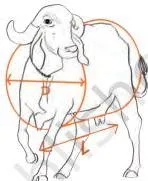
Schaeffle’s formula needs two dimensions: length (body length) and girth (the chest circumference just behind the forelegs). Figure 2.9 shows taking these measurements on a large farm animal; Figure 2.10 shows the same on a goat. Both go into the formula in inches, and the weight comes out in kilograms.
The formula exists because the animal does not stand on a scale — so expect the 10–15% error the chapter warns about (NCERT, p. 45–46).
Making silage, step by step (NCERT, p. 49–50)
Silage starts with 30–50 kg of green fodder — maize, sugarcane leaves or Napier grass. Then three actions decide success:
- Chop the fodder into 2–3 cm pieces — small pieces pack tightly, leaving fewer air pockets.
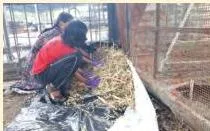
- Compact it in the bag, pressing firmly with your foot — pressing removes the oxygen that would let mould grow.
- Seal the top tightly with thread or adhesive tape, and leave it 2–3 weeks without opening, so lactic acid bacteria can lower the pH.
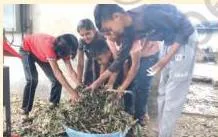
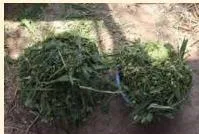
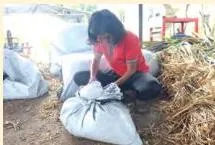
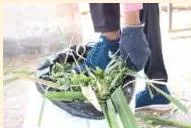
Ready silage is golden brown, free-flowing, smells pleasantly fruity and tastes mildly acidic at a pH around 4.0–4.5 — check it by adding 25 g of silage to 100 mL of water and testing the pH after 15 minutes (NCERT, p. 50).
Treating dry fodder (Step 2 and Fig. 2.12, NCERT, p. 52–53)
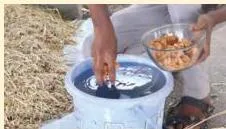
For dry fodder, the mixing happens before the fodder is spread: dissolve 3% jaggery and 1% common salt in 5 L of water, add the optional mineral mixture, then sprinkle it over chopped straw so every piece gets coated. Heap the fodder and cover it with a polythene sheet — after 2–3 hours the treated feed is ready (NCERT, p. 52–53).
A breed chosen for a purpose (Fig. 2.6, NCERT, p. 38)
Breeds are chosen for the work they do. Kasargod cattle from Kerala are a dwarf breed — about one metre tall on average — that produce high-quality milk at low maintenance cost. Siri cattle from Sikkim, Darjeeling and Bhutan have long, powerful legs for mountain work and are used as draught animals.
India ranks number one in the world for its cow and goat population, is the largest milk producer, and has 43 registered native breeds (NCERT, p. 38) — the record you build in Table 2.2 during Activity 2.
Terms defined in this project
These words repeat through the activities, and the book defines them inline as you read. Keep this glossary open while you work through the tables.
| Term | Plain definition | NCERT page |
|---|---|---|
| Livestock | Domestic animals kept on a farm, taken together — cattle, buffaloes, sheep, goats, pigs, poultry and more | p. 33 |
| Animal husbandry | The management and ethical care of livestock, including fair treatment and a healthy environment | p. 33 |
| Breeds | Types within the same kind of animal, chosen for the work they do (e.g. Kasargod dwarf cattle) | p. 38 |
| Veterinarian | A trained and certified animal doctor; the Veterinary Council of India decides how they are prepared | p. 38 |
| Gaushala | A cow shelter you can visit to observe livestock care | p. 35 |
| Dry matter (DM) | The non-water portion of animal feed | p. 47 |
| Ruminant | An animal with a four-chambered stomach — cow, buffalo, goat, sheep | p. 47 |
| Concentrate | Protein-rich feed such as grains, oil cakes and bran | p. 39 |
| Silage | Green fodder preserved by fermentation in an airtight bag — a pickle of green fodder | p. 49 |
| Ectoparasites | Ticks, mites and lice that live on the skin, feed on animal blood and spread diseases | p. 54 |
| Schaeffle’s formula | The body-measurement formula used to estimate the live weight of farm animals | p. 45 |
Mistakes to avoid while doing the project
The chapter repeats the same safety and measurement warnings again and again, because groups of 5–6 students doing real farm activities make these exact mistakes. Read this table before Activity 1.
| Mistake | What the chapter says instead | How to check yourself |
|---|---|---|
| Standing behind a large farm animal | Tie the animal, keep a safe distance, and never stand behind it — it may kick you if disturbed (NCERT, p. 34) | Stand beside the animal, near the shoulder, with the owner close by to handle it. |
| Approaching an animal without an adult handler | Interact with animals only when a teacher, farmer or veterinary professional is with you (NCERT, p. 34) | Confirm the adult handler is present before you walk towards the animal. |
| Counting both rises and falls of the flank | Count either the falls or the rises in one minute — never both (NCERT, p. 43) | Fix on one motion (say the rise), start the stopwatch, count only that for 60 seconds. |
| Using the wrong divisor or the wrong units | Goat: length × girth² ÷ 600; cow/buffalo: ÷ 330. Length and girth in inches, weight in kg (NCERT, p. 45–46) | Record measurements in inches (1 inch = 2.54 cm) and check the divisor matches the animal. |
| Treating the estimated weight as exact | The animal does not stand on a scale — the estimate can carry a 10–15% error (NCERT, p. 46) | Report the weight as a range (e.g. 21–29 kg), not a single value. |
| Forgetting the ×5 on green fodder | Green fodder is 80% water, so the green amount is multiplied by 5 — otherwise the animal feels hungry (NCERT, p. 47) | After finding the green-fodder amount, write multiplied by 5 and convert the answer to kg. |
| Opening the silage bag early, or feeding mouldy silage | Keep the bag sealed for 2–3 weeks; throw away silage with white or black mould or a bad smell — it causes food poisoning, serious illness and death (NCERT, p. 50) | Before feeding, check colour, smell and texture; when in doubt, discard and ask the owner. |
One belief the chapter tells you to investigate rather than repeat: some farmers think milk or meat becomes poisonous after vaccination. Activity 3 asks you to find the reasons behind such beliefs by asking a veterinary practitioner, and to record what you learn (NCERT, p. 41).
Completing the project: logbook, timeline and reflection
Because this is a project chapter, your submission is the project file you assemble: the observations you record in your diary or logbook, the tables you fill, and your answers to the reflection questions. The four outcomes on page 33 are the checklist.
- Work in groups of 5–6 students. Each group identifies a farmer or animal owner near the school, and takes help from veterinary professionals when needed (NCERT, p. 42).
- Keep the key artefacts: Table 2.5 health parameters, Tables 2.6–2.7 body measurements and estimated weight, Table 2.9 feeding chart, and Table 2.10 home remedies.
- Fill the timeline table on p. 57 — record how many school periods each of the ten activities took.
- Name three skills you learned from experts for the section What did I learn from others? (p. 56).
- Do the two extensions in What else can I do? (p. 57): prepare a daily feeding chart for a local animal, and make a short video or reel on folk songs and stories of the animal–human bond.
- Answer Think and Answer (p. 58): your challenges, what you would do differently, whether farm animals get proper care and technology, how the role of farm animals changed with farm machinery, and the jobs this work connects to.
The careers the chapter names from the work you just did are veterinarian, scientist, herder and farmer (NCERT, p. 58).
It also profiles India’s traditional herder communities — the Brokpas of Ladakh, Raika/Rabari of Rajasthan, Fakirani Jats of Haryana, Maldharis of Gujarat, Dhangar of Maharashtra and Kurubas of Karnataka — and suggests asking a local herder community about their lifestyle and challenges (NCERT, p. 55).
One honest note: textbook contents and the examinable syllabus are not always identical — check the current official syllabus for what is assessed from this book in your session.
For revision help on the other topics in this book, see the Class 8 vocational education notes on this site.
Project 2 in one page: outcomes and activities
If you only read one part of this page before starting the project, read this. It compresses the chapter into its four promises, ten activities and the numbers you will actually use.
- Identify important farm animals in your locality and record their health parameters (p. 33) — built by Activities 1–4.
- Estimate the weight of an animal from its body measurements to prepare a feeding chart (p. 33) — built by Activities 5–6.
- Prepare silage and a healthy, dry fodder mixture (p. 33) — built by Activities 7–9.
- Design a first-aid box for livestock with homemade Ayurvedic medicines (p. 33) — built by Activity 10.
The ten activities in one clause each:
- 1. Visit a farm and interview the owner about daily care.
- 2. Visit a veterinary clinic and record local animals and breeds.
- 3. Join a vaccination or health check-up drive.
- 4. Record the health of two animals — eyes, nostrils, skin, behaviour, appetite, respiration.
- 5. Estimate weight from length and girth.
- 6. Build a feeding chart from weight and dry matter.
- 7. Make silage from green fodder.
- 8. Treat dry fodder with jaggery and salt.
- 9. Offer the prepared feed and observe the animal’s response.
- 10. Prepare home remedies and design a first-aid box.
| Number to remember | Value | NCERT page |
|---|---|---|
| Cattle respiration rate | 25–50 breaths per minute | p. 43 |
| Goat respiration rate | 12–25 breaths per minute | p. 43 |
| Dry matter per day | 2–3% of live body weight | p. 47 |
| Concentrate | 25% of dry matter | p. 47 |
| Total fodder | 75% of dry matter | p. 47 |
| Dry fodder | 25% of total fodder | p. 47 |
| Green fodder | 75% of total fodder, then multiplied by 5 (80% water) | p. 47 |
| Goat weight formula | \( \text{Length} \times \text{Girth}^2 \div 600 \) | p. 45 |
| Cow/buffalo weight formula | \( \text{Length} \times \text{Girth}^2 \div 330 \) | p. 45 |
| Silage pH while fermenting | falls to about 4.0–3.8 in 15–20 days | p. 49 |
| Ready silage pH | about 4.0–4.5 | p. 50 |
| Silage feeding | goat/sheep 1–1.5 kg per day; cow/buffalo 10–15 kg per day | p. 50 |
| Dry fodder treatment | 3% jaggery + 1% salt (+ optional 100 g mineral mix per 10 kg) | p. 52 |
| Conversion | 1 inch = 2.54 cm | p. 45 |
Walk through the two worked examples once more — the 25 kg goat and its feeding chart — and the project’s arithmetic is done.
Related resources
This listing is maintained for the 2026-27 academic session using the NCERT textbook information available to us. NCERT remains the authority for confirming the latest edition.
Use these pages to move around the Class 8 resources on this site:
- NCERT Class 8 Kaushal Bodh book page — lists all project chapters, including the ones before and after Project 2.
- Class 8 NCERT book pages — every Class 8 subject in one place.
- Class 8 vocational education notes — revision help for the topics in this book.
- Class 8 notes hub — notes across subjects.
- CBSE notes index — the main notes directory.
- Related topic pages: Work with Life Forms notes and Work with Machines and Materials notes.
- Official NCERT textbook portal (ncert.nic.in) — open the complete Kaushal Bodh Grade 8 PDF and its official chapter files.
Sources and data verification
Plain transparency about this page’s data:
- The chapter described is Project 2, Feeding and Caring for Farm Animals, pages 31–58 of the NCERT Kaushal Bodh Grade 8 (vocational education) textbook, English medium edition.
- This page covers that one project chapter only — not the other projects in the same book, and not any other Class 8 subject book.
- It is maintained for the current academic session using the NCERT information available to us.
- NCERT settles textbooks, editions and official PDFs; CBSE settles curriculum, syllabus and examinations.
| What the chapter holds | Count | Where it is used |
|---|---|---|
| Printed pages | 28 | |
| Figures with NCERT captions | 24 | |
| Tables | 12 | |
| Official NCERT PDF | Download the chapter PDF | the chapter exactly as NCERT publishes it |




Frequently asked questions about Project 2
What is Project 2 in the NCERT Class 8 Kaushal Bodh book about?
It is the second project chapter, Feeding and Caring for Farm Animals, and it teaches animal husbandry by doing it. You visit a farm and a veterinary clinic, join a vaccination drive, record an animal’s health, estimate its weight, prepare a feeding chart, make silage and treated dry fodder, and prepare home remedies.
The chapter promises four abilities: identify farm animals and record health parameters, estimate weight from body measurements, prepare silage and dry fodder, and design a first-aid box with homemade Ayurvedic medicines (NCERT, p. 33).
How do you estimate the weight of a goat without a weighing scale?
Use Schaeffle’s formula: measure the goat’s length and girth in inches, then \( \text{Weight (kg)} = \frac{\text{Length} \times \text{Girth}^2}{600} \). For a cow or buffalo, divide by 330 instead. The result is an indirect estimate with a 10–15% error, because the animal is not standing on a scale (NCERT, p. 45–46).
Example: a goat with length 24 in and girth 25 in gives \( \frac{24 \times 25^2}{600} = 25\ \text{kg} \).
Why is silage called a pickle of green fodder?
Because the preservation works like a pickle. Green fodder is chopped, packed and sealed without oxygen, and lactic acid bacteria turn its sugar into lactic acid. The acid lowers the pH to about 4.0–3.8 within 15–20 days, and that acidity stops spoilage — just as vinegar preserves a pickle (NCERT, p. 49).
How much feed does a goat need each day, and how is the dry matter split?
An adult goat needs dry matter equal to 2–3% of its live body weight each day (NCERT, p. 47). For a 25 kg goat that is 750 g of DM: 25% as concentrate (about 188 g), 75% as fodder (about 562 g), and the fodder splits into 25% dry and 75% green. Feed is given 2–3 times a day in equal quantities.
Why is the green fodder amount multiplied by five in the feeding chart?
Because green fodder is about 80% water. Five kilograms of fresh green fodder carry only about one kilogram of dry matter, so the green-fodder amount from the dry-matter split is multiplied by 5. Skip this step and the animal feels hungry — the book compares it to drinking only fruit juice and expecting a meal (NCERT, p. 47).
What should you do if prepared silage has mould or a bad smell?
Throw it away and do not feed it to any animal. Mouldy or bad-smelling silage means air got in and the fermentation failed; feeding it can cause food poisoning, serious illness and even death (NCERT, p. 50). Open a fresh bag only after 2–3 weeks of sealed storage, and have the farmer or animal owner confirm the quality first (NCERT, p. 53).
Reference: NCERT Class 8 Kaushal Bodh (Vocational Education) textbook, chapter 2 — Feeding and Caring for Farm Animals, official edition on ncert.nic.in.
Explore Class 8 Vocational Education Books
Related chapters: