
Light: Shadows and Reflections Class 7 is Chapter 11 of the NCERT Science textbook Curiosity, printed on pages 153–168 of the official edition. The official chapter PDF is linked immediately below.
The chapter opens with Keshav on a summer vacation in the Western Ghats, watching fireflies flash in the dark and wondering whether the Moon makes its own light — that single question drives every idea the chapter teaches.
Light: Shadows and Reflections Class 7 — Official Chapter PDF
Open the official Light: Shadows and Reflections Class 7 chapter PDF (official NCERT Curiosity edition) to get the chapter exactly as printed — this is the file on ncert.nic.in, identical to pages 153–168 of the Curiosity textbook.
The rest of this page is a map of what sits inside that file — every section, the key figures, the activities and the closing exercise set, each with its NCERT page number — so you can open the chapter knowing exactly where each idea lives.
Chapter at a Glance: Sections, Figures and Activities


The table below lists how much this chapter holds — its sections, figures, activities and exercise questions, straight from the NCERT edition. Use it for the totals; the bullets that follow name each section and the page where it begins.
- 11.1 Sources of Light — p. 154
- 11.2 Does Light Travel in a Straight Line? — pp. 155–156
- 11.3 Light through Transparent, Translucent and Opaque Materials — pp. 156–157
- 11.4 Shadow Formation — pp. 157–159
- 11.5 Reflection of Light — pp. 159–160
- 11.6 Images Formed in a Plane Mirror — pp. 161–162
- 11.7 Pinhole Camera — pp. 162–163
- 11.8 Making Some Useful Items — p. 164, with 11.8.1 Periscope and 11.8.2 Kaleidoscope
The chapter then closes with these blocks: In a Nutshell (p. 165), Let Us Enhance Our Learning (pp. 165–167) and Exploratory Projects (p. 167). The Fascinating Facts boxes along the way cover shadow puppetry (p. 159), Aranmula Kannadi metal mirrors (p. 162) and sunlight’s 8 minutes 20 seconds travel time to Earth (p. 168).
What the Chapter Covers and in What Order
The chapter builds one idea on another — each section answers the question the previous one ends with. Read it in order and the connections are easy to follow.
It begins by sorting objects into luminous and non-luminous, because the Moon question from the opening story sets the whole chapter going (pp. 153–154).
It then proves that light travels in a straight line, using the matchbox-holes activity and the bent-pipe activity (pp. 155–156). This one fact is why shadows and pinhole images look the way they do.
Next it asks how much light passes through different materials. Transparent, translucent and opaque materials let light through completely, partially, or not at all — which decides the kind of shadow each one makes (pp. 156–157).
Shadows form where light cannot reach. Because light travels straight, an opaque object in its path blocks it and leaves a dark patch (pp. 157–159).
A mirror changes the direction of light — that is reflection. The chapter shows it with sunlight and with a thin beam of light (pp. 159–160).
A plane mirror forms an image that is the same size as the object, erect, not obtainable on a screen, and laterally inverted (pp. 161–162).
A pinhole camera forms an upside-down image on a screen, because light from the top and bottom of the object crosses while travelling straight through the hole (pp. 162–163).
The chapter closes by putting both ideas to work: a periscope uses two mirrors, a kaleidoscope uses three (p. 164). The exercise set that follows tests exactly these ideas (pp. 165–167).
Key Concepts Explained
The sections below take the chapter’s ideas one at a time, in the same order the book teaches them. Each is written to be read beside your open textbook — the NCERT page is given so you can follow along.
Luminous and Non-Luminous Objects: Who Emits Light?
The Sun is the Earth’s main natural source of light, but many other things also give off light of their own. This section teaches you to tell those apart from things that only shine by reflected light.
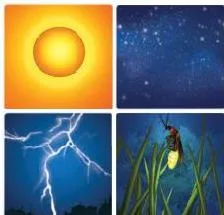
An object that emits its own light is called a luminous object. An object that does not emit its own light is called non-luminous (NCERT, p. 154). The Sun, stars, lightning, natural fire and fireflies are luminous; a mirror is not, because it only looks bright when light falls on it.
Notice what Fig. 11.1 groups together: the Sun, stars, lightning, fire and fireflies. Each emits its own light, so each is luminous. The book names the Sun as the main source of natural light on Earth (p. 154).
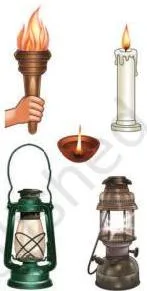
Fig. 11.2 shows fire, the earliest form of artificial lighting. Humans learned to make it, then made it from fuels such as animal fat, oil, wax and gas (p. 154).
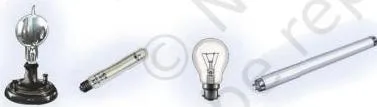
Fig. 11.3 shows electric lamps, which now meet most lighting needs (p. 154). All three figures teach the same test: does the object produce the light you see, or does it only reflect someone else’s?
Now the opening question: the Moon is a non-luminous object. It does not emit its own light; it reflects the sunlight that falls on it (p. 154).
The opening scene recalls the Grade 6 chapter ‘Beyond Earth’, which teaches that all other objects in the solar system shine only by reflected sunlight (p. 153). Mars and Venus work the same way, which is why exercise Q1 (p. 165) asks you to pick the luminous objects from a list that includes them.
The Science and Society box adds a modern example: LED lamps use much less power, are brighter and last longer than traditional lamps, and the Indian government has promoted them nationwide. At the end of their life, LEDs must be recycled or disposed of properly, not thrown in the garbage (p. 154).
Why We Know Light Travels in a Straight Line
Nearly everything else in the chapter — shadows, pinhole images, why a bent pipe hides a flame — follows from one fact: light travels in a straight line. The chapter proves it with two simple experiments.
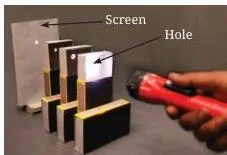
In Activity 11.1 you make a hole in the inner tray of three matchboxes at exactly the same position and arrange them in a straight line, with a torch on one side and a cardboard screen on the other (Fig. 11.4, p. 155).
As long as the three holes stay aligned, the screen shows a bright spot. Move one box slightly, breaking the line, and the spot vanishes — proof that light was travelling along that straight line.
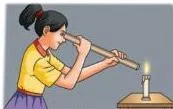
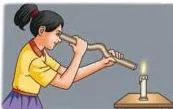
In Activity 11.2 you look at a candle flame through a long flexible pipe. The flame is visible through the straight pipe and invisible through the bent one (Fig. 11.5, p. 155). Use the candle only under adult supervision, as the book’s caution says.
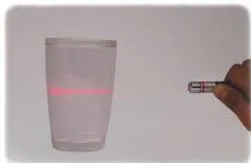
A laser-in-water option makes the same point visibly: a low-power laser beam passed through a beaker of water with a drop of milk follows a straight path (p. 156). The caution is strict — use the laser only under a teacher’s supervision, never point it at anyone’s eyes, and a low-power pointer is enough.
The chapter also flags the honest edge case: light can sometimes bend around corners. That is for higher grades; for this chapter the working rule is that light travels in a straight line (p. 156).
Transparent, Translucent and Opaque Materials: How Much Light Passes?
An object in the path of light either lets light through, stops some of it, or stops all of it. That single difference decides what kind of shadow the object makes.
The book’s conclusion from Activity 11.3 gives the three names. Light passes almost completely through transparent materials, partially through translucent materials, and not at all through opaque materials (NCERT, p. 157). Glass is the classic transparent example, tracing paper a translucent one, cardboard and thick cloth opaque ones.
In Activity 11.3 you classify everyday materials — cardboard, paper, glass, tracing paper, thick cloth — then predict in Table 11.1 whether the torch spot will reach the screen, and finally test each one. The book links this back to the Grade 6 chapter ‘Materials Around Us’, where you first met these words (p. 156).
Fig. 11.6 (p. 157) shows the setup — torch, object and screen in a line — and the Figure Walkthrough below reads it for you. The section ends with the question that starts the next one: what happens when an opaque object blocks the path of light?
Shadows: What They Need and What Changes Them
A shadow is simply the dark patch where light cannot reach. This section gives you the three things needed to see one, and the rules that control its size.
Because light travels in a straight line, an opaque object placed in its path blocks it. The dark patch on the other side, where light does not reach, is the shadow (NCERT, p. 157).
Work through Activity 11.4 and Table 11.2 and the conclusion is fixed: you need a source of light, an opaque object, and a screen to observe a shadow. The screen can be any surface — a wall, the floor or the ground (p. 158).
The book is careful about who casts shadows: opaque objects form darker shadows, translucent objects make lighter shadows, and even some transparent objects can create faint shadows (p. 157).
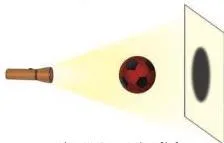
Table 11.2 also gives the rules for size and sharpness. Move the object closer to the torch and the shadow grows; closer to the screen and it shrinks. The shape, size and sharpness depend on the object’s position relative to the source and the screen (p. 158).
One thing never changes: the colour of an object does not change the colour of its shadow (p. 159).
Work it out with new numbers: a ball 10 cm from a torch and 90 cm from a wall blocks the light early in its journey, so its shadow spreads into a large blur. Move the ball to 90 cm from the torch and 10 cm from the wall, and the shadow shrinks to a small sharp patch.
Same ball, same torch — only the position changed.
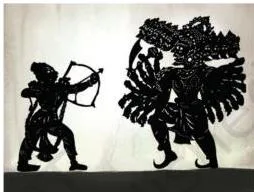
The Fascinating Facts box shows the science in action: shadow puppetry places flat cut-out figures between a light source and a screen, and moving them tells stories. Regional styles include Charma Bahuli Natya in Maharashtra, Tholu Bommalata in Andhra Pradesh and Ravana Chhaya in Odisha (p. 159).
Reflection of Light by a Mirror: Changing the Direction of Light
A normal opaque object simply blocks light. A shiny one sends some of the light off in a new direction — that is reflection, and it is why mirrors, periscopes and kaleidoscopes all work.
The book’s definition is exact: the change in the direction of light by a mirror is called the reflection of light (NCERT, p. 159).
In Activity 11.5 you let sunlight fall on a shiny steel plate or a plane mirror and turn it until a bright spot lands on a wall that sunlight does not reach directly. The spot moves as you tilt the mirror, which shows the mirror changed the light’s direction (pp. 159–160; Fig. 11.8, p. 160).
In Activity 11.6 you close all but one slit of a comb with black paper and shine a torch through it to make a thin beam along a white sheet. Place a plane mirror in the beam’s path and the beam changes direction at the mirror — reflection happens at the mirror’s surface (p. 160; Fig. 11.9, p. 160).
The student voice in the margin asks the natural question: seeing your own face in a mirror is the same reflection of light (p. 160). The next section investigates what that reflection produces.
Images in a Plane Mirror: Same Size, Erect, Laterally Inverted
When you look into a flat mirror you do not see a shadow — you see an image. That image has four fixed properties, which the chapter’s summary and exercises keep returning to.
First the words. The pen you hold in front of the mirror is the object; the similar pen that appears behind the mirror is its image (NCERT, p. 161; Fig. 11.10).
- Same size as the object (p. 161).
- Erect — upright, with the tip of the pen on top at every position (p. 161).
- Not obtainable on a screen — holding a screen behind or in front of the mirror never catches the image (p. 161).
- Laterally inverted — left appears right and right appears left (p. 162).
In Activity 11.8 you stand at different distances from the mirror and compare. Stand close and the image seems close; stand far and it seems far (p. 161; Fig. 11.11).
That is why an AMBULANCE is written in reverse on the vehicle: a driver ahead reads it correctly through the rear-view mirror, because the plane mirror laterally inverts it (p. 162). The Fascinating Facts box adds that the art of metal mirrors survives in Kerala, where the Aranmula Kannadi has been made for centuries (p. 162).
Watch the classic trap: lateral inversion swaps left and right — it does not turn the image upside down. That distinction comes back in the exercises.
Pinhole Camera: Why the Image Is Upside Down
If light travels in straight lines, a tiny hole should act like a gate and project an image. This section proves it with a candle and a piece of cardboard.
A pinhole camera is a device in which light rays from an object pass through a tiny hole and form an image on a screen (NCERT, p. 162).
In Activity 11.9 you make a small hole in a cardboard, stand it between a lighted candle and a screen in a dim room, and see the flame’s image on the screen — upside down (p. 163; Fig. 11.12). Use the candle only under adult supervision, as the caution says.
The reason is straight-line travel. Light from the top of the flame and light from the bottom both pass through the same hole and cross there, so the top of the flame lands at the bottom of the image — an inverted image.
In Activity 11.10 you build a sliding pinhole camera from two cardboard boxes, with a tracing-paper screen on the smaller one. Slide the boxes until a distant tree or building appears sharp on the paper (p. 163; Fig. 11.13).
The book makes the contrast that exercises love: a pinhole camera gives an upside-down image, while a plane mirror gives a laterally inverted image that is not upside down (p. 163).
Periscope and Kaleidoscope: Putting the Ideas to Work
The chapter’s final section takes the two ideas it has taught — straight-line travel and reflection — and builds two real devices from them.
A simple periscope is made by placing two plane mirrors in a Z-shaped box (p. 164; Fig. 11.14).
Reflection from the first mirror sends the light down the tube; reflection from the second sends it to your eye. Periscopes are used in submarines, tanks and bunkers — and, the book adds, to look ahead when standing behind taller friends.
A kaleidoscope is made from three rectangular plane mirror strips of equal width joined into a triangle and fixed inside a tube, with broken coloured bangles or beads at one end (p. 164; Fig. 11.15). Three mirrors mean reflections of reflections, so many patterns appear — and a different one every time you turn the tube.
Designers and artists use kaleidoscopes for pattern ideas.
Exercise Q11 (p. 167) asks whether a bent tube with two small mirrors can serve as a periscope — the answer follows from what the Z-shape does.
Reading the Chapter’s Diagrams: What Each One Shows
The diagrams in this chapter are not decoration — each one records an experiment or a result, and several exercise questions ask about them directly. Here is what to notice in each key figure.
Notice that the holes in the three matchboxes, the torch and the screen all sit at the same height, in one straight line. That is the point: the bright spot reaches the screen only while the holes stay aligned, and moving any box breaks the line (p. 155).
Part (a) shows the flame visible through the straight pipe; part (b) shows the same flame hidden once the pipe is bent. Light entering the pipe from the flame cannot turn the corner to reach your eye (p. 155).
This is the Activity 11.3 setup: torch on one side, screen on the other, and the material under test between them. What you see on the screen tells you whether the material is transparent, translucent or opaque (p. 157).
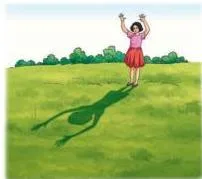
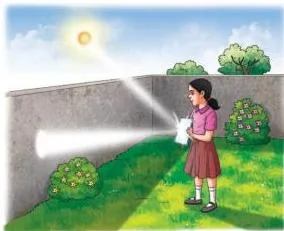
Every shadow in this figure is a dark patch where an object blocked the Sun’s light. The Sun is the source, the person or object is the opaque object, and the ground is the screen — the same ingredients needed for any shadow (p. 157).
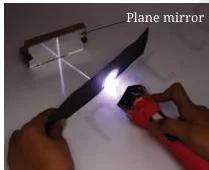
Part (a) shows the thin beam made by shining a torch through a single comb slit. In part (b) the beam reaches a plane mirror and leaves along a new direction — the path changes at the mirror and nowhere else (p. 160).
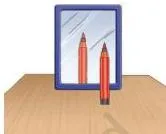
The pen in front is the object, and the pen that appears behind the glass is its image. They are the same size, the image is erect, and it cannot be captured on a screen placed anywhere around the mirror (p. 161).
Light from the flame passes through the tiny hole in the cardboard and lands on the screen as an inverted image — part (b) of the figure shows the result. Trace the straight lines: flame top goes to image bottom, flame bottom goes to image top, because both pass through the same hole (p. 163).
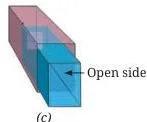
Two cardboard boxes slide inside each other — the larger carries the pinhole, the smaller the tracing-paper screen. Sliding the smaller box forward or backward sharpens the image of a distant tree or building (p. 163).
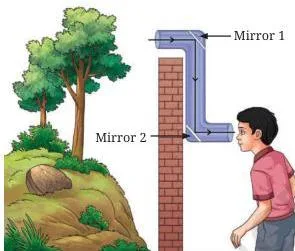
Follow the light’s journey in this figure: it enters the top opening, reflects off the first mirror down the tube, reflects off the second, and reaches your eye. Two reflections make an otherwise hidden object visible (p. 164).
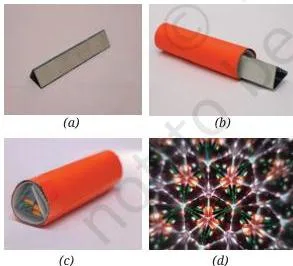
Three equal-width mirrors meet as a triangle inside the tube, so the coloured bangle pieces at one end are reflected again and again. Each turn produces a different pattern, which is why designers and artists use kaleidoscopes for pattern ideas (p. 164).
Definitions to Remember from This Chapter
The chapter introduces a small set of terms, and exam answers are expected to use them with their precise meanings. The table below is for quick checking during revision.
| Term | What it means | NCERT page |
|---|---|---|
| luminous | Emits light of its own, like the Sun, stars, fire and fireflies | p. 154 |
| non-luminous | Does not emit its own light; only reflects light that falls on it — the Moon is the book’s example | p. 154 |
| transparent | Lets light pass almost completely through | p. 157 |
| translucent | Lets light pass only partially through | p. 157 |
| opaque | Does not let light pass through at all | p. 157 |
| shadow | The dark patch where light does not reach because an object blocked it | p. 157 |
| reflection of light | The change in the direction of light by a mirror or shiny surface | p. 159 |
| image | The similar object that appears behind a mirror when an object is in front of it | p. 161 |
| erect | Upright — the image is not inverted | p. 161 |
| lateral inversion | The left-right reversal in a plane mirror image: left appears right, right appears left | p. 162 |
| pinhole camera | A device in which light from an object passes through a tiny hole and forms an image on a screen | p. 162 |
Use this table for checking, not for isolated memorising — each term matters because a later section builds on it.
The Activities and What Each One Proves
Nearly every claim in this chapter is built from a hands-on activity. Remembering which activity proves which claim is the fastest way to answer activity-based questions.
| Activity | What you do | What it proves |
|---|---|---|
| 11.1 (p. 155) | Make matching holes in three matchboxes, align them between a torch and a screen, then displace one box | Light travels in a straight line |
| 11.2 (p. 155) | View a candle flame through a straight flexible pipe, then through the same pipe bent | Light travels in a straight line |
| 11.4 (pp. 158–159) | Change the object’s position, remove the screen or torch, tilt the object, change its colour, and observe the shadow each time | A shadow needs a source, an opaque object and a screen; position changes its size and sharpness; colour changes nothing |
| 11.5 (p. 159) | Redirect sunlight with a shiny steel plate or plane mirror onto a wall | A shiny surface changes the direction of light — reflection |
| 11.9 (p. 163) | Pass a candle flame’s light through a tiny hole in cardboard onto a screen | Light through a tiny hole forms an upside-down image |
Other activities make the same ideas concrete: classifying materials with a prediction-then-observation table (Activity 11.3, p. 156), making a thin light beam with a comb slit (Activity 11.6, p. 160), observing a pen’s image and your own image in a plane mirror (Activities 11.7 and 11.8, pp. 161–162), building the sliding pinhole camera (Activity 11.10, p. 163), and constructing a periscope and a kaleidoscope (p. 164).
Mistakes Students Make in This Chapter — and the Corrections
Most lost marks in this chapter come from repeated misreads, and the textbook itself supplies every correction. The chapter’s ‘In a Nutshell’ summary on p. 165 backs each rule below.
| Mistake | Correct rule | How to check your answer |
|---|---|---|
| Calling the Moon, Mars, Venus or a mirror luminous because they look bright | Only objects that emit their own light are luminous; the Moon and planets reflect sunlight (p. 154) | Ask: would this object still glow in a dark room with no light source at all? The Moon would not. Exercise Q1 (p. 165) tests this. |
| Believing only opaque objects cast shadows | Opaque objects make darker shadows, translucent ones make lighter shadows, and even some transparent objects can make faint shadows (p. 157) | Repeat Activity 11.3 with tracing paper in the beam — a faint shadow still appears. |
| Expecting a shadow to take the object’s colour | Changing the colour of an opaque object never changes the colour of its shadow (p. 159) | Colour a ball and watch its shadow — it stays a dark patch. |
| Expecting a plane mirror image to appear on a screen | The image appears behind the mirror and cannot be obtained on a screen (p. 161) | Hold paper behind and in front of the mirror — the image never lands on it. |
| Confusing lateral inversion with an upside-down image | A mirror swaps left and right (lateral inversion, p. 162); a pinhole camera inverts the image (p. 163) — two different effects | Raise your left hand before a mirror: your image raises its right hand yet stays upright. Q10 (p. 167) tests this distinction. |
| Reversing the shadow-size rule | The shadow grows when the object moves closer to the torch and shrinks when it moves closer to the screen (p. 158) | Repeat Activity 11.4 and watch which way the shadow changes. Q5 (p. 166) tests the rule. |
How the Exercise Questions Test These Ideas
The questions that close this chapter each test one of the ideas above. Know which question uses which idea, and revision becomes much faster.
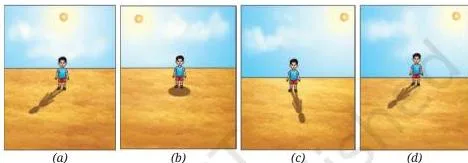
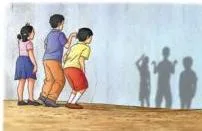
Question 4 shows four arrangements of a boy, a light source and a screen. Choose the one where the boy stands between the source and the screen: light travels straight from the source, the boy’s body blocks it, and the dark patch lands on the screen. Where the boy stands beside or behind the screen, no shadow can form on it.
| Question | What it tests | Page |
|---|---|---|
| Q1 | Luminous vs non-luminous — the Sun and Pole Star are luminous; the Moon, Mars, Venus and a mirror are not | p. 165 |
| Q2 | Matching — pinhole camera, opaque object, transparent object and shadow with their descriptions | p. 165 |
| Q3 | Straight-line travel — only the straight pipe lets the candle flame be seen (Fig. 11.16) | p. 165 |
| Q4 | Shadow formation — the boy must stand between the light source and the screen (Fig. 11.17) | p. 166 |
| Q5 | Shadow-size rule — the ball closer to the torch makes the larger shadow | p. 166 |
| Q6 | Shadow-size rule — match each torch position to the shadow it produces, as Activity 11.4 showed | p. 166 |
| Q7 | Pinhole camera — the image of the tree is upside down (Fig. 11.19) | p. 167 |
| Q8 | Lateral inversion — your name appears reversed in a plane mirror | p. 167 |
| Q9 | Source position and shadow length — the shadow is shortest at midday, when the Sun is high | p. 167 |
| Q10 | Lateral inversion — the mirror image is laterally inverted (true), and symmetric letters like T and O look unchanged (true); the correct option is (i) | p. 167 |
| Q11 | Periscope — two plane mirrors fixed in a bent tube can work as a periscope (Fig. 11.20) | p. 167 |
| Q12 | Shadow sharpness — a distant object casts a faint, spread-out shadow | p. 167 |
Apply the size rule with new numbers. A ball 20 cm from a torch and 80 cm from a wall casts a large, blurred shadow, because the light spreads widely before reaching the wall.
Move the ball to 80 cm from the torch and 20 cm from the wall and the shadow becomes small and sharp. Only the position changed — which is the whole point of the rule on NCERT p. 158.
One honest note: textbook contents and the examinable syllabus are not always identical. Check the current official CBSE syllabus to see what is examinable this session — no question here is promised to appear in any exam.
In a Nutshell: the Chapter’s Own Summary, Rephrased
The book closes the chapter with a seven-point summary, and those seven points are the whole chapter. Here they are in working vocabulary.
- Luminous objects emit their own light; non-luminous objects only reflect light that falls on them (p. 154).
- Light travels in a straight line — shown by the matchbox and bent-pipe activities (p. 155).
- Transparent materials let light pass almost completely, translucent ones partially, opaque ones not at all (p. 157).
- A shadow forms where light is blocked: opaque objects make darker shadows, translucent ones lighter shadows, and some transparent objects make faint shadows (p. 157).
- Reflection of light is the change in the direction of light by a mirror (p. 159).
- A plane mirror image is the same size as the object, erect, not obtainable on a screen, and laterally inverted (p. 161).
- A pinhole camera creates an inverted image of an object on a screen (p. 163).
Revise in the chapter’s own order — sources, straight-line travel, materials, shadows, reflection, images, pinhole camera, applications — because each step explains the next.
Related Chapters and Resources
This listing is maintained for the 2026-27 academic session using the NCERT textbook information available to us. NCERT remains the authority for confirming the latest edition.
This chapter sits inside the Class 7 Science textbook Curiosity, and it reaches back to two Grade 6 chapters the book itself names: ‘Beyond Earth’ (p. 153), where the Moon’s reflected light is first taught, and ‘Materials Around Us’ (p. 157), where transparent, translucent and opaque materials are first classified.
- Class 7 Science notes — organised chapter by chapter
- Class 7 notes hub — the Class 7 landing page for notes
- the CBSE notes library — other classes and subjects
- Earth, Moon and the Sun notes — the chapter where sunlight and the Moon’s reflected light are covered
- Life processes in plants notes — another chapter of the same Class 7 Science book
For anything you want to verify, the official NCERT portal at ncert.nic.in hosts the current edition of Curiosity; the chapter PDF linked at the top of this page is from that same source.
| What the chapter holds | Count | Where it is used |
|---|---|---|
| Printed pages | 16 | |
| Sections in the chapter | 10 | |
| Figures with NCERT captions | 30 | |
| Tables | 4 | |
| Activities | 5 | |
| Official NCERT PDF | Download the chapter PDF | the chapter exactly as NCERT publishes it |
Reference: NCERT Class 7 Science textbook (Curiosity), chapter 11, official edition on ncert.nic.in.
Sources and Data Verification
This page describes the NCERT Class 7 Science textbook Curiosity, Chapter 11 ‘Light: Shadows and Reflections’, official edition on ncert.nic.in, printed pages 153–168.
Section titles, activity names, figure captions and page numbers come from that same NCERT edition. This page covers this textbook only, not every Class 7 science resource.
The listing is maintained for the current academic session using the NCERT information available to us.
NCERT settles textbooks, editions and official PDFs; CBSE settles the curriculum, syllabus and examinations. A chapter appearing in this book does not by itself prove it is examinable this session — check the current official CBSE syllabus.
Frequently Asked Questions about Light: Shadows and Reflections
Quick answers to the questions students most often search after studying this chapter.
Is the Moon a luminous object?
No. The Moon is a non-luminous object — it does not emit its own light and only reflects the sunlight that falls on it (NCERT, p. 154).
Why is the image in a pinhole camera upside down?
Because light travels in a straight line. Light from the top of the flame and light from the bottom pass through the same tiny hole and cross there, so the top of the flame lands at the bottom of the image (NCERT, p. 163).
Why is AMBULANCE written backwards on ambulances?
So that drivers ahead can read it correctly in their rear-view mirrors. A plane mirror laterally inverts the word — left appears right — which turns the reversed spelling back into a readable one (NCERT, p. 162).
Does the colour of an object change the colour of its shadow?
No. A shadow is a dark patch where light is blocked, so changing the object’s colour changes nothing about the shadow (NCERT, p. 159).
What three things are needed to see a shadow?
A source of light, an opaque object and a screen. The screen can be any surface — a wall, the floor or the ground (NCERT, p. 158).
Why does a high-flying bird not cast a visible shadow on the ground?
Because a shadow’s sharpness depends on the object’s position. A bird high in the sky is far from the ground, so its shadow is faint and spread out; when the bird swoops close to the ground the shadow becomes clear. The book raises this as exercise Q12 (p. 167).
Explore Class 7 Science Books
Related chapters: