
Looking for The World of Metals Class 7 NCERT Science Chapter 4 PDF? It is right here. This chapter comes from the NCERT Class 7 Science textbook Curiosity, where it is headed “The World of Metals and Non-metals”, and it is the chapter that builds a full comparison of how metals and non-metals behave.
Below the download you will find a plain-language walkthrough of the chapter: every property, the activities that prove them, the rusting experiment, the oxide test, and what the exercise section at the end demands of you.
Download The World of Metals Class 7 Chapter PDF
Download the NCERT Class 7 Science The World of Metals chapter PDF (official Curiosity edition) from the NCERT textbooks portal — this is the full chapter exactly as published, with every activity and figure, so you can read or zoom it without hunting for a scanned copy.
The file is the complete chapter from the official NCERT Class 7 Science Curiosity textbook — nothing added, nothing cut.
Chapter 4 at a Glance: What Is Inside the PDF
The table with this section shows how much the chapter holds — its sections, figures, activities and tables — so you can judge its size before you start reading. In order, the chapter:
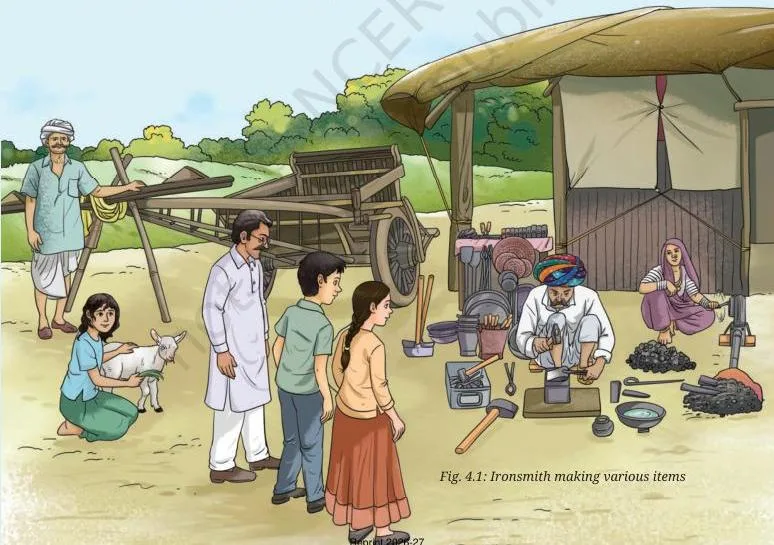
- opens with Yashwant and Anandi visiting an ironsmith, Sudarshan, who heats and hammers iron into tools (NCERT, p. 41);
- builds the metal properties one by one — metallic lustre, hardness, malleability, ductility, sonority, and conduction of heat and electricity (pp. 42–48);
- pauses on the impact of iron on Indian civilisation and why copper and gold were used before iron (p. 44);
- tests the effect of air and water on iron, ending with rusting, corrosion and the Iron Pillar of Delhi (pp. 48–50);
- compares what metals and non-metals form when they burn — basic metal oxides and acidic non-metal oxides (pp. 51–53);
- shows that non-metals are essential in daily life and explains what makes a substance an element (pp. 53–54);
- closes with the “In a Nutshell” summary, the “Let Us Enhance Our Learning” exercises, a Science and Society note on alloys and recycling, and the Exploratory Projects (pp. 54–56).
What This Chapter Covers: From the Ironsmith’s Shop to Everyday Non-metals
The chapter is built like a lesson in one shop: every definition comes out of an observation you can do yourself. That is why the story of the ironsmith matters — heating, hammering, flattening and cutting are the first experiments of the chapter.
- The ironsmith’s shop (p. 41). Sudarshan heats an iron block until it is red hot and beats it into an axe. His answer to “why are you beating it?” — “to shape it into an axe” — sets up malleability.
- Properties through activities (pp. 42–48). Activities 4.1 to 4.4 introduce malleability, brittleness, ductility, sonority, heat conduction and electrical conduction, in that order.
- A short history of iron (p. 44). The Harappans used copper and gold but rarely iron; when iron tools finally arrived, iron ploughs advanced agriculture.
- Air + water = rust (pp. 48–50). The three-bottle experiment shows that moist air corrodes iron, and the Iron Pillar of Delhi appears as a rust-resistant counter-example.
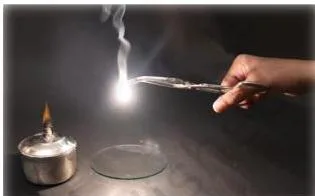
- Two burning tests (pp. 51–53). Magnesium burns to a white powder whose solution is basic; sulfur burns to a gas that dissolves to an acidic solution.
- Non-metals matter (pp. 53–54). Oxygen, carbon, nitrogen, chlorine and iodine are everyday non-metals, and metals and non-metals are both sub-classes of elements.
- Closing sections (pp. 54–56). “In a Nutshell” restates the chapter’s key results; the exercises and Exploratory Projects turn the properties into questions and projects.
Key Concepts: The Properties That Define Metals and Non-metals
One method runs through the whole chapter: watch what metals and non-metals do when they are hammered, dropped, heated, put into a circuit, exposed to air and water, or burned. The observations, not the names, decide which class a substance belongs to. Each property below is restated more plainly than the book does, with its page.
The Five Properties of a Metal — and the Two Exceptions
A metal in this chapter is a material that is generally lustrous, hard, malleable, ductile, sonorous, and a good conductor of heat and electricity. Non-metals like coal, sulfur and oxygen fail most of these tests. Before the checklist, the book enters two exceptions that often appear in exercises (NCERT, p. 43):
- Sodium and potassium are so soft that they can be cut with a knife.
- Mercury is a metal found in a liquid state at room temperature — the one you have seen in thermometers.
These exceptions matter because “metals are hard and solid” is a general statement, not a definition. A substance is classified as a metal by its whole set of properties, not by any single one.
Malleability and Ductility: Beating and Drawing
These are the two properties that let metals change shape without breaking — and they are the reason the chapter begins with a hammer (NCERT, pp. 42–44).
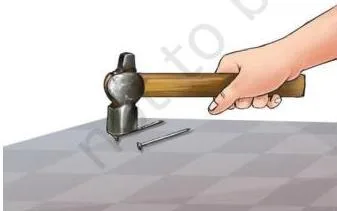
- Malleability is the property of being beaten into thin sheets. Silver foil on sweets and the aluminium foil used for wrapping food exist because of it. Gold and silver are the most malleable metals (p. 43).
- Ductility is the property of being drawn into wires. Copper and aluminium wires, metal-wire ornaments, and the strings of veena, sitar, violin and guitar all depend on it (p. 44).
Coal and sulfur are brittle: they break into pieces when hammered. Wood is the third case — it neither flattens into a sheet nor breaks, so it is neither malleable nor brittle (p. 43). Steel ropes, made from steel wires, are so strong that they support suspension bridges and crane loads (p. 44).
Worked example (try it with new numbers): the book states that one gram of gold can be drawn into a 2 km-long wire (NCERT, p. 44).
Mass and wire length are in direct proportion, so:
\[ 1\ \text{g} \rightarrow 2\ \text{km}, \quad \text{so} \quad 5\ \text{g} \rightarrow 5 \times 2 = 10\ \text{km} \]
Reverse it: to make a 5 km gold wire you need \( 5 \div 2 = 2.5\ \text{g} \) of gold.
Answer: 5 g of gold can be drawn into a 10 km wire, and 2.5 g gives a 5 km wire.
Sonority: The Ringing-Sound Test
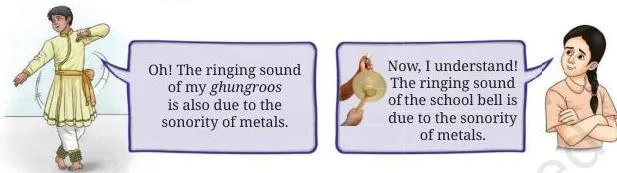
Drop a metal spoon and a piece of coal from the same height and your ears classify them instantly. The metal rings; the coal thuds. That ringing quality is sonority, and metals are described as sonorous (NCERT, pp. 45–46).
The chapter grounds the test in a real use: a visually impaired person explains that she tells whether her stick has hit wood or metal by the difference in sound — using sonority to find her way (p. 45).
Why Metals Conduct Heat and Electricity
These two activities share one idea: some materials let energy move through them, and some stop it. Metals are on the “lets it move” side for both heat and electricity. A conductor is any material that lets heat or electricity flow through it easily; a poor conductor blocks them, which is why poor conductors work as safety barriers (NCERT, pp. 46–48).
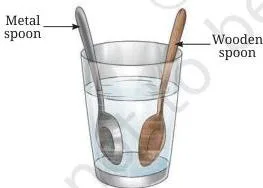
- Heat — Activity 4.3: a metal spoon and a wooden spoon of the same size are dipped into the same hot water. The metal spoon’s upper end becomes hotter. Metals are good conductors of heat; wood is a poor conductor of heat (pp. 46–47). This is why cooking vessels are metal while their handles are wood — the handle stays cool enough to touch.
- Electricity — Activity 4.4: the tester circuit from the chapter Electricity: Circuits and their Components glows with aluminium, iron and copper, but not with sulfur, coal, wood, stone, rubber or nylon (pp. 47–48). That is why the plastic covering on a screwdriver and an electrician’s rubber gloves and shoes protect against shock — poor conductors block the current.
The book notes that you will study heat conduction further in the chapter “Heat Transfer in Nature” (p. 47).
Rusting and Corrosion: What Damages Metals
Iron objects left in the open grow a brown deposit. The chapter’s central experiment, Activity 4.5, finds the exact conditions that cause it, using three bottles and three iron nails (NCERT, pp. 48–49).
| Bottle | What is in it | What reaches the nail | Result |
|---|---|---|---|
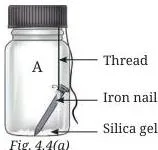
| A | Iron nail + silica gel (dries the air), tightly capped | Dry air only — no water | No rust |
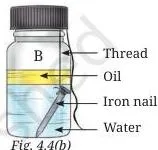
| B | Nail fully dipped in freshly boiled and cooled water, sealed with an oil layer | Water only — no air | No rust |
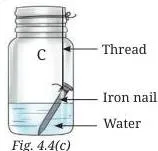
| C | Nail partially dipped in water, bottle left open | Both air and water (moist air) | Brown rust appears |
Bottle A isolates dry air — the silica gel absorbs moisture. Bottle B isolates water — boiling removes gases dissolved in it, and the oil layer stops fresh air from dissolving in. Bottle C keeps the nail half in water and half in air.
Only C rusts, so the conclusion is: both air and water together — moist air — are needed for rusting (p. 49).
The brown deposit is rust, and the process of forming it on iron is rusting. The wider word is corrosion — the gradual deterioration of a metal surface caused by air, water or other substances. Copper develops a green coating and silver a black one (pp. 49–50).
Rusting is costly: the book says an enormous amount of money is spent every year in India to replace or repair iron structures damaged by rust (p. 50). The prevention methods named are painting, oiling, greasing, and galvanisation — a protective layer of zinc over the iron (p. 50).
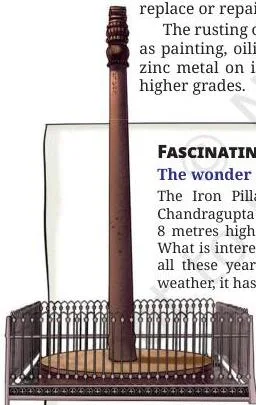
The counter-example is the Iron Pillar of Delhi: made in the time of Chandragupta II more than 1600 years ago, about 8 metres tall and weighing over 6000 kilograms, it has barely any rust despite centuries of wind and rain (p. 50).
Metal Oxides Are Basic, Non-metal Oxides Are Acidic
Burn a metal and a non-metal, dissolve what forms in water, and test with litmus — the results separate the two classes chemically (NCERT, pp. 51–53).
- Activity 4.6 — magnesium (p. 51): a cleaned magnesium ribbon burns with a dazzling white flame, leaving a white powder, magnesium oxide. Its solution turns red litmus paper blue, so it is basic. Generally, metal oxides are basic. The book adds that sodium is stored in kerosene because it reacts vigorously with oxygen and water — kerosene keeps moisture and air away.
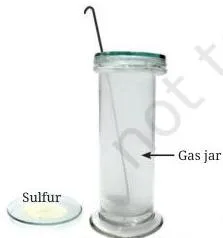
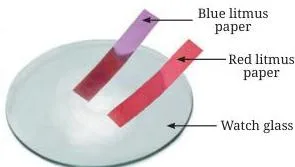
- Activity 4.7 — sulfur (pp. 52–53): burning sulfur forms sulfur dioxide gas; dissolved in water it gives sulfurous acid, which is acidic on an indicator. Non-metal oxides are acidic.
- Activity 4.8 — sulfur in water (p. 53): unlike metals, sulfur simply does not react with water. Phosphorus is stored in water because it catches fire in air.
The full list of non-metal behaviours completes the picture: usually soft, dull in appearance, neither malleable nor ductile, not sonorous, and poor conductors of heat and electricity (p. 53).
The chapter says the burning of magnesium will be discussed further in the chapter Changes Around Us: Physical and Chemical (p. 51).
Non-metals in Everyday Life — and What an Element Is
Metals are easy to notice; this section stops you from concluding that non-metals are unimportant (NCERT, pp. 53–54).
- Oxygen — we breathe it; without it we could not survive.
- Carbon — the building block of all life forms; a key component of proteins, fats and carbohydrates.
- Nitrogen — used in manufacturing fertilisers and essential for the growth of plants.
- Chlorine — commonly used in water purification.
- Iodine — its solution is applied on wounds as an antiseptic.
Then comes the classification point (p. 53): metals and non-metals are both sub-categories of elements, and an element is a substance that cannot be broken down into simpler substances. This is why plastic, glass, wood, rubber and paper are not classified as metals or non-metals — they are not elements.
The book adds that 118 elements are known, some naturally occurring and some made in laboratories.

The “Science and Society” note beside this image defines an alloy as a mixture of two or more metals, or of a metal and a non-metal (p. 54) — steel, iron plus carbon, is the chapter’s example.
The same note adds that special metals such as zirconium (atomic energy) and titanium (aerospace) matter to modern technology, and that iron and aluminium are recycled in India to reduce waste.
Activity Map: Which Activity Proves Which Property
If you revise only one part of this chapter, make it this table — it connects every activity the book asks you to do to the single property it proves.
| Activity | What you do | What you observe | Property or idea it proves | NCERT page |
|---|---|---|---|---|
| 4.1 | Beat copper, aluminium, an iron nail, coal, sulfur and wood with a hammer | Metals flatten; coal and sulfur break into pieces; wood does neither | Malleability of metals; brittleness of coal and sulfur | p. 42 |
| 4.2 | Drop a metal spoon, a coin, coal and wood from a height | Metal objects give a ringing sound; coal and wood give dull sounds | Sonority — metals are sonorous | p. 45 |
| 4.3 | Dip a metal and a wooden spoon of the same size into hot water | The metal spoon’s upper end becomes hotter than the wooden one | Metals are good conductors of heat; wood is a poor conductor | p. 46 |
| 4.4 | Test materials one by one in the tester circuit | Bulb glows for aluminium, iron and copper; not for sulfur, coal, wood, stone, eraser or nylon | Metals are good conductors of electricity | p. 47 |
| 4.5 | Keep iron nails in three bottles: A dry air, B water only, C air and water | Rust appears only in bottle C | Rusting needs both air and water — moist air | p. 49 |
| 4.6 | Burn a magnesium ribbon; dissolve the white ash in water; test with litmus | Dazzling white flame; the solution turns red litmus blue | Metal oxides are basic | p. 51 |
| 4.7 | Burn sulfur in a deflagrating spoon; dissolve the gas in water; test | The solution is acidic | Non-metal oxides are acidic | p. 52 |
| 4.8 | Add water to sulfur powder in a glass tumbler | No reaction takes place | Non-metals generally do not react with water | p. 53 |
Figure Walkthrough: Reading NCERT’s Diagrams in This Chapter


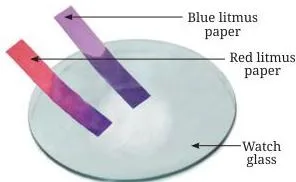
NCERT uses pictures to make each property visible. Look for four things while reading: heat before hammering, the same water in both spoons, the single rusted nail, and the opposite litmus results.
Figures That Build the Idea of a Metal
Fig. 4.1 is the chapter’s opening scene. Read it for the sequence: the iron is heated in the furnace first, then beaten. The exercises ask why heating matters — the story’s answer is that red-hot iron is the iron that can be shaped.
Fig. 4.2 shows Activity 4.1 in action: the nail flattens instead of shattering. That flattening is malleability made visible.
The strainer is the everyday proof of ductility: a metal was drawn into wire, then woven. Coal or sulfur could never be shaped this way.
This image sits beside Activity 4.2. The picture is about your ears: the same drop makes metal ring and wood thud.
Fig. 4.3 is a controlled comparison: same water, same time, same spoon size — only the material differs. The metal spoon’s far end gets hot; the wooden one does not. That one difference is the whole lesson on heat conduction.
Figures That Show Rusting and Oxide Behaviour
Bottle A isolates dry air — the silica gel pouch dries the air inside. No water, no rust.
Bottle B isolates water — boiling drove out dissolved gases, and the oil layer stops air from re-entering. No air, no rust.
Bottle C keeps the nail half in water, half in air, with the bottle open. Only here does the brown deposit appear. Read the three images as one experiment: each of the first two bottles removes one condition, and only the bottle with both conditions fails.
The pillar is the chapter’s real-life proof that rusting can be resisted. The facts to quote: made in the time of Chandragupta II, more than 1600 years old, about 8 metres tall, over 6000 kilograms, and almost rust-free despite centuries of weather (p. 50).
The companion image makes the same point at close range: the metal has stayed almost clean, which tells us about the metal-working skill developed in ancient India.
Fig. 4.5 belongs to Activity 4.6. The white powder left behind is magnesium oxide, formed by the reaction of magnesium with oxygen in the air.
Fig. 4.6 shows the litmus result: red litmus turns blue, so the solution is basic. This one observation is the evidence for “metal oxides are basic.”
Fig. 4.7(c) shows sulfur burning in a long-handled deflagrating spoon inside a covered gas jar, so the gas is trapped. The gas formed is sulfur dioxide.
Fig. 4.7(d) is the mirror image of Fig. 4.6: the indicator shows an acidic solution — for litmus, that means blue turns red. The same litmus logic that proved metal oxides basic now proves non-metal oxides acidic: the opposite result in the two figures.
Key Terms and Definitions: What Each Word Means
These are the exact words the chapter uses. Each is restated so you can answer any definition question in your own words.
| Term | Meaning | NCERT page |
|---|---|---|
| Metal | A material that is generally lustrous, hard, malleable, ductile, sonorous, and a good conductor of heat and electricity; examples: iron, copper, aluminium, gold | p. 43 |
| Non-metal | A material that is usually dull, soft, brittle, not sonorous, and a poor conductor of heat and electricity; examples: oxygen, sulfur, carbon | p. 53 |
| Metallic lustre | The shine shown by metals | p. 43 |
| Malleability | The property of being beaten into thin sheets | p. 43 |
| Ductility | The property of being drawn into wires | p. 44 |
| Brittleness | Breaking into pieces when hammered; coal and sulfur are brittle | p. 43 |
| Sonority / sonorous | The property of producing a ringing sound when struck; metals are sonorous | p. 46 |
| Good / poor conductor of heat | Lets heat pass through easily (metals), or does not (wood) | pp. 46–47 |
| Good / poor conductor of electricity | Lets electric current flow through easily, or blocks it | p. 48 |
| Rust | The brown deposit that forms on iron in moist air | p. 49 |
| Rusting | The process by which rust forms on objects made of iron | p. 49 |
| Corrosion | The gradual deterioration of a metal surface caused by air, water or other substances; examples: green coating on copper, black coating on silver | p. 50 |
| Element | A substance that cannot be broken down into simpler substances; 118 are known | p. 53 |
| Alloy | A mixture of two or more metals, or of a metal and a non-metal; steel (iron + carbon) is an example | p. 54 |
Common Mistakes Students Make in This Chapter
Most lost marks in this chapter come from six fixed ideas that the chapter explicitly corrects. Read them before the exercise section, not after.
| Mistake | Correct rule | How to check your answer |
|---|---|---|
| “Wood breaks when hit, so it is brittle.” | Wood neither flattens into a sheet nor breaks into pieces — it is neither malleable nor brittle (NCERT, p. 43). | Ask: did the material break into pieces? Coal and sulfur do; wood does not. |
| “All metals are hard and solid.” | Sodium and potassium can be cut with a knife, and mercury is a liquid at room temperature (p. 43). | Recheck the chapter’s own exceptions before writing “all metals…” |
| “Rust forms in water alone or in air alone.” | Both air and water together — moist air — are needed (p. 49). | Recall the three bottles: A dry air → no rust; B water only → no rust; C both → rust. |
| “Metal oxides turn blue litmus red.” | Reversed: metal oxides are basic, so magnesium oxide turns red litmus blue (p. 51); non-metal oxides are acidic (pp. 52–53). | Exercise Q3(ii) tests exactly this reversal (p. 55). Remember: basic → red litmus turns blue. |
| “Copper vessels are used for cooking because copper conducts electricity.” | The property that matters for cooking is conduction of heat, not electricity (p. 55, Q3(iv)). | Ask what the vessel actually needs to do — transfer heat to the water. |
| “Plastic, glass, wood, rubber and paper are non-metals.” | They are not elements, and only elements are classified as metals or non-metals (p. 53). | Check the definition first: is the substance an element? |
How the Exercises Test You: Question Types and Exam Notes
The “Let Us Enhance Our Learning” section rewards students who connect each property to a use. Memorised sentences will not get you far; the questions make you apply one property to a situation.
| Question type | What it demands | Which questions | What a full answer must include |
|---|---|---|---|
| Identification (multiple-choice) | Pick the metal a fact describes | Q1 (food packaging metal — aluminium), Q2 (metal that catches fire with water — sodium) | The correct option, and for Q2 the reason sodium is stored in kerosene |
| True or false with reasons | Judge a statement and justify it | Q3, all four parts | The word True or False plus a reason drawn from a property of the chapter |
| Matching | Decode jumbled names of elements | Q5 | Wire each use to the correct element |
| Reasoning | One property decides a use | Q4 (jewellery), Q8 (pan for boiling), Q9 (nail in oil), Q10 (properties to uses), Q11 (sulfur as a coating), Q12 (heating iron) | Name the property first, then apply it — the reason earns the mark, not the answer alone |
The true-or-false traps in Q3 are worth pinning down now: Q3(i) is False — aluminium and copper are metals, not non-metals; Q3(ii) is False — the oxide solution turns red litmus blue, because metal oxides are basic (p. 51); Q3(iii) is True — oxygen is a non-metal essential for respiration (p. 53); Q3(iv) is False — copper vessels work because copper is a good conductor of heat, not electricity (pp. 46–48).
For Q5, the jumbled names decode as follows:
| Use (Column I) | Element (decoded) |
|---|---|
| (i) Used in electrical wiring | Copper |
| (ii) Most malleable and ductile | Gold |
| (iii) Living organisms cannot survive without it | Oxygen |
| (iv) Plants grow healthy when fertilisers containing it are added | Nitrogen |
| (v) Used in water purification | Chlorine |
Properties to uses: Q4 asks why only a few metals suit jewellery — the answer is the trio of malleability, ductility and lustre, and gold has all three (p. 44). Q8 asks what material makes the best pan for boiling water — iron or copper, because they are good conductors of heat, unlike coal, sulfur, plastic, wood or cardboard (pp. 46–47).
Q9 asks which of three nails will not rust — the one dipped in oil, because the oil layer blocks air and moisture from reaching it, the same idea as the oil layer over bottle B (p. 49).
Q12 asks why the ironsmith heats iron first — the red-hot iron becomes soft enough to be hammered into the shape he needs, exactly as Sudarshan does in the opening story (p. 41).
The chapter points forward to two later chapters: heat conduction returns in “Heat Transfer in Nature” (p. 47), and the burning of magnesium returns in Changes Around Us: Physical and Chemical (p. 51), where the same white-flame reaction is viewed as a chemical change.
One honest caution: this page describes the textbook chapter, and textbook contents and the examinable syllabus are not always identical — check the current official CBSE syllabus for what is examinable.
The Chapter’s “In a Nutshell” Points, Re-stated Simply
This is the chapter’s own closing summary in plainer words. If you can say all of these from memory, you have the chapter.
- Metals and non-metals are separated by their properties, not by their names.
- Metals are generally lustrous; most non-metals are not.
- Metals are generally malleable and ductile; non-metals are not.
- Metals are good conductors of heat and electricity; non-metals are generally poor conductors.
- Metal oxides are basic in nature.
- Non-metal oxides are acidic in nature.
- Generally, non-metals do not react with water.
- Metal objects get damaged when exposed to moist air — that process is corrosion.
- Both metals and non-metals have wide applications in everyday life.
Related Resources
This listing is maintained for the 2026-27 academic session using the NCERT textbook information available to us. NCERT remains the authority for confirming the latest edition.
This chapter feeds straight into two later ones mentioned inside the book itself. Continue with the Class 7 Science notes for every Curiosity chapter, the Class 7 hub for all subjects, and the main CBSE notes directory for other classes.
The two chapters this one connects to are “Heat Transfer in Nature” (conduction continues) and Changes Around Us: Physical and Chemical (burning magnesium as a chemical change).
Sources and Data Verification
Four things, plainly.
- What the figures describe: the NCERT Class 7 Science textbook Curiosity, chapter 4, “The World of Metals and Non-metals”, official edition published on ncert.nic.in. Page references use the printed book’s page numbers.
- What this page covers: this one chapter of the Class 7 Science Curiosity book — not other Science textbooks, other languages, or other classes.
- Session: this listing is maintained for the current academic session using the NCERT information available to us.
- Who settles what: NCERT settles textbooks, editions and official PDFs; CBSE settles the curriculum, syllabus and examinations. Textbook contents and the examinable syllabus are not always identical — check the current official CBSE syllabus.
| What the chapter holds | Count | Where it is used |
|---|---|---|
| Printed pages | 16 | |
| Sections in the chapter | 10 | |
| Figures with NCERT captions | 16 | |
| Tables | 4 | |
| Activities | 3 | |
| Official NCERT PDF | Download the chapter PDF | the chapter exactly as NCERT publishes it |
Frequently Asked Questions
Why does an iron nail not rust in dry air or in water alone?
Because rust needs air and water together. In the three-bottle experiment, bottle A (dry air — silica gel removes moisture) shows no rust, and bottle B (water only — boiled water and an oil layer keep air out) shows no rust. Only bottle C, where the nail touches both air and water, develops the brown deposit (NCERT, p. 49).
The shorthand is: rust needs moist air.
Is wood a metal or a non-metal?
Neither. Metals and non-metals are both sub-categories of elements, and wood is not an element, so it is not classified either way (NCERT, p. 53). Wood also behaves differently from coal and sulfur: it neither flattens like a metal nor breaks into pieces like a brittle non-metal (p. 43).
Which metal catches fire when it touches water, and why is it stored in kerosene?
Sodium. It reacts vigorously with oxygen and with water, generating a lot of heat. Storing it in kerosene keeps moisture and air away from it, so the reaction cannot start (NCERT, p. 51).
Why is mercury considered a metal even though it is a liquid at room temperature?
Because “metals are hard and solid” is only generally true. Mercury is the one metal found in a liquid state at room temperature — the kind you have seen in thermometers — and the chapter gives it explicitly as an exception (NCERT, p. 43).
Can sulfur be coated on iron to stop rusting, since it does not react with water?
No. Rusting stops when moist air cannot reach the iron. Sulfur not reacting with water is irrelevant — it does not act as a barrier keeping air and moisture away, and being brittle, it would not form a protective coating the way the zinc layer in galvanisation does (NCERT, pp. 49–50; exercise Q11 on p. 55).
How can we tell a metal oxide from a non-metal oxide using litmus paper?
Dissolve the oxide in water and test with litmus. A metal oxide like magnesium oxide gives a basic solution — red litmus turns blue. A non-metal oxide like sulfur dioxide dissolves to sulfurous acid, an acidic solution — so blue litmus turns red (NCERT, pp. 51–53).
Reference: NCERT Class 7 Science textbook (Curiosity), chapter 4, official edition on ncert.nic.in.
Explore Class 7 Science Books
Related chapters: