
Looking for the Earth, Moon, and the Sun Class 7 chapter PDF? This page carries the official NCERT Class 7 Science (book Curiosity) Chapter 12 — a 20-page chapter (pp. 168–187) on rotation, revolution, seasons and eclipses — plus a plain-language walkthrough of everything inside it, from the current NCERT edition (reprint 2026).
The official file is on the NCERT website. Download the NCERT Class 7 Science Chapter 12 Earth, Moon, and the Sun PDF — the exact chapter your school follows, straight from the National Council of Educational Research and Training, with every figure and activity included. No registration, no third-party links — just the official file.
Chapter 12 at a Glance: What Is Inside the PDF
The table below lists what the chapter file contains — its sections, hands-on activities, captioned figures and end-of-chapter questions — so you can see the shape of the chapter before you open it.
Earth, Moon, and the Sun Class 7: What This Chapter Covers
The chapter explains the three big movements of the Earth–Moon–Sun system and the everyday consequences they create: day and night, the year, seasons, and eclipses.
It opens with 12-year-old Rashmika in Kanniyakumari, Tamil Nadu, wondering why coconut-tree shadows are long in the morning and short in the afternoon (NCERT, p. 169). Her first guess — that the Sun has moved — is exactly the idea the chapter will replace with a better explanation.

The photo above is the question the whole chapter answers: the same tree throws a long shadow in the morning and a short one by afternoon. Rashmika’s instinct says the Sun moved; the rest of the chapter shows that the Earth turned instead.
The chapter’s four content blocks are:
- Rotation and day and night — pp. 170–174
- Revolution and the changing night sky — pp. 175–176
- Seasons from the tilted axis — pp. 177–179
- Solar and lunar eclipses — pp. 179–183
It also carries an explicit safety warning — the book’s “Safe Viewing of a Solar Eclipse” box (p. 181) — about why the Sun must never be looked at directly.
This is the final chapter of the Class 7 Science book Curiosity; the closing note (NCERT, p. 187) ends the book with a challenge to find hidden science clues on its covers. It builds on the Grade 6 chapter “Beyond Earth” from the same series, which first introduced the Earth’s motion and the Moon as a natural satellite.
Rotation of the Earth: Why the Sun Appears to Move
The Sun looks as if it travels across the sky, but that journey is an illusion caused by the Earth turning. This is the first and most important idea in the chapter, and once it clicks, day and night stop being mysterious.
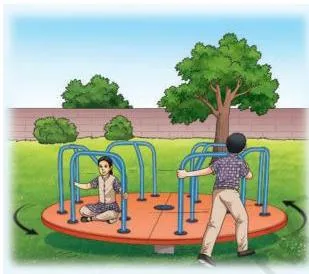
Activity 12.1 builds the logic with a merry-go-round. Sit facing outward while the ride turns anti-clockwise, and the trees and buildings around you appear to move in the opposite, clockwise direction (NCERT, p. 170).
Exactly the same thing happens on the Earth. We watch the Sun appear in the east, cross the sky and set in the west — so the Earth itself must be turning the other way, from West to East.
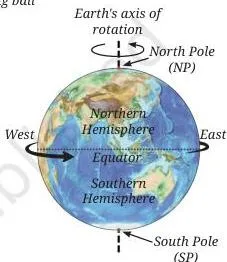
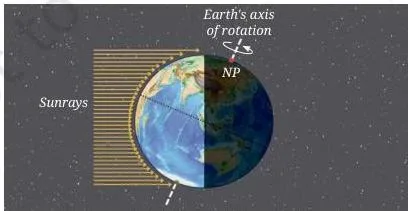
That turning motion has a name. Rotation is the motion of an object in which all its parts move in circles around an imaginary line through it, called the axis of rotation (NCERT, p. 171). The Earth’s axis passes through the geographic North Pole and the South Pole.
The Earth completes one rotation in about 24 hours. Viewed from above the North Pole, it turns anti-clockwise — in other words, from West to East (NCERT, p. 171).
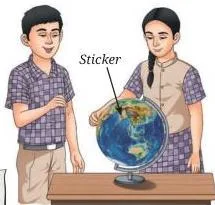
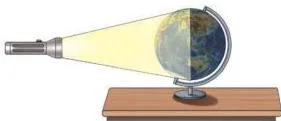
Activity 12.2 turns this into day and night. In a dark room, shine a torch on a globe from about 1.5 metres away: the half facing the torch is lit, so it is daytime there, while the other half stays dark (NCERT, p. 172).
Now rotate the globe from West to East and watch your location move into the light — that is sunrise — and then out of it — sunset. Because the Earth turns from West to East, the eastern parts of India enter daylight first: sunrise happens earlier in the east than in the west (NCERT, p. 172).
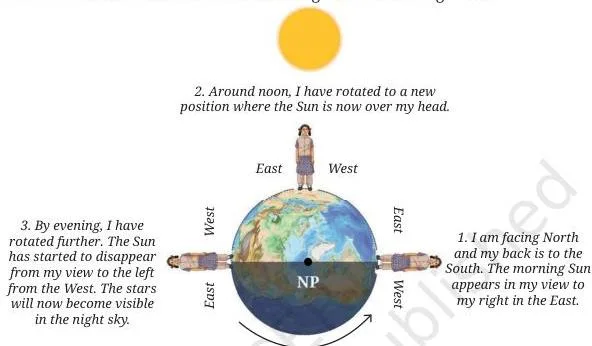
Fig 12.6 shows what one rotation looks like from the Equator. The girl sees the Sun rise in the eastward direction, move across the sky from East to West, and set; night begins, and the stars become visible (NCERT, p. 173).
The book offers two further pieces of evidence that the Earth really rotates:
- A Foucault pendulum — a 22-metre pendulum hung in the Constitution Hall of the new Parliament building in New Delhi — gives a visible demonstration of the Earth’s rotation (NCERT, p. 173).
- The Moon and the stars also appear to rise in the east and set in the west, just like the Sun, because the Earth rotates from West to East (NCERT, p. 174).
- Ancient Indian astronomers noticed the same apparent motion. Aryabhata, in his Aryabhatiya (around the fifth century CE), stated the rotation period as about 23 hours 56 minutes 4.1 seconds — impressively close to the accepted value today (NCERT, p. 175).
Revolution of the Earth: A Year and a Changing Night Sky
Rotation spins the Earth in place; revolution carries it around the Sun. This second motion is slower but just as important — it gives us the year, and it changes the stars we see.
In the book’s words: revolution is the motion of one object around another, and the path it follows is its orbit (NCERT, p. 175). The Earth completes one revolution around the Sun in about 365 days and 6 hours.
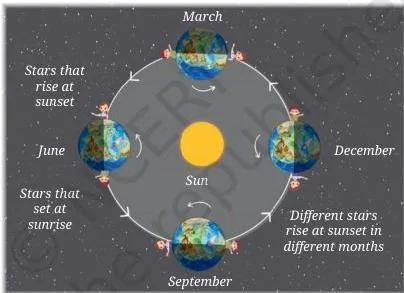
Why do the constellations change across the year? Fig 12.8 shows the Earth at four positions on its orbit. At the same time of night, each position faces a different direction in space, so the stars visible after sunset gradually change month by month (NCERT, p. 176).
The chapter adds a cultural note: the Bhil and Pawara communities of the Tapi Valley in western India used the appearance of certain star patterns as markers for the arrival of the monsoon (NCERT, p. 176).
Keep the two motions separate: rotation gives the day-night cycle and makes the Sun, Moon and stars appear to move; revolution gives the year and the changing night sky.
Why Seasons Happen: The Tilted Axis, Not the Distance
Seasons are not about how close the Earth is to the Sun. This is the one idea students most often get backwards, so the chapter spends a full section on it.
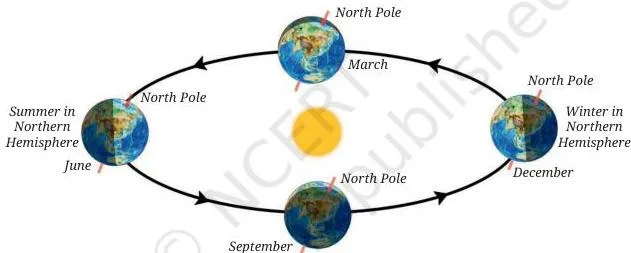
The real causes are two, and they work together. First, the Earth’s axis is tilted, not upright, with respect to its orbit — and the Earth keeps that tilt direction as it revolves (NCERT, p. 177).
Second, the Earth is spherical, so a given bundle of sunrays spreads over a smaller area wherever it arrives steeply — and that area gets heated more (NCERT, p. 178).
What happens in June? The Northern Hemisphere tilts towards the Sun. Sunlight there is more intense and lasts more than 12 hours a day, so the Northern Hemisphere experiences summer. In December the tilt points the other way: the Northern Hemisphere gets weaker sunlight for fewer hours, and it is winter (NCERT, p. 178).
The Southern Hemisphere is exactly opposite: winter in June, summer in December (NCERT, p. 178). That is why the chapter asks why the Indian cricket team plays in Australia in December — it is the Australian summer.
Then the book names the two wrong reasons students give, and rejects both (NCERT, p. 178):
- “When the Northern Hemisphere tilts towards the Sun, it is closer to the Sun.” — Wrong. The distance difference is very small and is not why seasons occur.
- “The orbit is an oval, so the Earth is at different distances from the Sun over the year.” — Wrong for the same reason.
In fact, the Earth is closest to the Sun in January — deep in the Northern Hemisphere’s winter. Distance is not the driver of seasons (NCERT, p. 178).
The chapter also gives the calendar dates to remember (NCERT, pp. 178–179):
- Summer solstice — around 21 June, the longest day in the Northern Hemisphere.
- Winter solstice — around 22 December, the shortest day and longest night.
- Equinoxes — around 21 March and 23 September, when day and night each last about 12 hours.
At the North Pole the pattern is extreme: on 21 March the Sun rises and stays continuously in the sky for six months, then sets on 22 September — followed by six months of darkness. The South Pole is the opposite (NCERT, p. 179).
Near the Equator, day and night stay at about 12 hours each all year. That is why southern Indian states close to the Equator feel seasons less strongly (NCERT, p. 179).
Solar and Lunar Eclipses: When Shadows Fall
An eclipse is a shadow event: one body blocks the sunlight that would otherwise reach another. The chapter works up to it by first removing a wrong guess — that Mercury or Venus, which orbit between the Earth and the Sun, could block the Sun.
They cannot. Mercury and Venus appear very small beside the Sun, and when Venus passes across the Sun’s face — a Transit of Venus — it shows only as a tiny black dot (NCERT, pp. 179–180).
So why can the Moon, which is far smaller, cover the Sun completely? The answer is apparent size — how large an object looks, which depends on both its real size and its distance from your eye (NCERT, p. 180).
Activity 12.4 demonstrates it: stand about 5 metres from a friend and hold up your thumb at arm’s length. The thumb covers your friend’s whole head, even though the head is much bigger, because the thumb is much closer to your eye (NCERT, p. 180).
In the same way, the Moon is far smaller than the Sun but also far closer, so their apparent sizes nearly match — and the Moon can slide exactly in front of the Sun, producing a solar eclipse (NCERT, p. 180).
A solar eclipse happens when the Moon comes between the Sun and the Earth and blocks sunlight from reaching us (NCERT, p. 180). Observers inside the Moon’s shadow see a total solar eclipse — the sky darkens for a few minutes during the day; nearby areas, where the Moon covers only part of the Sun, see a partial solar eclipse (NCERT, p. 181).
The chapter stops here for a safety warning, because this is where damage happens. Never look at a solar eclipse directly with your eyes — even during an eclipse the Sun is intense enough to damage your eyes and cause blindness. Sunglasses, binoculars and telescopes are all unsafe (NCERT, p. 181).
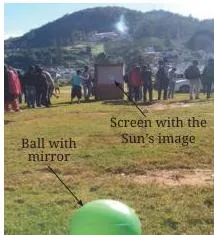
The safe way to enjoy a solar eclipse is to join one of the viewing events that planetaria and astronomy clubs organise; organisers provide special eye protection and explain the science (NCERT, p. 181). Fig 12.15 shows such a public viewing in Ooty.
A mirror-projection set-up is another way, but the book insists it must be done strictly under a teacher’s supervision, and the reflected beam must never be directed at anyone’s eyes (NCERT, p. 182).
A lunar eclipse is the mirror image of the same geometry: the Earth comes between the Sun and the Moon and blocks sunlight from reaching the Moon (NCERT, p. 182). When the whole Moon is inside the Earth’s shadow, it is a total lunar eclipse, and the Moon turns a dark red colour.
When only part of the Moon is shadowed, it is a partial lunar eclipse (NCERT, p. 183).
Unlike the Sun, the eclipsed full Moon is safe to watch with your naked eye (NCERT, p. 183).
Why the difference in visibility? The Moon’s shadow is small, so it falls on only a small patch of the Earth’s surface. A total solar eclipse is visible only from that patch, and only for minutes.
The Earth’s shadow is large enough to cover the whole Moon, so a lunar eclipse is visible from everywhere on the night side of the Earth (NCERT, pp. 181–183).
Eclipses are not new to India. The Sanskrit name grahan is used for an eclipse in many Indian languages, and ancient texts such as the Surya Siddhanta give calculations for predicting them (NCERT, p. 182). Scientists still travel around the world to observe eclipses, because they are opportunities to study phenomena that cannot be seen otherwise (NCERT, p. 182).
The chapter also mentions the Kodaikanal Solar Observatory in the Palani hills of southern India — established in 1899 and operated by the Indian Institute of Astrophysics, it has collected data about the Sun for over 100 years (NCERT, p. 183).
And the “Know a Scientist” box introduces M.K. Vainu Bappu, the father of modern Indian astronomy, who built telescopes in India and travelled abroad to study solar eclipses (NCERT, p. 184).
The Four ‘Let Us Explore’ Activities and What Each Teaches
This chapter is built around doing, not just reading. Each activity removes a confusion that reading alone leaves behind — sit on a ride, shine a torch, watch a constellation, hold up a thumb.
| Activity | What you do | The idea it proves | NCERT page |
|---|---|---|---|
| 12.1 | Sit on a merry-go-round facing outward while it turns anti-clockwise | Objects appear to move opposite to your own turning — so the Sun’s apparent motion means the Earth turns | p. 170 |
| 12.2 | Rotate a globe in a dark room with a torch placed about 1.5 m away | Rotation causes the day-night cycle; the eastern parts of India see sunrise first | pp. 171–172 |
| 12.3 | Sketch the Big Dipper, then sketch it again two hours later | Stars appear to circle the nearly fixed Pole Star during one night | p. 174 |
| 12.4 | Cover a friend’s head 5 m away with your thumb at arm’s length | Apparent size depends on real size and distance, not on size alone | p. 180 |
The two figures below show what two of these activities look like in practice.
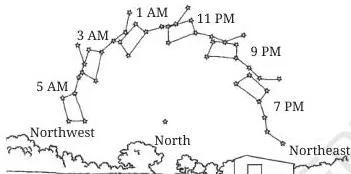
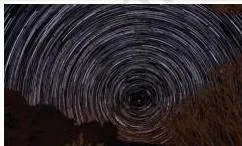
Fig 12.7 is a real student’s sketch from Pune. The Big Dipper is drawn at two times on the same night, and the second sketch shows it swung around the Pole Star — the effect of the Earth’s rotation. The Pole Star itself stays nearly fixed because the Earth’s axis points very close to it (NCERT, p. 174).
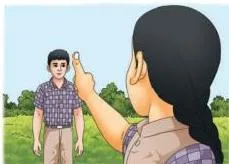
Fig 12.12 shows the set-up of Activity 12.4: the thumb, held close to the eye, exactly covers a head five metres away. The head is physically far larger, but the thumb’s apparent size wins because it is so much closer (NCERT, p. 180).
One caution from the book: any activity that projects an image of the Sun — such as the mirror-projection method similar to Activity 11.5 — must be set up by your teacher and performed strictly under supervision (NCERT, p. 182).
Figure Walkthrough: What to Look For in the Key Diagrams



The figures do most of the explaining in this chapter. The skill is knowing what each line and arrow means — so here is each key diagram, read line by line.
Fig 12.3: Rotation of the Earth (p. 171)
What to notice: the axis is drawn as a straight line through the Earth from pole to pole, and the arrow shows the direction of spin. Viewed from above the North Pole, the turn is anti-clockwise — which is the same as turning from West to East.
That single arrow is the cause of the Sun appearing to rise in the east.
Fig 12.5: Sunlight falls on half of the Earth’s surface (p. 172)
The boundary between the lit and dark halves is the day-night edge. The half facing the Sun is in daytime; the half turned away is in night. As the Earth rotates West to East, the eastern side of any country crosses this edge first — which is why sunrise reaches eastern India before western India.
Fig 12.8: Revolution and the changing night sky (p. 176)
The drawing shows the Earth at four positions along its orbit. At the same time of night, each position faces a different part of space, so the constellations you see after sunset change month by month. The caption warns that sizes and distances are not to scale.
Fig 12.9: Different positions of the Earth while revolving around the Sun (p. 177)
This is a side view, which is why the orbit looks elongated — an oval — even though from above it is nearly circular. The important detail is the tilt arrow: it points the same way at every position. Because the tilt direction never changes, the Northern Hemisphere leans toward the Sun in June and away from it in December.
Fig 12.10: More intense sunlight in June, less in December (p. 178)
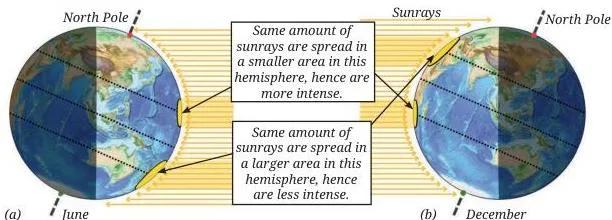
Both parts of this figure show the same bundle of sunrays reaching the Earth. In June (a) the rays hit the Northern Hemisphere steeply and spread over a small area, so that area heats more intensely; the Southern Hemisphere receives the same rays spread over a larger area. In December (b) the situation is reversed.
Fig 12.11: Longer daytime in June, shorter in December (p. 178)
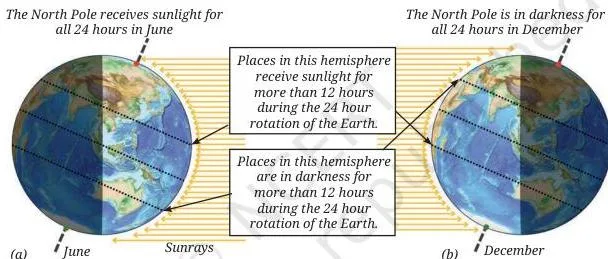
The arc above the horizon line is the daytime part of the daily circle. In June (a) the Northern Hemisphere’s arc is long — more than 12 hours of daylight. In December (b) the arc is short. Longer, more intense sunlight together produce summer; shorter, weaker sunlight produce winter.
Fig 12.13: Geometry of a solar eclipse (p. 181)
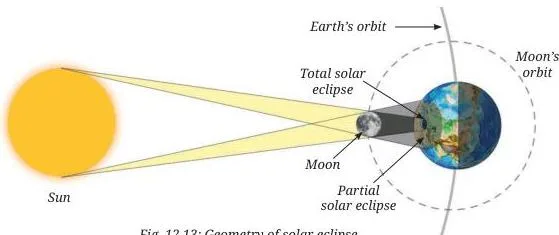
Follow the shadow: the Moon sits between the Sun and the Earth, and its shadow cone lands on a small patch of the Earth’s surface. Only observers inside that patch see the total solar eclipse; everyone else sees a partial eclipse or nothing.
The Moon’s shadow is small — that is why a total solar eclipse lasts only a few minutes and is visible from a tiny area.
Fig 12.14: Solar eclipse photographs (p. 181)
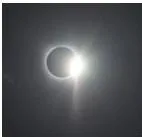
Three photographs of the real event: (a) total, when the Moon fully covers the Sun; (b) partial, when it covers only part; and (c) the diamond-ring effect, the bright flash just as the Moon begins to move away. If you ever see a diamond ring, totality is ending — daylight is returning.
Fig 12.16: Geometry of a lunar eclipse (p. 183)
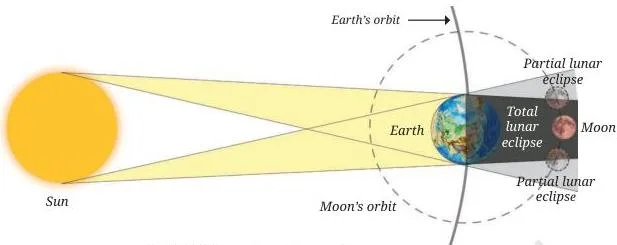
Here the Earth sits between the Sun and the Moon, and the Earth’s shadow is wide enough to cover the entire Moon. That is why a lunar eclipse is visible from every place on the night side of the Earth — the whole night half faces a fully shadowed Moon.
When the whole Moon is inside the shadow, it turns dark red.
Notice how often the captions add “sizes and distances are not to scale”. The drawings stretch the orbits and the shadow cones so the geometry is visible. Read them for arrangement and direction, never as true proportions.
Key Definitions in This Chapter
These are the terms the chapter builds on; each appears in NCERT with a plain meaning you can re-state in your own words.
| Term | Plain meaning | NCERT page |
|---|---|---|
| Rotation | The motion of an object in which every part of it moves in a circle around one imaginary line running through it | p. 171 |
| Axis of rotation | That imaginary line. The Earth’s axis runs from the North Pole to the South Pole | p. 171 |
| Revolution | The motion of one object around another object | p. 175 |
| Orbit | The path an object follows while it revolves around another object | p. 175 |
| Apparent size | How large an object looks from where you stand; it depends on the object’s real size and its distance from your eye | p. 180 |
| Solar eclipse | An event in which the Moon comes between the Sun and the Earth and blocks sunlight from reaching part of the Earth | p. 180 |
| Total solar eclipse | A solar eclipse in which the Moon fully covers the Sun for observers inside the Moon’s shadow | p. 181 |
| Partial solar eclipse | A solar eclipse in which the Moon covers only part of the Sun | p. 181 |
| Lunar eclipse | An event in which the Earth blocks sunlight from reaching the Moon | p. 182 |
| Total lunar eclipse | A lunar eclipse in which the whole Moon lies inside the Earth’s shadow and appears dark red | p. 183 |
| Partial lunar eclipse | A lunar eclipse in which only part of the Moon is shadowed | p. 183 |
| Summer solstice | The longest day in the Northern Hemisphere, around 21 June | p. 178 |
| Winter solstice | The shortest day and longest night in the Northern Hemisphere, around 22 December | p. 179 |
| Equinox | A day with about 12 hours of daylight and 12 hours of darkness, around 21 March and 23 September | p. 179 |
Common Mistakes Students Make in This Chapter
Most of the lost marks in this chapter come from a small set of confusions — and NCERT itself points most of them out, including two wrong reasons printed in the book.
| Mistake | Correct rule | How to check your answer |
|---|---|---|
| “Seasons happen because the Northern Hemisphere is closer to the Sun in June.” | The distance difference is very small. Seasons come from the tilted axis and the spherical shape; the Earth is actually closest to the Sun in January. | Ask yourself: in which month is the Earth closest to the Sun? January — mid-winter in the north (p. 178). |
| “Seasons happen because the oval orbit puts the Earth at different distances.” | Wrong for the same reason — the distance change is too small to drive seasons. | If distance caused seasons, both hemispheres would have summer at the same time. They do not (p. 178). |
| “The Sun moves across the sky.” | The Sun stays put; the Earth rotates from West to East, so the Sun appears to cross from East to West. | Merry-go-round test: things appear to move opposite to your own turning (p. 170). |
| “Day and night are caused by the Earth’s revolution.” | Day and night come from rotation — the spin of the Earth on its axis. | The chapter’s own True/False question 3(vi) traps this — the statement is false (p. 185). |
| “Sunrise happens earlier in Gujarat than in Jharkhand.” | The reverse. Eastern India (Jharkhand) enters daylight before western India (Gujarat). | Rotate your globe from West to East and watch which part lights first (p. 172; question 3(ii), p. 185). |
| “A solar eclipse is safe to watch directly, or with sunglasses.” | Never. Even during an eclipse the Sun can damage your eyes and cause blindness; sunglasses, binoculars and telescopes are all unsafe. | If a classmate plans to watch with sunglasses, warn them — join an organised eclipse event instead (pp. 181–182). |
| “Mercury or Venus could block the Sun.” | Their apparent sizes are far too small. A Venus transit shows only a tiny black dot. | Compare apparent sizes: real size and distance together decide how large something looks (pp. 179–180). |
| “The stars stay fixed all night and all year.” | Rotation makes all stars appear to circle the nearly fixed Pole Star each night; revolution changes which constellations appear, month by month. | Sketch the Big Dipper two hours apart — the position changes (pp. 174, 176). |
Exam Notes: Practising the Chapter’s Questions
The chapter closes with “Let Us Enhance Our Learning” — twelve questions, each testing one idea. Mapping them tells you exactly what to practise.
| Question | The idea it tests | Where the idea appears |
|---|---|---|
| Q1. Hours of sunlight at the North and South Poles in one rotation | Rotation and the polar day-night pattern | pp. 172, 179 |
| Q2. Fill in the blanks | Apparent motion of stars, cause of day and night, naming a full solar eclipse | pp. 170–181 |
| Q3. True or False | Eclipse geometry, sunrise order, solstice, safe viewing, seasons, rotation vs revolution | pp. 171–185 |
| Q4. When Orion appears overhead again | Rotation repeats the sky every 24 hours | p. 171 |
| Q5. When the same star group rises at midnight again | Revolution brings the same night sky back after one year | pp. 175–176 |
| Q6. Day in India, night in the USA | The day-night cycle from rotation | p. 172 |
| Q7. Which of four friends was careless | The safe viewing rule for a solar eclipse | p. 181 |
| Q8. Fill in Fig 12.18 with Sun, Moon, Earth | The straight-line eclipse arrangement | pp. 180–183 |
| Q9. Why the small Moon can block the Sun | Apparent size | p. 180 |
| Q10. Cricket in Australia in December | Reversed seasons in the Southern Hemisphere | p. 178 |
| Q11. Lunar eclipse seen widely, total solar eclipse narrowly | Shadow geometry — small Moon shadow vs large Earth shadow | pp. 181–183 |
| Q12. If the axis had no tilt | No tilt means no seasons | p. 177 |
Question 8: Filling the eclipse diagram (Fig 12.18)
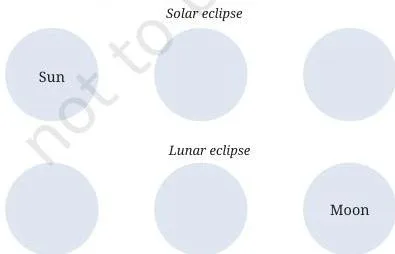
The three bodies must lie in a straight line, with the middle one casting a shadow on the far one. If the Moon is between the Sun and the Earth, that is the solar eclipse arrangement of Fig 12.13; if the Earth is between the Sun and the Moon, that is the lunar arrangement of Fig 12.16 (NCERT, pp. 180–183).
After the table, check that you can do these four things:
- State the direction and time period of rotation (West to East, about 24 hours) and of revolution (about 365 days and 6 hours).
- Read the two eclipse geometry diagrams and say which body is in the middle in each.
- Apply the tilt argument to either hemisphere — June is summer in the north and winter in the south.
- Give the safe-viewing rules for a solar eclipse and for a lunar eclipse.
One honest note: textbook contents and the examinable syllabus are not always identical. Before the exams, check the current official syllabus on the CBSE academic website to see how this chapter is treated this session.
For faster on-the-night revision, the Class 7 Science revision notes and the Class 7 study hub summarise the same concepts; the full CBSE notes index covers every class and subject.
The optional “Exploratory Projects” (NCERT, p. 186) offer deeper practice — repeating the globe-and-lamp activity at different orbit positions, drawing two circles of radius 14.7 cm and 15.2 cm to see how small the Earth’s distance change really is, and investigating what would happen if the Earth’s tilt increased.
Revision Summary: The Chapter in One Breath
If you have two minutes, this is what the chapter wants you to keep. These seven points paraphrase the book’s own “In a Nutshell” list (NCERT, p. 184):
- The Earth rotates on its axis once in about 24 hours.
- The West-to-East rotation causes day and night and makes the Sun, Moon and stars appear to move.
- The Earth revolves around the Sun, one revolution taking about 365 days and 6 hours.
- The Earth’s axis is tilted, not upright, relative to its orbit.
- Seasons come from the tilt together with the Earth’s spherical shape.
- A solar eclipse occurs when the Moon blocks sunlight from reaching the Earth.
- A lunar eclipse occurs when the Earth blocks sunlight from reaching the Moon.
Keep three dates and one “remember not” in mind:
- Summer solstice around 21 June, winter solstice around 22 December, equinoxes around 21 March and 23 September (NCERT, pp. 178–179).
- The poles get six months of continuous sunshine followed by six months of darkness; the Equator gets about 12 hours of day and night all year (NCERT, p. 179).
- Do not explain seasons by distance from the Sun — the Earth is closest to the Sun in January (NCERT, p. 178).
Related Chapters and Resources
This listing is maintained for the 2026-27 academic session using the NCERT textbook information available to us. NCERT remains the authority for confirming the latest edition.
Chapter 12 is the final chapter of the book, so there is no next chapter to move on to — but the rest of the book and the revision pages are one link away.
- Browse the full NCERT Class 7 Science book page to open any chapter of Curiosity.
- Go back to the previous chapter — Chapter 11 of Curiosity.
- Return to the Class 7 hub for all subjects.
- If you are also revising light, the Class 7 light, shadows and reflections notes are ready.
| What the chapter holds | Count | Where it is used |
|---|---|---|
| Printed pages | 20 | |
| Sections in the chapter | 7 | |
| Figures with NCERT captions | 34 | |
| Activities | 4 | |
| Official NCERT PDF | Download the chapter PDF | the chapter exactly as NCERT publishes it |
Reference: NCERT Class 7 Science textbook, chapter 12, official edition on ncert.nic.in.
Sources and Data Verification
The figures and page references on this page describe the NCERT Class 7 Science textbook Curiosity, Chapter 12 (Earth, Moon, and the Sun), printed pages 168–187 of the current edition (reprint 2026).
This listing is maintained for the academic session for which the reprint 2026 edition of Curiosity is current. This page covers this one chapter only; it is not a statement about the whole CBSE curriculum.
NCERT settles textbooks, editions and official PDFs. CBSE settles the examinable curriculum and syllabus — so for what is examinable this session, check the official CBSE syllabus rather than this page.
Frequently Asked Questions
Why does the Sun appear to rise in the east and set in the west if the Sun is not moving?
The Sun is not moving — the Earth is rotating from West to East. From our turning Earth, the fixed Sun appears to do the opposite: rise in the east, cross the sky, and set in the west. The merry-go-round activity (NCERT, p. 170) shows why: when you turn anti-clockwise, everything around you appears to move clockwise.
Why do seasons occur on the Earth, and why is distance from the Sun not the reason?
Seasons occur because the Earth’s axis is tilted and the Earth keeps that tilt as it revolves, and because the spherical Earth spreads a fixed amount of sunlight over different areas. Distance from the Sun is not the reason — the distance differences are very small, and the Earth is actually closest to the Sun in January (NCERT, pp. 177–178).
The Moon is much smaller than the Sun, so how can it fully cover the Sun during a total solar eclipse?
Because of apparent size. The Moon is far smaller than the Sun in real size, but it is also far closer to us, so its apparent size nearly matches the Sun’s. Hold up your thumb at arm’s length and it covers a friend’s head five metres away, for exactly the same reason (NCERT, p. 180).
Is it safe to watch a lunar eclipse with the naked eye? What about a solar eclipse?
A lunar eclipse is safe to watch with the naked eye — the chapter says so directly (NCERT, p. 183). A solar eclipse is never safe to view directly: even during an eclipse the Sun can damage your eyes and cause blindness, and viewing through sunglasses, binoculars or telescopes is also unsafe (NCERT, p. 181).
Why can a lunar eclipse be seen from a large part of the Earth but a total solar eclipse only from a small part?
Because of shadow size. The Moon’s shadow is small, so during a total solar eclipse it falls on only a small patch of the Earth’s surface; because the shadow moves, that patch sees totality for only a few minutes.
The Earth’s shadow is large enough to cover the whole Moon, so a lunar eclipse is visible from the entire night side of the Earth (NCERT, pp. 181–183).
What is the difference between the rotation and the revolution of the Earth?
Rotation is the Earth spinning on its own axis; it takes about 24 hours and causes day and night. Revolution is the Earth travelling around the Sun; it takes about 365 days and 6 hours and, together with the tilt, produces the year and the seasons (NCERT, pp. 171, 175).
Explore Class 7 Science Books
Related chapters: