
Life Processes in Plants is Chapter 10 of NCERT Class 7 Science (Curiosity). If you are searching for life processes in plants class 7, this page gives you the official chapter PDF and then explains what the chapter contains—its activities, diagrams and formulas—with NCERT page numbers so you can follow along in the printed book.
Download NCERT Class 7 Science Chapter 10 Life Processes in Plants PDF
This is the official chapter file published by NCERT, not a third-party copy. Open it to read the complete lesson in the Curiosity textbook, including every activity, table and the Let Us Enhance Our Learning exercise set.
NCERT Class 7 Science Chapter 10 Life Processes in Plants PDF is published on the official NCERT textbook portal, where students and teachers can download every NCERT book free.
| What the chapter holds | Count | Where it is used |
|---|---|---|
| Printed pages | 16 | |
| Sections in the chapter | 10 | |
| Figures with NCERT captions | 24 | |
| Tables | 4 | |
| Activities | 1 | |
| Official NCERT PDF | Download the chapter PDF | the chapter exactly as NCERT publishes it |
Reference: NCERT Class 7 Science (Curiosity) textbook, chapter 10, official edition on ncert.nic.in.
Chapter at a Glance: What Is Inside the PDF
The chapter teaches plants as living systems: it starts with growth, moves to food-making, then transport, then respiration. Use this list to jump to the part you need.
- 10.1 How Do Plants Grow? (NCERT pp. 138–139) — a three-pot experiment tests the roles of sunlight and water.
- 10.2 How Do Plants Get Food for their Growth? (NCERT pp. 140–146) — the starch test, chlorophyll, carbon dioxide, oxygen release and stomata.
- 10.3 Transport of water, minerals and food (NCERT pp. 147–148) — xylem and phloem.
- 10.4 Do Plants Respire? (NCERT p. 149) — the moong seed experiment and the respiration equation.
- End material (NCERT pp. 150–152) — In a Nutshell, Let Us Enhance Our Learning, Exploratory Projects and two KNOW A SCIENTIST boxes (R. H. Dastur on photosynthesis and Kamala Sohonie on plant respiration).
How the Chapter Builds: Growing, Feeding, Transporting, Respiring
Grade 6 taught you that all living beings grow and need food for growth, and the previous chapter showed how animals obtain nutrition. This chapter asks the same question for plants and answers it with experiments you can try at home or in the lab (NCERT, p. 137).
10.1 How Do Plants Grow? The Three-Pot Experiment (NCERT pp. 138–139)
Take three pots with similar chilli or tomato saplings. Pot A gets sunlight plus water, Pot B gets sunlight but no water, Pot C gets water but stays in the dark. After two weeks the plant in Pot A grows best, Pot C grows less well, and Pot B may even die.
Why this order? The plant needs water to survive and transport materials, and it needs sunlight to make food. Remove either one and growth suffers. That single experiment settles the chapter’s first question: plants need both sunlight and water for growth (NCERT, p. 139).
10.2 Food for Growth: Photosynthesis and Its Evidence (NCERT pp. 140–146)
Plants make food in leaves, which are generally broad, flat and green because of the green pigment chlorophyll. The food is stored as starch. The chapter then runs three experiments to identify what food-making requires: the starch test, the variegated-leaf test, and the caustic soda bottle test.
Each experiment removes one condition and watches whether starch still forms. Take away light, take away chlorophyll, or take away carbon dioxide—no starch.
Together they prove that sunlight, water, chlorophyll and carbon dioxide are all essential, and that photosynthesis releases oxygen (NCERT, pp. 142–145). A Fascinating Facts box also notes that some pigments in red, violet and brown leaves can help photosynthesis even when they hide the green colour (NCERT, p. 142).
10.3 Transport: How Water, Minerals and Food Move (NCERT pp. 147–148)
Roots take up water and minerals, but leaves need them. The red ink experiment shows the route: coloured water rises through thin tubes called xylem and spreads to stem, leaves and even flowers. The food made in leaves travels separately through phloem to every part, and may be stored in roots or seeds.
10.4 Respiration: Every Part of a Plant Respires (NCERT p. 149)
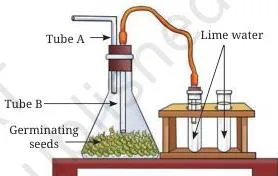
Soaked moong seeds in a flask produce carbon dioxide that turns lime water milky. The extra carbon dioxide comes from the seeds themselves as they respire. Respiration breaks down glucose with oxygen to release carbon dioxide, water and energy—and it happens in all parts of a plant, green or non-green.
Key Ideas: Photosynthesis, Transport and Respiration
Three ideas carry the whole chapter. Learn the inputs and outputs of each process, and you can answer most of its questions.
Photosynthesis: sunlight, water, chlorophyll and carbon dioxide make glucose and oxygen
The chapter defines photosynthesis as the process by which plants prepare food in the presence of sunlight and chlorophyll (NCERT, p. 144). During photosynthesis, the food produced is glucose—a simple carbohydrate that gives instant energy and is later converted to starch for storage (NCERT, p. 146).
\[ \text{Carbon dioxide} + \text{Water} \xrightarrow[\text{Chlorophyll}]{\text{Sunlight}} \text{Glucose} + \text{Oxygen} \]
- Carbon dioxide enters from the air through tiny pores called stomata.
- Water comes from the soil through the roots.
- Chlorophyll captures sunlight so the reaction can run.
- Glucose is the food; oxygen is the gas released.
- Leaves are the primary site of photosynthesis, but other green parts of the plant also carry it out (NCERT, p. 144).
Why broad flat leaves? A broad flat surface gives chlorophyll more area to capture sunlight efficiently, which is why the book calls leaves the “food factories” of the plant (NCERT, p. 140).
Transport: xylem carries water and minerals; phloem carries food
Plants have two different tube systems because water and food travel in different directions (NCERT, p. 148).
- Xylem — thin tubes in the stem, branches and leaves that carry water and dissolved minerals upward from the roots. The red ink experiment makes these tubes visible.
- Phloem — tubes that carry food made in leaves to all parts of the plant; the food may be stored in seeds and roots.
Respiration: glucose plus oxygen releases carbon dioxide, water and energy
Respiration is the process that releases energy from food. The word equation has inputs and outputs opposite to photosynthesis in terms of gases (NCERT, p. 149):
\[ \text{Glucose} + \text{Oxygen} \longrightarrow \text{Carbon dioxide} + \text{Water} + \text{Energy} \]
The energy released is used for growth and development. Because all parts of a plant—green or non-green—respire, respiration goes on all the time, not just at night (NCERT, pp. 149, 152).
Photosynthesis vs respiration: quick comparison
| Feature | Photosynthesis | Respiration |
|---|---|---|
| Raw materials | Carbon dioxide and water | Glucose and oxygen |
| Products | Glucose and oxygen | Carbon dioxide, water and energy |
| Word equation | \( \text{Carbon dioxide} + \text{Water} \xrightarrow[\text{Chlorophyll}]{\text{Sunlight}} \text{Glucose} + \text{Oxygen} \) | \( \text{Glucose} + \text{Oxygen} \rightarrow \text{Carbon dioxide} + \text{Water} + \text{Energy} \) |
| Importance | Makes food and releases oxygen | Releases energy for growth and development |
| Where it happens | Green parts with chlorophyll, mainly leaves | All parts of the plant, green or non-green |
Reading the Diagrams: What Each Figure Shows
Each figure in this chapter is a small experiment. Read it as: what was set up, what was observed, and what it proves.
Fig. 10.1: The three-pot experiment
The full figure shows Pots A, B and C under three different conditions. The panel below isolates Pot B—sunlight without water—because it is the condition that damages the plant despite enough sunlight (NCERT, p. 138).
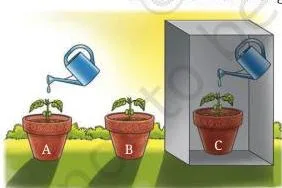
Fig. 10.2: The starch test in a leaf
This figure shows two stages: the leaf losing colour in a test tube placed in boiling water, and the decolourised leaf turning blue-black where iodine is dropped. The blue-black colour is the positive test for starch (NCERT, p. 140).
Boiling water softens the leaf; alcohol removes chlorophyll so the colour change is easy to see. The test tube is kept in boiling water, never on a direct flame, because alcohol is highly flammable.
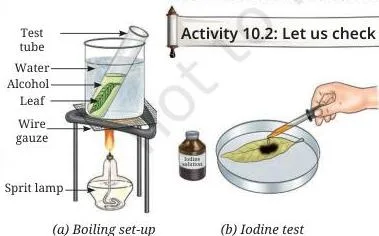
Fig. 10.3: The half-leaf bottle experiment
The leaf is split through a cork—half inside a bottle containing caustic soda, half outside. Caustic soda absorbs carbon dioxide from the air, so the inside half has everything needed except carbon dioxide. Only the outside half turns blue-black with iodine, proving carbon dioxide is essential for starch formation (NCERT, p. 143).
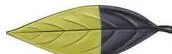
Fig. 10.4: Oxygen is released during photosynthesis
Two set-ups are compared: an aquatic plant in sunlight and one in the dark. Bubbles appear only in sunlight and collect in an inverted test tube. When a lit matchstick is inserted into the collected gas, it produces an intense flame—so the gas is rich in oxygen (NCERT, p. 145).
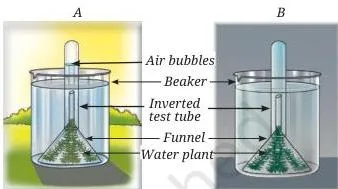

Fig. 10.5: Photosynthesis at a glance
This diagram collects the whole process on one page: sunlight, carbon dioxide and water go in; glucose and oxygen come out; chlorophyll makes it possible. It is the figure to redraw when you revise (NCERT, p. 146).
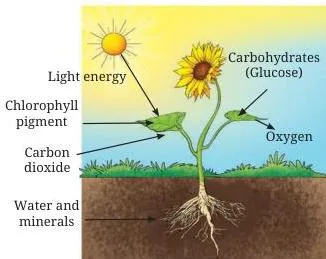
Fig. 10.6: Stomata on a rhoeo leaf
A thin peel from the lower surface of a rhoeo leaf shows tiny pores called stomata. These are the openings through which leaves exchange gases—taking in carbon dioxide for photosynthesis and releasing oxygen (NCERT, p. 147).
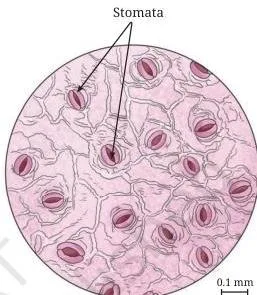
Fig. 10.7: The red ink experiment
Twigs with white flowers are placed in plain water and in red ink. After a day, the red colour appears in the stem, leaves and flowers of the ink twig, and a cut stem shows red in thin tubes. That visible red path is the xylem, which carries water and dissolved minerals upward (NCERT, p. 148).
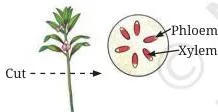
Fig. 10.8: Xylem and phloem routes
The diagram traces both routes in one plant: water and minerals move upward through xylem; food moves from the leaves to all parts through phloem. Keep the two directions separate in your head (NCERT, p. 148).
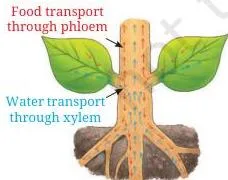
Fig. 10.9: Testing respiration in moong seeds
Soaked moong seeds sit in a flask connected to a test tube of lime water. The lime water connected to the flask turns milky because the seeds release extra carbon dioxide while respiring; the lime water in the test tube not connected to the flask shows the difference (NCERT, p. 149).
Definitions: Terms Used in This Chapter
Learn the terms in this order—each one is needed by the next.
| Term | Meaning | NCERT page |
|---|---|---|
| Chlorophyll | The green pigment in leaves and other green plant parts that captures sunlight for making food. | p. 140 |
| Photosynthesis | The process by which plants make glucose from carbon dioxide and water using sunlight and chlorophyll, releasing oxygen. | p. 144 |
| Stomata | Tiny pores on the surface of leaves that help in exchanging carbon dioxide and oxygen. | p. 147 |
| Xylem | Thin tube-like structures in the stem, branches and leaves that carry water and minerals upward from the roots. | p. 148 |
| Phloem | Thin tube-like structures that carry food made in the leaves to all parts of the plant. | p. 148 |
| Respiration | The process in which glucose is broken down using oxygen to release carbon dioxide, water and energy. | p. 149 |
Common Mistakes Students Make in This Chapter
These are the errors this chapter’s activities are designed to catch. Read the correction before you do the experiment.
| Mistake | Correct rule | How to check your answer |
|---|---|---|
| Expecting non-green patches of a variegated leaf to turn blue-black with iodine. | Only green patches in sunlight have enough chlorophyll to make starch; non-green patches do not turn blue-black (NCERT, p. 142). | Look at Bhaskar’s Table 10.2: the non-green patch shows no colour change even on the sunlight leaf. |
| Heating alcohol directly on a flame to decolourise the leaf. | Alcohol is highly flammable. The test tube of alcohol goes inside boiling water, never over a flame (NCERT, p. 140). | The test tube must sit inside the beaker of boiling water the whole time. |
| Thinking only leaves can photosynthesise. | Any green part of a plant that has chlorophyll can perform photosynthesis (NCERT, p. 144). | Test a green stem or leaf sheath with iodine—starch formation shows food was made there. |
| Confusing xylem and phloem. | Xylem carries water and minerals upward; phloem carries food from leaves to all parts (NCERT, p. 148). | The red ink experiment shows xylem; food stored in roots and seeds shows the phloem route. |
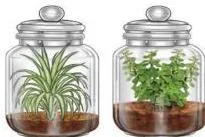
| Believing plants respire only at night. | Respiration happens all the time in every part of a plant, green or non-green (NCERT, pp. 149, 152). | The sealed bottle garden stays alive because respiration’s carbon dioxide is reused in photosynthesis. |
Exam-Focused Points: What to Practise from This Chapter
The chapter ends with Let Us Enhance Our Learning on NCERT pages 150–152. Here is what each question is actually testing.
| Question | What it tests | What a full answer needs |
|---|---|---|
| 1 | Photosynthesis vs respiration | A complete comparison table—raw materials, products, word equations and importance (NCERT, p. 150). |
| 2 | Impact of losing all photosynthesisers | Food and oxygen production would stop; organisms that depend on plants directly or indirectly would be affected. |
| 3 | Where starch comes from and how it moves | Photosynthesis makes glucose in leaves; the glucose is converted to starch and carried by phloem to storage parts such as roots and seeds, where a potato stores it (NCERT, p. 148). |
| 4 | Leaf shape and efficiency | Broad flat leaves give chlorophyll more surface area to capture sunlight, making photosynthesis more efficient (NCERT, p. 140). |
| 5 | Respiration equation components | X is glucose, Y is oxygen, Z is water. Compare with the respiration equation on page 149. |
| 6 | Sunlight needed for starch formation | The sunlight plant photosynthesis and stores starch, so its leaves test blue-black; the dark plant cannot make new starch (NCERT, p. 151). |
| 7 | Carbon dioxide needed for photosynthesis | Use the conditions table below (NCERT, p. 151). |
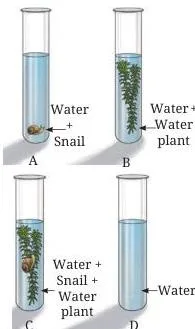
| 8 | Gas exchange between snail and plant | The snail releases carbon dioxide, the plant uses it in photosynthesis and releases oxygen; the carbon dioxide indicator shows this exchange (NCERT, p. 151). |
| 9 | Designing a transport experiment | Use two similar twigs in red ink, keep one in warm conditions and one in cold conditions, and compare how far the red colour travels (NCERT, p. 148). |
| 10 | Balance in nature | Photosynthesis uses carbon dioxide and releases oxygen; respiration uses oxygen and releases carbon dioxide (NCERT, p. 152). |
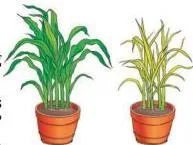
Fig. 10.10: Sunlight vs darkness for starch formation (Q6)
Question 6 asks why one plant grows in sunlight and the other in complete darkness. The sunlight plant can photosynthesise and store starch, so its leaves test blue-black; the dark plant cannot make new starch.
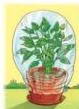
Vani’s conditions: where starch forms and where oxygen is generated (Q7)
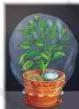
Question 7 gives four set-ups with sufficient water: sunlight with carbon dioxide, sunlight without carbon dioxide, dark with carbon dioxide, dark without carbon dioxide. Starch and oxygen both appear only where photosynthesis can run (NCERT, pp. 143, 146, 151).
| Condition | Starch formed? | Oxygen generated? | Why |
|---|---|---|---|
| Sunlight with carbon dioxide | Yes | Yes | All four requirements—sunlight, water, chlorophyll and carbon dioxide—are present (NCERT, p. 146). |
| Sunlight without carbon dioxide | No | No | Photosynthesis cannot run without carbon dioxide (NCERT, p. 143). |
| Dark with carbon dioxide | No | No | No sunlight, so photosynthesis cannot run (NCERT, p. 140). |
| Dark without carbon dioxide | No | No | Neither sunlight nor carbon dioxide is available. |
Fig. 10.12: Snail and water plant test tubes (Q8)
Question 8 asks what Ananya wants to find out. The set-up compares a snail alone, a plant alone, and both together. The snail releases carbon dioxide, the plant uses it in photosynthesis and releases oxygen, and the carbon dioxide indicator colour changes show this exchange.
Textbook contents and the examinable syllabus are not always identical, so check the current official syllabus before you decide which parts of this chapter to revise most heavily.
Quick Recap: What to Remember from This Chapter
The chapter’s In a Nutshell block (NCERT p. 150) plus the bottle garden project (NCERT p. 152) give you the complete revision list:
- Plants need food for growth and development, just as all living organisms do.
- Photosynthesis uses carbon dioxide and water in the presence of sunlight and chlorophyll to produce glucose and oxygen.
- Leaves are the “food factories” of a plant because they are the primary site of photosynthesis.
- Stomata are tiny pores on leaves that exchange oxygen and carbon dioxide during photosynthesis and respiration.
- Xylem transports water and minerals from roots; phloem carries food from leaves to all parts of the plant.
- Respiration breaks down glucose using oxygen and releases carbon dioxide, water and energy.
- Respiration happens in all parts of a plant, green or non-green.
Fig. 10.13: The bottle garden shows gas recycling
If a sealed bottle garden keeps growing, the plant is recycling its own gases: carbon dioxide from respiration is reused in photosynthesis, and oxygen from photosynthesis is reused in respiration (NCERT, p. 152).
Related Resources: More Class 7 Science Help
This listing is maintained for the 2026-27 academic session using the NCERT textbook information available to us. NCERT remains the authority for confirming the latest edition.
Use the official NCERT link above for the chapter PDF, and use these site pages for revision help on this chapter and the rest of Class 7 Science.
- Class 7 Science Curiosity book page
- Life Processes in Plants Class 7 revision notes
- Light, Shadows and Reflections Class 7 notes
- Class 7 study hub
- CBSE notes index
The final authority for textbook editions and PDFs is the NCERT official website.
Sources and Data Verification
- The figures and page references on this page describe NCERT Class 7 Science (Curiosity), Chapter 10, official edition on ncert.nic.in.
- This page covers that one chapter and not the other chapters of Class 7 Science.
- The listing is maintained for the current academic session using the NCERT information available to this site.
- NCERT settles textbook editions and PDFs; CBSE settles curriculum, syllabus and examinations.
Reference: NCERT Class 7 Science (Curiosity) textbook, chapter 10, official edition on ncert.nic.in.
FAQs: Life Processes in Plants Class 7 Questions Answered
Why do we boil a leaf and dip it in alcohol before testing for starch?
Boiling water softens the leaf so that the alcohol can enter and remove chlorophyll. Removing chlorophyll makes the blue-black colour easy to see. The test tube is placed in boiling water, never directly on a flame, because alcohol is highly flammable (NCERT, p. 140).
Do plants respire only at night?
No. Respiration happens all the time in every part of the plant, green or non-green. It only looks like plants release oxygen in daytime because photosynthesis is producing oxygen then (NCERT, pp. 149, 152).
Why do only the green patches of a variegated leaf turn blue-black with iodine?
Only the green patches have enough chlorophyll to make starch in sunlight. The non-green patches lack sufficient chlorophyll, so no starch forms there and they do not turn blue-black (NCERT, p. 142).
What is the difference between xylem and phloem?
Xylem carries water and minerals upward from the roots; phloem carries food made in the leaves to all parts of the plant. The red ink experiment shows the xylem route, while food stored in seeds and roots shows the phloem route (NCERT, p. 148).
Why does lime water turn milky in the respiration experiment with soaked moong seeds?
Because the seeds produce extra carbon dioxide while respiring in the flask, and lime water turns milky in the presence of carbon dioxide. Air already has a small amount of carbon dioxide, but the milky change is caused by the additional carbon dioxide from the seeds (NCERT, p. 149).
Can red or brown leaves still carry out photosynthesis?
Yes. Red, violet or brown leaves contain more of their coloured pigments, which hide the green chlorophyll. Some of those pigments help photosynthesis, and an iodine test can still confirm starch formation in such leaves (NCERT, p. 142).
Explore Class 7 Science Books
Related chapters: