
This page has the official NCERT Class 7 Science (Curiosity) textbook Chapter 9, ‘Life Processes’ — the complete 16-page chapter (NCERT pages 121–136) on nutrition and respiration in animals.
The life processes class 7 chapter PDF is right here from ncert.nic.in — no sign-in and no payment. Below it is a plain-language walkthrough: what each section teaches, how to read the key diagrams, and how to answer the chapter’s questions.
Download the Life Processes Class 7 Chapter 9 PDF
You can download the Life Processes Class 7 NCERT Science Chapter 9 PDF directly from the official NCERT textbook portal — it is the complete chapter exactly as printed in the Curiosity book, with every figure, activity and exercise question intact. The file is free, needs no account, and opens in any browser or PDF reader.
What Is Inside the Class 7 Science Chapter 9 PDF
The table below shows how much this chapter holds — sections, figures, activities and exercise questions, counted from the book itself. The shape matters more than the numbers, so here is how the chapter is organised.
- Part 9.1, Nutrition in Animals, opens with digestion in human beings (NCERT, p. 122) and then asks whether all animals digest food the same way (NCERT, p. 127).
- Part 9.2, Respiration in Animals, covers how humans breathe and respire (NCERT, pp. 129–132) and then how other animals breathe (NCERT, p. 133).
- Feature boxes titled SCIENCE AND SOCIETY and FASCINATING FACTS run through the chapter — real science stories such as how a 19th-century gunshot wound let a doctor watch digestion happen (NCERT, p. 125) and why smoking damages the lungs (NCERT, p. 133).
- Hands-on activities to try: Activity 9.1 tests the action of saliva on starch with iodine (NCERT, p. 123), Activity 9.2 builds a bottle-and-balloon model of breathing (NCERT, p. 130), and Activity 9.3 compares inhaled and exhaled air with lime water (NCERT, p. 131).
- The chapter closes with its summary, ‘In a Nutshell’ (NCERT, p. 134), the question section ‘Let Us Enhance Our Learning’ (NCERT, pp. 135–136), and Exploratory Projects (NCERT, p. 136).
What This Chapter Covers: Nutrition and Respiration
Life processes are the essential activities that keep living beings alive, and this chapter studies two of them in animals — nutrition (breaking food down) and respiration (releasing energy from it).
The chapter opens with a Thirukkural couplet on making sure your food is fully digested before you eat again (NCERT, p. 121). It builds directly on the Grade 6 Curiosity chapter ‘Living Creatures: Exploring their Characteristics’, where you first met nutrition, respiration, excretion and reproduction as life processes.
You can open that Grade 6 chapter from the Class 6 Science book page. The Grade 7 chapter then takes two big ideas — nutrition and respiration — and works through each one in order.
The arc of the chapter: first the digestive journey in section 9.1, from mouth to anus, then how ruminants and birds digest differently; then breathing and respiration in section 9.2, ending with a first look at the circulatory system that transports what digestion and respiration produce (NCERT, p. 133).
The big idea behind both halves: animals get energy from food, and food contains complex components — carbohydrate, protein and fat — that must be broken into simpler forms before the body can use them. That breaking down happens in the alimentary canal (NCERT, pp. 121–122).
Key Concepts: The Journey of Food and the Path of Air
This section follows the chapter’s two halves — where food goes and where air goes — and explains what each organ does and why. The book’s experiments are worked through here step by step.
Digestion in Humans: From Mouth to Anus
Digestion is the breaking down of complex food into simpler forms the body can use (NCERT, p. 123). The journey happens in a long tube called the alimentary canal, which starts at the mouth and ends at the anus (NCERT, p. 122).
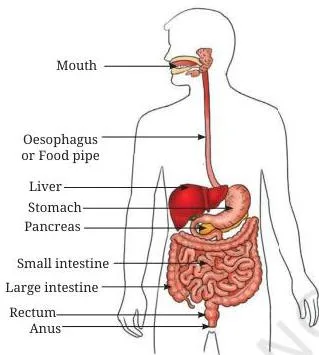
Food enters at the mouth, where teeth crush and chew it into fine pieces — this initial breakdown is called mechanical digestion (NCERT, p. 122).
Saliva does the first chemical work: chapati and rice contain starch, a carbohydrate, and the digestive juice in saliva breaks starch down into sugar. That is why starchy food starts to taste sweet when you chew it for 30–60 seconds (NCERT, p. 122).
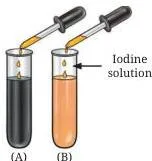
Activity 9.1 tests this with iodine (NCERT, p. 123). Two test tubes hold boiled rice — test tube A plain, and test tube B after the rice has been chewed for 30–60 seconds. Iodine is added to both, and the results are recorded in Table 9.1.
- Test tube A (boiled rice): the rice-water mixture turns blue-black — iodine reacts with the starch still in the rice, so starch is present.
- Test tube B (chewed rice): little or no blue-black colour appears — chewing gave saliva time to convert the starch into sugar, so little starch remains.
- Conclusion: the blue-black colour is the test for starch, and its absence is the evidence that saliva did its job (NCERT, p. 123).
Notice what this means for the word ‘failed’: if test tube B shows no colour change, the experiment worked, not failed. The book asks what you would change if the colour still appeared in B — one answer is to chew for longer before testing.
The chewed, softened food is pushed into the food pipe (oesophagus), a long flexible tube. Its walls contract and relax in a wave-like motion that pushes the food down into the stomach — the same wave-like movement continues through the rest of the alimentary canal (NCERT, p. 124).
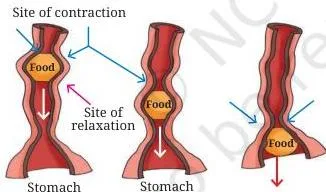
The stomach churns the food by contracting and relaxing its walls. A secretion from the inner lining adds three things: digestive juice that breaks down proteins, acid that helps break down proteins and kills harmful bacteria, and mucus that protects the stomach lining from the acid. The food leaves as a semi-liquid mass (NCERT, pp. 124–125).
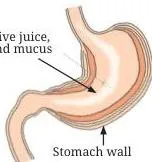
Next stop is the small intestine — the longest part of the alimentary canal, about 6 metres, almost twice the height of your classroom (NCERT, p. 125). Its name says ‘small’, but that means narrow, not short.
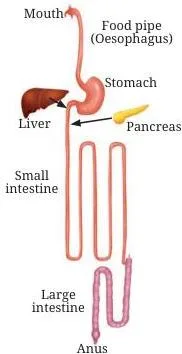
The small intestine receives digestive secretions from three sources: its own inner lining, the liver, and the pancreas.
The liver secretes bile, which is mildly basic. Bile neutralises acids coming from the stomach and breaks fats into tiny droplets, making their digestion easier. The pancreas secretes pancreatic juice, also basic, which neutralises acids and breaks down carbohydrates, proteins and fats (NCERT, pp. 125–126).
This is where absorption happens. The inner lining of the small intestine is thin and covered in thousands of finger-like projections, which increase the surface area for efficient absorption. Digested nutrients pass through these projections into the blood, which carries them to every part of the body (NCERT, p. 126).
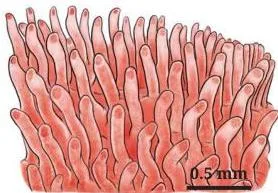
Whatever is not digested moves into the large intestine — about 1.5 metres long, but wider than the small intestine, which is why it is called ‘large’ (NCERT, pp. 125–126).
The large intestine absorbs water and some salts from the undigested food, making the waste semi-solid. This waste is called stool; it is stored in the rectum until it is expelled through the anus, a process called egestion (NCERT, p. 127).
Memory aid for the order: ‘My Old Sister Sells Lovely Red Apples’ — take the first letters, M-O-S-S-L-R-A, and each stands for Mouth, Oesophagus, Stomach, Small intestine, Large intestine, Rectum, Anus.
How Other Animals Digest Food: Ruminants and the Bird Gizzard
Do all animals digest food the same way humans do? No — the alimentary canal changes to suit the food an animal eats (NCERT, p. 127).
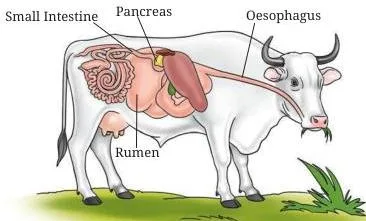
Grass-eating animals such as cows and buffaloes partially chew grass and swallow it into the stomach, where partial digestion takes place. Later, the partially digested food is brought back to the mouth for thorough chewing — this process is called rumination, and these animals are called ruminants. A cow spends about 8 hours a day just chewing (NCERT, p. 128).
Birds have no teeth. Instead, they have a chamber called the gizzard, where the walls contract and relax to break food down, often with the help of grit — small stones — that the bird swallows (NCERT, p. 128).
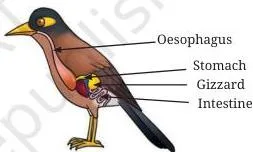
The point of both examples: animals show variations in the structure and function of the alimentary canal, adapted to digesting different kinds of food (NCERT, p. 128).
Breathing: The Path of Air Into the Lungs
How does air actually get into your body and back out? Breathing is the process of inhaling and exhaling air, and it follows a fixed pathway through the respiratory system (NCERT, p. 129).
The pathway: air enters through the nostrils, passes through the nasal passages, travels down the windpipe, splits into two branches entering the two lungs, and reaches balloon-like sacs called alveoli at the end of finer branches. The lungs are protected by the rib cage (NCERT, p. 129).
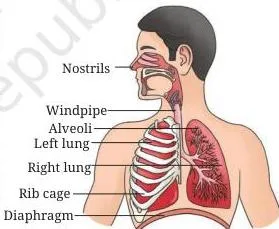
Tiny hairs inside the nostrils, along with mucus, trap dust and dirt from the incoming air — which is why you should breathe through your nose, not your mouth (NCERT, p. 129).
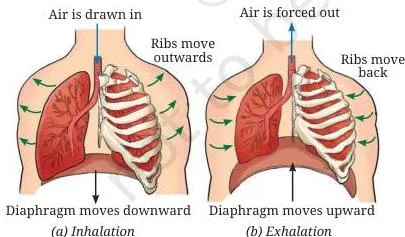
The mechanics of a breath: when you inhale, the ribs move up and outwards and the diaphragm — a dome-shaped muscle below the lungs — moves downwards. This increases the space inside the chest, and air enters the lungs (NCERT, p. 130).
Exhaling reverses the movement: ribs move down and inwards, the diaphragm moves up, the chest space shrinks, and air is pushed out. Activity 9.2 builds a model of exactly this — the walkthrough below reads it figure by figure (NCERT, p. 130).
Respiration: Turning Food Into Energy
How does the food you eat become the energy you run on? Respiration is the process, and it needs both food and oxygen (NCERT, p. 132).
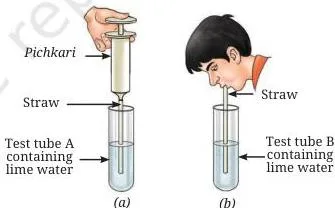
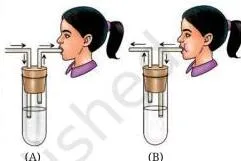
Activity 9.3 gives the evidence (NCERT, p. 131). Two test tubes hold equal amounts of lime water; test tube A gets ordinary air pushed through a syringe, test tube B gets air you blow out through a straw.
- Test tube B turns milky (cloudy); test tube A does not.
- Lime water turns milky when it reacts with carbon dioxide.
- So exhaled air contains more carbon dioxide than the air we inhale — the extra CO₂ is produced inside the body and breathed out (NCERT, p. 131).
Then the exchange itself: the alveoli have thin walls surrounded by fine tubes containing blood.
Oxygen from the inhaled air passes through those thin walls into the blood and is carried to all parts of the body; meanwhile blood brings carbon dioxide from the body to the alveoli, where it is released into the air to be breathed out (NCERT, p. 132).
This is the step that releases energy. The chapter’s word equation (NCERT, p. 132):
\[ \text{glucose} + \text{oxygen} \rightarrow \text{carbon dioxide} + \text{water} + \text{energy} \]
The book is sharp about one point: breathing is a physical process — air moving in and out — while respiration is a chemical process inside the body (NCERT, p. 132). The table below keeps the two apart.
| Point of comparison | Breathing | Respiration |
|---|---|---|
| What it is | Physical process of moving air in (inhalation) and out (exhalation) of the lungs | Chemical process inside the body |
| What it needs | Air from the surroundings | Glucose from digested food and oxygen from breathing |
| What it produces | Exhaled air that is richer in carbon dioxide | Carbon dioxide, water, and energy |
| The chapter’s rule of thumb | Brings in oxygen and removes carbon dioxide | Uses oxygen to break down food and release energy (NCERT, p. 132) |
The chapter also introduces the circulatory system here: the heart, blood and blood vessels. The heart pumps blood through vessels, delivering nutrients and oxygen to all parts of the body and carrying waste products away (NCERT, p. 133).
How Other Animals Breathe: Gills, Lungs and Skin
Do other animals breathe the same way humans do? No — breathing parts are adapted to each animal’s habitat (NCERT, p. 133).
Mammals, birds and reptiles breathe through lungs, though the structure of their lungs differs. Most aquatic animals, like fish, use gills — specialised structures richly supplied with blood vessels, across which oxygen and carbon dioxide are exchanged with gases dissolved in water (NCERT, p. 133).
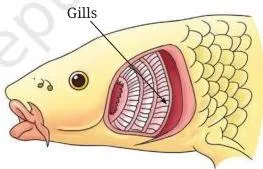
Amphibians change with their life stage: tadpoles breathe through gills, while adult frogs use lungs on land and their skin in water. Earthworms exchange gases through their moist skin. Each animal’s mechanism suits its habitat (NCERT, p. 133).
Reading the Chapter’s Key Diagrams

Four diagrams in this chapter are where students most often get stuck. Each one is read below figure by figure — what to look at, and what the picture proves.
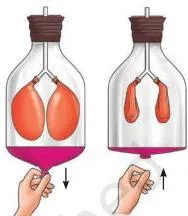
The Bottle and Balloon Breathing Model (Figs 9.9 and 9.10)
Activity 9.2 builds a working model of the chest (NCERT, p. 130). In the model, the Y-shaped tube stands for the windpipe, the two balloons stand for the lungs, the rubber sheet stands for the diaphragm, and the bottle stands for the chest cavity.
Watch what happens: pull the rubber sheet down and the balloons inflate — more room inside the bottle makes air get drawn in through the tube. Release the sheet up and the balloons deflate — less room pushes the air back out.
The real body works the same way. When you inhale, the ribs move up and out and the diaphragm moves down, so the chest space grows and air enters; when you exhale, both move the other way and air leaves (NCERT, p. 130).
The book’s own check questions: the balloons represent the lungs, and the rubber sheet represents the diaphragm (NCERT, p. 130).
Gas Exchange at the Alveoli (Fig 9.12)
This diagram is the answer to ‘how does oxygen actually get into my blood?’
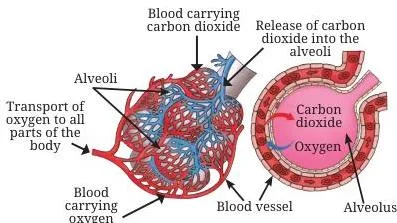
Read the diagram by direction: oxygen from the air inside the alveolus passes into the surrounding blood tubes, and carbon dioxide from the blood passes out into the air. The walls are thin, so the gases cross quickly. Blood then carries the oxygen to every part of the body (NCERT, p. 132).
Inhaled Air Versus Exhaled Air (Fig 9.13)
This diagram compares the percentage of oxygen and carbon dioxide in inhaled and exhaled air, and it answers ‘do we use up all the oxygen we breathe in?’
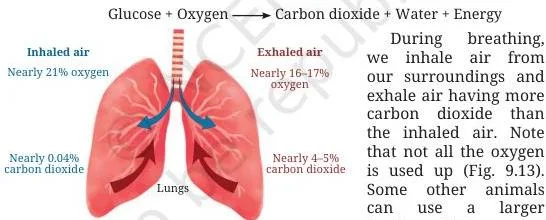
Inhaled air has more oxygen and less carbon dioxide; exhaled air has less oxygen and more carbon dioxide. Read it as ‘more’ and ‘less’ rather than memorising exact numbers. The subtle point the book insists on: not all the oxygen is used up — exhaled air still contains oxygen (NCERT, p. 132).
That is why the correct statement is ‘we inhale air rich in oxygen’, not ‘we inhale oxygen’.
Chapter Terms, Explained in Plain Words
These are the terms the chapter uses, defined the way you would write them in your own answer. Each definition matches the meaning the book gives.
| Term | Plain meaning | NCERT page |
|---|---|---|
| Alimentary canal | The long tube through which food travels, from the mouth to the anus | 122 |
| Mechanical digestion | The initial breakdown of food into fine pieces by crushing and chewing | 122 |
| Digestion | Breaking complex food components into simpler forms inside the body | 123 |
| Absorption | Passage of digested nutrients from the small intestine into the blood | 126 |
| Stool | Semi-solid waste left after the large intestine absorbs water and salts | 127 |
| Rectum | Lower part of the large intestine that stores stool until it is expelled | 127 |
| Egestion | Expelling stool through the anus; removal of waste the body does not need | 127 |
| Rumination | Bringing partially digested food back to the mouth for thorough chewing | 128 |
| Ruminants | Grass-eating animals, such as cows and buffaloes, that ruminate | 128 |
| Gizzard | Chamber in birds where food is broken down by wall movements and swallowed grit | 128 |
| Breathing | The process of inhaling and exhaling air | 129 |
| Nostrils | The pair of nasal openings through which air is inhaled and exhaled | 129 |
| Nasal passages | Small passages behind the nostrils where hair and mucus trap dust | 129 |
| Alveoli | Balloon-like sacs at the ends of fine lung branches where gas exchange occurs | 129 |
| Diaphragm | Dome-shaped muscle below the lungs that helps inhalation and exhalation | 130 |
| Respiration | Process by which glucose is broken down with oxygen to release energy | 132 |
| Gills | Breathing organs of most aquatic animals, richly supplied with blood vessels | 133 |
| Circulatory system | The heart, blood and blood vessels that transport substances around the body | 133 |
Mistakes Students Make in This Chapter
These are the traps the chapter’s own questions and activities are designed to catch. Each row names the wrong idea, the correct rule, and how to check yourself.
| Mistake | Correct rule | How to check your answer |
|---|---|---|
| ‘We inhale oxygen.’ | We inhale air rich in oxygen — air is a mixture of gases, and oxygen is only one part of it. | Question 6 (NCERT, p. 135): Tanu’s statement is the correct one; Fig 9.13 (NCERT, p. 132) shows oxygen is not the only gas in air. |
| Breathing and respiration are the same process. | Breathing is the physical movement of air in and out of the lungs; respiration is the chemical breakdown of glucose inside the body that releases energy. | Question 5 (NCERT, p. 135): ask ‘where does the breakdown of glucose happen?’ NCERT, p. 132 states physical vs chemical. |
| The small intestine is the shortest part because its name means ‘small’. | ‘Small’ means narrow. The small intestine is the longest part, about 6 m; the large intestine is shorter, about 1.5 m, but wider. | NCERT, p. 125: ‘almost 6 metres long — almost twice the height of your classroom’. |
| The iodine test on chewed rice failed when no blue-black appeared. | No blue-black is the result — it shows saliva converted the starch into sugar, so little starch remains. | Activity 9.1 (NCERT, p. 123): compare test tubes A and B — A turns blue-black because starch is still present. |
| All the oxygen we breathe in is used up during respiration. | Not all — exhaled air still contains oxygen. | Fig 9.13 (NCERT, p. 132): the exhaled-air comparison still shows oxygen present. |
| Breathing through the mouth is the same as breathing through the nose. | The nasal passages line with hair and mucus that trap dust; mouth breathing skips this filter. | NCERT, p. 129: ‘This is why we should breathe through the nose and not through the mouth.’ |
How to Answer the Questions in This Chapter
The chapter closes with ‘Let Us Enhance Our Learning’ (NCERT, pp. 135–136). Each question checks one concept from the chapter — the table below maps question to idea, with the answer to write. Note that textbook contents and the examinable syllabus are not always identical — check the current official syllabus.
| Question | What it checks | What to write |
|---|---|---|
| Q1: Journey of food | The order of the alimentary canal | Food → Mouth → Oesophagus → Stomach → Small intestine → Large intestine → Anus. |
| Q2: Iodine on three foods | The iodine test for starch | A (chapati pieces): blue-black — starch present. B (chewed chapati): little or no blue-black — saliva broke starch into sugar. C (boiled, mashed potato): blue-black — potato contains starch. |
| Q3: Role of the diaphragm | The meaning of each respiratory part | (iii) To help in inhalation and exhalation. |
| Q4: Matching respiratory parts | What each part does | (i)–(a), (ii)–(d), (iii)–(e), (iv)–(b), (v)–(c). |
| Q5: Breathing vs respiration | Physical vs chemical process | Ask: ‘If they are the same process, what is the oxygen we breathe in used for?’ or ‘Where does the breakdown of glucose happen — in the lungs or in the body?’ |
| Q6: Inhaled air or oxygen | Air is a mixture of gases | Tanu is correct: ‘We inhale air rich in oxygen.’ Shanu is wrong because we do not inhale pure oxygen. |
| Q7: Sneezing on dusty air | Dust trapping in the nasal passages | Possible explanation: hair and mucus trap dust, but heavy dust irritates the lining; sneezing pushes the irritant out. |
| Q8: Faster breathing after running | Oxygen demand and CO₂ removal | Two reasons: Anusha’s body needs more oxygen to release energy during running, and it produces more carbon dioxide that must be removed — both call for faster breathing. |
| Q9: Rice flour with saliva (Fig 9.15) | Does saliva break down starch? | Test tube A shows blue-black — starch present. B, with saliva added and left 35–45 min, shows no blue-black — saliva broke the starch into sugar. |
| Q10: Lime water test (Fig 9.16) | Carbon dioxide in exhaled air | She is comparing inhaled and exhaled air. B (exhaled air) turns milky, A does not; lime water turns milky with carbon dioxide, so exhaled air carries more CO₂. |
Answer structure that works for every observation question in this chapter: state the observation first, then the reason. Example: ‘Test tube B does not turn blue-black because saliva has already broken the starch into sugar.’
Question 9 shows Yadu’s rice-flour experiment — read the results in Fig 9.15. He wants to test whether saliva digests the starch in rice flour: the tube without saliva turns blue-black with iodine, the tube with saliva (left for 35–45 minutes) does not, because saliva broke the starch into sugar (NCERT, p. 136).
Question 10 shows Rakshita’s lime water set-up — read it in Fig 9.16. She is investigating whether exhaled air contains more carbon dioxide than inhaled air. She can confirm her findings because lime water turns milky in the presence of carbon dioxide: the tube receiving exhaled air turns milky, while the tube receiving inhaled air stays clear (NCERT, p. 136).
In a Nutshell: The Chapter in One Screen
The book closes with its own summary, ‘In a Nutshell’ (NCERT, p. 134). Here is that summary rebuilt in plain words — read this table the night before an exam for a one-screen revision.
| Idea | What the chapter says |
|---|---|
| Life processes | Nutrition, circulation, respiration, excretion and reproduction are essential for the survival of living beings. |
| Human digestive system | An alimentary canal — mouth, oesophagus, stomach, small intestine, large intestine, anus — with the liver and pancreas as associated parts. |
| Absorption | Digested food is absorbed mainly through the walls of the small intestine. |
| Distribution | Blood carries the absorbed nutrients to all parts of the body, where they are used for various functions. |
| Large intestine | Absorbs most of the remaining water and some salts from the undigested food. |
| Ruminants | Cows and goats chew food partially, swallow it, then bring the partially digested food back to the mouth and chew it thoroughly. |
| Breathing | The movement of air into the lungs (inhalation) and out of the lungs (exhalation). |
| Gas exchange | The exchange of oxygen and carbon dioxide occurs in the alveoli of the lungs. |
| Respiration | Uses oxygen from inhaled air to break down glucose into carbon dioxide and water, releasing energy. |
| Circulatory system | The heart pumps blood through blood vessels, delivering oxygen and nutrients and removing waste. |
| Physical vs chemical | Breathing is a physical process; respiration is a chemical process. |
| Adaptation | Different animals have different breathing mechanisms adapted to their habitats. |
Related Chapters and Resources
This listing is maintained for the 2026-27 academic session using the NCERT textbook information available to us. NCERT remains the authority for confirming the latest edition.
This chapter builds directly on the Grade 6 Curiosity chapter ‘Living Creatures: Exploring their Characteristics’ — open it from the Class 6 Science book page. Within this book, Chapter 9 sits between Chapter 8 and Chapter 10; the previous chapter page and next chapter page will keep the order straight.
The Class 7 Science (Curiosity) book page lists every chapter of this textbook, and the Class 7 hub links all Class 7 subjects. For revision, the Class 7 Science notes section covers these topics question by question; the notes on life processes in plants are the natural plant-side companion to this animal-focused chapter, and the measurement notes match the book’s earlier measurement chapter.
The general Class 7 notes and the CBSE notes home page are useful starting points for any topic.
The official PDF for this chapter is the NCERT file on ncert.nic.in (linked at the top of this page); the NCERT portal is the authoritative source for every NCERT textbook edition and PDF.
Sources and data verification: the contents described above are from the NCERT Class 7 Science (Curiosity) textbook, Chapter 9, official edition on ncert.nic.in, maintained for the current session. NCERT settles textbook editions, chapters and PDFs; CBSE settles the curriculum and syllabus.
| What the chapter holds | Count | Where it is used |
|---|---|---|
| Printed pages | 16 | |
| Sections in the chapter | 6 | |
| Figures with NCERT captions | 27 | |
| Tables | 1 | |
| Activities | 2 | |
| Official NCERT PDF | Download the chapter PDF | the chapter exactly as NCERT publishes it |
Reference: NCERT Class 7 Science (Curiosity) textbook, chapter 9, official edition on ncert.nic.in.
Frequently Asked Questions
Why does chapati or rice taste sweet when you chew it for 30 to 60 seconds?
Because saliva breaks down the starch in the chapati or rice into sugar. Starch is a carbohydrate; once saliva’s digestive juice acts on it during chewing, sugar forms and the food tastes sweet (NCERT, p. 122).
Do we inhale oxygen? What is the correct answer?
No — the correct statement is ‘We inhale air rich in oxygen.’ We breathe in air, which is a mixture of gases; oxygen is one of its components. That is why Tanu’s statement in Question 6 is the right one (NCERT, pp. 132, 135).
Why is the small intestine called small when it is longer than the large intestine?
‘Small’ refers to width, not length. The small intestine is the longest part of the alimentary canal — about 6 metres — while the large intestine is about 1.5 metres long but wider, which is why it is called ‘large’ (NCERT, pp. 125–126).
What is the difference between breathing and respiration?
Breathing is the physical movement of air in and out of the lungs; respiration is the chemical process inside the body that breaks down glucose using oxygen to release energy. Breathing brings in oxygen and removes carbon dioxide, while respiration uses that oxygen to release energy from food (NCERT, p. 132).
Why do cows keep chewing even when they are not eating?
Because cows are ruminants. They chew grass partially, swallow it, and later bring the partially digested food back to the mouth for thorough chewing — a cow spends about 8 hours a day chewing (NCERT, p. 128).
How do fish and earthworms breathe without lungs?
Fish use gills — organs richly supplied with blood vessels — to exchange oxygen and carbon dioxide with gases dissolved in water. Earthworms exchange gases through their moist skin (NCERT, p. 133).
Explore Class 7 Science Books
Related chapters: