
Looking for the Measurement of Class 7 Science Chapter 8 PDF? You are on the right page. This is NCERT Class 7 Science (Curiosity textbook) Chapter 8, Measurement of Time and Motion. The official chapter PDF is right below — it runs 16 printed pages covering how time was measured before clocks, the simple pendulum, the SI unit of time, speed, and uniform motion.
Download the Measurement of Class 7 Science Chapter 8 PDF
Open the official file — the NCERT Class 7 Science Chapter 8 Measurement of Time and Motion PDF — directly from the NCERT textbook portal, where every page of the Curiosity edition can be viewed and downloaded for free. It is the same book your school uses, and the contents table below shows what sits inside the chapter.
What the chapter holds: sections, figures and exercises at a glance






Use the table below to see the chapter’s sections, figures, worked examples and exercise questions in one place, so you know the size and shape of the file before opening it. The chapter works through Examples 8.1, 8.2 and 8.3 and ends with a titled exercise set.
How the chapter is organised: from ancient clocks to uniform motion
The chapter opens by measuring time, then uses time to measure motion; speed is the bridge between the two. Use the map below to jump straight to any section before you start reading.
| Section | What it teaches | NCERT pages |
|---|---|---|
| Opening story: Prerna’s race | What timekeeping looked like before clocks, and why the question matters | p. 105 |
| 8.1 Measurement of Time | Ancient devices — sundial, water clock, hourglass, candle clock — and their limits | pp. 106–108 |
| 8.1.1 A simple pendulum | Bob, oscillation, time period; Activity 8.2 | pp. 109–110 |
| 8.1.2 SI unit of time | The second, symbol rules, Activity 8.3 | pp. 111–112 |
| 8.2 Slow or Fast | Comparing motions by distance covered in the same time | pp. 112–113 |
| 8.3 Speed | Formula, units, Examples 8.1–8.3 | pp. 113–115 |
| 8.3.1 Relationship between speed, distance and time | Rearranged forms of the speed formula | p. 115 |
| 8.4 Uniform and Non-uniform Linear Motion | Constant versus changing speed on a straight line | pp. 116–117 |
| In a Nutshell, exercise set, Exploratory Projects | The chapter summary, the exercise set, and hands-on projects | pp. 118–119 |
Key ideas of the chapter, explained simply
The chapter teaches two measurements — time and motion. The pendulum and the speed formula are the tools it uses for each, and the five ideas below build on one another.
Why every clock uses a repeating process
Time itself is invisible, so we measure it by counting events that repeat at fixed intervals. A day is one sunrise-to-sunrise cycle; the phases of the Moon and the changing seasons are longer natural cycles that gave the first calendars (NCERT, p. 106).
Every early clock turned a steady, repeating flow into equal time intervals:
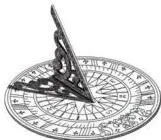
- Sundial — a gnomon’s shadow moves across a marked scale as the Sun crosses the sky; the shadow’s position is the time (NCERT, p. 106).
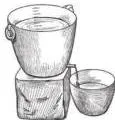
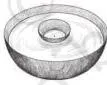
- Water clock — water flowing out past markings, or a floating bowl with a fine hole that fills and sinks in a fixed time (NCERT, p. 106).
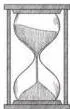
- Hourglass — sand flowing from one bulb to the other at a steady rate (NCERT, p. 106).
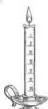
- Candle clock — a marked candle; the burned length shows how much time has passed (NCERT, p. 106).
None of these was very accurate. Ancient Indian water clocks lost accuracy as the water level dropped and the flow slowed, which led to the sinking-bowl Ghatika-yantra, first mentioned by Aryabhata. Its hole was sized so the bowl filled and sank in 24 minutes, giving the unit ghati — a day held 60 ghatis (NCERT, pp. 108, 111).
The breakthrough came with the pendulum clock, invented in 1656 by Christiaan Huygens, who was inspired by Galileo’s observation that a swinging lamp took the same time for every swing (NCERT, p. 108). All clocks, old or modern, work on one principle: some process repeating continuously marks equal intervals of time.
Modern clocks use the same principle, but far faster. Quartz clocks vibrate a quartz crystal and atomic clocks vibrate specific atoms; where Huygens’ clocks could gain or lose 10 seconds a day, atomic clocks lose about one second in millions of years (NCERT, p. 110).
The simple pendulum: bob, oscillation and time period
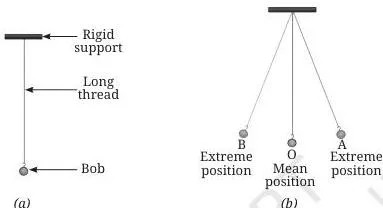
The pendulum is the first timekeeper in the chapter that swings, and it gives the definition the whole chapter depends on: the time period. A simple pendulum is a small metallic ball — the bob — suspended from a rigid support by a long thread (NCERT, p. 109).
The bob at rest is in its mean position (O in Fig 8.7b). Move it slightly to one side and release it, and it starts oscillatory motion; the motion is periodic because it repeats its path after a fixed interval of time.
One oscillation is a complete to-and-fro trip: from O to extreme A, back through O to the other extreme B, and back to O. The time taken for that one complete oscillation is the time period (NCERT, p. 109).
In Activity 8.2 you set up a pendulum about 100 cm long, time 10 oscillations with a stopwatch, repeat it 3–4 times, and divide each reading by 10 (NCERT, pp. 109–110).
The book times ten swings and divides by ten instead of timing one swing because a single swing is too short to time accurately: the error from starting and stopping the watch is a large fraction of one swing, but a small fraction of ten. Dividing the batch gives a time period far closer to the true value.
You should find the time period is almost the same every time. The conclusion: the time period of a simple pendulum of a given length is constant at a place — it depends on the pendulum’s length, not on the bob’s mass (NCERT, p. 110). A playground swing behaves the same way, as the Exploratory Projects point out (NCERT, p. 119).
The second: SI unit of time and how to write symbols
For measurements to be compared, everyone must use the same standard unit. The SI unit of time is the second, with symbol s; the larger units are the minute (min) and the hour (h), with 60 s = 1 min and 60 min = 1 h (NCERT, p. 111).
NCERT is strict about writing units: units and symbols begin with a lowercase letter, symbols are written in the singular, no full stop follows the symbol, and a space always separates the number from the unit. Writing ‘sec’ for second and ‘hrs’ for hour is incorrect (NCERT, p. 111).
In Activity 8.3 you look at a wall clock and identify its smallest measurable interval — one second (NCERT, p. 112). Fractions of a second matter beyond school: sports timing records races to hundredths or thousandths of a second, ECG machines measure millisecond variations in heartbeats, digital recordings capture sound thousands of times per second, and computers process signals in microseconds (NCERT, p. 112).
Speed: how we decide what is faster
The chapter now pivots from measuring time to measuring motion. For two races over the same distance, the runner with the shorter time is faster; for different distances, you need speed — the distance covered in one unit of time (NCERT, p. 113).
Speed compares any two motions the same way: whoever is ahead at a given instant has covered more distance in the same time, so that runner is faster (NCERT, p. 113). The formula is \[ \text{Speed} = \frac{\text{Total distance covered}}{\text{Total time taken}} \]
Its SI unit is metre per second (m/s); the everyday unit is kilometre per hour (km/h) (NCERT, p. 113). Here is a worked example with fresh numbers — a metro train covers 12 km between two stations in 10 minutes.
- Step 1: Write the given values with their units: distance = 12 km, time = 10 min.
- Step 2: Convert to SI units before dividing: \( 12\ \text{km} = 12 \times 1000 = 12000\ \text{m} \) and \( 10\ \text{min} = 10 \times 60 = 600\ \text{s} \).
\[ \text{Speed} = \frac{12000\ \text{m}}{600\ \text{s}} = 20\ \text{m/s} \]
Step 3: Convert to km/h using \( 1\ \text{m/s} = \frac{18}{5}\ \text{km/h} \).
\[ 20 \times \frac{18}{5} = 72\ \text{km/h} \]
Final answer: The metro train’s speed is \( 20\ \text{m/s} \), or \( 72\ \text{km/h} \).
The formula can be rearranged to find the other two quantities (NCERT, p. 115):
- \( \text{Total distance covered} = \text{Speed} \times \text{Total time taken} \)
- \( \text{Total time taken} = \dfrac{\text{Total distance covered}}{\text{Speed}} \)
One caution the book prints itself: the object probably did not move at one steady speed the whole way, so the speed you calculate is the average speed. This book uses the shorter word ‘speed’ to mean average speed (NCERT, p. 115).
Vehicles carry two instruments you will see in everyday life: a speedometer, which displays the speed in km/h, and an odometer, which measures the distance travelled in kilometres (NCERT, p. 116).
Uniform and non-uniform linear motion
Real vehicles rarely move at one steady speed, so the chapter names the ideal case first and then the everyday one. When an object moves along a straight line, its motion is linear motion — you met this in the Grade 6 chapter ‘Measurement of Length and Motion’ (NCERT, p. 116).
A train moving between two stations on a straight track is the chapter’s example: it starts from station A slowly, speeds up, then slows down and halts at station D. Only the stretch from B to C is covered at a constant speed (NCERT, p. 116).
- Uniform linear motion — motion along a straight line at constant speed. The object covers equal distances in equal intervals of time (NCERT, pp. 116–117).
- Non-uniform linear motion — motion along a straight line whose speed keeps changing. The object covers unequal distances in equal intervals of time (NCERT, p. 117).
Table 8.3 shows the difference with data from two trains, X and Y, at ten-minute intervals (NCERT, p. 117). Train X advances exactly 20 km every ten minutes — uniform. Train Y covers 20, 15, 15, 25, 20 and then 25 km in successive ten-minute intervals — non-uniform. Because uniform motion is an idealisation we seldom meet in real life, we use average speeds for real journeys (NCERT, p. 117).
Reading the diagrams: what Figures 8.1 to 8.11 show
The diagrams in this chapter are not decoration — each one is a claim about how a device works or how motion is compared. The three groups below walk through what to look for in each figure.
Figures 8.1 to 8.5: how early clocks kept time
Fig 8.1 shows a sundial. Read it by the shadow: the upright gnomon casts a shadow on a marked scale, and as the Sun moves across the sky the shadow rotates, so its position on the scale is the time of day (NCERT, p. 106).
Fig 8.2 packs two designs into one picture. In (a), water flows out of a marked vessel and the falling level shows the time; in (b), a bowl with a fine hole floats on water, fills up in a fixed time and sinks, then is lifted and floated again (NCERT, p. 106).
Fig 8.3, the hourglass, shows sand streaming between two bulbs at a steady rate — when the upper bulb empties, a fixed time has passed (NCERT, p. 106).
Fig 8.4, the candle clock, is read by length: the candle carries markings, and the portion already burned shows the elapsed time (NCERT, p. 106).
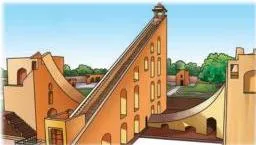
The image of the Samrat Yantra at Jantar Mantar, Jaipur shows early timekeeping at its grandest: about 27 metres tall, its shadow creeps at roughly 1 millimetre per second across a scale marked to read intervals as short as 2 seconds. Like every sundial, it reads local solar time, which needs a correction to convert to Indian Standard Time (NCERT, p. 107).
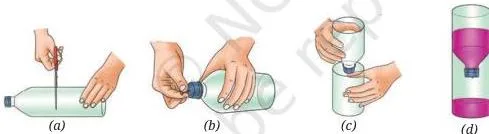
Fig 8.5, making a simple water clock, shows the construction steps of Activity 8.1: cut a bottle in half, pierce the cap with a drawing pin, invert the upper part over the lower half, fill it with water and mark the collecting water level every minute. Every time the dripping water reaches a mark, one more minute has passed (NCERT, p. 107).
The shared idea across all five figures: a steady, repeating flow — of shadow, water, sand or burning — is converted into equal time intervals.
Figures 8.6 to 8.9: pendulums and modern clocks
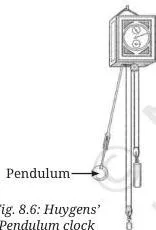
Fig 8.6, Huygens’ pendulum clock, is the seventeenth-century breakthrough in mechanical timekeeping. A swinging pendulum counts equal swings, and each swing marks an equal interval of time; the clock was invented in 1656 and patented in 1657 by Christiaan Huygens, building on Galileo’s work (NCERT, p. 108).
Fig 8.7, the simple pendulum, is the most important diagram to read carefully. Find the mean position O where the bob rests, the extremes A and B on either side, and trace one complete oscillation along the arc: O to A, back through O to B, and back to O (NCERT, p. 109).
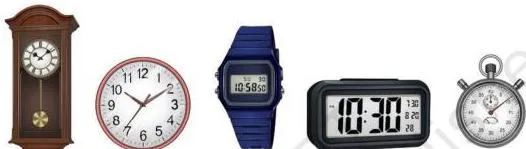
Fig 8.8, some common clocks and watches, makes the key point about modern timekeeping: the devices look different from a pendulum, but all run on a process repeating continuously. Quartz clocks vibrate a quartz crystal, atomic clocks vibrate specific atoms, and both are far more rapid than a pendulum swing (NCERT, pp. 110–111).
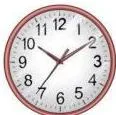
Fig 8.9, a wall clock, is the object of Activity 8.3: look at it and identify the smallest interval you can measure — one second, the beat of the second hand (NCERT, p. 112).
Figures 8.10, 8.11 and the playground swing: reading motion
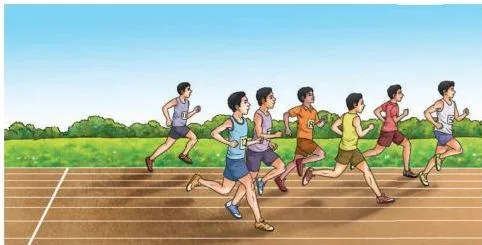
Fig 8.10, boys running a race on a straight track, gives the definition of “faster” used throughout the chapter: at any instant, the runner who is ahead has covered more distance in the same time, and that runner has the higher speed (NCERT, p. 113).
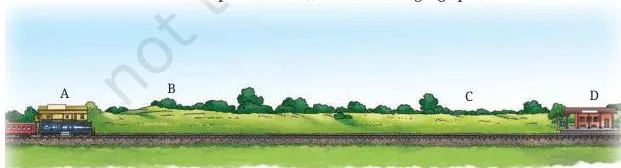
Fig 8.11, a train on a straight track, should be read as three stretches, not one journey. From A to B the train starts slowly (non-uniform), from B to C it holds a constant speed (uniform), and from C to D it slows and halts (non-uniform) (NCERT, p. 116).
The playground swing from the Exploratory Projects is a pendulum in disguise.
The project asks you to measure the time for 10 swings, divide by 10 for the time period, repeat with children of different weights (the time period should stay almost the same), and then repeat with swings of different lengths to see how the time period changes with length (NCERT, p. 119).
Key terms and definitions from the chapter
Definitions carry much of the weight in this chapter because the chapter is built on precise words — one oscillation, time period, speed, uniform. Memorise the table below, then check yourself by closing the page and defining each term aloud.
| Term | Plain definition | NCERT page |
|---|---|---|
| Bob | The small metallic ball of a pendulum, suspended by a thread | p. 109 |
| Mean position | The rest position of the bob, marked O in Fig 8.7 | p. 109 |
| Oscillatory motion | The to-and-fro motion of the bob after it is released | p. 109 |
| Periodic motion | Motion that repeats its path after a fixed interval of time | p. 109 |
| One oscillation | One complete to-and-fro trip: O to A, back to B, and back to O (or A to B and back to A) | p. 109 |
| Time period | The time taken by the pendulum to complete one oscillation | p. 109 |
| Speed | The distance covered by an object in a unit time | p. 113 |
| SI unit of speed | Metre per second, written m/s | p. 113 |
| Average speed | Total distance covered divided by total time taken | p. 115 |
| Uniform linear motion | Motion along a straight line at constant speed, covering equal distances in equal times | pp. 116–117 |
| Non-uniform linear motion | Motion along a straight line with changing speed, covering unequal distances in equal times | p. 117 |
The three terms that glue the chapter together are oscillation, time period and speed — define those three and the rest of the chapter follows.
The speed formula in its three forms
Every numerical question in this chapter is one of the same three operations — find speed, find distance, or find time. The table gives all three forms of the formula.
| Form of the formula | What it finds | SI units | Everyday units |
|---|---|---|---|
| \( \text{Speed} = \dfrac{\text{Total distance}}{\text{Total time}} \) | Speed | m/s | km/h |
| \( \text{Distance} = \text{Speed} \times \text{Time} \) | Distance | m | km |
| \( \text{Time} = \dfrac{\text{Distance}}{\text{Speed}} \) | Time | s | h |
The method of Example 8.1 also gives a conversion shortcut you will need for the exercise set (Q4 and Q5): because 1 km = 1000 m and 1 h = 3600 s, \[ 1\ \text{km/h} = \frac{5}{18}\ \text{m/s} \qquad 1\ \text{m/s} = \frac{18}{5}\ \text{km/h} \]
Worked example — finding speed:
Step 1: A metro train covers 12 km in 10 minutes.
Convert first: \( 12\ \text{km} = 12000\ \text{m} \), \( 10\ \text{min} = 600\ \text{s} \).
\[ \text{Speed} = \frac{12000}{600} = 20\ \text{m/s} \]
Step 2: Convert to km/h: \( 20 \times \frac{18}{5} = 72\ \text{km/h} \).
Final answer: \( 20\ \text{m/s} = 72\ \text{km/h} \).
Worked example — finding distance using the rearranged form:
Step 1: A bus moves at 15 m/s for 8 minutes.
Convert the time: \( 8\ \text{min} = 480\ \text{s} \).
\[ \text{Distance} = 15\ \text{m/s} \times 480\ \text{s} = 7200\ \text{m} \]
Step 2: Convert metres to kilometres: \( 7200\ \text{m} = 7.2\ \text{km} \).
Final answer: The bus covers \( 7200\ \text{m} \), or \( 7.2\ \text{km} \).
The four activities: what each one trains you to do
The chapter’s four activities form a progression: build a clock, use a clock, read a clock, then use time to measure real motion.
| Activity | What you do | Skill it builds | NCERT page |
|---|---|---|---|
| 8.1 Let us construct | Make a water clock from a cut bottle with a pierced cap; mark the water level every minute | Constructing a time-measuring device | p. 107 |
| 8.2 Let us experiment | Time 10 oscillations of a pendulum, repeat 3–4 times, divide by 10 | Measuring time and calculating a time period | pp. 109–110 |
| 8.3 Let us identify | Read the smallest interval of a wall clock | Identifying the limit of an instrument | p. 112 |
| 8.4 Let us calculate | Find train speeds from a railway timetable and compare them | Calculating and comparing speeds | pp. 114–115 |
The fastest train in Activity 8.4 is the one with the highest speed — the same rule as the fastest runner in Fig 8.10.
Mistakes this chapter traps: what NCERT warns about
The chapter quietly plants several traps, and the book itself names most of them. Check your work against this table before you practise.
| Mistake | Correct rule | How to check your answer |
|---|---|---|
| Writing ‘sec’ for second and ‘hrs’ for hour | Use the symbols s, min and h — lowercase, singular, no full stop, with a space between number and unit (NCERT, p. 111) | Re-read your written symbols after every calculation |
| Counting a half swing as one oscillation | One oscillation is a full O to A to B and back to O (or A to B back to A), not one side and back (NCERT, p. 109) | Trace the bob’s path in Fig 8.7 before counting |
| Thinking a heavier bob changes the time period | The time period depends on length, not on the bob’s mass (NCERT, p. 110) | Repeat Activity 8.2 with the same length but different bobs |
| Mixing units inside the speed formula | Convert km to m and minutes to seconds before dividing, as in Example 8.1 (NCERT, pp. 113–114) | Write every value with its unit and check the units cancel to m/s |
| Reading the book’s ‘speed’ as the speed at every instant | The book uses ‘speed’ for average speed (NCERT, p. 115) | Remember the object may have moved slower or faster in between |
| Calling the whole train journey uniform because the track is straight | Only the B to C stretch is uniform; A to B and C to D are non-uniform (NCERT, p. 116) | Name the stretch in Fig 8.11 that has constant speed |
| Expecting a wall clock to measure fractions of a second | Its smallest measurable interval is one second (NCERT, p. 112) | Watch the second hand — it jumps in one-second steps |
What the chapter’s own exercises ask you to do
The chapter’s closing exercise set, Let Us Enhance Our Learning, shows exactly the kinds of tasks this material produces. Work through Examples 8.1, 8.2 and 8.3 first — they demonstrate the three calculation patterns the exercises reuse (NCERT, pp. 113–115).
- Calculating speed from distance and time — Q1
- Comparing two runners over the same distance — Q2
- Finding time from speed and distance — Q3
- Expressing a speed in km/h and in m/s, and comparing speeds in different units — Q4 and Q5
- Classifying uniform and non-uniform motion with real examples — Q6 and Q9
- Filling gaps in a uniform-motion distance–time table — Q7
- Deciding whether a car’s motion is uniform and finding its average speed — Q8
- Judging uniform or non-uniform motion from data and averaging it — Q10
- A mixed journey with different speeds and segments — Q11
Textbook contents and the examinable syllabus are not always identical — check the current official CBSE syllabus for what is examinable this session.
In a Nutshell: the whole chapter in six points
These are the six statements the book itself chooses to keep at the end of the chapter (NCERT, p. 118).
- The time taken for one complete oscillation is the time period.
- The time period of a simple pendulum of a given length is constant at a place.
- The SI unit of time is the second, symbol s.
- The average speed of an object is the total distance covered divided by the total time taken.
- An object moving along a straight line at constant speed is in uniform linear motion.
- An object whose speed along a straight line keeps changing is in non-uniform linear motion.
Night-before self-check: can you define one oscillation, write the speed formula in all three forms, and convert 36 km/h into m/s? (Answer: \( 36 \times \frac{5}{18} = 10\) m/s.)
Related NCERT pages and chapters
This chapter looks backwards and forwards. It recalls the Grade 6 chapter ‘Measurement of Length and Motion’, where you first met oscillatory motion and linear motion (NCERT, p. 109).
The same habit of careful measurement runs through Class 7 Science — move on to the heat transfer notes or the life processes notes on this site, or keep every chapter together on the Class 7 Science notes page. Other subjects sit on the Class 7 hub, and the NCERT notes home page is the starting point for every class.
Sources and data verification
This listing is maintained for the 2026-27 academic session using the NCERT textbook information available to us. NCERT remains the authority for confirming the latest edition.
- The page references and figures on this page describe NCERT Class 7 Science — Curiosity, Textbook of Science for Grade 7 — Chapter 8, Measurement of Time and Motion, official edition on ncert.nic.in.
- This page covers that chapter only, not the whole CBSE scheme of studies.
- The listing is maintained for the current academic session using the NCERT information available to us.
- NCERT settles textbooks, editions and PDFs; CBSE settles curriculum, syllabus and examinations.
| What the chapter holds | Count | Where it is used |
|---|---|---|
| Printed pages | 16 | |
| Sections in the chapter | 7 | |
| Figures with NCERT captions | 23 | |
| Tables | 5 | |
| Official NCERT PDF | Download the chapter PDF | the chapter exactly as NCERT publishes it |
Reference: NCERT Class 7 Science textbook, chapter 8, official edition on ncert.nic.in.
Frequently asked questions about this chapter
How do I calculate the time period of a pendulum in Activity 8.2?
Time the pendulum for 10 oscillations, then divide by 10. Set up a pendulum about 100 cm long, release the bob, and use a stopwatch to measure the time taken for 10 complete oscillations. Repeat 3–4 times, then divide each reading by 10 (NCERT, pp. 109–110). You divide because one swing is too short to time accurately; timing a batch and dividing gives a reliable average.
Your readings should come out almost the same every time.
Does the time period of a pendulum depend on how heavy the bob is?
No. The time period of a simple pendulum of a given length is constant at a place and does not depend on the bob’s mass (NCERT, p. 110). It does depend on the length: pendulums of different lengths have different time periods.
What is the SI unit of speed and how do I change km per hour into m per second?
The SI unit of speed is metre per second, written m/s (NCERT, p. 113). To convert km/h to m/s, multiply by \( \frac{5}{18} \); to convert m/s to km/h, multiply by \( \frac{18}{5} \). For example, 72 km/h = \( 72 \times \frac{5}{18} \) = 20 m/s, and 20 m/s = \( 20 \times \frac{18}{5} \) = 72 km/h. The factors come from 1 km = 1000 m and 1 h = 3600 s.
What is the difference between uniform and non-uniform linear motion?
Uniform linear motion is motion along a straight line at constant speed, covering equal distances in equal intervals of time; non-uniform linear motion is motion along a straight line with changing speed, covering unequal distances in equal intervals (NCERT, pp. 116–117). In Table 8.3, Train X is uniform because it covers exactly 20 km every 10 minutes, while Train Y is non-uniform.
Why does the textbook call the calculated value just ‘speed’ instead of average speed?
Because the object may not have moved at the same speed for the whole journey — it may have been slower or faster at different moments. The value you calculate from total distance and total time is the average speed, and the book simply uses the shorter term ‘speed’ for it (NCERT, p. 115).
Is it wrong to write ‘sec’ for second and ‘hrs’ for hour?
Yes. NCERT states plainly that writing ‘sec’ for second and ‘hrs’ for hour is incorrect (NCERT, p. 111). The correct symbols are s for second, min for minute, and h for hour — lowercase, written in the singular, with no full stop after the symbol and a space between the number and the unit.
Explore Class 7 Science Books
Related chapters: