
This is Chapter 7 of the NCERT Class 7 Science textbook Curiosity — “Heat Transfer”, printed under the running heading “Heat Transfer in Nature”. It runs across printed pages 88 to 103 and explains how heat moves, first through simple activities and then through the water cycle, groundwater and the ice stupas of Ladakh.
If you searched for the heat transfer class 7 chapter PDF, the official NCERT file is right below — the same pages that appear in the printed book.
Heat Transfer Class 7 PDF Download
NCERT publishes each chapter of Curiosity separately on its official website. Download the Heat Transfer Class 7 chapter PDF to read the full activities, figures and review questions exactly as they appear in the printed book. This is the official NCERT edition, free to download.
What Is Inside Chapter 7
The counts table on this page lists how much the chapter holds — its sections, figures, activities and questions. What follows describes what the chapter teaches.
The chapter opens with Pema and Palden sitting around a fireplace in Gangtok, wondering why Kerala is warmer than Sikkim. Their grandfather’s answer — closeness to the equator and a long coastline — leads Pema to ask why cooking utensils are made of metal, and the chapter sets out to answer how heat gets transferred.
Each idea is built from a hands-on activity rather than a formula:
- a metal strip with wax-mounted pins — heat travelling through a solid;
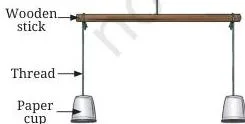
- paper cups above a candle — warm air rising;
- a coloured water streak in a heated beaker — the same movement in a liquid;
- bowls of soil and water in sunlight — why land and sea heat differently;
- flame warmth across a room — heat that needs no medium.
The second half applies those ideas beyond the classroom: the water cycle, water seeping into the ground, aquifers, and the ice stupas of Ladakh. The chapter ends with an “In a Nutshell” summary, review questions and exploratory projects.
What This Chapter Covers: From a Gangtok Fireplace to an Ice Stupa
Follow this roadmap with a finger on your own book; each entry gives the printed page where the topic starts.
- Opening story — Gangtok, the fireplace and the question “how does heat get transferred?” (NCERT, p. 89)
- Activity 7.1 and the definition of conduction; good and poor conductors (NCERT, pp. 90–91)
- House-building facts — cow dung and mud walls in the Himalayas, hollow bricks in hot regions (NCERT, p. 92)
- Convection in air and water — Activities 7.2 and 7.3 (NCERT, pp. 92–94)
- Activity 7.4 and land and sea breezes (NCERT, pp. 94–96)
- Radiation from the fireplace and the Sun, including the Dive Deeper note on light and dark clothes (NCERT, pp. 96–97)
- All three modes working together in one pan — Fig. 7.8 (NCERT, p. 97)
- The water cycle (NCERT, p. 98)
- Varahamihira’s rainfall predictions, Activity 7.5 on seepage, and aquifers (NCERT, pp. 99–101)
- The ice stupa of Ladakh (NCERT, p. 101)
- “In a Nutshell”, “Let Us Enhance Our Learning” and the exploratory projects (NCERT, pp. 101–104)
Key Concepts: The Three Ways Heat Moves
Heat moves from a hotter place to a colder one. This chapter teaches the three routes it can take: conduction, convection and radiation.
Conduction: Heat Passes Along a Solid, Particle by Particle
Conduction is why the handle of a metal pan gets hot even though only the bottom touches the flame — heat travels through the metal itself.
In Activity 7.1, four pins are stuck to a metal strip with wax, about 2 cm apart, and one end of the strip is heated with a candle. The pin nearest the flame falls first, then the next, then the next.
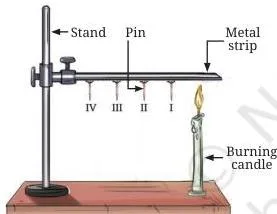
Why the order? Heat travels along the strip from the hot end to the cold end. As it reaches a pin, the wax holding that pin melts and the pin drops — the nearest pin’s wax melts first because the heat has the shortest distance to travel.
Conduction is heat transfer from the hotter part of an object to its colder part, in which a heated particle passes heat on to its neighbour but does not move away from its position (NCERT, p. 90).
Try this prediction with new numbers: stick pins at 1 cm, 3 cm and 5 cm from the flame. The 1 cm pin falls first because heat has just 1 cm of metal to cross before melting its wax; the 5 cm pin falls last. Pins never fall together because heat reaches their wax at different times.
Materials that let heat pass through easily are good conductors — metals, which is why cooking utensils are made of metal. Materials that block heat are poor conductors, or insulators: wood, glass, clay and porcelain (NCERT, p. 91). That is why tea stays hot longer in a clay or porcelain cup.
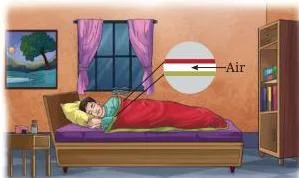
Air is also a poor conductor. Woollen clothes trap air in their pores, and the trapped air slows the flow of heat from your body to the surroundings (NCERT, p. 92). The same idea explains why two thin blankets with air between them keep you warmer than one thick blanket.
Convection: Heated Particles Rise and Carry Heat
Conduction cannot explain why smoke goes up — the heated material itself moves. This second mode is convection.
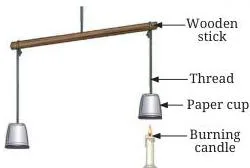
Smoke rises because it is a mixture of hot gases and tiny solid particles, warmer than the surrounding air. In Activity 7.2, a paper cup hung above a candle rises as the air inside it warms up: the heated air expands, takes more space, becomes lighter and moves upward (NCERT, p. 93).
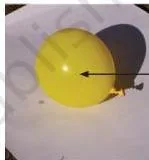
You can feel the same expansion without a candle. A partially inflated balloon placed in the Sun grows larger as the air inside warms and expands (NCERT, p. 93).
Activity 7.3 shows the same cycle in water. A grain of potassium permanganate is placed at the centre of the base of a beaker of water and a candle is lit below it. The coloured streak rises in the middle and sinks at the sides.
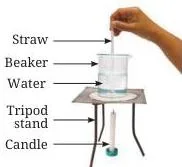
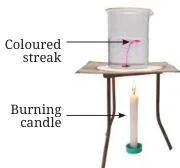
Water at the bottom expands, becomes lighter and rises; cooler water at the sides moves down to take its place, gets heated and rises in turn. The cycle continues until the whole beaker is warm. This is convection: heat transfer by the actual movement of particles of a liquid or gas from one place to another (NCERT, p. 93).
That is why convection happens in liquids and gases, where particles can move, and not in solids. Solids transfer heat mainly by conduction (NCERT, p. 101).
Radiation: Heat That Needs No Medium
You can sit near a fire and feel warm even though the air between you and the fire is not moving as a current. The warmth arrives by radiation — heat transfer that needs no medium (NCERT, pp. 96–97).
This is how the Sun’s heat reaches the Earth across empty space. Every object radiates heat; a hot utensil kept away from the flame cools down because it radiates heat to its surroundings.
Dive Deeper (NCERT, p. 97): light-coloured clothes reflect most of the heat that falls on them, so they suit summers; dark surfaces absorb more heat, so dark clothes suit winters.
One pan can show all three modes at once. In Fig. 7.8, heat goes from the flame to the pan by conduction, the water heats by convection, and the warmth you feel around the flame and the hot pan is radiation.
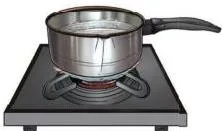
The chapter’s own wrap-up gives the rule to remember: conduction and convection need a material medium, radiation does not (NCERT, p. 97).
| Mode of heat transfer | Does it need a medium? | What the particles do | One example from this chapter |
|---|---|---|---|
| Conduction | Yes — a material must be present | Particles stay in their positions; each passes heat to its neighbour | Metal strip with wax pins — Activity 7.1 |
| Convection | Yes — in liquids and gases | Particles actually move from one place to another | Coloured water streak rising and sinking — Activity 7.3 |
| Radiation | No — no material medium required | No particles carry the heat; it travels directly from the hot object | Sun’s heat reaching the Earth; warmth from a fireplace |
Land Breeze and Sea Breeze: Why Coastal Wind Reverses at Night
This is convection on the scale of a coastline, and the chapter’s most asked-about application. Everything follows from one difference you can measure: land heats and cools faster than water.
Activity 7.4 puts soil in one bowl and water in another, each with a thermometer, and leaves both in sunlight. The soil’s temperature rises more in the same time, and after the pair is brought indoors the soil cools faster too (NCERT, p. 94).
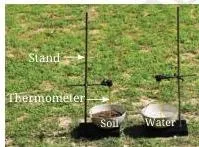
During the day:
- Land and sea are heated by the same Sun, but the land heats faster.
- Air above the land becomes warmer and rises.
- Cooler air from the sea moves in to take its place — that moving air is the sea breeze (Fig. 7.7a).
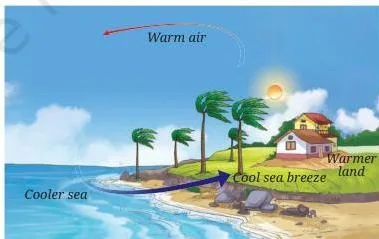
That is why coastal houses put their windows facing the sea — the breeze brings relief from the heat (NCERT, p. 95).
At night the process reverses:
- With no sunlight, the land cools faster than the sea.
- The air above the sea is now the warmer air, so it rises.
- Cooler air from the land moves towards the sea — the land breeze (Fig. 7.7b).
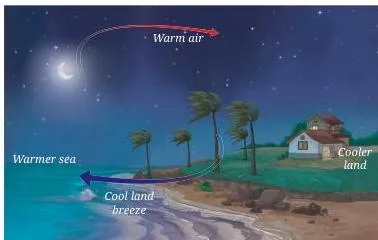
Memory aid: sea in the day, land at night. The same heating difference explains review question 8: large water bodies heat and cool slowly, so they prevent extreme temperatures in the areas around them.
Radiation and the Water Cycle: Sunlight That Drives Weather
The same Sun that dries wet clothes drives the movement of water between the earth and the sky.
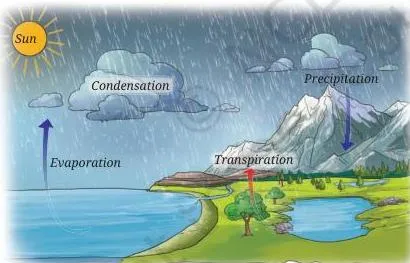
The Sun is the main source of heat for the Earth. Its radiation heats oceans, rivers and lakes, and water evaporates as vapour; water also leaves trees and plants through transpiration. Vapour rises, cools and condenses into clouds, and clouds release rain, snow or hail — precipitation (NCERT, p. 98).
The water cycle is the continuous movement of water — upward as vapour and downward through precipitation, passing through soil, rocks and plants, and finally returning to water bodies (NCERT, p. 98). It redistributes and replenishes water in rivers, lakes and oceans, and conserves the total amount of water on the Earth.
The Himalayan bukhari heater shows all three modes in daily use: the iron stove conducts heat, the chimney pipe and the room air convect, and the surrounding warmth radiates (NCERT, p. 97).
Figure Walkthrough: The Diagrams That Explain the Chapter


The chapter’s second half moves from heat transfer to water — how it seeps into the ground, where it is stored, and how people save it. These are the diagrams to read, not just look at.
Fig. 7.10 — seepage through clay, sand and gravel (NCERT, p. 99). Activity 7.5 pours the same amount of water through bottles filled with clay, sand and gravel. Water seeps fastest through gravel, slower through sand and slowest through clay, because the spaces between gravel particles are the widest.
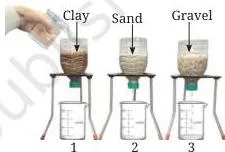
Fig. 7.11 — pore spaces (NCERT, p. 100). Water moves easily and is stored where the spaces between particles are wide, open and connected. Tight, disconnected spaces slow the water down.
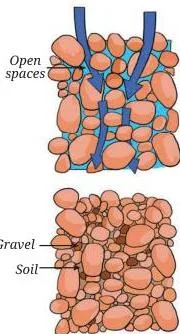
Fig. 7.12 — an aquifer (NCERT, p. 100). An aquifer is an underground layer of sediments or rocks that stores water in its pore spaces. Wells and bore wells draw this groundwater, which can lie from a few metres to hundreds of metres below the ground.
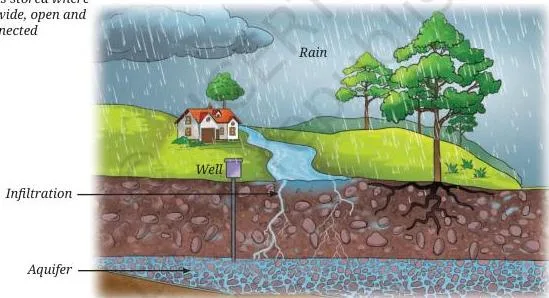
Fig. 7.13 — the ice stupa (NCERT, p. 101). In Ladakh, winter stream water is channelled through pipes and sprayed into the cold air, where it freezes as it falls. Layer by layer it builds a tall cone — the ice stupa — which melts slowly through spring, giving water for farming through the summer.
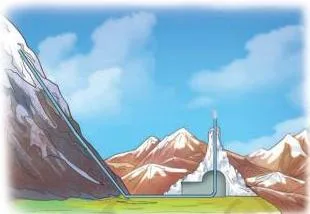
Fig. 7.14 — the saucepan (NCERT, p. 102, review question 1(i)). The pan is made of two materials. For it to work, the body that sits over the flame must be a good conductor so the food heats quickly, and the handle must be a poor conductor so you can hold it.
Match that idea to the parts labelled in the figure to pick the correct option.
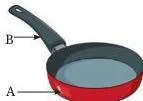
Fig. 7.15 — the pin-fall set-up (NCERT, p. 102, review question 1(ii)). This is Activity 7.1 again: the pins nearer the candle, I and II, fall before the pins farther away, III and IV, because heat reaches their wax earlier.
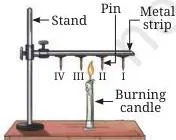
Fig. 7.16 — two thermometers in two test tubes (NCERT, p. 103, review question 6). The question asks which thermometer records the higher temperature. Do not memorise an answer — apply the convection cycle: the water closest to the flame heats first, expands, becomes lighter and rises.
Find where the flame is and where the bulb sits, then decide which bulb the rising warm water reaches first.
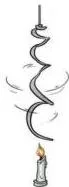
Fig. 7.17(b) — spiral paper above a candle (NCERT, p. 104, Exploratory Projects). Suspend a paper spiral over a burning candle and watch it turn: the rising hot air is a convection current you can see.
Definitions: The Words to Write Correctly in an Answer
These are the words the chapter expects you to use correctly in an answer. Each entry is one line, with the page to check.
- Conduction — heat transfer from the hotter part of an object to its colder part, with particles staying in position (NCERT, p. 90).
- Good conductors — materials that allow heat to pass through them easily, such as metals (NCERT, p. 91).
- Poor conductors / insulators — materials that do not allow heat to pass through them easily, such as wood, glass, clay, porcelain and air (NCERT, p. 91).
- Convection — heat transfer by the actual movement of particles of liquids and gases (NCERT, p. 93).
- Radiation — heat transfer from a hot object that needs no medium, such as the Sun’s heat reaching the Earth (NCERT, pp. 96–97).
- Sea breeze — the movement of cooler air from the sea towards the land during the day (NCERT, p. 95).
- Land breeze — the movement of cooler air from the land towards the sea at night (NCERT, p. 96).
- Evaporation — water turning into vapour when heated by the Sun (NCERT, p. 98).
- Transpiration — evaporation of water from trees and plants (NCERT, p. 98).
- Condensation — water vapour cooling to form clouds (NCERT, p. 98).
- Precipitation — rain, snow or hail released from clouds (NCERT, p. 98).
- Water cycle — the continuous movement of water upward as vapour and downward through precipitation, through soil, rocks and plants, back to water bodies (NCERT, p. 98).
- Infiltration — surface water seeping through soil and rocks (NCERT, p. 100).
- Groundwater — water stored in pore spaces of sediments and openings in rocks beneath the surface (NCERT, p. 100).
- Aquifer — an underground layer of sediments and rocks that stores water in pore spaces (NCERT, p. 100).
- Ice stupa — a cone of ice built in Ladakh by freezing sprayed stream water in winter, which melts slowly through spring (NCERT, p. 101).
Common Mistakes Students Make in Heat Transfer
Six confusions come up again and again in this chapter. Read the wrong idea, then the correct rule, then the check that catches the mistake.
| Mistake | Correct rule | How to check your answer |
|---|---|---|
| “Air is a good conductor because hot air rises” | Air is a poor conductor; rising air is convection, not conduction (NCERT, pp. 91–93) | Ask what moves — if the particles move, it is convection. |
| “Woollen clothes give us heat” | Wool traps air in its pores; the trapped air is a poor conductor that slows heat loss from your body (NCERT, p. 92) | Your body is the heat source; wool only slows the escape. |
| “Sea breeze blows at night, land breeze by day” | Sea breeze by day — land heats faster, its air rises, cool air comes off the sea; land breeze at night — the reverse (NCERT, pp. 95–96) | Repeat: sea in the day, land at night. |
| “Radiation needs a medium” | Radiation needs no medium; the Sun’s heat crosses empty space (NCERT, p. 96) | A fire warms you across a room with no moving current. |
| “Convection happens in solids” | Solids transfer heat mainly by conduction; convection needs particles that can move, so it happens in liquids and gases (NCERT, p. 101) | In a solid, particles stay in position — review question 3(i). |
| “Seepage and aquifer are the same thing” | Seeping into the ground is infiltration; groundwater is the stored water; the layer that stores it is the aquifer (NCERT, p. 100) | Gravel seeps fastest; the stored result is groundwater. |
What Each Activity in the Chapter Proves
The review questions test whether you understood the experiments, not just the definitions. This table maps each activity to the idea it demonstrates.
| Activity | What you do | What it proves |
|---|---|---|
| Activity 7.1 (NCERT, p. 90) | Stick wax-mounted pins on a metal strip and heat one end | Conduction in solids; the pin nearest the flame falls first as heat travels along the strip. |
| Activity 7.2 (NCERT, p. 92) | Hang two paper cups on a stick and place a candle under one | Convection in air; heated air expands, becomes lighter and rises, lifting the cup. |
| Activity 7.3 (NCERT, p. 93) | Heat a beaker of water with a potassium permanganate grain at its base | Convection in liquids; the coloured streak rises in the middle and sinks at the sides. |
| Activity 7.4 (NCERT, p. 94) | Leave bowls of soil and water with thermometers in sunlight | Soil heats faster than water and cools faster too — the cause of sea and land breezes. |
| Activity 7.5 (NCERT, p. 99) | Pour 200 mL of water through bottles of clay, sand and gravel | Infiltration depends on particle spaces; water seeps fastest through gravel and slowest through clay. |
Review questions 1(ii), 2, 5 and 6 lean directly on these experiments: the pin-fall order comes from Activity 7.1, the leaky tumbler uses the trapped-air idea behind the blanket figure, and the smoke and thermometer questions both use convection from Activities 7.2 and 7.3.
Exam Notes: How to Answer “Let Us Enhance Our Learning”
Textbook contents and the examinable syllabus are not always identical — check the current official syllabus for what counts this year. Nothing on this page promises a specific exam question; the table below maps each review question (NCERT, pp. 102–103) to the concept it tests, so you know what the question is really asking.
| Review question | Concept it tests | One line of guidance |
|---|---|---|
| 1(i) | Conductors and insulators | A saucepan needs a good-conducting body and a poor-conducting handle; match the labels in Fig. 7.14. |
| 1(ii) | Conduction order | Pins nearer the candle fall earlier — I and II before III and IV. |
| 1(iii) | Hot air rises by convection | Smoke rises with warm air and collects at the ceiling, so fit the detector there. |
| 2 | Trapped air as an insulator | The outer tumbler holds a layer of air round the leaky one; air is a poor conductor, so heat reaches the lassi slowly. |
| 3(i) | Convection vs conduction | False — solids transfer heat mainly by conduction. |
| 3(ii) | Definition of convection | True — convection is the actual movement of particles. |
| 3(iii) | Seepage and particle spaces | False — clay seeps slower than sand; gravel seeps fastest. |
| 3(iv) | Direction of land breeze | True — land breeze is cooler air moving from land to sea at night. |
| 4 | Radiation from the surroundings | Ice gains heat from the surroundings; all objects exchange heat by radiation. |
| 5 | Convection — smoke rises | The smoke moves upward even from a downward-pointing stick; draw an upward arrow. |
| 6 | Convection currents in water | Find the flame and the bulb in the figure; the bulb reached first by rising warm water records higher. |
| 7 | Air as a poor conductor | Hollow bricks trap air, which slows heat transfer and keeps rooms cooler in hot regions. |
| 8 | Land heats and cools faster than water | Large water bodies change temperature slowly, so they stop nearby areas from getting extreme. |
| 9 | Infiltration and groundwater | Rain seeps through soil and rocks into pore spaces and rock openings, stored as groundwater in aquifers. |
| 10 | Water cycle | The cycle moves water up as vapour and down as precipitation, through soil, rocks and plants, back to water bodies. |
A full answer in this chapter follows one shape: name the process, give the reason in one or two lines, then give an example from the chapter. Question 5 also asks for a diagram — draw the incense stick and an upward arrow for the smoke.
There are no numerical problems in this chapter’s review questions; every question tests a concept or an explanation.
Revision Summary: The Chapter in a Nutshell
The chapter’s “In a Nutshell” (NCERT, pp. 101–102), restated for a quick reread:
- Heat moves in three ways: conduction, convection and radiation.
- Conduction transfers heat from the hotter part of an object to the colder part; particles pass heat along but do not move. It works mainly in solids.
- Good conductors allow heat through easily — the metals. Poor conductors (insulators) — wood, glass, clay, porcelain, air — slow it down.
- Convection transfers heat by the actual movement of particles, so it happens in liquids and gases; land and sea breezes are examples.
- The Sun’s heat reaches the Earth by radiation, and all objects exchange heat with their surroundings through radiation.
- Conduction and convection need a medium; radiation does not.
- These principles are used in designing houses and clothing — wool, hollow bricks, mud-and-wood walls.
- The water cycle is the continuous upward movement of water as vapour and downward movement through precipitation, through soil, rocks and plants, back to water bodies.
- Infiltration is surface water seeping through soil and rocks; groundwater is stored in pore spaces and rock openings; aquifers are the underground layers that hold it.
Related Resources and Sources
This listing is maintained for the 2026-27 academic session using the NCERT textbook information available to us. NCERT remains the authority for confirming the latest edition.
Useful places to go next — the full book, the Class 7 pages, and the official source.
The book directory has the Class 7 Science Curiosity book page and the Class 7 hub. For study help, the Class 7 Science notes hub collects the science study pages on this site, and the Class 7 notes hub links the subjects covered at this level.
Two more chapter notes are Adolescence: a stage of growth and change and the measurement chapter; the notes home page lists everything else.
The official NCERT portal at ncert.nic.in publishes the Curiosity textbook and every chapter PDF. The download link above points straight to the NCERT edition of this chapter.
Sources and data verification
- The figures and page references on this page describe the NCERT Class 7 Science textbook Curiosity, Chapter 7 (“Heat Transfer”), printed pages 88–103, current NCERT edition.
- This page covers that single chapter, not the wider CBSE scheme of studies.
- The listing is maintained for the current academic session using the NCERT edition described above.
- NCERT settles the textbook, its editions and the official PDFs; CBSE settles the curriculum, syllabus and examinations. For what is examinable in this chapter, check the current official CBSE syllabus.
| What the chapter holds | Count | Where it is used |
|---|---|---|
| Printed pages | 16 | |
| Sections in the chapter | 6 | |
| Figures with NCERT captions | 33 | |
| Tables | 5 | |
| Activities | 3 | |
| Official NCERT PDF | Download the chapter PDF | the chapter exactly as NCERT publishes it |
Heat Transfer Class 7 FAQs
Short answers to the questions students ask while revising this chapter.
Why do pins stuck on a heated metal strip fall one by one from the flame end?
Because heat travels along the strip from the hot end, melting the wax of each pin in turn. The pin nearest the flame falls first because its wax melts first; the pins farther away fall as the heat reaches their wax (NCERT, p. 90).
How does heat from the Sun reach the Earth if space is empty?
By radiation, which requires no medium. Heat travels directly from the hot object — the Sun — across empty space to the Earth. Conduction and convection need a material medium; radiation does not (NCERT, pp. 96–97).
Why does the wind blow from the sea to the land during the day and reverse at night?
During the day, land heats faster than the sea, so warm air above the land rises and cooler air moves in from the sea — the sea breeze. At night the land cools faster, the air above the sea is warmer and rises, and cooler air moves from the land towards the sea — the land breeze (NCERT, pp. 95–96).
Do woollen clothes produce heat — why do they keep us warm?
No. Woollen fabric traps air in its pores, and air is a poor conductor of heat, so the trapped air slows heat loss from your body. The warmth is your own body heat, not heat produced by the wool (NCERT, p. 92).
What is the difference between conduction and convection?
In conduction, a particle passes heat to its neighbour while staying in its own position, which is why it works mainly in solids. In convection, the particles themselves move from one place to another, carrying heat with them, which is why it works in liquids and gases (NCERT, pp. 90, 93).
How does rainwater become groundwater?
Rainwater seeps through soil and rocks — a process called infiltration. The seeping water collects in pore spaces of sediments and openings in rocks beneath the surface as groundwater, and the underground layers that store it are aquifers (NCERT, p. 100).
Reference: NCERT Class 7 Science textbook (Curiosity), chapter 7, official edition on ncert.nic.in.
Explore Class 7 Science Books
Related chapters: