
This page gives you the official Adolescence: A Stage of Growth and Change Class 7 PDF — NCERT Class 7 Science (Curiosity), Chapter 6 — and explains what is actually inside the chapter. The chapter runs 16 printed pages, from book page 72 to page 88, and covers the physical, emotional and hormonal changes of the teenage years.
The official PDF is right here, and the sections below teach the ideas you need before you read it.
Download the NCERT Class 7 Science Chapter 6 Adolescence: A Stage of Growth and Change PDF
Get the NCERT Class 7 Science Chapter 6 Adolescence: A Stage of Growth and Change PDF from the official NCERT portal, where the whole Curiosity — Textbook of Science, Grade 7 is published free of charge — the chapter runs book pages 72 to 88 and closes with the Exploratory Projects.
Chapter 6 at a glance
The table below lists what Chapter 6 contains — its sections, figures, worked examples and exercise questions — so you can see the chapter’s size before you open the PDF.
What this chapter covers
This chapter explains what happens to the body between childhood and adulthood, and why, so the changes feel understandable instead of strange. It opens with an analogy: a seed must grow into a mature plant before it can produce new seeds — and humans, like all living beings, must reach maturity before they can reproduce (NCERT, p. 73).

The seedling figure above carries the chapter’s core idea: germination alone is not enough — the plant must grow and mature first. The book transfers that idea to human life: our bodies also need to grow and mature before we can reproduce, and adolescence is precisely that period of maturing (NCERT, p. 73).
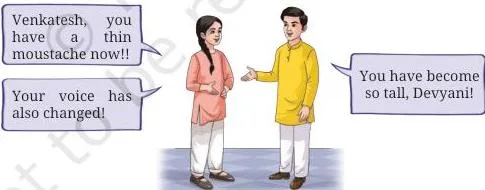
After this introduction, the chapter moves through the stages of life — infancy, childhood, adolescence, adulthood and old age — and opens the teenage years with a conversation between Venkatesh and his 12-year-old cousin Devyani (NCERT, p. 74). The chapter then follows this order:
- Section 6.1 — the visible changes of adolescence: height, body structure, voice, hair and facial skin (NCERT, pp. 74–77).
- Section 6.2 — the internal changes that indicate reproductive capability, especially the menstrual cycle, plus the myths around menstruation (NCERT, pp. 77–78).
- Section 6.4 — “Making Adolescence a Joyful Experience”: nutrition, personal hygiene, physical activity, a balanced social life and learning to say NO to harmful substances (NCERT, pp. 79–84). The printed book jumps from section 6.2 to 6.4, so there is no 6.3 heading to look for.
- Section 6.5 — the “why” of adolescence, answered with hormones (NCERT, pp. 84–85).
The chapter closes with an ‘In a Nutshell’ summary, the exercise set ‘Let Us Enhance Our Learning’, and Exploratory Projects (NCERT, pp. 85–88). Classroom activities woven through the sections ask you to observe changes in yourself and classmates, list emotional changes, note locally available foods and their nutrients, and design awareness posters on responsible social media use.
Key concepts of adolescence in this chapter
Adolescence is the bridge between childhood and adulthood. This chapter is about what happens on that bridge — what changes, why they happen, and how to manage them.
What adolescence is, and when it begins
Adolescence is the stage of development between childhood and adulthood, generally from about 10 to 19 years of age. It is a period of rapid growth and development, and its most important task is preparing the body for adulthood (NCERT, pp. 74–75).
Until about 10–12 years, most changes in the body are related to height and weight; the more noticeable changes that follow mark the onset of adolescence. Each person experiences these stages at their own pace, and their duration varies from one individual to another (NCERT, p. 73).
The class activity on page 74 asks you to write, without names, the changes you notice in students from Grades 5 to 8 — height, weight, strength, behaviour — and discuss them together.
The observable changes of the teenage years
These are the changes you can see, and the chapter groups them into five clear sets (NCERT, pp. 75–76):
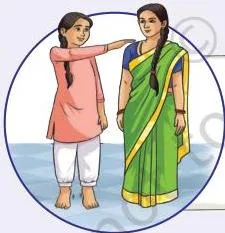
- Height: growth was always happening, but the increase becomes more prominent during adolescence (NCERT, p. 75).
- Body structure: boys gain weight with broader shoulders and a wider chest; girls grow in height and weight and develop breasts (NCERT, p. 75).
- Voice: in boys, the voice box grows, the voice sounds hoarse, and the growth may show as a bump in the throat called the Adam’s apple. Girls’ voice boxes also grow, but less, so the change is only slight (NCERT, p. 76).
- Hair: both boys and girls grow hair in the armpits and pubic region; boys often develop facial hair that becomes a moustache and beard, and some grow chest or back hair (NCERT, p. 76).
- Facial skin: acne appears as small reddish pimples when oily skin secretions increase and clog the pores, sometimes leading to infections (NCERT, p. 76).
The chapter’s key point: the timing, nature and extent of all these changes vary between individuals, and the variation is completely normal. Each person experiences adolescence at their own pace (NCERT, p. 76).
Changes like the voice change, facial hair and breast development distinguish males from females without being directly involved in reproduction; for this reason they are called secondary sexual characteristics.
They are natural signs that the body is preparing for adulthood, and they mark the onset of puberty — the stage in which the body changes, externally and internally, to become capable of reproduction (NCERT, p. 77).
Changes that indicate reproductive capability
Not all adolescent changes are visible. One important internal change in girls is the start of the menstrual cycle, commonly called “the period”. It recurs generally every 28–30 days, though many healthy girls have cycles anywhere from 21 to 35 days. The cycle is a natural process and one of the signs of good reproductive health (NCERT, p. 77).
Menstruation is the phase of the cycle in which blood discharges from the body. It lasts three to seven days, and some girls feel pain or discomfort in the lower abdomen during these days. Menstruation begins at puberty and generally stops by the age of 45–55, marking the end of reproductive capability (NCERT, p. 77).
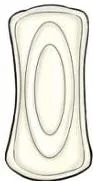
Menstrual hygiene matters for both comfort and health. The chapter recommends sanitary pads or reusable cloth pads, and proper disposal — wrap the used pad in newspaper and put it inside a dustbin. Biodegradable pads are also available, and used pads should never be left scattered near the bin (NCERT, pp. 80–81).
To support menstrual hygiene, the government runs several schemes (NCERT, p. 81):
| Scheme or initiative | What it does |
|---|---|
| Menstrual Hygiene Scheme (MHS) | Provides sanitary pads free of charge or at reduced price to adolescent girls in rural areas, with awareness programmes on menstrual hygiene and health. |
| Rashtriya Kishor Swasthya Karyakram (RKSK) | Aims to improve the overall health of adolescents, including menstrual health, and encourages peer education in which older students help younger ones learn. |
| Suvidha Sanitary Napkin Initiative | Provides biodegradable sanitary pads at affordable prices through Jan Aushadhi Kendras. |
| State-level initiatives | Examples include the ‘Shuchi Scheme’ in Karnataka and free sanitary napkin schemes in Tamil Nadu and Odisha, which distribute pads in government schools. |
Emotional and behavioural changes
Adolescence is not only physical. It brings stronger emotions than childhood, and the chapter’s Table 6.2 links mood swings with varied activities like music, dance or sport, and strong emotions with increased sensitivity, which can grow into compassion and social work (NCERT, p. 78).
These emotions show up in behaviour — joining social initiatives to support the needy, or developing deeper interest in new areas. Understanding how emotions influence behaviour helps adolescents make better choices and respond thoughtfully (NCERT, p. 78).
Hormones: the ‘why’ behind the changes
Why do all these changes cluster at this one stage of life? The chapter’s answer is hormones — chemicals produced in different parts of the body and released at the right time in response to signals from the brain. They regulate growth and development, and some of them influence mood and behaviour (NCERT, pp. 84–85).
Think of the brain as the control room: it sends the signal, the body’s hormone-producing parts release the chemical, and the change follows. Menstruation and the other signs of puberty are mainly driven by hormones — which is why the chapter treats hormones as the answer to the “why” question (NCERT, p. 84).
Figures in this chapter and what they show



Reading the figures in order is a quick way to revise the chapter. Each picture below illustrates one concrete idea — from pimples to smoke-damaged lungs.
Illustrations of the visible changes
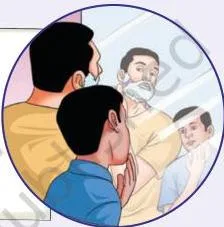
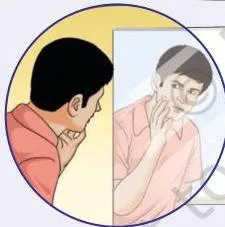
The two pictures on page 76 make the visible changes concrete. The first shows acne — small, reddish pimples, most often on the face, that appear because oily skin secretions increase during adolescence and clog the pores. The second shows the facial hair boys develop, which later grows into a moustache and beard towards adulthood (NCERT, p. 76).
The book’s reassurance applies to both pictures: the timing, nature and extent of these changes vary from person to person, and the variation is completely normal (NCERT, p. 76).
Health and safety figures: Figs 6.1 to 6.5
Five numbered figures carry the chapter’s health messages. Each one below is tied to one pillar of a healthy adolescence.
Fig. 6.1 shows a sanitary pad, one of the products used to maintain menstrual hygiene. The chapter also mentions reusable cloth pads and biodegradable pads, and stresses that used pads must be wrapped in newspaper before disposal (NCERT, p. 80).
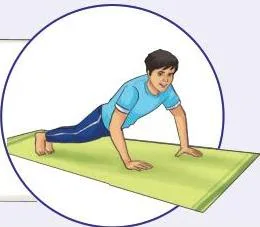
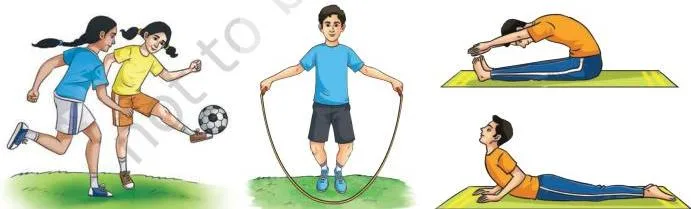
Fig. 6.2 shows physical activities. Regular exercise and games keep the body and mind fit, build stamina and boost mood — this is why physical activity is one of the chapter’s pillars of a healthy adolescence (NCERT, p. 81).
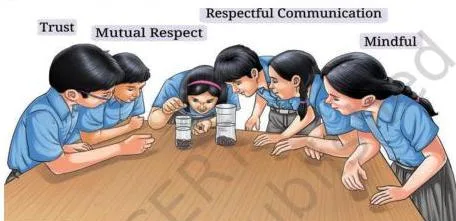
Fig. 6.3 shows collaborative learning. Being polite and respectful towards each other creates a favourable and safe environment, and is the heart of a balanced social life during adolescence (NCERT, p. 82).
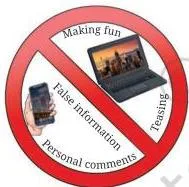
Fig. 6.4 shows cyberbullying — using phones, computers or online platforms to harass others by sending misleading messages, spreading false rumours, or sharing personal information without consent. If someone bullies you, seek help from parents and teachers, and be cautious about uploading pictures or sharing details with strangers (NCERT, p. 82).
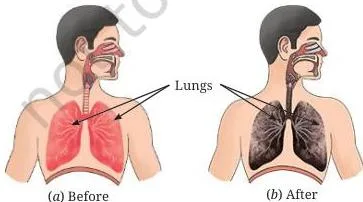
Fig. 6.5 is the chapter’s strongest visual: the condition of the lungs before and after prolonged exposure to beedi or cigarette smoke. It makes the case for saying NO to addictive substances, which can cause breathing difficulties, memory loss and lung damage (NCERT, p. 83).
Know a Scientist: Dorothy Hodgkin and vitamin B12
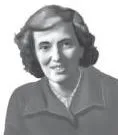
The scientist box on page 80 features Dorothy Hodgkin, who studied the structure of vitamin B12 and in 1964 became the third woman to win a Nobel Prize in chemistry. Vitamin B12 is needed for the proper functioning of the body, but like most vitamins it cannot be made in the body — it has to come from food.
This connects directly to the chapter’s note that adolescents, especially girls, may face blood-related health problems from iron or B12 deficiency (NCERT, p. 80).
Key terms and their meanings
This table collects the chapter’s exam-critical terms in plain words, with the NCERT page where each is explained.
| Term | Meaning |
|---|---|
| Adolescence | The stage of development between childhood and adulthood, generally from about 10 to 19 years, when the body prepares for adulthood (NCERT, pp. 74–75). |
| Puberty | The stage in which the body of an adolescent changes, externally and internally, to become capable of reproduction (NCERT, p. 77). |
| Secondary sexual characteristics | Features such as voice change, facial hair and breast development that distinguish males from females but are not directly involved in reproduction (NCERT, p. 77). |
| Menstrual cycle and menstruation | The natural cycle in girls, generally recurring every 28–30 days; menstruation is the phase of blood discharge, lasting 3–7 days (NCERT, p. 77). |
| Adam’s apple | The bump in the throat caused by the growing voice box in adolescent boys (NCERT, p. 76). |
| Acne | A skin condition in which small, reddish pimples appear because oily secretions clog the skin pores (NCERT, p. 76). |
| Substance abuse | The regular, addictive use of harmful substances such as tobacco, alcohol or drugs (NCERT, p. 83). |
| Hormones | Chemicals produced in the body and released in response to signals from the brain; they regulate growth and development, and some influence mood and behaviour (NCERT, pp. 84–85). |
Common mistakes and myths to avoid
This is where the chapter corrects ideas that students — and adults — often get wrong. Read each row before it becomes your mistake.
| Mistake | Correct rule | How to check your answer |
|---|---|---|
| “Adolescence is only physical changes” (Shalu’s claim in the exercise) | Adolescence also brings emotional and behavioural changes — mood swings, strong emotions and changed behaviour (NCERT, p. 78). | The chapter’s Table 6.2 lists emotional changes and their effects on behaviour; exercise Q4 asks you to correct exactly this claim. |
| “My changes are abnormal because my friends changed first” | The timing, nature and extent of changes vary between individuals, and the variation is completely normal (NCERT, p. 76). | ‘A key point to remember’ on page 76 states that each person experiences adolescence at their own pace. |
| “Menstruating girls should be physically isolated” | Menstruation is a natural process and a sign of good reproductive health; isolation has no scientific basis (NCERT, p. 77). | The ‘Breaking myths about menstruation’ passage on page 77 calls such taboos baseless. |
| “Just one try of a harmful substance won’t matter” | Addiction can begin with that one try — someone addicted today may have started with ‘just one time’ (NCERT, p. 83). | The chapter’s slogan on page 83: say NO to addictive substances the first time and every time. |
| “Any neck bump in a teenager is the Adam’s apple” | A neck bulge treated with an iodine-rich diet points to the thyroid; the Adam’s apple is the growing voice box (NCERT, pp. 76, 87). | Use the worked answer to exercise Q8 below: Mary vs Manoj. |
Menstrual myths, named and corrected
The chapter names the wrong beliefs about menstruation that cause fear, shame and guilt, and singles out physical isolation as a still common taboo (NCERT, p. 77).
| Myth | Why it is wrong |
|---|---|
| “A menstruating girl should be kept isolated from daily life” | Menstruation is a natural process; this myth has no scientific basis. Isolation comes from taboo, not from any health reason. |
| “Menstruation is something to fear or feel ashamed of” | Wrong beliefs create unnecessary fear, shame and guilt. The menstrual cycle is actually one of the signs of good reproductive health. |
Worked answer: the case of Mary and Manoj (exercise Q8)
Question: Mary, 11, developed a bulge on the front of her neck; the doctor gave her medication and asked her to take an iodine-rich diet. Manoj, 12, developed a bump on his neck; the doctor said it was part of growing up. Why the different advice?
Answer: Mary’s bulge, treated with medication and an iodine-rich diet, points to a thyroid problem linked to iodine deficiency — the thyroid gland needs iodine, so the doctor prescribed food rich in it.
Manoj’s bump is his voice box growing during adolescence; the visible bump in the throat is the Adam’s apple, a normal change of growing up (NCERT, p. 76; exercise, p. 87).
What a full answer includes: name the thyroid and iodine connection for Mary, name the Adam’s apple and voice box for Manoj, and state that Manoj’s change is normal while Mary’s needed treatment.
How to say NO: a practical checklist
Peers may tempt, persuade or pressure you to try tobacco, gutka, cigarettes, beedi, alcohol or drugs. The chapter’s advice is direct (NCERT, pp. 83–84):
- Say NO the first time and every time — stay firm and confident in your decision (NCERT, p. 83).
- Seek help from family and friends, and talk to trusted people such as parents or teachers (NCERT, p. 83).
- Use counselling and medical advice when handling pressure or addiction (NCERT, p. 83).
- Contact the National De-addiction Helpline — 14446 for support (NCERT, p. 84).
The chapter also mentions the Nasha Mukt Bharat Abhiyaan, launched by the Ministry of Social Justice and Empowerment, which spreads awareness about avoiding substance abuse with special focus on prevention among early-age children (NCERT, p. 84).
How to prepare for questions from this chapter
This chapter is descriptive: there are no formulas, so preparation means knowing the definitions, the age anchors and the examples. The chapter’s own exercise set, ‘Let Us Enhance Our Learning’ (NCERT, pp. 85–87), shows the question styles you should be ready for.
| Exercise question | Concept it tests | What a full answer includes |
|---|---|---|
| Q1 — pimples on an 11-year-old’s face | Acne and its cause | Oily secretions clog the skin pores and produce small reddish pimples; keep the skin clean and avoid squeezing the pimples (NCERT, p. 76). |
| Q2 — choosing a food group | Nutrition needs of adolescents | Pick the option with proteins and carbohydrates plus fats, vitamins and minerals — proper growth and playground performance need a balanced diet (NCERT, p. 79). |
| Q3 — unscramble the words | Terminology recall | menstruation, voice box, puberty, alcohol and drugs — spelling the terms correctly shows you know them. |
| Q4 — Shalu’s claim | Misconception correction | Shalu is wrong: adolescence brings physical, emotional and behavioural changes together, not physical changes alone (NCERT, p. 78). |
| Q5 — two discussion points | Reasoning on behaviour and addiction | Behavioural changes do matter; and a single try of a harmful substance does not mean you can stop any time — addiction can start with ‘just one time’ (NCERT, p. 83). |
| Q6 — mood swings | Emotional and behavioural changes | Name mood swings, strong emotions and increased sensitivity, and suggest positive outlets such as music, dance or sport (NCERT, p. 78). |
| Q7 — used pads scattered near a bin | Menstrual hygiene habits | Use pads or reusable cloth pads; wrap used pads in newspaper and dispose of them inside a dustbin, never beside it (NCERT, pp. 80–81). |
| Q8 — Mary’s bulge and Manoj’s bump | Applying ideas: iodine and the Adam’s apple | Mary’s iodine-rich diet points to the thyroid; Manoj’s bump is his growing voice box, a normal change (NCERT, pp. 76, 87). |
| Q9 — sorting physical changes | Categorising changes | Sort the seven changes into boys only, girls only and common to both — see the solved table below. |
| Q10 — healthy lifestyle poster | Applying all of section 6.4 | Show diet, hygiene, exercise, responsible social media use and saying NO to harmful substances (NCERT, pp. 79–84). |
Exercise Q9 solved: sorting the physical changes
The exercise lists seven changes and asks you to sort them into three columns. Here is the sorted table:
| Observed only in boys | Observed only in girls | Common in boys and girls |
|---|---|---|
| Change in voice (marked hoarseness) | Development of breasts | Pimples on the face |
| Growth of moustache | Growth of hair in the pubic region | |
| Growth of facial hair | Growth of hair in armpits |
The book notes that girls’ voices change slightly too, because their voice boxes also grow — but the marked hoarseness and the Adam’s apple belong to boys (NCERT, p. 76). That is why “change in voice” sorts under boys only in this exercise.
Two final notes. Definitions and age anchors matter most: adolescence (10–19), the menstrual cycle (28–30 days), menstruation (3–7 days) and its end (45–55) are the numbers to recall. Also, textbook contents and the examinable syllabus are not always identical — check the current official syllabus.
What the chapter’s ‘In a Nutshell’ recaps
The book closes the chapter with ten summary points. In plain words, they are:
- Adolescence is the change from childhood to adulthood, beginning around age 10 and usually lasting until 19.
- It brings significant physical, biological and emotional changes.
- Secondary sexual characteristics distinguish male from female but are not directly involved in reproduction.
- Puberty is the stage when the body changes, visibly and internally, to become capable of reproduction.
- Girls’ adolescence includes the start of the menstrual cycle, with blood discharge generally every 28–30 days (menstruation), beginning at puberty and generally ending by 45–55.
- Adolescents face several emotional and behavioural changes.
- A balanced diet, personal hygiene and physical activity help adolescents stay healthy.
- Addictive substances harm the body and mind — say NO and stay away.
- Hormones, the chemicals produced in the body, primarily control the changes of adolescence.
- Proper guidance and awareness help adolescents manage all these changes effectively.
For a night-before revision, lock in the four age anchors with this memory pattern: 10–19, 28–30, 3–7, 45–55.
| Age anchor | Number | Way to remember it |
|---|---|---|
| Adolescence | 10 to 19 years | roughly one decade of growing up |
| Menstrual cycle | generally 28–30 days | about one month |
| Menstruation (bleeding) | 3 to 7 days | a short week |
| Menstruation ends | 45 to 55 years | around the half-century mark |
Related resources
This listing is maintained for the 2026-27 academic session using the NCERT textbook information available to us. NCERT remains the authority for confirming the latest edition.
For the wider set of chapter notes, see the Class 7 Science notes on this site, the Class 7 hub, or the full CBSE notes collection. The notes for the preceding chapter, Changes Around Us: Physical and Chemical Changes, and the following chapter, Heat Transfer, are useful for a complete revision of the book.
For reference, NCERT’s official textbook portal hosts the whole Curiosity — Textbook of Science, Grade 7 as a free PDF.
| What the chapter holds | Count | Where it is used |
|---|---|---|
| Printed pages | 16 | |
| Sections in the chapter | 10 | |
| Figures with NCERT captions | 21 | |
| Tables | 5 | |
| Official NCERT PDF | Download the chapter PDF | the chapter exactly as NCERT publishes it |
Reference: NCERT Class 7 Science (Curiosity) textbook, chapter 6, official edition on ncert.nic.in.
Sources and data verification
The page references and figure captions above describe the NCERT Curiosity — Textbook of Science, Grade 7, English edition, Chapter 6: Adolescence: A Stage of Growth and Change (book pages 72–88). This page covers the NCERT Curiosity textbook only — it does not cover other publishers’ books or the wider CBSE subject scheme.
This listing is maintained for the current academic session, using the NCERT Curiosity edition published on ncert.nic.in as its reference.
Who settles what: NCERT settles textbooks, their editions and the official PDFs; CBSE settles the curriculum, syllabus and examinations. A chapter in a textbook does not by itself prove that every part of it is examinable — check the current official syllabus.
Frequently asked questions about adolescence
What is the difference between adolescence and puberty?
Adolescence is the broad stage of development between childhood and adulthood, generally from 10 to 19 years of age. Puberty is the stage within it when the body changes, externally and internally, to become capable of reproduction. In short: puberty is about reproductive capability, while adolescence is the whole period that also includes emotional and behavioural changes (NCERT, pp. 74–77).
Why do pimples appear on the face during adolescence, and what relieves them?
Oily secretions from the skin increase during adolescence and clog the skin pores, producing small reddish pimples — the condition called acne (NCERT, p. 76). For relief, keep the skin clean and avoid squeezing the pimples, since the problem starts with clogged pores that can become infected.
Is it normal to grow taller or develop a voice change later than my friends?
Yes, completely normal. The book says the timing, nature and extent of changes like height and voice vary between individuals, and these variations are normal; each person experiences adolescence at their own pace (NCERT, p. 76).
Why are myths and taboos about menstruation wrong?
Because menstruation is a natural process and a sign of good reproductive health. Myths and taboos — such as physically isolating menstruating girls — have no scientific basis and create unnecessary fear, shame or guilt (NCERT, p. 77).
What should a student do if someone pressures them to try tobacco, alcohol, or drugs?
Say NO firmly, the first time and every time. Seek help from family and trusted people such as parents or teachers; counselling and medical advice can also help. The National De-addiction Helpline is 14446 (NCERT, pp. 83–84).
Where can I get the official NCERT Class 7 Science Chapter 6 Adolescence PDF?
Open the official NCERT textbook portal, choose Class 7 and the Science (Curiosity) book, and select Chapter 6 — the same free official PDF is linked at the top of this page. The chapter runs from book page 72 to page 88.
Explore Class 7 Science Books
Related chapters: