
The Value of Work Class 6 chapter — Chapter 13 of the NCERT Social Science textbook Exploring Society: India and Beyond — opens on printed page 182 and closes around page 194, inside the book’s theme “Economic Life Around Us”.
It is a story-driven chapter that sorts everyday activities into economic and non-economic ones and shows how people are paid for work. The official NCERT PDF of this chapter is right here.
Download the Value of Work Class 6 NCERT Chapter 13 PDF
Get the official NCERT Class 6 Social Science Chapter 13 The Value of Work PDF from NCERT’s own textbook portal at ncert.nic.in, where the publisher hosts the chapter files for Exploring Society: India and Beyond — no sign-in required and no third-party host.
Chapter 13 at a glance
Before you open the file, here is what kind of chapter it is. The Value of Work is a story-and-dialogue chapter: it gathers everyday activities through two children’s stories, then sorts them into two big categories — economic activities and non-economic activities.
Along the way, the chapter defines payment terms in small boxes — market, fee, money’s worth, salary, wage and payment in kind — and shows how a carpenter’s skill adds value to wood. It includes two fill-in tables, closes with a recap and four questions, and ends on a doodle page called “Noodles” — short for “Notes and Doodles”.
The running theme printed in the header of every page is “Economic Life Around Us”, so this chapter belongs to a set of chapters about how people earn, spend and share.
How the chapter is organised: from a park conversation to value addition
The chapter never starts with definitions. It first lets two children collect real activities from people around them, and only then sorts those activities into categories — so the definitions land on examples you already know. Follow the book’s own flow:
- pp. 182-183 — Opening. A Swami Vivekananda quote about doing work with full attention as worship, then two “Big Questions”: what types of activities people engage in, and what these activities contribute to everyday life.
- pp. 183-184 — Anu and Kabir’s park conversation. The children notice their neighbour Geeta Aunty, an Indian Air Force pilot, returning from work. The conversation introduces the grandfather’s free Geography classes and garden work, the parents’ uniform shop, Maa’s voluntary knitting group and Rohan’s software job with weekend volunteering.
- p. 185 — First definitions. The first LET’S EXPLORE table collects the characters’ activities. The chapter then defines economic activities and non-economic activities, with boxes for market, fee and money’s worth.
- pp. 186-187 — Examples on both sides. An illustration spread shows economic examples (selling school bags, farmers selling produce, a lawyer earning a fee, a truck driver, factory workers) and non-economic examples (parents cooking, helping with schoolwork, caring for grandparents, helping renovate the house). A second task adds a third column — “economic / non-economic activity” — to the first table. The salary box appears here.
- p. 188 — Kavya’s visit to Kamlapur. A second story begins: highway construction with technicians operating excavators and bulldozers; Kavya’s uncle runs a bulldozer for a monthly salary, and her aunt works at the post office and also conducts paid online classes for a weekly fee.
- p. 189 — Wage and payment in kind. At a mango orchard, Sahil the farm labourer is tilling land with a tractor, earning a daily wage — part in cash, part in mangoes of equal value.
- p. 190 — Value addition and a second table. Rajesh the carpenter buys wood for ₹600, works it with his tools and sells a chair for ₹1,000; the ₹400 is the value of his skill, time and effort. A second LET’S EXPLORE table asks you to tick activities that create monetary value.
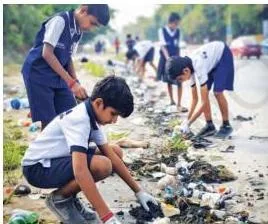
- pp. 191-192 — Importance of non-economic activities. The chapter presents sevā through temple prasad and the langar at the Golden Temple, then community participation through Swachh Bharat Abhiyan and Van Mahotsav.
- p. 193 — Recap and questions. “Before we move on…” sums up the chapter, and four closing questions test it. Three THINK ABOUT IT prompts along the way are for discussion.
- p. 194 — Noodles. The chapter ends with a doodle page.
The two LET’S EXPLORE tables and how to use them
The chapter contains two LET’S EXPLORE tables, and both are practice, not theory.
- First table (p. 185): fill in what each character in the story does. On p. 187 you add a third column, “economic / non-economic activity”, and classify every row.
- Second table (p. 190): tick the activities or professions that create monetary value, state an example of money-related value creation for each, and add two rows of your own.
Key concepts: economic and non-economic activities
The whole chapter turns on one question: does the activity bring money or money’s worth to the person doing it? If yes, it is economic; if it is done from feeling — gratitude, love, care or respect — it is non-economic. Keep that single test in mind and every example in the chapter sorts itself.
The one rule that separates the two
An economic activity is one performed in exchange for money or money’s worth — for example, a business person selling school bags in the market, a farmer selling produce, a lawyer charging a fee, or a truck driver carrying goods (p. 185).
A non-economic activity brings in no income; people do it out of gratitude, love, care or respect — for instance, parents cooking for the family, children helping grandparents, or family members renovating the house together (p. 186).
Apply the rule to the story’s people:
| Person from the story | What they do | Category |
|---|---|---|
| Geeta Aunty, Air Force pilot | Flies aircraft; receives a salary | Economic |
| Kabir’s grandfather | Free Geography classes for neighbourhood kids | Non-economic |
| Kabir’s parents | Run a shop selling uniforms and ready-made garments | Economic |
| Maa | Works in the shop; teaches knitting in a voluntary group | Both — shop work is economic, knitting is non-economic |
| Rohan, software engineer | Develops computer applications for a company; volunteers computer skills on weekends | Both — the job is economic, the volunteering is non-economic |
Now practise the rule on cases the book does not use. Decide each one yourself before reading the answer column.
| Activity | Economic or non-economic? | Why |
|---|---|---|
| A cobbler mending shoes for cash | Economic | Done in exchange for money |
| A student watering the school garden | Non-economic | No payment; done from care for the school |
| A neighbour baking a cake for a child’s birthday | Non-economic | A free gift of love, not a sale |
| A plumber fixing a tap for payment | Economic | The payment is a wage for the work |
| A grandchild reading to a grandmother | Non-economic | Done from care and respect |
The same comparison, arranged for revision:
| Economic activities | Non-economic activities | |
|---|---|---|
| What they are | Performed in exchange for money or money’s worth (p. 185) | Performed from gratitude, love, care or respect; generate no income (p. 186) |
| Why people do them | For the income the work brings | From feeling, with no expectation of payment |
| Do they earn income? | Yes | No |
| Examples | Selling school bags, farming for the market, a lawyer’s fee, truck driving, factory work | Cooking for the family, helping with schoolwork, caring for grandparents, sevā and langar |
How people are paid
The chapter keeps meeting people who work, and each one is paid differently. These payment terms are the easiest things to mix up, so separate them clearly.
Salary is a fixed regular payment, generally paid monthly by an employer to an employee (p. 187). Geeta Aunty the pilot, Kavya’s uncle the bulldozer technician and Kavya’s aunt at the post office all receive salaries.
Fee is a payment for professional advice or services — a doctor or lawyer charges a fee (p. 185). Kavya’s aunt charges a weekly fee for her online exam-preparation classes.
Wage is a payment made by an employer to a worker for a specific period of work, often calculated daily (p. 189). Sahil the farm labourer earns a daily wage for tilling the farmer’s land.
Payment in kind is a non-cash payment received for work (p. 189). Sahil gets part of his wage as mangoes of equal value.
Memory hook: “Fee for a professional, salary for a steady job, wage for daily work, kind when goods replace cash.” One activity can also mix forms — Sahil’s cash-plus-mangoes wage is still fully economic, because the mangoes are money’s worth.
Value addition: what work adds to materials
Why is a chair worth more than the wood it came from? Because work — skill, time, effort and tools — adds value to materials at each stage of transforming them (p. 189).
The chapter’s own example: Rajesh the carpenter buys wood for ₹600, builds a chair and sells it for ₹1,000 (p. 190). The remaining ₹400 — ₹1,000 minus ₹600 — is the monetary value of his skill, time and effort. Rajesh has added value to the wood by turning it into furniture.
Try the same subtraction on a fresh case. A tailor buys cloth for ₹300, stitches a shirt and sells it for ₹500. The value added is ₹500 minus ₹300, that is, ₹200. Where did that ₹200 come from? It is the value of the tailor’s stitching skill, the time taken and the use of the sewing machine — not simply profit.
The same logic works for a baker: flour, sugar and fuel costing ₹200, turned into bread sold for ₹350, give a value addition of ₹150.
Reading the chapter’s pictures: a figure walkthrough


The chapter’s pictures are teaching tools, not decoration. Each one below is an original NCERT illustration, and each adds a detail the text alone does not carry.
Pictures from Anu and Kabir’s story
The first four pictures build the chapter’s two categories from real people.
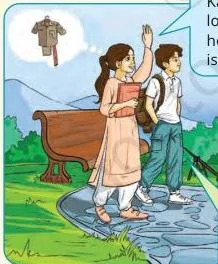
The park scene opens the chapter’s question: what do people around us do all day? Geeta Aunty, the Indian Air Force pilot, is the first of many working people the children meet.
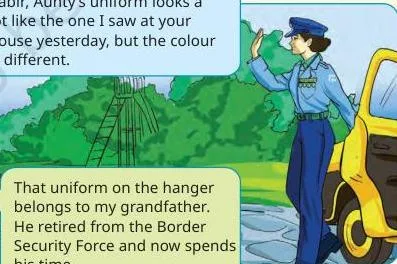
The uniform picture links two worlds. Geeta Aunty wears her Air Force uniform for a salaried job; the similar BSF uniform at Kabir’s home belongs to his grandfather, who now spends his retirement teaching free Geography classes, tending the garden and running errands — work without payment.
The shop is an economic activity: the parents sell uniforms and other garments for money. It also explains why uniforms keep appearing in the story — Kabir’s family sells them.
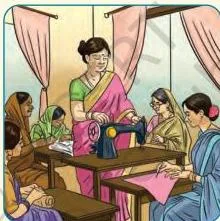
Maa is the chapter’s clearest case of one person in both categories. In the shop she takes part in an economic activity; in the voluntary group that teaches knitting to women in the community she works for free — a non-economic activity.
Pictures from Kavya’s trip
The five pictures from Kavya’s visit to Kamlapur show how a working village runs — salaries, wages and the value a carpenter adds.
The trip to Kamlapur carries the chapter’s second set of examples. On the way, Kavya sees a highway being built — large machines such as excavators and bulldozers operated by dedicated technicians.
Her uncle is a bulldozer technician in a construction company and receives a monthly salary; her aunt works at the post office and also conducts online classes for a weekly fee.
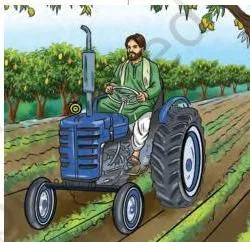
Sahil is the chapter’s example of a wage and of payment in kind. He earns a daily wage for tilling the farmer’s land — part in cash, part in mangoes of equal value. The mangoes are money’s worth, so his work stays fully economic.
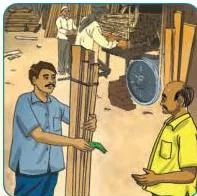
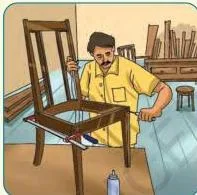
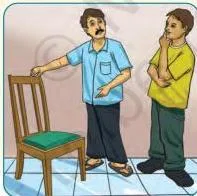
Rajesh the carpenter is shown in three linked panels. Together they are the whole value-addition lesson; read them left to right like a story.
Step by step: the first panel introduces Rajesh the carpenter; the second shows the raw material — wood bought for ₹600 in the market; the third shows the skill stage, with special tools and other materials. The final step lives in the text: the finished chair sells for ₹1,000.
The ₹400 difference between wood and chair is exactly the value added by skill, time and effort.
Pictures of sevā and community service
The last two pictures show non-economic activities in action.
Prasad is an example of sevā — selfless service. The chapter notes that sevā is seen in temples, gurudwaras, mosques and churches, and that such practices foster a sense of satisfaction and gratitude for what we have (p. 191).
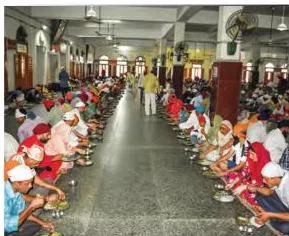
Langars, the community kitchens at gurudwaras, serve food to every visitor free of charge. The chapter calls this contributing to society without expecting anything in return, and connects it to collective efforts like Swachh Bharat Abhiyan and Van Mahotsav (pp. 191-192).
Key terms and what they mean
The chapter drops its payment terms in small boxes as it goes. This table gathers every boxed term in one place, in plain words.
| Term | Plain meaning | Chapter example | NCERT page |
|---|---|---|---|
| Market | A place where people exchange goods and services, usually for money | A business person selling school bags | 185 |
| Fee | Payment for professional advice or services | A doctor or lawyer; Kavya’s aunt’s online classes | 185 |
| Money’s worth | The monetary value a person places on something from the benefit it gives | The mangoes Sahil receives as part of his wage | 185 |
| Salary | A fixed regular payment, generally paid monthly by an employer | Geeta Aunty the pilot; Kavya’s aunt at the post office | 187 |
| Wage | Payment by an employer to a worker for a specific period of work, often daily | Sahil the farm labourer tilling the land | 189 |
| Payment in kind | A non-cash payment received for work performed | Sahil’s mangoes | 189 |
| Value addition | The increase in value at each stage of transforming something into another form | Rajesh’s wood (₹600) into a chair (₹1,000) | 189-190 |
Mistakes students make in this chapter
Students rarely struggle with the definitions of economic and non-economic activity — they struggle with the boundary: what actually counts as economic. These four errors cover most of the slips.
| Mistake | Correct rule | How to check your answer |
|---|---|---|
| “Money is involved, so it must be economic.” | The test is not whether money touches the activity, but whether the activity is performed in exchange for money or money’s worth (p. 185). | Ask: who does this activity for, and does the doer earn income from it? Buying vegetables for dinner earns nothing. |
| “Non-economic activities have no value.” | Care, gratitude and community spirit carry real value even though no income is earned (pp. 191-192). | Ask: does it strengthen family, community or personal wellbeing? That is value. |
| “Salary, wage and fee mean the same thing.” | Salary is fixed and regular (usually monthly, from an employer); a wage is for a specific period of work, often daily; a fee is for a professional service (pp. 185, 187, 189). | Match payer and period: employer + monthly = salary; daily work = wage; professional advice = fee. |
| “Payment in kind is not economic.” | Sahil’s mangoes are money’s worth — a non-cash part of his wage — and the activity stays fully economic (p. 189). | Check whether the work still earns income; only the form of payment has changed. |
What the chapter’s questions expect you to know
The chapter tells you what it expects through its own closing questions. Here is what each of the four questions (p. 193) is really asking, and where to revise.
| Closing question | What it really tests | Where to revise |
|---|---|---|
| 1. How are economic activities different from non-economic activities? | The core rule and the definitions of both categories | pp. 185-186 |
| 2. What kind of economic activities do people engage in? Illustrate with examples. | Using the payment types and value addition with the story’s people — the pilot’s salary, the online classes’ fee, Sahil’s wage, Rajesh’s carpentry | pp. 187-190 |
| 3. There is great value attached to people who are engaged in community service activities. Comment on this statement. | Why non-economic activities matter — sevā, langar, Swachh Bharat Abhiyan, Van Mahotsav | pp. 191-192 |
| 4. What are the various ways in which people are compensated for various economic activities? Give some examples. | Salary, wage, fee and payment in kind, with one example for each | pp. 185, 187, 189 |
Along the way, three THINK ABOUT IT prompts (pp. 187, 189, 191-193) are discussion practice, not written work: comparing the grandfather’s free classes with school teaching, recalling economic activities on the way to school, and finding community programmes in your own neighbourhood or school.
One honest note: textbook contents and the examinable syllabus are not always identical — check the current official syllabus.
What to remember from this chapter
These lines, built from the chapter’s own closing recap (p. 193), are the whole chapter in five points:
- Every activity is either economic — performed in exchange for money or money’s worth — or non-economic — done from gratitude, love, care and respect.
- Economic activities add value at each stage of transforming materials into another form (p. 189).
- Non-economic activities contribute to social welfare, personal wellbeing and the overall quality of life (p. 193).
- “Value” means more than money: the chapter opens with Swami Vivekananda’s advice to do every task with full attention, as a form of worship (p. 182).
- The payment words — salary, wage, fee and payment in kind — tell you the period, the payer and the form of payment.
Related resources
This listing is maintained for the 2026-27 academic session using the NCERT textbook information available to us. NCERT remains the authority for confirming the latest edition.
This chapter belongs to the book’s running theme “Economic Life Around Us”, so it connects to the chapters around it. Open the full textbook from the Class 6 Social Science book page, or start at the Class 6 hub for every subject.
For fast revision, use the notes on Economic Activities Around Us, the Grassroots Democracy Part 3 notes, or the Class 6 Social Science notes hub. The class 6 revision notes collection and the general notes index cover the other subjects too.
Sources and data verification
Page references and figure captions on this page describe the NCERT Class 6 Social Science textbook Exploring Society: India and Beyond, Chapter 13 “The Value of Work”, printed pages 182-194. This page covers that single chapter — not the whole book, and not the full CBSE curriculum. It is maintained for the current NCERT edition of the book available on ncert.nic.in.
NCERT settles textbook editions and PDFs; CBSE settles curriculum, syllabus and examinations.
| What the chapter holds | Count | Where it is used |
|---|---|---|
| Printed pages | 12 | |
| Figures with NCERT captions | 11 | |
| Tables | 2 | |
| Official NCERT PDF | Download the chapter PDF | the chapter exactly as NCERT publishes it |
Frequently asked questions
What is the difference between economic and non-economic activities?
Economic activities are performed in exchange for money or money’s worth; non-economic activities earn no income and are done out of feelings like gratitude, love, care and respect (pp. 185-186). Selling school bags in the market is economic; parents cooking for the family is non-economic. Put simply: does the person get paid for it?
Why is Kabir’s grandfather teaching free classes a non-economic activity, while school teachers are doing an economic activity?
Because the grandfather teaches without taking anything in return — no money or money’s worth changes hands, so his teaching is non-economic (p. 187). A school teacher is employed by a school and receives a salary, a fixed regular payment, so the teaching is performed in exchange for payment and is economic (p. 187).
What is value addition? Can you give an example with numbers?
Value addition is the increase in value at each stage of transforming something into another form (p. 189). In the book, Rajesh buys wood for ₹600 and sells the chair he makes for ₹1,000 — the ₹400 is the value of his skill, time and effort (p. 190). Fresh example: a tailor buys cloth for ₹300 and sells the stitched shirt for ₹500; the value added is ₹200.
What is payment in kind? Is it still an economic activity?
Payment in kind is a non-cash payment received for work performed (p. 189). Sahil the farm labourer receives part of his wage as mangoes of equal value. Yes, it is still fully economic: the mangoes are money’s worth, and the work is done in exchange for payment — only the form of payment differs.
What are the different ways people are paid for economic activities?
Salary, fee and wage. Salary is a fixed regular payment, usually monthly — Geeta Aunty the pilot and Kavya’s aunt at the post office receive it. Fee is a payment for professional services — a lawyer, or Kavya’s aunt’s online classes. Wage is payment for a specific period of work, often daily — Sahil the farm labourer.
Payment in kind is a non-cash form, like Sahil’s mangoes (pp. 185, 187, 189).
Why are non-economic activities important even though they do not earn money?
Because their value is not measured in money. Langars at gurudwaras serve free food to every visitor, fostering satisfaction and gratitude; Swachh Bharat Abhiyan keeps the country clean through collective effort (pp. 191-192). The chapter’s recap states it directly: non-economic activities contribute to social welfare, personal wellbeing and the overall quality of life (p. 193).
Reference: NCERT Class 6 Social Science textbook, chapter 13, official edition on ncert.nic.in.
Explore Class 6 Social Science Books
- Previous: Grassroots Democracy – Part 3
- Next: Economic Activities Around Us
Related chapters:
- Why Social Science?
- Oceans and Continents
- Landforms and Life