
This page covers the Family and Community Class 6 NCERT chapter — Chapter 9 of the current NCERT Social Science textbook, Exploring Society: India and Beyond, on printed pages 136 to 148. The official chapter PDF is on this page, right below.
Download the official NCERT Class 6 Social Science Chapter 9 Family and Community PDF from the NCERT textbook portal — it is free, and the text matches the printed book exactly. Keep it open while you work through the chapter guide below.
Chapter 9 at a Glance: What the Family and Community PDF Holds
The table below lists what the printed chapter holds — its pages, sections, figures, worked examples and exercise questions. Use it to see the size of the chapter, then let the walk-through below show you what is inside.
What Chapter 9 Teaches: A Walk Through Family, Stories and Community
This chapter is not a problem chapter — there are no formulas to solve. It builds its ideas through two model families, Shalini’s in Kerala and Tenzing’s in Meghalaya, and through three real community stories.
- The Big Questions (p. 136): why the family unit is important, and what a community is and what it does. The chapter opens with Tiruvalluvar’s line that love and dharma are the flower and fruit of family life.
- Family types and kinship terms (pp. 137–139): the joint and nuclear family definitions, and the many relationship words Indian languages carry.
- Roles and responsibilities (pp. 139–142): how members cooperate, the values children learn at home, and the two family stories that show those values.
- Community (pp. 143–147): what a community is, its unwritten rules for shared resources, three real-life stories, and why every community depends on others.
- Closing points (p. 148): the book’s own summary — family as the foundation of society, community as the larger circle, and interdependence.
Joint Family and Nuclear Family: The Two Types on NCERT Page 137
Almost all of us live in a family, and the chapter calls the family ‘the fundamental and most ancient unit of any society’ (NCERT, p. 137). It starts by naming the two types most Indians live in, so get these definitions exact.
Joint family: several generations living together — grandparents, parents, uncles and aunts, brothers, sisters and cousins (NCERT, p. 137).
Nuclear family: a couple and their children, and sometimes one parent and children (NCERT, p. 137).
| Question | Joint family | Nuclear family |
|---|---|---|
| Who lives together? | Several generations: grandparents, parents, uncles, aunts, brothers, sisters and cousins | A couple and their children; sometimes one parent and children |
| What does the chapter’s example look like? | Shalini’s Kerala home (p. 140); Tenzing’s Meghalaya home (p. 141) | Presented as the other common type, weighed in the debate activity (p. 143) |
The chapter does not declare either type better. Its activity on p. 143 asks you to weigh the advantages and disadvantages of both, and to consider why some couples today choose a nuclear family, living apart from older generations.
Honest starting points for that debate: a joint family shares work and support, as Shalini’s story shows, but has less privacy; a nuclear family gains independence, but has fewer helping hands at home. Argue both sides before you decide.
Your observation task comes first, on p. 137: survey the family types in your neighbourhood, count the households of each type, and compare your findings with your classmates.
Why Indian Languages Have Many Family Words — and No Word for ‘Cousin’
This passage looks like a vocabulary note, but it is making a bigger point: Indian families are so close that their languages carry many precise relationship words.
- English has few family terms; Indian languages have many more. Hindi alone gives bua, tau, tai, chacha, mausi, nana and nani (p. 138).
- Tamil separates elder and younger: there are different words for elder brother or sister and younger brother or sister (p. 138).
- There is no word for ‘cousin’: in most Indian languages, cousins are simply brothers and sisters — which the chapter reads as a sign of the deep bonds among all the children in the family (p. 138).
The activity on p. 139 makes the point concrete. List your family members, including a few distant relatives; write each one’s term in your mother tongue; then try to find the English equivalent.
| Name | Term in Hindi | Description / term in English |
|---|---|---|
| Rani | बहन | Mother’s brother’s daughter (cousin), among other possible meanings |
| Sameer | चाचा | Father’s younger brother (uncle) |
Notice the rule the book points out: a single word in your mother tongue often needs several English words for a precise definition (p. 139).
Roles, Responsibilities and the Values the Chapter Names
A family runs on cooperation — the chapter defines the word plainly as working together (p. 139) — and every member carries a role towards the others.
- Parents are responsible for raising children into happy individuals and responsible members of society (p. 139).
- Children take on more responsibilities as they grow, helping parents or siblings; daily practice is how they learn to participate in the life of the household.
- Traditions pass on: in many homes, children learn the traditions and practices their family has followed for generations (p. 139).
- Dharma means duty: ‘following our dharma, or doing our duty, has been an important principle of Indian culture’ — in this chapter the word is not used as a religious term (p. 140).
- The family as a school: the home is where children learn the values ahimsa, dana, seva and tyaga (p. 140).
| Value | Plain meaning | Where the chapter shows it |
|---|---|---|
| Ahimsa | Avoiding harm | Listed among the values children learn in the family (p. 140) |
| Dana | Giving | Shalini’s parents buying festival clothes for everyone, not just themselves (pp. 140–141) |
| Seva | Service | Tenzing’s father joining household chores; his grandfather’s social work (pp. 141–142) |
| Tyaga | Sacrifice | Shalini giving up the silk dress she had expected (pp. 140–141) |
The chapter also holds a mirror to your own home — the who-does-what questions on p. 140: who decides what is bought from the market, who cooks, who cleans the floor, who washes utensils, who helps you with homework? Answer them, then compare with classmates.
Two Family Stories That Carry the Chapter: Shalini’s Onam and Tenzing’s Meghalaya
The chapter teaches family values not as rules but through two model families — one in Kerala, one in Meghalaya.
Shalini’s Onam story (pp. 140–141)
Shalini lives in a Kerala town with her parents, her younger brother, her grandmother Acchamma (her father’s mother), Chittappa (her father’s brother), Chitti (the uncle’s wife) and her cousin Chinni — a joint family of several generations.
Her uncle has just lost his job, so there is less money for the festival of Onam. When Shalini’s parents take the children shopping, they buy new clothes not only for themselves but also for Chittappa, Chitti and Chinni — because of which Shalini does not get the silk dress she expected and settles for a simple cotton one.
Acchamma explains that this is how families support each other and share what they have. Shalini does not mind; she is happy that everyone could get new clothes. That, in one story, is tyaga and dana in action.
The activity on p. 141 asks you to draw this family’s tree, explain why the parents bought clothes for everyone, and say what you would have done in Shalini’s place.
Tenzing’s Meghalaya story (pp. 141–142)
Tenzing’s father runs a small grocery store. When his mother becomes busy in a local handicraft cooperative, his father joins in cleaning the house, tending the vegetable garden and helping his grandmother prepare food.
His grandmother tells stories full of humour and wisdom. His grandfather helps with homework, takes him to the school bus stop, registers power-failure complaints, and once collected money from the whole neighbourhood to repair a neighbour’s storm-damaged house.
For special expenses, Tenzing’s parents discuss things together, and his mother insists the family save some money for unexpected needs.
The THINK ABOUT IT box on p. 142 asks why Tenzing’s father consults his wife over expenses, how you feel about his share of household chores, and what roles the grandparents fill.
Notice the quiet point in these stories: household roles are shared, not fixed by gender — the father cooks and cleans while the mother works outside, and the grandfather does neighbourhood social work.
What Is a Community? The Chapter’s Answer on NCERT Page 143
Families do not live alone — they connect with other families, and that group of connected people is what the chapter calls a community (NCERT, p. 143).
- Definition: a group of connected people who come together for festivals, feasts, weddings and other events; in some villages people also gather for shared agricultural work like land preparation, sowing and harvesting (p. 143).
- Shared resources: communities often agreed on practices for using water, grazing lands and forest produce — the case with many tribal communities, and partly still true in rural Indian villages today.
- Rules rarely written down: these practices were rules in effect, even if rarely written, and they gave everyone secure access to resources — but only if every family did its part (p. 143).
Then the chapter opens the idea up: ‘community’ is a flexible concept (p. 147). A jati, or a subdivision of it, is often called a community.
So are smaller groups of a particular religion, region, common work or interest — Mumbai’s Parsi community, Chennai’s Sikh community, Kerala’s scientific community, a school’s art community, the village’s farming community. The list is endless, the book says.
You are already part of several communities at school: your class, the sports community, the National Service Scheme, the National Cadet Corps, or a science or drama club (p. 147).
Community in Action: Halma, the Chennai Floods and Kamal Parmar’s Classes
The chapter proves the idea with three real events, and the thread joining them is unpaid duty toward others.
Halma around Jhabua, Madhya Pradesh (p. 144)
Halma is the Bhil tradition of coming together to support any individual or family in times of crisis (p. 144). Around the town of Jhabua, which suffered an acute water crisis year after year, the Bhil community planted thousands of trees, dug trenches to conserve rainwater and built water-harvesting structures.
No one was paid — the work was done as duty towards the community and the environment, and in the halma tradition the objective is to serve Mother Earth. In 2019, Shri Mahesh Sharma of the Shivganga movement received the Padma Shri for this work with the Bhil communities.
The Chennai floods of 2015 (p. 144)
When roads turned to rivers and almost all shops closed, many private groups — particularly spiritual and religious organisations — cooked large quantities of food and distributed it to the people who needed it.
Kamal Parmar’s night classes in Ahmedabad (pp. 144–146)
More than twenty years ago, Kamal Parmar, owner of a small auto-fabrication workshop, noticed underprivileged children on the street — some had dropped out of school, others had never been to school. After his regular work hours he began giving them tuition from 5:30 to 9:30 pm every day, and provided a free dinner.
Soon 150 children were attending those classes regularly. Teachers from a local school joined for a while, and older students volunteered too; one of them remarked, ‘We went there to teach, instead we learnt a lot from them.’
The questions this story raises are worth discussing: what attitude towards the community it reveals, which values it reflects, whether society has been unfair to those children, and what society should do so that all children get access to education (p. 146).
Residents’ Welfare Associations and interdependence (p. 146)
New communities have emerged in the last 30 to 40 years. Urban Residents’ Welfare Associations make their own rules and regulations — about waste management, cleanliness of common areas and pets — with residents themselves taking part in making them.
Here is the chain of interdependence: the same Residents’ Welfare Association depends on the trading community for supplies and on municipal workers to handle waste. In our complex societies, everyone depends on a number of other people and communities (p. 146).
The Four Figures in This Chapter, Read One by One
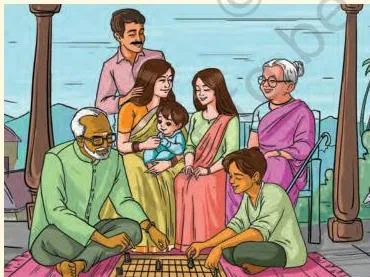
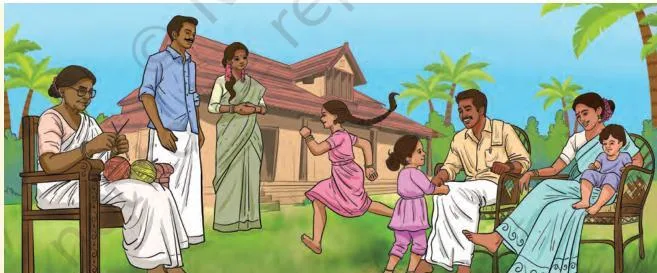
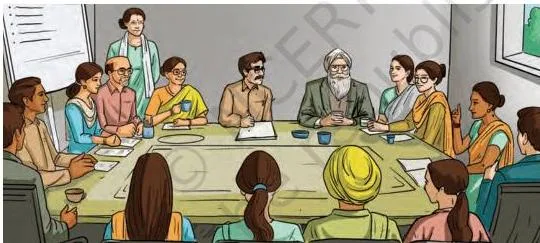

The chapter’s key ideas ride on captioned illustrations. Read each one with its caption, and notice what it is telling you.
This illustration sits beside the joint and nuclear family definitions on p. 137. Read it as the chapter’s opening claim: almost all of us live in a family, and the family is the fundamental and most ancient unit of any society.
This is the visual cue that the values passage is about to become a story — Shalini’s Onam story, where a family supports its members by sharing what it has during a difficult time (pp. 140–141).
Placed beside the closing point on p. 147, this illustration carries the chapter’s final visual statement: no community stands alone, and every person depends on many others.
This activity illustration asks you to build your own list — every person outside your family whose work supports you. Run through your day and name them; the chapter’s point is that each of us depends on many unseen helpers.
Key Terms and Definitions From the Chapter
A quick-reference list of the words the chapter actually defines — each term, its plain meaning, and the NCERT page where it appears.
| Term | Plain meaning | NCERT page |
|---|---|---|
| Family | The fundamental and most ancient unit of any society | 137 |
| Joint family | Several generations living together — grandparents, parents, uncles, aunts, brothers, sisters, cousins | 137 |
| Nuclear family | A couple and their children; sometimes one parent and children | 137 |
| Cooperation | Working together | 139 |
| Dharma | Doing one’s duty | 140 |
| Ahimsa, dana, seva, tyaga | Avoiding harm; giving; service; sacrifice — values learned in the family | 140 |
| Community | A group of connected people who come together for festivals, feasts, weddings and shared work | 143 |
| Halma | The Bhil tradition of coming together to support any individual or family in crisis | 144 |
| Interdependence | Communities depending on one another | 146 |
Common Mistakes Students Make With This Chapter
This chapter has no formulas, so the traps are conceptual. Read the table before your class discussion, not after.
| Mistake | Correct rule | How to check your answer |
|---|---|---|
| ‘A community is only a village or tribal group.’ | Community is a flexible concept — urban Residents’ Welfare Associations, school clubs, religious, regional and occupational groups all count (p. 147) | Re-read the examples on p. 147: Mumbai’s Parsi community, Kerala’s scientific community, a school’s sports community |
| ‘A nuclear family is modern, so it is better.’ | The chapter asks for the advantages and disadvantages of both kinds and gives no verdict (p. 143) | Check you argued both sides in the debate activity on p. 143 |
| ‘Unwritten rules are not real rules.’ | Shared-resource practices were rarely written down yet secured everyone’s access to water, grazing lands and forest produce (p. 143) | Retell the water, grazing and forest-produce example from p. 143 in your own words |
| ‘Dharma means religion.’ | In this chapter dharma means doing one’s duty (p. 140) | Swap the word in the chapter’s sentence — following our dharma means following our duty |
| ‘Household chores are fixed by gender.’ | Roles are shared — Tenzing’s father cleans, gardens and helps cook (pp. 141–142) | Run the who-does-what survey on p. 140 at home and compare the answers |
| ‘A family is just parents and children.’ | Joint families include grandparents, uncles, aunts and cousins; in most Indian languages cousins are simply brothers and sisters (pp. 137–139) | List your own relatives’ mother-tongue terms using the p. 139 activity |
Most of these confusions come from reading the chapter in fragments. The pattern to remember runs through the whole chapter: family, then values, then community, then interdependence — each idea building on the previous one.
How to Use This Chapter for Class Work and Review
Work from what the chapter actually asks of you. The closing ‘Questions, activities and projects’ on p. 148 are all open-ended and observation-based.
- What are some of the rules you follow in your family and neighbourhood? Why are they important?
- Do you think some rules are unfair to a few people in the family or community? Why?
- Describe situations you have observed where community support makes a difference — you can draw or write about these.
Along the way, the chapter’s LET’S EXPLORE boxes hand you small observation tasks. Use them in the order the chapter sets:
| Page | Activity in the chapter |
|---|---|
| 137 | Survey the family types in your neighbourhood; count households of each type and compare with classmates |
| 139 | List family members and distant relatives; record their terms in your mother tongue and find English equivalents |
| 140 | Answer the who-does-what questions about your own home and compare with classmates |
| 141 | Draw Shalini’s family tree; say why the parents bought clothes for everyone; say what you would have done |
| 143 | Write or stage a family drama; debate the advantages and disadvantages of joint and nuclear families |
| 147 | List everyone outside your family whose work supports you |
| 148 | List the communities you belong to; describe a school club you are part of and how it functions |
Because the chapter has no numeric problems, review means the vocabulary, the two family stories, the three community examples and the closing points. One honest caution: textbook contents and the examinable syllabus are not always identical — check the current official syllabus.
Before You Move On: The Chapter’s Closing Points in Plain Words
The book closes with a ‘Before we move on’ box (p. 148). Its three points, in plain words:
- Family is the foundation of human society. Ideally, members of a family support each other in their many duties and tasks.
- Community is the bigger unit, and it also means people supporting each other. ‘Community’ can be defined in several ways, so there are many kinds of community.
- Communities are ultimately interdependent. Everyone depends on other people and other communities.
The easiest way to hold the chapter together is to remember the four values on p. 140: ahimsa, dana, seva and tyaga are the bridge between the family half and the community half — families teach them, communities practise them.
Related NCERT Class 6 Social Science Material
Continue with the rest of the book from the Class 6 Social Science NCERT book page, or move straight to the chapter just before this one, Class 6 Social Science Chapter 8 PDF, or the chapter that follows, Class 6 Social Science Chapter 10 PDF.
The NCERT Class 6 hub collects the Class 6 textbook pages by subject.
For the revision stage, the CBSE notes for Class 6 Social Science and the Class 6 notes hub carry summaries for this book; the Unity in Diversity and Grassroots Democracy Part 1 pages cover related chapters. The CBSE notes index lists study material by class and subject.
Sources and data verification
This listing is maintained for the 2026-27 academic session using the NCERT textbook information available to us. NCERT remains the authority for confirming the latest edition.
The description above refers to the NCERT Class 6 Social Science textbook Exploring Society: India and Beyond, Chapter 9 (Family and Community), pages 136–148 of the edition published on ncert.nic.in.
This page covers that one textbook chapter, not the whole CBSE curriculum. It is maintained for the current academic session in which this NCERT edition is prescribed.
NCERT settles the textbook text, editions and official PDFs; CBSE settles the syllabus and examinations. Textbook contents and the examinable syllabus are not always identical — check the current official syllabus.
| What the chapter holds | Count | Where it is used |
|---|---|---|
| Printed pages | 12 | |
| Figures with NCERT captions | 4 | |
| Tables | 1 | |
| Official NCERT PDF | Download the chapter PDF | the chapter exactly as NCERT publishes it |
Frequently Asked Questions About the Family and Community Class 6 Chapter
What is the difference between a joint family and a nuclear family in Class 6 Social Science Chapter 9?
A joint family has several generations living together — grandparents, parents, uncles and aunts, brothers, sisters and cousins. A nuclear family is limited to a couple and their children, sometimes one parent and children (NCERT, p. 137).
The chapter presents both as common in Indian society and asks you to weigh the advantages and disadvantages of each (p. 143).
What is a community according to the NCERT Class 6 Family and Community chapter?
A community is a group of connected people who come together for festivals, feasts, weddings and shared work such as sowing and harvesting (NCERT, p. 143).
The chapter stresses that ‘community’ is a flexible concept: a jati, a religious or regional group, an occupational or interest group, an urban Residents’ Welfare Association or a school club can all be communities (p. 147).
What do ahimsa, dana, seva and tyaga mean in the Family and Community chapter?
They are values children learn in the family, which the chapter calls a school for such values (NCERT, p. 140). Ahimsa is avoiding harm, dana is giving, seva is service and tyaga is sacrifice.
Shalini giving up her silk dress so everyone could have new festival clothes shows tyaga and dana; Tenzing’s father joining household chores shows seva in daily life.
Who was Kamal Parmar and what did he do for underprivileged children?
Kamal Parmar owned a small auto-fabrication workshop in Ahmedabad. More than twenty years ago he noticed underprivileged children on the street — some had dropped out of school, some had never been.
After his work hours he ran free tuition from 5:30 to 9:30 pm and provided free dinner; soon 150 children attended regularly, and local teachers and older students joined as volunteers (NCERT, pp. 144–146).
What is the halma tradition of the Bhil community?
Halma is the Bhil tradition of coming together to support any individual or family in times of crisis (NCERT, p. 144). Around Jhabua in Madhya Pradesh, the Bhils planted thousands of trees, dug trenches to conserve rainwater and built water-harvesting structures — unpaid, as duty toward their community and the environment.
What are the three points in the ‘Before we move on’ section of this chapter?
Family is the foundation of human society, and ideally its members support each other in their duties; community is the bigger unit in which people support one another, and it can be defined in several ways; and ultimately all communities are interdependent (NCERT, p. 148).
Reference: NCERT Class 6 Social Science textbook (Exploring Society: India and Beyond), chapter 9, official edition on ncert.nic.in.
Explore Class 6 Social Science Books
Related chapters:
- Why Social Science?
- Oceans and Continents
- Landforms and Life