
Grassroots Democracy – Part 1 Class 6 is Chapter 10 of the NCERT Social Science textbook Exploring Society – India and Beyond. The chapter runs over 14 printed pages, from page 149 to page 162, inside the Governance and Democracy theme. The official PDF is directly below; the rest of this page explains every section so you can start studying before you open the file.
Download the Grassroots Democracy – Part 1 Class 6 PDF
The official file is published by NCERT itself. Download the Grassroots Democracy – Part 1 Class 6 PDF from the NCERT textbooks page — choose Class 6, then Social Science, then the Exploring Society – India and Beyond book, and Chapter 10 is listed there as its own PDF file.
Chapter 10 at a Glance
The table below comes straight from the NCERT chapter file. It lists what this chapter holds — sections, figures and exercise questions — and is the single place those counts appear on this page, so you can judge the chapter’s size before downloading.
What This Chapter Teaches: From Rules to Democracy
This is a page-by-page map of the chapter, so you can follow it with a finger on the NCERT book. Each entry names the section, the page it starts on, and the idea it carries.
- Big Questions (p. 149) — opens with three questions: the meaning of governance, why we need a government, and the meaning and importance of democracy.
- Introduction (pp. 150–151) — why large communities need rules, and the meanings of governance, government and laws.
- LET’S EXPLORE — Fig. 10.1 (p. 151) — describe two pictures and connect their differences to rules.
- LET’S EXPLORE — Fig. 10.2 (p. 152) — identify ten public services and the government’s role in each.
- Three Organs of Government (pp. 153–154) — legislature, executive and judiciary, shown through a cybercrime story and the separation of powers.
- Three Levels of Government (p. 155) — local, State and Central tiers, with the bulb-and-electrician comparison and the flood example.
- DON’T MISS OUT (pp. 156–157) — the national and State functions table (Fig. 10.5) and the two institutional mottos.
- Dr A.P.J. Abdul Kalam (p. 158) — profile of the 11th President, and what a nominal head can still achieve.
- Democracy (pp. 159–160) — the Greek roots of the word, representative and direct democracy, and grassroots democracy.
- Before we move on (p. 160) — the chapter’s own four-point recap.
- Questions, activities and projects (p. 161) — four end-of-chapter questions.
- Noodles – Notes and Doodles (p. 162) — a light closing page of notes and doodles.
Key Concepts in Grassroots Democracy – Part 1 Class 6
This chapter asks one question in three ways: who makes society’s rules, who carries them out, and why ordinary citizens get a say in both. These definitions are the whole chapter in miniature.
Governance (NCERT, p. 150) is the process of taking decisions, organising society’s life through rules, and ensuring the rules are followed. It is an activity, not a group of people.
Government (NCERT, p. 150) is the group of individuals, or the system, that makes the rules and ensures they are followed. Laws are the more important rules, set for society as a whole.
Democracy (NCERT, p. 159) comes from two Greek words: dēmos, meaning ‘people’, and kratos, meaning ‘rule’ or ‘power’. So democracy literally means ‘rule of the people’.
Representative democracy (NCERT, p. 159) is the system in which citizens elect representatives — MLAs at the State level and MPs at the national level — who discuss and decide in assemblies. Direct democracy is the opposite: every member of the group votes on the decision itself.
Grassroots democracy (NCERT, pp. 159–160) is a system that enables and encourages ordinary citizens to take part in decisions that affect them. The name points to the base of the pyramid of government — the grass roots, not the top.
Two everyday tests keep these ideas apart. A school cricket team that elects its captain is a representative democracy — players vote once, then one elected person leads. A family that chooses a film by a show of hands is a direct democracy — every member votes on the outcome itself.
Three Organs of Government: Legislature, Executive, Judiciary
One group cannot write the laws, run the country and judge disputes all at once — the same people would hold every kind of power. So a modern government is split into three organs, each with one job (NCERT, p. 153).
Legislature — makes new laws, and sometimes updates or removes existing ones. It is an assembly of representatives of the people.
Executive — implements the laws. It includes the head of state (a president, prime minister or chief minister), the ministers, and agencies that enforce law and order, such as the police.
Judiciary — the courts. It decides whether someone has broken a law and what should happen, including punishment if needed. It can also examine whether an executive decision is right, and whether a law is fair to all.
Separation of powers (NCERT, p. 154) is the rule that the three organs must be kept separate, even though they interact and work together. It exists to provide checks and balances: each organ can check what the others do and restore balance if one oversteps its role.
Worked example: a fake job-offer fraud
This example uses invented details to show the three organs acting one after another — legislate, implement, judge.
- The legislature makes the law first. Parliament had passed a Digital Payments Protection Act, making online payment fraud a punishable offence.
- The executive enforces the law. Meera’s mother answers a WhatsApp message offering a data-entry job and pays a ₹2,500 ‘registration fee’. The caller vanishes, so she complains at the cyber police station, and officers trace, arrest and charge the caller.
- The judiciary judges the case. The court hears the evidence, decides the law was broken, and convicts the caller — ordering the ₹2,500 refunded and a one-year jail term.
Notice the order: make, implement, judge. Each organ did only its own job, which is exactly what separation of powers means in practice (NCERT, pp. 153–154).
Three Levels of Government: Centre, State and Local
A burst pipe in one street and a cyclone across three states cannot be fixed from the same office. India therefore runs its government at three levels, or tiers (NCERT, p. 155).
The chapter’s comparison: if a bulb fails at home, you first check the bulb, switch and fuse; if that fails, you call an electrician; and if the problem is outside your home, you go to the Electricity Board. One problem, three levels of dealing with it (NCERT, p. 155).
| Everyday problem | Level that handles it | Why |
|---|---|---|
| A burst water pipe in your street | Local government | The problem fits inside one neighbourhood, so no higher tier is needed. |
| A flood covering several districts | State Government | Many towns and villages are affected, so the State sends rescue teams. |
| A cyclone affecting many states | Central Government | The disaster covers vast areas, so the Centre sends relief supplies and the army. |
The flood logic in the table comes straight from the chapter: a small flood stays with local authorities, a bigger one moves to the State, and a massive one brings in the Centre (NCERT, p. 155).
What each level runs — Fig. 10.5 (NCERT, pp. 156–157) lists the Central government’s functions: defence, foreign affairs, atomic energy, communications, currency, interstate commerce and education. The State government handles police and law and order, adapting and implementing Central laws at the State level, public health, agriculture, irrigation and education.
Notice that education appears in both columns of Fig. 10.5. Some subjects are handled at more than one level: the Centre frames national policy while States run their own education systems.
Two institutional mottos appear in this section (NCERT, p. 156). The Government of India’s motto is Satyameva Jayate — ‘Truth alone triumphs’. The Supreme Court’s motto is Yato Dharmastato Jayah — ‘Where there is dharma, there is victory.’
Two words in the table need care. A house is an assembly where laws are discussed or passed. Nominal means ‘in name only’: the President of India and the Governors of States are not the actual executive heads — the Prime Minister and Chief Ministers are. Nominal heads hold certain powers in special circumstances but normally do not interfere (NCERT, p. 157).
Figure Walkthrough: Reading the Diagrams in Chapter 10
The four key images of this chapter each carry an idea that the text repeats, so read them rather than skipping them.
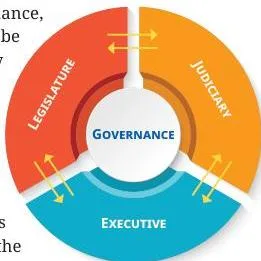
Fig 10.3 is the visual for separation of powers. Read it as three separate parts that stay connected: separate, so power does not collect in one place; connected, because the organs still work together and check one another (NCERT, p. 154).
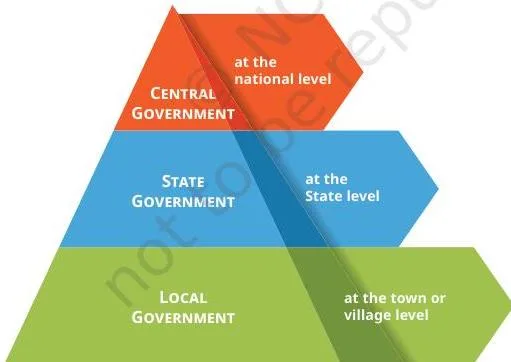
Fig 10.4 shows the levels of government as a pyramid, with local government at the base. The chapter later calls local government ‘the base of the pyramid’ when it defines grassroots democracy (NCERT, p. 159). State government sits in the middle and the Central government at the top.
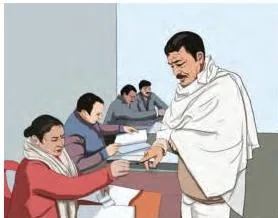
The image on NCERT page 159 sits beside the chapter’s key claim about representative democracy. The surrounding text gives the scale: India is the world’s largest democracy, with some 970 million voters in 2024, and in principle all citizens above 18 have the right to vote (NCERT, p. 159).

The image on NCERT page 160 marks a promise the chapter makes: local government, and more features of Indian democracy, come in the next two chapters and in later grades (NCERT, p. 160).
Key Terms and Definitions from Chapter 10
Scan this table in under a minute before you close the chapter. Every term here is vocabulary the chapter introduces, with the NCERT page where it is defined.
| Term | Meaning in this chapter | NCERT page |
|---|---|---|
| Governance | The process of taking decisions, organising society through rules, and ensuring rules are followed | p. 150 |
| Government | The group or system that makes the rules and ensures they are followed | p. 150 |
| Laws | The more important rules that apply to society | p. 150 |
| Legislature | The organ that makes new laws, and updates or removes old ones | p. 153 |
| Executive | The organ that implements the laws, including heads of state and ministers | p. 153 |
| Judiciary | The courts that decide whether a law was broken and what action follows | p. 153 |
| Separation of powers | The rule that keeps the three organs separate though they work together | p. 154 |
| House | An assembly where laws are discussed or passed | p. 157 |
| Nominal | ‘In name only’ — the President and Governors are not the actual executive heads | p. 157 |
| Democracy | ‘Rule of the people’, from Greek dēmos (people) and kratos (rule or power) | p. 159 |
| Representative democracy | Citizens elect representatives who discuss and decide for them | p. 159 |
| Direct democracy | Every member of the group votes on the decision itself | p. 159 |
| Grassroots democracy | A system that encourages ordinary citizens, the base of the pyramid, to take part | p. 160 |
| MLA | Member of Legislative Assembly, elected at the State level | p. 159 |
| MP | Member of Parliament, elected at the national level | p. 159 |
Common Mistakes Students Make in This Chapter
Most errors in this chapter come from words that look similar. Each row names the mistake first, then the rule that fixes it.
| Mistake | Correct rule | How to check your answer |
|---|---|---|
| Governance and government are the same thing | Governance is the process; government is the body that runs the process (p. 150) | Ask: is this a group of people or an activity? |
| The President of India is the executive head | The President is the nominal head; the Prime Minister is the real executive head. Same pattern for Governor and Chief Minister (p. 157) | Who runs the government day to day? The PM or CM. |
| In a democracy, every citizen rules directly | Citizens elect representatives because everyone ruling directly is impractical (p. 159) | Would the whole class go to the principal, or one representative? |
| Direct and representative democracy are the same | Direct: everyone votes (show of hands). Representative: an elected member decides for the group (p. 159) | Who made the final decision — all members or one elected person? |
| The judiciary only punishes criminals | It also reviews executive decisions and checks whether laws are fair to all (p. 153) | List the judiciary’s two jobs, not one. |
| The three organs must never interact | They are separate but do interact and work together — that interaction enables checks and balances (p. 154) | Look at Fig 10.3: separate parts, still connected. |
Dr A.P.J. Abdul Kalam’s presidency makes the nominal-head idea concrete (NCERT, p. 158). His position was nominal, yet he inspired millions of young Indians through education, innovation and humility. A nominal head is not a powerless figurehead — just not the daily decision-maker of the executive.
How the Chapter’s Own Questions Test You
The chapter ends with four questions on page 161, and there are no multiple-choice or numerical questions here — just concept, recall, reasoning and project work. This map shows what each one tests and where the answer sits.
| Question | What it tests | Where the answer sits |
|---|---|---|
| Q1 — Test yourself: meaning of democracy; direct vs representative | The definitions themselves, and the contrast between the two systems | NCERT, pp. 159–160 |
| Q2 — Recall the three organs; their different roles | Each organ’s single job | NCERT, p. 153 |
| Q3 — Why do we need three tiers of government? | The ‘different matters, different levels’ logic and the flood example | NCERT, p. 155 |
| Q4 — Project: COVID-19 lockdown actions, tiers involved, role of each organ | Applying organs and levels to a real event; research and synthesis | Apply NCERT, pp. 153–155; project brief on p. 161 |
A full answer to Question 1 must give the Greek roots of democracy (dēmos, kratos) and contrast the two systems: an elected representative decides in one; every member votes in the other. Question 2 is easiest as three separate sentences, one per organ.
Question 3 wants the ‘different matters need different levels’ idea, not a list of functions. The Question 4 project needs actions, tiers and organs all named together in one account.
One honest note: textbook contents and the examinable syllabus are not always identical — check the current official syllabus for what is tested from this chapter.
The LET’S EXPLORE Activities: What Each One Trains
Six activities appear inside the chapter. Each trains a different skill, and doing them in order is a complete self-check.
- Describe the two pictures in Fig. 10.1 (p. 151) — trains observation and connecting images to the idea of rules.
- Identify the public services in the ten pictures of Fig. 10.2 (p. 152) — trains mapping the government’s role in daily life.
- Explain the three organs in the cybercrime case (p. 153) — trains applying definitions to a real situation.
- Discuss what happens if one group controls all three organs (p. 154) — trains debate and reasoning about separation of powers.
- Highlight functions from Fig. 10.5 and interview two or three adults (p. 156) — trains personal connection to government.
- Plan the COVID-19 lockdown project (p. 161) — trains research and synthesis across tiers and organs.
Key Takeaways from Chapter 10
These four points are the chapter’s own recap from page 160, rewritten in plain words. If you remember four things tonight, remember these.
- No country can run without governance and government.
- A modern government has three organs — legislature, executive, judiciary — which need to work together.
- India’s government works at three levels — Central or national, State, and local.
- Democracy is the overall framework, run through elected representatives such as MLAs and MPs.
Mnemonic for tonight: L-E-J for the three organs (Legislature, Executive, Judiciary) and C-S-L for the three levels (Central, State, Local).
Related Resources
This listing is maintained for the 2026-27 academic session using the NCERT textbook information available to us. NCERT remains the authority for confirming the latest edition.
This chapter sits between two chapters that continue its story. Chapter 9, Family and Community, sets up how people live and help one another, and the chapter itself promises that local government is studied in Grassroots Democracy – Part 2 and Part 3 (NCERT, p. 160).
- All Class 6 Social Science notes
- Class 6 study resources
- CBSE notes home
Sources and Data Verification
This page describes the NCERT Class 6 Social Science textbook Exploring Society – India and Beyond, Chapter 10, ‘Grassroots Democracy – Part 1’. The official edition is published on ncert.nic.in, and this page is maintained for the current academic session using the NCERT information available to us.
NCERT settles textbooks, editions and PDFs; CBSE settles the curriculum, syllabus and examinations. A chapter in a textbook and the examinable syllabus are not always identical. This page is not an official NCERT or CBSE product.
| What the chapter holds | Count | Where it is used |
|---|---|---|
| Printed pages | 14 | |
| Figures with NCERT captions | 4 | |
| Tables | 1 | |
| Official NCERT PDF | Download the chapter PDF | the chapter exactly as NCERT publishes it |
Chapter-wise notes for this subject are not published yet. The unit-wise syllabus on this page is complete and verified against the official CBSE curriculum document.
Reference: NCERT Class 6 Social Science textbook, Chapter 10, official edition on ncert.nic.in.
FAQs
What is the meaning of grassroots democracy in Class 6 Social Science Chapter 10?
Grassroots democracy is a system that enables and encourages ordinary citizens — the base of the pyramid of government — to participate in decisions that affect them (NCERT, pp. 159–160). It is democracy starting at ground level, not only at the top.
What is the difference between direct democracy and representative democracy?
In direct democracy, every member of the group votes on the decision itself, like a class settling a picnic spot by a show of hands. In representative democracy, people elect representatives — MPs and MLAs — who make the decisions on their behalf (NCERT, p. 159).
Why is the President of India called a nominal head?
Nominal means ‘in name only’. The President has certain powers under special circumstances but is not the actual executive head; the Prime Minister is. The Governor of a State is likewise nominal, with the Chief Minister as the real executive head (NCERT, p. 157).
Dr Kalam’s presidency is the chapter’s example of a nominal head who still achieved a great deal (NCERT, p. 158).
How many levels of government are there in India according to Chapter 10?
Three: local government, State government, and the Central or Union government (NCERT, p. 155). Some countries manage with two levels — local and national — but India uses three.
What are the three organs of government and what does each one do?
The legislature makes, updates or removes laws; the executive implements those laws; the judiciary decides whether a law was broken and also reviews executive decisions and the fairness of laws (NCERT, p. 153).
Where can I download the official NCERT Class 6 Chapter 10 PDF?
From the official NCERT textbooks page on ncert.nic.in. Select Class 6, then Social Science, then Exploring Society – India and Beyond, and open Chapter 10, Grassroots Democracy – Part 1.
Explore Class 6 Social Science Books
Related chapters:
- Why Social Science?
- Oceans and Continents
- Landforms and Life