
This is NCERT Class 6 Social Science Chapter 12, Grassroots Democracy – Part 3 — the chapter on Local Government in Urban Areas from the book Exploring Society: India and Beyond. It runs from printed page 173 to 182 and explains how the same participatory democracy that runs a village panchayat also runs a city.
The official chapter PDF is right below; beneath that, this page walks you through everything the chapter contains.
Download the Official Grassroots Democracy – Part 3 Class 6 Chapter 12 PDF
This is the chapter file your teacher’s book is printed from — the official NCERT edition, hosted on ncert.nic.in. Open the textbook page and download the NCERT Class 6 Social Science Chapter 12 Grassroots Democracy – Part 3 PDF to read it on screen, print it, or keep it for offline revision — the file is the same edition the book is printed from.
Chapter 12 at a Glance: What the File Holds
The counts table on this page states how much the chapter holds — its sections, figures and exercises. This section tells you how the chapter is arranged, so you know where each idea sits before you start reading.
- The chapter sits in the Governance and Democracy unit of Exploring Society: India and Beyond.
- It opens with a quote from Rustom K. Sidhwa, a member of the Constituent Assembly, and two Big Questions: what urban local bodies are, and why they matter in a democracy (NCERT, p. 173).
- It builds from the general idea of participatory democracy to the concrete structure of urban local bodies.
- Chennai and Indore run through the chapter as the two working examples — one for history, one for everyday city services.
- It is a short, text-based chapter that closes with five activity-style questions and a Noodles notes page (NCERT, p. 181–182).
What This Chapter Covers: From Village Panchayat to City Corporation
Use this section as a guided tour: read it once to see the chapter’s argument, so the details below have a place to stick.
- The opening quote and the two Big Questions (p. 173) — the chapter tells you upfront what it must answer.
- Participatory democracy and the governance pyramid (p. 174–175): the national level sits at the top; the local level sits at the base, closest to the people.
- The move from rural Panchayati Raj to urban local government (p. 175): Chapter 11 took the left side of the pyramid; this chapter takes the right.
- Wards and ward committees (p. 176) — how a city is divided into neighbourhood-sized units.
- Chennai’s corporation (p. 177) and the services of Indore’s corporation (p. 178) — the chapter’s two case studies.
- The three body types by population (p. 179) — Corporation, Council and Nagar Panchayat.
- The village-city dialogue between Anita and Sameer (p. 179–180) — they compare village and city life and find the same democratic idea in both.
- The closing points and five activities (p. 181), followed by the Noodles page (p. 182).
Key Concepts: Urban Local Bodies, Wards and Ward Committees
Here is the chapter’s central mechanism: urban local bodies are the city version of the village panchayat. The same participatory idea runs through both — local people taking local decisions.
Participatory democracy and decentralisation
Participatory democracy means citizens actively take part in how their country or area is run — at rural, regional, urban, state or national level (NCERT, p. 174). Urban local bodies are decentralised: instead of everything being directed from a central authority at the top, local communities have a direct say in how their areas are managed (NCERT, p. 175).
Wards and ward committees
Cities and towns are divided into smaller units called wards. Ward committees organise local activities — health camps, campaigns against single-use plastics — and watch for problems such as water leaks, blocked drains or damaged roads, which they report to the authorities (NCERT, p. 176). The precise working of wards differs from State to State, because each State makes its own rules.
The functions of urban local bodies cover infrastructure, burial grounds, garbage collection and disposal, checking that government schemes are implemented, and collecting local taxes and fines. They also have some role in planning the area’s economic and social development (NCERT, p. 176).
The three urban local bodies by population
| Population of the city or town | Highest urban local body | Also called |
|---|---|---|
| Above 10 lakhs | Municipal Corporation | Mahanagar Nigam |
| Between 1 and 10 lakhs | Municipal Council | Nagar Palika |
| Smaller populations | Nagar Panchayat | — |
Chennai and Indore, the chapter’s two examples, both have a Municipal Corporation at the top of their urban bodies (NCERT, p. 179).
Village life versus city life: the Anita–Sameer dialogue
Sameer and Anita compare their worlds, and the chapter uses their conversation to show that the two systems work on one idea (NCERT, p. 179–180).
| Village life (Sameer) | City life (Anita) |
|---|---|
| Everyone knows everyone; people pitch in to help | Busy, crowded, tall buildings; people are independent and often do not know their neighbours |
| People work together in the fields and celebrate festivals as a community | Community still exists — after heavy rains, dozens of people gathered to clear rubble from a collapsed house |
| The Gram Panchayat has elected members; even children get heard (kids reported a dangerously low electric wire and it was fixed) | Urban local bodies have elected representatives who represent citizens’ interests |
| Sameer’s verdict: the city body sounds like the village Panchayat, only bigger. Anita’s verdict: the city is more complicated, but the idea is the same — everyone’s voice matters. | |
Citizen duties checklist
For urban local bodies to work, citizens must act, not just receive. The chapter’s examples are (NCERT, p. 176):
- Segregate waste — following waste segregation instructions makes garbage collection easier.
- Report a water leak promptly — a quick report prevents wastage of precious water.
- Show care and concern for your area — this is what participatory democracy expects.
The chapter also points to Indore, named India’s cleanest city under the Swachh Survekshan scheme seven years in a row, and asks what role its citizens played (NCERT, p. 179).
Figure Walkthrough: Mumbai, Madras and the Ward Diagram
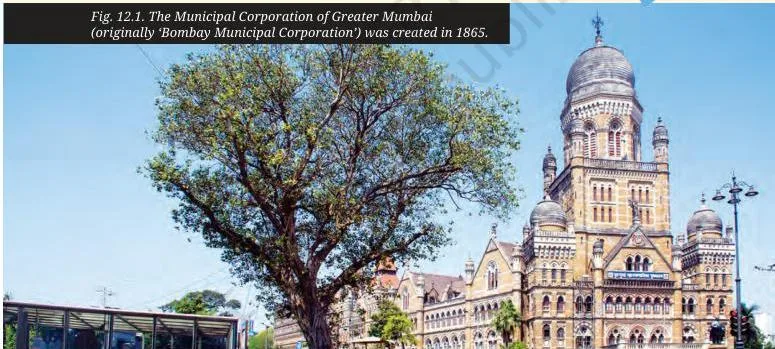
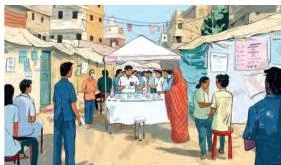
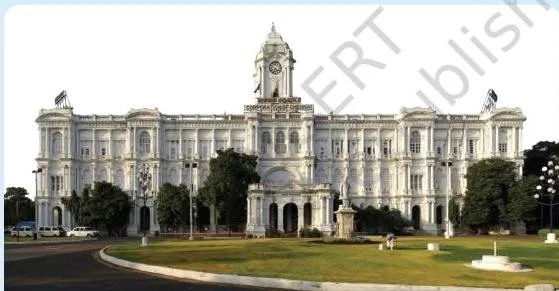
The three figures below appear in your copy of the chapter. They do three different jobs: one shows how old Indian city corporations are, one shows how wards make a city manageable, and one presents India’s oldest corporation. Read each with its caption.
Fig 12.1 — A Municipal Corporation from 1865
This figure makes a historical point: long before independence, Indian cities already had municipal government. The caption dates the Municipal Corporation of Greater Mumbai — originally the Bombay Municipal Corporation — to 1865. Urban local bodies in India are established, working institutions, not a recent experiment (NCERT, p. 173).
The Ward Diagram on NCERT Page 176
This is the chapter’s central diagram. It shows how the city breaks down to the citizen: a city is divided into wards, and ward committees work inside those wards — holding health camps, running anti-single-use-plastic campaigns, and keeping an eye on water leaks and blocked drains.
The ward is the point where the urban local body actually meets the person on the street (NCERT, p. 176).
Fig 12.3 — Madras, India’s Oldest Corporation
The Madras Corporation — now the Greater Chennai Corporation — was established on 29 September 1688 and is the oldest municipal institution in India. An East India Company charter created it for Fort St George and all territory within 16 km of the Fort.
A Parliamentary Act of 1792 gave it the power to levy municipal taxes, which the chapter says is when municipal administration properly began (NCERT, p. 177).
Key Terms Defined: Corporation, Council, Ward, Participatory Democracy
These are the terms a question may ask you to define from memory. Learn the idea behind each, not a word-for-word definition.
| Term | What it means | NCERT page |
|---|---|---|
| Participatory democracy | A system in which citizens actively take part in governance at every level — rural, urban, regional, state or national | p. 174 |
| Urban local body | The local government structure that manages a city or town | p. 175 |
| Decentralised | Managed from the local level, with communities having a direct say, rather than from a central authority at the top | p. 175 |
| Ward | A smaller unit into which a city or town is divided | p. 176 |
| Ward committee | The group that organises activities in a ward and reports local problems to the authorities | p. 176 |
| Municipal Corporation (Mahanagar Nigam) | The highest urban body for cities with a population above 10 lakhs | p. 179 |
| Municipal Council (Nagar Palika) | The highest urban body for populations between 1 and 10 lakhs | p. 179 |
| Nagar Panchayat | The urban body for cities and towns with smaller populations | p. 179 |
Notice the pattern: the ward is the smallest unit, and it is where a local body meets the citizen.
Common Mistakes in Chapter 12: Corporation v Council, Rights v Duties
Students lose marks here by treating urban government as one uniform system. The five corrections below cover the errors that actually appear in answers.
| Mistake | Correct rule | How to check your answer |
|---|---|---|
| “Every city has a Municipal Corporation” | Only cities above 10 lakhs do; populations between 1 and 10 lakhs get a Municipal Council, and smaller towns get a Nagar Panchayat (p. 179) | Name the population before you name the body |
| “Urban and rural local government are completely different” | Both are decentralised and both have elected members; the Anita–Sameer dialogue shows the idea is the same (p. 180) | Ask: are members elected, and do locals decide? If yes, the systems share one principle |
| “Citizens only receive services” | Citizens also have duties — waste segregation and reporting leaks are the chapter’s examples (p. 176) | In any answer about citizens, add at least one duty |
| “People in cities do not form communities” | The house-collapse story shows residents gathering to help clear rubble (p. 180) | Look for the evidence of community the chapter actually gives |
| “Local bodies are run from the top” | They are decentralised by definition — communities have a direct say (p. 175) | Recite the definition of decentralised if you are unsure |
How to Prepare Chapter 12 for Tests and Projects
This chapter has no numerical problems. It tests three things: definitions, examples from the chapter, and applying an idea to a new situation. The closing activities map directly to skills you can practise.
| Closing activity (NCERT, p. 181) | Skill it practises |
|---|---|
| Water-pipe leak scenario (Q1) | Civic response — what a responsible citizen should do on the spot |
| Invite an urban local body member (Q2) | Interview preparation — framing respectful, useful questions |
| Family expectations list (Q3) | List making — turning opinions into clear demands |
| Characteristics of a good urban local body (Q4) | Criteria thinking — deciding what makes governance effective |
| Rural-urban comparison (Q5) | Synthesis — combining Chapter 11 and Chapter 12 |
Four facts are worth memorising for a quick answer:
- What an urban local body is, and why it is decentralised (p. 175).
- The three population ranges that decide Corporation, Council and Nagar Panchayat (p. 179).
- What wards and ward committees do (p. 176).
- Two citizen duties — waste segregation and reporting leaks (p. 176).
Textbook contents and the examinable syllabus are not always identical — check the current official CBSE syllabus before you decide what to prioritise.
What to Remember from Chapter 12: A Five Line Recap
These five lines carry the chapter’s own closing points, in the order the book gives them (NCERT, p. 181).
- Urban local bodies are decentralised — city governance works from the local level up, not from the top down.
- Wards and ward committees make the city local — they bring decisions and services close to the citizen (p. 176).
- The top body depends on population — Corporation, Council or Nagar Panchayat (p. 179).
- Members are elected and represent local citizens, just as in the village Panchayat (p. 181).
- Citizens have duties too — the bodies can only work if people participate (p. 181).
Related Resources: Chapter 11 and the Class 6 Social Science Hub
This listing is maintained for the 2026-27 academic session using the NCERT textbook information available to us. NCERT remains the authority for confirming the latest edition.
Chapter 12 covers the right side of the governance pyramid shown on NCERT page 175 — urban local government — while its rural counterpart, Chapter 11, Grassroots Democracy – Part 2 (Panchayati Raj), covers the left side. Studying the two together is the fastest way to prepare, and the Class 6 Social Science notes keep both chapters in one place.
Earlier work in the same book, such as The Value of Work, builds the same citizenship ideas. To move across subjects, use the Class 6 hub, or back out to the full CBSE notes index.
Sources and Data Verification
The figures, page numbers and section references on this page describe the NCERT Class 6 Social Science textbook Exploring Society: India and Beyond, Chapter 12, official edition on ncert.nic.in. This page lists that textbook chapter, not the full CBSE subject scheme. It is maintained for the current academic session from the NCERT information available to us.
NCERT settles textbooks, editions and PDFs; CBSE settles curriculum, syllabus and examinations.
| What the chapter holds | Count | Where it is used |
|---|---|---|
| Printed pages | 10 | |
| Figures with NCERT captions | 3 | |
| Official NCERT PDF | Download the chapter PDF | the chapter exactly as NCERT publishes it |
Reference: NCERT Class 6 Social Science textbook, chapter 12, official edition on ncert.nic.in.
Frequently Asked Questions
The questions below are what students actually search for on this chapter. Each answer is grounded in the chapter text.
What is the difference between a Municipal Corporation, a Municipal Council and a Nagar Panchayat?
Population decides it. Cities above 10 lakhs have a Municipal Corporation (Mahanagar Nigam) as their highest body; towns between 1 and 10 lakhs have a Municipal Council (Nagar Palika); smaller towns have a Nagar Panchayat (NCERT, p. 179). Chennai and Indore, the chapter’s examples, both have a Corporation.
Which is the oldest municipal institution in India?
The Madras Corporation, now the Greater Chennai Corporation. It was established on 29 September 1688 under an East India Company charter that created a corporation for Fort St George and the territory within 16 km of it. A Parliamentary Act of 1792 gave it the power to levy municipal taxes (NCERT, p. 177).
How do urban local bodies fund their activities?
Through local taxes and fines, which the chapter lists among their functions, and through some paid services — the chapter’s own activity points you to Figure 12.4 to work out which services citizens pay for (NCERT, p. 176–178).
Why does the chapter call city government participatory democracy?
Because citizens take part in running their area rather than only receiving services: they participate through wards and committees, and they perform duties such as waste segregation and reporting leaks. That participation is the whole point of the system (NCERT, p. 174, p. 181).
How is an urban local body similar to a Gram Panchayat?
Both are decentralised local bodies, both have elected members who represent citizens, and both depend on citizen participation to work. Sameer in the dialogue puts it directly: the city body sounds like the village Panchayat, only bigger (NCERT, p. 180–181).
Explore Class 6 Social Science Books
Related chapters:
- Why Social Science?
- Oceans and Continents
- Landforms and Life