
This page gives you the NCERT Class 6 Social Science Chapter 7 India’s Cultural Roots PDF, the official chapter file, and explains what the chapter teaches.
The chapter runs from page 104 to page 123 of the textbook Exploring Society: India and Beyond, and it asks three questions: what the Vedas are, which new schools of thought emerged in the 1st millennium BCE, and what folk and tribal traditions contribute to Indian culture.
The official file is right below; the walkthrough follows it.
Download the India’s Cultural Roots Class 6 PDF
The chapter PDF is published by NCERT on ncert.nic.in. Opening it shows the chapter exactly as printed — its opening quotation and portraits, its figures, and the tasks that close it.
Get the NCERT Class 6 Social Science Chapter 7 India’s Cultural Roots PDF from ncert.nic.in, and keep it open beside this page so you can follow every page reference as you read.
India’s Cultural Roots Class 6 at a glance
This section shows what the chapter file contains and where its questions sit. A table on this page lists how much the chapter holds — sections, figures and exercise questions — so the numbers always match the official PDF.
The chapter opens with a Subhāṣhita, a wise saying, on knowledge as the wealth that cannot be stolen or confiscated, and with portraits of a rishi, the Buddha and Mahāvīra. Then come the three big questions (NCERT p. 104):
- The Vedas — what they are and what message they carry.
- The new schools of thought of the 1st millennium BCE — what emerged and what their core principles are.
- Folk and tribal traditions — what they contribute to Indian culture.
The chapter closes with “Questions, activities and projects”, a “True or false” exercise, and a class activity (NCERT pp. 122–123). Working through those tasks is the quickest way to check whether you understood the chapter.
What the chapter covers: from the Vedas to tribal roots
The chapter’s central image is a tree: many roots feed a common trunk, and from that trunk spread many branches — art, literature, science, medicine, governance and the schools of thought. Some roots reach back to the Harappan or Sindhu-Sarasvati civilisation, the subject of the previous chapter, The Beginnings of Indian Civilisation.
The table below maps the order in which the book proceeds.
| Stage | What it introduces | NCERT pages |
|---|---|---|
| 1 | The Vedas: names, hymns, oral transmission | 106–107 |
| 2 | Vedic society: janas, assemblies, professions | 108 |
| 3 | The Upanishads: rebirth, karma, brahman, ātman | 109 |
| 4 | Yoga and the foundations of Hinduism | 110 |
| 5 | Three Upanishadic stories | 110–112 |
| 6 | Buddhism: the Buddha, ahimsa, the Sangha | 110–114 |
| 7 | Jainism: Mahāvīra, anekāntavāda, aparigraha | 115–118 |
| 8 | The shared trunk; Chārvāka; why not “religion” | 119 |
| 9 | Folk and tribal roots | 120–121 |
| 10 | Closing recap, questions, true or false, play | 122–123 |
Read the table as a route map. Each stage is explained in plain words in the next section.
Key concepts in India’s Cultural Roots Class 6
This section works through the ideas the chapter treats as the roots of Indian culture, in the order the book presents them. Each idea below is explained in original words so you can follow it with the textbook open.
The Vedas: ancient oral texts of India
The Vedas come first because they are the most ancient texts the chapter studies. Everything later either grows from them or reacts against them.
- Veda comes from the Sanskrit root vid, meaning “knowledge” — the same root that gives vidyā (NCERT p. 106).
- There are four Vedas: the Rig Veda, Yajur Veda, Sāma Veda and Atharva Veda. The Rig Veda is the most ancient; experts date it somewhere between the 5th and 2nd millennium BCE.
- The Vedas hold thousands of hymns — prayers shaped as poems and songs — composed in the Sapta Sindhava region, the land visited in Chapter 5.
- The hymns were recited aloud and memorised, never written down. Through demanding training they were handed on by voice for about 100 to 200 generations with almost no change.
- This unbroken oral chain is why, in 2008, UNESCO named Vedic chanting a “masterpiece of the oral and intangible heritage of humanity” (NCERT p. 107).
- The hymns were composed by rishis (male seers) and rishikas (female seers) in early Sanskrit, and addressed to deities such as Indra, Agni, Varuṇa, Mitra, Sarasvatī and Uṣhas.
- Together, seers and deities sustained ritam — the truth and order that keep both human life and the cosmos balanced.
- The seers saw the many deities as one reality. A famous hymn puts it: ekam sat viprā bahudhā vadanti — “the Existent is one, sages give it many names.”
- The final mantras of the Rig Veda ask people to unite their speech, their minds and their purposes.
Vedic society and the Upanishads
Two ideas sit side by side here: how early Vedic society was organised, and what the Upanishads added to Vedic thought. The second builds on the first.
Early Vedic society was organised in janas, or clans. The Rig Veda alone lists over thirty of them — the Bharatas, Purus, Kurus, Yadus and Turvaśas among them — each tied to a region of the northwest (NCERT p. 108).
The Vedas give only clues about governance: rājā meant king or ruler, while sabhā and samiti both meant a collective assembly. The texts also name many professions — agriculturist, weaver, potter, builder, carpenter, healer, dancer, barber and priest.
Vedic culture developed rituals called yajña, directed to deities for individual and collective wellbeing. Daily worship was usually prayer and offerings to Agni, the fire deity; over time the rituals grew more complex (NCERT p. 109).
The Upanishads built on Vedic ideas and added two new ones: rebirth, the idea of being born over and over, and karma, the principle that our actions bring results.
The Vedanta school taught that a single divine essence, brahman, lies behind all that exists — human life, nature, the universe itself. Sometimes this essence is simply called tat, “that”. The chapter adds a warning: brahman is not the god Brahmā.
The Upanishads also introduced ātman, the Self — the spark of the divine that lives in each being and is, at the deepest level, one with brahman. Because of this unity, everything is connected and interdependent, which is why the prayer sarve bhavantu sukhinah — “May all creatures be happy” — wishes every being freedom from illness and grief.
Later Vedic schools included Yoga, which developed methods to realise brahman in one’s consciousness. These schools together laid the base of what today is called Hinduism (NCERT p. 110).
Three Upanishadic stories: Śhvetaketu, Nachiketa and Gārgī
The chapter gives three stories to make brahman concrete — and to show that asking questions matters, whether the questioner is a man, a woman or a child (NCERT p. 110).
- Śhvetaketu and the seed. After twelve years at a gurukula, Śhvetaketu returned proud of his learning. His father, rishi Uddālaka Āruṇi, tested him on brahman; he could not answer. A banyan seed looks empty yet holds a whole future tree, and one clay makes many pots. So, the father taught, one hidden essence underlies everything — and he ended: “You are That, Śhvetaketu” (NCERT pp. 110–111).
- Nachiketa and Yama. During a ritual, Nachiketa kept asking his father to which god he would be offered. The annoyed father answered, “I give you to Yama”, the god of death. Nachiketa went to Yama’s world and waited.
- His one question was: what happens after the death of the body? Yama tried to avoid it, but the boy persisted. Yama finally explained that the ātman is hidden within all creatures — neither born nor dying, immortal (NCERT p. 111).
- Gārgī and Yājñavalkya. At king Janaka’s court, Yājñavalkya defeated many scholars in debate. Gārgī, a rishika, questioned him about the world and finally about brahman. He asked her to stop; she resumed. He then explained that brahman is what makes the world, the seasons, the rivers and everything else possible (NCERT p. 112).
Read together, the three stories carry one lesson: the search for truth begins with hard questions, and no one is too young, too old or the wrong gender to ask them.
Buddhism: the Buddha, ahimsa and the Sangha
Buddhism is the first school the chapter shows that did not accept the authority of the Vedas. The Buddha’s own story explains why his teachings look the way they do.
- Siddhārtha Gautama was born a prince in Lumbini, today in Nepal, about two and a half millennia ago. Scholars differ on the exact year; Chapter 4 of the textbook took 560 BCE as an approximation (NCERT p. 110).
- He grew up sheltered in the palace. At 29 he rode through the city and, for the first time, saw an old man, a sick man and a dead body — and also an ascetic who seemed at peace.
- He left the palace, his wife and his son, and travelled on foot as an ascetic, meeting other ascetics and scholars, searching for the root cause of suffering.
- Days of meditation under a pipal tree at Bodh Gaya, in today’s Bihar, ended in enlightenment. He saw the cause of suffering in avidyā (ignorance) and attachment, and worked out a way to remove both (NCERT p. 112).
- From then on he was the Buddha — the enlightened or awakened one.
- He taught ahimsa, usually translated “non-violence” but originally meaning “non-hurting” or “non-injuring”, and insisted on sincere inner discipline (NCERT p. 113).
- His saying runs: “Not by water is one made pure, though many people may bathe here. But one is pure in whom truth and dharma reside. Conquering oneself is greater than conquering a thousand men on the battlefield a thousand times.”
- The Buddha founded the Sangha, a close-knit community of monks (bhikshus) and, later, nuns (bhikshunīs), who devoted themselves to living and spreading his teaching (NCERT p. 114).
- His influence on India and the whole of Asia was enormous and is still felt today.
Jainism: Mahāvīra, anekāntavāda and aparigraha
Jainism is the chapter’s second non-Vedic school. It spread at the same time as Buddhism, shares ahimsa with it, and adds two ideas of its own.
- The prince who became Mahāvīra was Vardhamāna, born close to the city of Vaiśhālī — in what is now Bihar — in the early 6th century BCE (NCERT p. 115).
- At 30 he left home to search for spiritual knowledge. After twelve years of ascetic discipline he achieved “infinite knowledge”, or supreme wisdom, and became known as Mahāvīra, the “great hero”.
- The name Jain comes from jina, “conqueror” — but the conquest is of ignorance and attachments, not of territory or enemies (NCERT p. 115).
- Jain teaching rests on three ideas: ahimsa; anekāntavāda, meaning the truth has many aspects and no single statement can fully describe it; and aparigraha, non-possession, detachment from everything beyond what is truly necessary (NCERT pp. 115–116).
- Jainism insists that every living thing — from a human being down to organisms we cannot see — depends on every other, and that this web of life holds together. Scientists studying nature keep confirming the same truth.
- The story of Rohineya, an extraordinarily skilled burglar who overheard part of Mahāvīra’s sermon, was later caught, confessed his crimes, returned the stolen treasures and became a monk, teaches right action, right thinking, and the simple rule that everyone deserves a second chance (NCERT p. 117).
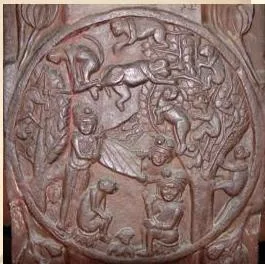
- The chapter also retells a well-known tale in which the Buddha was the king of a troop of monkeys. He let his troop cross a stream using his own body as a bridge and died of his wounds; a king watching from a distance was moved to rethink his duty to his subjects (NCERT pp. 116–117).
- Monks, and sometimes nuns, travelled across the land spreading the teachings, building monasteries and living in rock-cut caves. At Ellora in Maharashtra, caves carved out over the 6th to 10th centuries CE belong to all three traditions — Hindu, Buddhist and Jain (NCERT p. 118).
What the schools share: the common trunk
Different methods, same trunk. The chapter’s tree metaphor does its real work here: beneath their differences, the schools shared a core.
- All three worked with dharma, karma and rebirth, and all three wanted the same thing at the core: an end to suffering and to ignorance (NCERT p. 119).
- Their difference lay in authority: the Vedic schools kept the Vedas as their base, while Buddhism and Jainism rejected Vedic authority and built their own systems.
- There were other voices too. The Chārvāka school (also called Lokāyata) held that only the material world exists and there is no life after death. It never became popular and faded away, but its existence shows how wide the field of thought was (NCERT p. 119).
- The chapter deliberately avoids the word “religion” for these traditions, preferring “schools of thought”. Its reason: each has a philosophical, a spiritual, a religious, an ethical and a social aspect, and many scholars find “religion” too narrow for the Indian context (NCERT p. 119).
The table below lines the three traditions up side by side.
| Point of comparison | The Vedas and Vedic schools | Buddhism | Jainism |
|---|---|---|---|
| Origin | Most ancient texts of India; composed in the Sapta Sindhava region; Rig Veda dated by experts between the 5th and 2nd millennium BCE | Founded by Siddhārtha Gautama, born in Lumbini about two and a half millennia ago | Founded by Prince Vardhamāna, born near Vaiśhālī in the early 6th century BCE |
| Authority of the Vedas | Accepted — the Vedas are the source of knowledge | Rejected — developed its own system | Rejected — roots said to be much more ancient |
| Central ideas | Hymns to many deities, yajña rituals, ritam; the Upanishads added brahman, ātman, karma and rebirth | Avidyā and attachment cause suffering; ahimsa; inner discipline | Ahimsa, anekāntavāda, aparigraha; interconnectedness of all creatures |
| Key persons | Rishis, rishikas, Upanishadic teachers | The Buddha; the Sangha of bhikshus and bhikshunīs | Mahāvīra; monks and nuns |
| Practice | Prayer and offerings to Agni; yajña; Yoga’s methods of realising brahman | Meditation, monastic life, travelling teachers | Ascetic discipline, monasteries, rock-cut caves |
| The shared “trunk” | Dharma, karma, rebirth, ending suffering and ignorance | Dharma, karma, rebirth, ending suffering and ignorance | Dharma, karma, rebirth, ending suffering and ignorance |
Source for all rows: NCERT pp. 106–119.
Folk and tribal roots
The last root the chapter examines is the one least visible in written texts: traditions carried by common people day to day, and by tribes. These have fed the same trunk from the other side.
- Oral traditions are teachings passed through everyday practice instead of written texts — the Vedas themselves are an example. Folk traditions are kept by common people; tribal traditions by tribes (NCERT p. 120).
- Today’s anthropologists define a tribe as families or clans bound by a common ancestry, a shared culture and a shared language, living closely together under a chief, with no private property (NCERT p. 120).
- Ancient India had no separate word for “tribe” — tribes were simply janas living in a particular environment, such as forests or mountains. The Constitution of India says “tribes” and “tribal communities” in English and janjāti in Hindi.
- The scale is large: in 2011, official figures counted 705 tribes across most States — about 104 million people, a population larger than Australia’s and the United Kingdom’s put together.
- Nineteenth-century anthropologists often labelled tribes “primitive” or “inferior”. Deeper study of their rich, complex cultures led to those biased judgments being mostly abandoned.
- The exchange ran both ways. Tradition says the Jagannath of Puri, Odisha, was a tribal deity before he was worshipped as he is today; the same is said of various forms of the mother-goddess (NCERT p. 121).
- Conversely, some tribes adopted Hindu deities long ago and keep their own versions of the Mahābhārata and the Rāmāyaṇa — documented from the northeastern States all the way to Tamil Nadu.
- The exchange came naturally because the belief systems share ground: in folk, tribal and Hindu traditions alike, mountains, rivers, trees, plants, animals and some stones are sacred, because consciousness is seen behind all of them.
- The Toda tribals of the Nilgiris in Tamil Nadu treat over thirty mountain peaks as the homes of gods and goddesses, so sacred that the Todas never point a finger towards them (NCERT p. 121).
- Many tribal groups also hold a higher divinity. Tribes of Arunachal Pradesh worship Donyipolo, the Sun and Moon combined, later honoured as a supreme god; Khandoba is worshipped in parts of central India; and the Munda and Santhal of eastern India worship Singbonga, a supreme creator god.
- André Béteille’s summing up: from the earliest recorded times, and before, the subcontinent’s castes and tribes have shaped one another’s beliefs. Everyone accepts that Hindu practice shaped tribal religion, but the reverse is equally true — Hinduism grew and changed under tribal influence at every stage of its evolution. The result was mutual enrichment.
Reading the figures in India’s Cultural Roots Class 6
The chapter’s images are not decoration; each one carries a concept the text is making. Read them with the surrounding paragraphs and they fix the idea in memory.
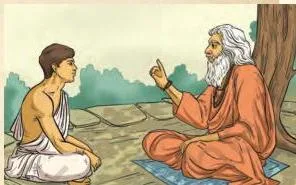
The image at the start of the Śhvetaketu story shows the rishi sending his son to a gurukula. It makes the chapter’s point about transmission visible: knowledge travelled from teacher to student in person, which is how the Vedas survived orally for so many generations.
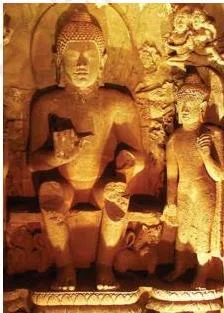
This image sits where the Buddha begins teaching what he had realised. The chapter pairs it with ahimsa as non-hurting and with inner discipline — the Buddha’s enlightenment was not an end in itself but something to teach.
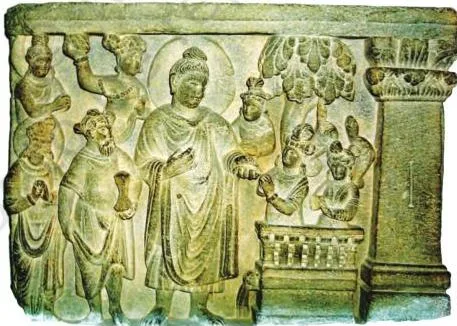
The stone panel, some 1,800 years old, again shows the Buddha teaching — this time to introduce the Sangha. The community of monks and, later, nuns existed to practise the teaching and carry it outward (NCERT p. 114).
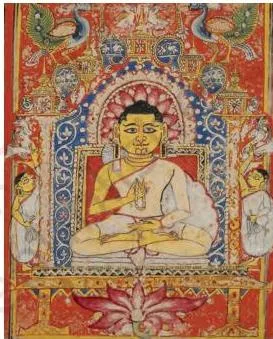
The traditional painting of Mahāvīra introduces Jainism. It pairs the “great hero” — the prince who achieved supreme wisdom after twelve years of discipline — with the teachings of ahimsa, anekāntavāda and aparigraha that follow (NCERT p. 115).
The stone panel from Bharhut in Madhya Pradesh depicts the monkey-king’s selfless sacrifice: he used his own body as a bridge so his troop could cross the stream. The king who watched from a distance was moved to rethink his role and his duty to his subjects (NCERT pp. 116–117).
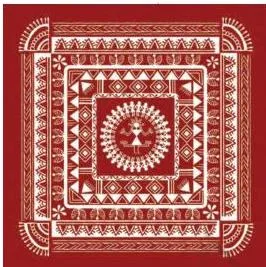
The photograph shows a Toda tribal person of the Nilgiris. It sits beside the chapter’s point that tribal groups hold natural features sacred — over thirty peaks in the Nilgiris are the homes of gods and goddesses, too sacred to point at with a finger (NCERT p. 121).
Definitions: key terms in India’s Cultural Roots Class 6
Most of the difficulty in this chapter is vocabulary, not ideas. Once the Sanskrit terms are clear, the concepts follow easily.
| Term | Plain meaning | NCERT page |
|---|---|---|
| rishi / rishika | A male or female seer who composed Vedic hymns | 107 |
| ritam | Truth and order in human life and in the cosmos | 107 |
| jana | A clan; a large group of people in early Vedic society | 108 |
| yajña | A ritual directed to deities for benefit and wellbeing (often read “yagya”) | 109 |
| brahman | The one divine essence of everything; not the god Brahmā | 109 |
| ātman | The Self; the divine essence inside every being, ultimately one with brahman | 109 |
| karma | One’s actions or their results | 109 |
| rebirth | Taking birth again and again | 109 |
| avidyā | Ignorance, one of the two causes of suffering the Buddha identified | 112 |
| attachment | A bond with someone or something, usually through sentiment or habit | 113 |
| ascetic | Someone practising rigorous discipline to attain a higher consciousness | 113 |
| ahimsa | Non-hurting or non-injuring, in action and in thought | 113 |
| Sangha | The community of Buddhist monks and nuns founded by the Buddha | 114 |
| bhikshu / bhikshunī | A Buddhist monk / nun | 114 |
| monk / nun | A man / woman who gives up ordinary life for spiritual pursuit, usually under vows | 114 |
| jina | “Conqueror” of ignorance and attachment; the root of the word “Jain” | 115 |
| anekāntavāda | The truth has many aspects; no single statement describes it fully | 115–116 |
| aparigraha | Non-possession; detachment from material things | 116 |
| tribe / janjāti | Families or clans sharing descent, culture and language, close-knit under a chief, with no private property | 120 |
Two terms from the table are often mixed up even by careful readers: brahman is the one essence of everything, while Brahmā is a god. The chapter marks the difference explicitly (NCERT p. 109).
Common mistakes in India’s Cultural Roots Class 6
The chapter’s own True or false exercise shows exactly which wrong ideas students carry into this topic. Each statement below is one of those errors, with the correction and where the chapter settles it.
| Mistake | Correction | Where the chapter settles it |
|---|---|---|
| The Vedic hymns were written on palm-leaf manuscripts | They were recited aloud and memorised for generations; writing was not how they were preserved | True or false Q1; NCERT p. 106 |
| Buddhism is older than the Vedas | The Vedas are India’s oldest texts; Buddhism arose about two and a half millennia ago | True or false Q4; NCERT pp. 106, 110 |
| Jainism emerged as a branch of Buddhism | Jainism spread at the same time as Buddhism, and its roots are said to be much more ancient | True or false Q5; NCERT p. 115 |
| Tribal belief systems are only about spirits and minor deities | Tribes also worship supreme deities such as Donyipolo and Singbonga | True or false Q7; NCERT p. 121 |
| Brahman and the god Brahmā are the same | Brahman is the one divine essence of everything; the book warns “not to be confused with the god Brahmā” | NCERT p. 109 |
| Ahimsa means only not hitting or fighting | It means non-hurting in thought too — no ill feelings towards anyone, including oneself | NCERT pp. 113, 118 |
Test yourself: cover the middle column, read each mistake, and say the correction aloud before checking. Then do the True or false exercise at the end of the chapter without looking back.
How to practise India’s Cultural Roots Class 6
Working through the end-of-chapter tasks is the easiest way to check understanding of this chapter. The table below shows what each task tests, so you know what to listen for while you answer.
| Task | What it tests |
|---|---|
| Q1: Questions you would ask Yama | The Upanishad stories (NCERT pp. 110–111) and the habit of asking questions |
| Q2: Central ideas of Buddhism | Avidyā, attachment, ahimsa, inner discipline, the Sangha |
| Q3: The Buddha quotation in class | The meaning of dharma and inner purity, not outward bathing (NCERT p. 113) |
| Q4: Central ideas of Jainism | Ahimsa, anekāntavāda, aparigraha (NCERT pp. 115–116) |
| Q5: André Béteille’s thought | Folk–tribal interaction and mutual influence (NCERT p. 121) |
| Q6: Local gods and festivals | Folk tradition and the exchange of deities (NCERT p. 121) |
| Q7: Tribal groups and their art | Tribal roots and oral traditions (NCERT pp. 120–121) |
| Class activity: the play with Yama | Upanishadic questioning, retold dramatically (NCERT p. 123) |
The first task asks you to write, in 100–150 words, the questions you would put to Yama if you were Nachiketa. A strong answer does not retell the story; it asks real questions that build on the story’s ideas — the ātman, karma and rebirth. Here is an original skeleton to model yours on:
Yama, you have watched every life end and every life begin. When the body falls, what is it that continues? Is the ātman aware of dying, or does it simply move on? If karma carries our actions to their results, what carries that account from one birth to the next — and why do we remember nothing of a past life? If the ātman is one with brahman, as the Upanishads teach, then is death only the end of the body’s story, not of the self’s? Teach me these things, and my fear of death will turn into understanding.
For the discussion tasks (the Buddha quotation, and Béteille’s thought), a full answer names the concept, says what it means in one line, and gives the chapter’s example. For the list tasks (local gods and festivals; tribal art), the quality is in the observation, not the length.
One honest reminder: textbook contents and the examinable syllabus are not always identical, so check the current official syllabus for what is expected this year.
What to carry forward from India’s Cultural Roots
NCERT closes the chapter with a “Before we move on” box. These are its points restated in different words, so you can check that you understood.
- From India’s earliest texts, the Vedas, came several schools of thought — among the best known are Vedanta and Yoga.
- Buddhism and Jainism moved away from the authority of the Vedas and stressed their own values and practices.
- Their principles and methods differed, but the schools shared important concepts; each one searched for the cause of suffering and for a way to end ignorance.
- For millennia, tribal belief systems and art have borrowed from Hinduism and given back to it; the exchange flowed in every direction. Tribal systems see the land and everything on it as sacred, and alongside that they usually keep a belief in a supreme divinity.
The chapter’s closing note — the banyan tree as a symbol of Indian civilisation — fits the whole argument: deep roots, a massive trunk, and branches that throw fresh roots of their own (NCERT p. 123).
Related NCERT Class 6 Social Science pages
Continue reading through the book with the pages nearest to this chapter:
- Class 6 Social Science book — all chapters of Exploring Society: India and Beyond
- Chapter 6: The Beginnings of Indian Civilisation — the previous chapter, which this one follows
- Chapter 8: Unity in Diversity, or “Many in the One?” — the next chapter, which takes the folk-tribal point further
- Class 6 hub — study material for every Class 6 subject
- CBSE notes index — notes for all classes
The official NCERT textbook page at ncert.nic.in/textbook.php publishes the Class 6 Social Science chapter PDFs; the direct file for this chapter is linked in the download section above.
Sources and data verification
This listing is maintained for the 2026-27 academic session using the NCERT textbook information available to us. NCERT remains the authority for confirming the latest edition.
The references and content on this page come from the NCERT Class 6 Social Science textbook Exploring Society: India and Beyond, Chapter 7, “India’s Cultural Roots”, official edition on ncert.nic.in. This page covers that chapter only, not the whole syllabus or curriculum.
This page is maintained for the current NCERT edition of the textbook. NCERT settles textbooks, editions and PDFs; CBSE settles curriculum, syllabus and examinations. No independent expert review of this page has been carried out.
| What the chapter holds | Count | Where it is used |
|---|---|---|
| Printed pages | 20 | |
| Figures with NCERT captions | 6 | |
| Official NCERT PDF | Download the chapter PDF | the chapter exactly as NCERT publishes it |
Reference: NCERT Class 6 Social Science textbook, chapter 7, official edition on ncert.nic.in.
Frequently asked questions about India’s Cultural Roots Class 6
What are the Vedas and why are they described as oral texts?
The Vedas are the oldest surviving texts of India — four collections of hymns called the Rig, Yajur, Sāma and Atharva Vedas.
They are called oral because they were composed, recited and memorised aloud for roughly 100 to 200 generations before anyone wrote them down; UNESCO recognised Vedic chanting as a masterpiece of the oral and intangible heritage of humanity in 2008 (NCERT pp. 106–107).
What do brahman and ātman mean in the Upanishads?
Brahman is the one divine essence of everything, and ātman is the Self within every being, ultimately one with brahman — not to be confused with the god Brahmā. Their unity is why everything is connected, and why the prayer “May all creatures be happy” makes sense (NCERT p. 109).
What are the main teachings of Buddhism and Jainism, and how are they different?
Buddhism teaches that avidyā (ignorance) and attachment cause suffering, and that ahimsa — non-hurting, not merely non-violence — plus inner discipline remove them. The Buddha founded the Sangha, a community of monks and nuns.
Jainism teaches ahimsa, anekāntavāda (truth has many aspects) and aparigraha (non-possession), and stresses the interconnectedness of all creatures. Both schools rejected Vedic authority, yet Jainism’s roots are said to be far more ancient than Buddhism’s, and the two developed different methods and emphases (NCERT pp. 112–116).
Why does the NCERT chapter avoid the word religion for Hinduism, Buddhism and Jainism?
Because “religion” is too narrow for them. Each tradition has a philosophical, a spiritual, a religious, an ethical and a social aspect, and the chapter prefers “schools of thought” until all of those aspects have been explored. Many scholars agree that the word is limiting in the Indian context (NCERT p. 119).
How have tribal and folk traditions influenced Indian culture?
By a two-way exchange of deities, concepts, legends and rituals. Jagannath at Puri was originally a tribal deity, and so were forms of the mother-goddess; some tribes adopted Hindu deities and keep their own versions of the Mahābhārata and the Rāmāyaṇa (NCERT p. 121).
Tribal systems also hold nature sacred and include supreme deities such as Donyipolo and Singbonga. As André Béteille put it, the influence ran in both directions, and the result was mutual enrichment (NCERT pp. 120–121).
Who were Śhvetaketu, Nachiketa, Gārgī and Yājñavalkya?
They are the four figures of the chapter’s Upanishadic stories. Śhvetaketu was the son taught by rishi Uddālaka Āruṇi that he is brahman; Nachiketa asked Yama what happens after death and learned that the ātman is immortal.
Gārgī was the rishika who questioned Yājñavalkya, a renowned rishi, about the nature of brahman at King Janaka’s court. Together the three stories show that questions from men, women and children all matter (NCERT pp. 110–112).
Explore Class 6 Social Science Books
- Previous: The Beginnings of Indian Civilisation
- Next: Unity in Diversity, or
Related chapters:
- Why Social Science?
- Oceans and Continents
- Landforms and Life