
The Anandi’s Rainbow Class 1 chapter PDF is on this page — Chapter 9 of the NCERT Class 1 English book Mridang. It is a short, picture-led story about a girl who paints the flowers of her garden with the colours of a rainbow.
The download is below, and the rest of the page explains the story, the activities and the words children practise.
Download the Anandi’s Rainbow Class 1 chapter PDF
Download the chapter file to read or print at home — it is the official NCERT file for the current Mridang Class 1 English edition, hosted on ncert.nic.in: Anandi’s Rainbow Class 1 English chapter PDF from NCERT.
Chapter at a glance
The table below lists what is inside the chapter file — its sections, figures, activities and questions — in one place. In words, this chapter is a story with four speaking questions, an outdoor observation activity, a writing page, a note to the teacher and a Cat Mask craft page.
| What the chapter holds | Count | Where it is used |
|---|---|---|
| Printed pages | 8 | |
| Figures with NCERT captions | 3 | |
| Activities | 1 | |
| Official NCERT PDF | Download the chapter PDF | the chapter exactly as NCERT publishes it |
There are no long exercise sums at the end of this chapter. The work of the chapter is talking, watching the sky and drawing, so the counting happens in conversations rather than on answer sheets.
What this chapter contains: story, speaking, doing, writing
This is a read-aloud chapter for young children, not a lesson with formulas or rules to memorise. Each part has a different job, and the parts work best in order.
- Anandi’s Rainbow — the story of a girl who paints garden flowers with the colours of the rainbow.
- Let us speak — four questions that get the child talking about a rainbow they may have seen, and about the colour of the sky at sunrise and sunset.
- Let us do — observation tasks: go outside and look at the sky, find shapes in the clouds, draw them, and watch the sky at sunrise, sunset and at night to share with the class.
- Let us write — a page where the child writes about themselves and colours the Indian flag.
- Note to the teacher — one line of guidance: encourage every child to express what they see.
- Cat Mask — a craft page at the end of the chapter, for an activity on an earlier page of the book.
Key ideas in Anandi’s Rainbow
The chapter has one main job: it gets children naming rainbow colours, looking carefully at the sky, and putting what they see into words. The story carries that job; the activities after it practise it.
The story in the order Anandi paints
Rain is falling outside and Anandi is fast asleep, dreaming of rainbows. She wakes up, looks out of her window and sees a huge, bright rainbow across a clear blue sky.
Anandi runs out to the garden with Milli, her favourite cat. She loves to draw and paint, so today she decides to paint the garden flowers with the colours of the rainbow. She gives the colours in this order:
- Violet — one flower is coloured violet.
- Indigo — another flower gets the indigo of the rainbow.
- Blue — one flower is coloured blue, with the leaves getting green.
- Orange — one flower is coloured orange.
- Red — one flower is coloured red.
- Yellow — she keeps this colour back, so that the Sun may look bright and cheerful.
And lo! The garden is full of beautiful flowers all over, with the Sun shining in its yellow glory. After giving its colours to the flowers and the Sun, the rainbow is gone.
The rainbow colours the story names
The story names all seven rainbow colours: violet, indigo, blue, green, orange, red and yellow. They appear in the order Anandi paints, which is not the usual order of the rainbow — in the familiar rainbow order the colours run red, orange, yellow, green, blue, indigo and violet.
Anandi simply starts with violet and leaves yellow for last, because yellow belongs to the Sun.
Speaking, observing and making
After the story, the chapter asks the child to do three kinds of work:
- Speak — answer the four Let us speak questions: whether they have seen a rainbow, when, where, and what colour the sky is during sunrise and sunset.
- Observe and draw — go outside, look at the sky, find shapes in the clouds, draw what they see, and watch the sky at sunrise, sunset and at night before sharing the experience with the class.
- Write and make — fill in the about-myself page, colour the Indian flag, and make the Cat Mask.
Here is a sample completed Let us write page, with made-up details only:
| Line in the book | Example answer |
|---|---|
| My name is… | Meera |
| I am… years old | Six years old |
| I study in… school | Sunshine School |
| My favourite colour is… | Blue, like the sky in the story |
| I like… | Drawing and playing in the garden |
The answers must be the child’s own — this page is early practice in writing about yourself, not about Anandi. Change every detail to match the real child.
What the pictures and the Cat Mask activity show
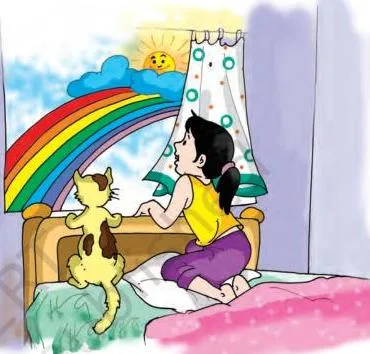
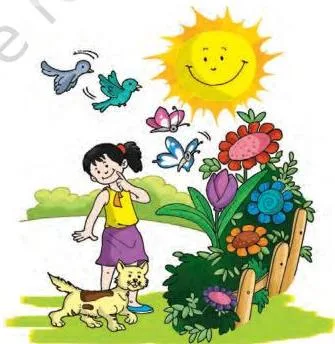
The pages of Mridang are picture-led, and this chapter’s story is built around scenes a child can see on the page. The illustrations in this chapter are story scenes rather than numbered diagrams with captions, so the page focuses on the text and activities those scenes belong to.
- Anandi asleep while rain falls outside.
- The huge, bright rainbow across a clear blue sky, seen from her window.
- The garden, with Milli the cat.
- Flowers being given violet, indigo, blue, green, orange and red.
- The Sun shining in its yellow glory.
The Cat Mask page at the end of the chapter is a craft mask page, and the chapter text says it is for an activity on an earlier page of the book. It is the making part of the chapter: children turn the printed page into a mask they can wear while talking about the story.
Words to know from the story and the rainbow colours
This section is for the child who stumbles on an unfamiliar word while reading. The story uses everyday words, most of which a six-year-old already knows.
| Word | What it means in the story |
|---|---|
| rainbow | The arch of colours in the sky when rain and sunshine come together |
| asleep | Sleeping, not awake |
| dream | The pictures the mind makes while sleeping |
| favourite | The one you like best |
| bright | Full of light, easy to see |
| clear | Without clouds or mist |
| garden | The ground near a house where flowers grow |
| lo | An old word for “look!” — here it shows surprise |
| gay | In this story it means bright and cheerful, not the modern use of the word |
The seven rainbow colours to say aloud:
- violet
- indigo
- blue
- green
- orange
- red
- yellow
Common mistakes to avoid with this chapter
The chapter looks so simple that the mistakes children make here are about what they skip or copy, not about hard content. Each mistake below has its correction.
| Mistake | Correct rule | How to check your answer |
|---|---|---|
| Treating the chapter as read-only and skipping the outdoor Let us do observation. | The sky-watching, cloud-drawing and sharing tasks are part of the chapter’s learning; the child should actually go outside and look. | Ask the child what shapes they saw in the clouds today and whether they can draw one. |
| Confusing indigo with violet when colouring. | Indigo is the deep blue–purple band between blue and violet, and violet is the last band of the rainbow; Anandi simply paints violet first. | Name the bands blue, indigo, violet in order before colouring them. |
| Thinking yellow is missing from the rainbow because Anandi left it. | Anandi saved yellow for the Sun; yellow is still a rainbow colour. | Recite all seven colours — violet, indigo, blue, green, orange, red and yellow. |
| Copying Anandi’s details into Let us write instead of writing about the child. | The about-myself page asks for the child’s own name, age, school, favourite colour and likes. | Read the page back — every answer should belong to the child, not to the story. |
| Answering the sunrise and sunset sky question with “blue” without looking. | At sunrise and sunset the sky usually shows orange, pink or red, not the blue of midday. | Watch the sky at those times and say what colour it actually is. |
How teachers use this chapter in Class 1
There is no written board examination at Class 1, so this chapter is assessed through speaking, drawing, observation and the completed Let us write page rather than through a test.
- Let us speak — a one-to-one check: each child answers the four questions aloud, and the teacher listens for complete, confident sentences.
- Let us do — an observation activity to share with the class; children report what they saw in the sky and the shapes they found in the clouds.
- Let us write — a record of the child: name, age, school, favourite colour and likes, kept as early handwriting practice.
- Cat Mask — a craft follow-up that lets the child make something from the chapter.
The book’s own note to the teacher is one line — encourage every child to express what they see. That is the whole aim of the chapter: observation and language, not memorising.
One caution: textbook contents and the examinable syllabus are not always identical — check the current official syllabus.
One minute recap: Anandi’s Rainbow
Read this aloud to the child, or let a child who can read try it:
Anandi sleeps through the rain and dreams of rainbows. She wakes to a bright rainbow in a clear sky. She runs to the garden with Milli, her cat. She paints the flowers violet, indigo, blue, green, orange and red. She leaves yellow for the Sun, so the Sun shines bright and cheerful.
The rainbow fades, and the garden is full of colour.
Before closing the chapter, check three things:
- Can the child say the seven rainbow colours aloud?
- Has the child drawn the sky they saw?
- Are the about-myself lines filled in with the child’s own details?
Related chapters and resources
This listing is maintained for the 2026-27 academic session using the NCERT textbook information available to us. NCERT remains the authority for confirming the latest edition.
Anandi’s Rainbow is Chapter 9 of the NCERT Class 1 English book Mridang. The official edition is published on ncert.nic.in, and the pages below help you move through the book and the site.
- Mridang Class 1 English book page — every chapter of the book in one place.
- Seasons in Mridang Class 1 English — a story chapter in the same book, with its own activities.
- Class 1 notes hub — notes and resources across Class 1 subjects.
- All CBSE notes — study material for every class on this site.
The official NCERT website (ncert.nic.in) publishes the current Mridang edition and its chapter PDFs. NCERT settles textbook editions and files; CBSE settles the curriculum and syllabus.
Reference: NCERT Class 1 English Mridang textbook, chapter 9, official edition on ncert.nic.in.
Frequently asked questions about Anandi’s Rainbow
Where can I download the Anandi’s Rainbow Class 1 chapter PDF?
The official PDF is the link at the top of this page — Anandi’s Rainbow Class 1 English chapter PDF from NCERT — hosted on ncert.nic.in as part of the current Mridang Class 1 English edition.
What is the story Anandi’s Rainbow about?
Anandi wakes from a rainy sleep and sees a bright rainbow through her window. She runs to the garden with her cat Milli and paints the flowers in rainbow colours — violet, indigo, blue, green, orange and red — leaving yellow for the Sun. When the rainbow is gone, the garden is full of colour.
Which colours of the rainbow does the story name?
All seven: violet, indigo, blue, green, orange, red and yellow. Anandi paints them in her own order, keeping yellow back so the Sun looks bright and cheerful.
What do children have to do in the Let us do activity?
They go outside and look at the sky, find and draw shapes in the clouds, and watch the sky at sunrise, sunset and at night. Then they share what they saw with the class.
What is the Cat Mask page for?
It is a craft mask page near the end of the chapter. The chapter text says it is for an activity on an earlier page of the book.
Explore Class 1 English Books
Related chapters: