
Looking for the Let Us Read Class 1 chapter PDF? It is on this page. Chapter 4 (Let Us Read) of the NCERT Class 1 English textbook Mridang is a 21-page early-literacy unit with two illustrated stories, an action song and phonics activity pages.
The official PDF comes from the NCERT edition of Mridang published for the current academic session, and the download link is right below.
Download Let Us Read Class 1 PDF: NCERT English Mridang Chapter 4
The chapter file is issued by NCERT itself, so the pages your child studies match the official Class 1 English book. The link below opens the official NCERT page for Mridang, where every chapter PDF — including Chapter 4 — is published.
Use it to open the file from the official NCERT website (ncert.nic.in): Download NCERT Class 1 English Mridang Chapter 4 (Let Us Read) PDF
Chapter at a glance
The table below lists what the Chapter 4 file contains — page count, sections, illustrations, activity pages and teacher-guidance notes — as recorded from the official NCERT publication. Use it for the totals; the prose on this page explains what each part teaches.
| What the chapter holds | Count | Where it is used |
|---|---|---|
| Printed pages | 21 | |
| Figures with NCERT captions | 6 | |
| Tables | 5 | |
| Activities | 2 | |
| Official NCERT PDF | Download the chapter PDF | the chapter exactly as NCERT publishes it |
The named parts of the chapter are:
- The Cap-seller and the Monkeys — the first reading unit: a picture story with a prediction pause and its own comprehension questions.
- Butterflies — the song page, sung with up, down, in and out actions.
- Catch me if you can — the second reading unit: a rhyming cat-and-rat story.
- Let us speak, write, listen, do and explore — the activity pages, from talk frames and sound games to mask-making and outdoor drawing.
There are no numbered exercise blocks; instead, each activity page carries its own short instructions, and several pages add a note for the adult.
What this chapter is about
This is an early-literacy chapter, not a content-heavy one. It builds a beginning reader’s first sounds, syllables, rhyming and simple story comprehension — through stories, songs and games rather than written work.
The chapter runs in this order:
- Reading unit one: The Cap-seller and the Monkeys, with comprehension questions, first-sound rows and picture-sequence work.
- The Butterflies song page, for singing and clapping.
- Reading unit two: Catch me if you can, with listening work on rhyming words and a read-it-alone task.
- The Let us speak, write and listen pages: dialogue frames, sound and letter games, action commands.
- The Let us do and Let us explore pages: mask-making, animal-homes matching, family story-sharing and outdoor drawing.
The chapter closes with a Let us do spread: children help animals find their homes, ask a family member for an animal story to share in English, and — in small groups — draw pictures for a story and present it in class.
The two stories in this chapter
Two separate stories sit under the single Let us read title, and each ends with its own comprehension questions. Parents sometimes search for one story and miss that the chapter holds both.
The two stories, and what each one practises:
| Story | What happens | What the child practises |
|---|---|---|
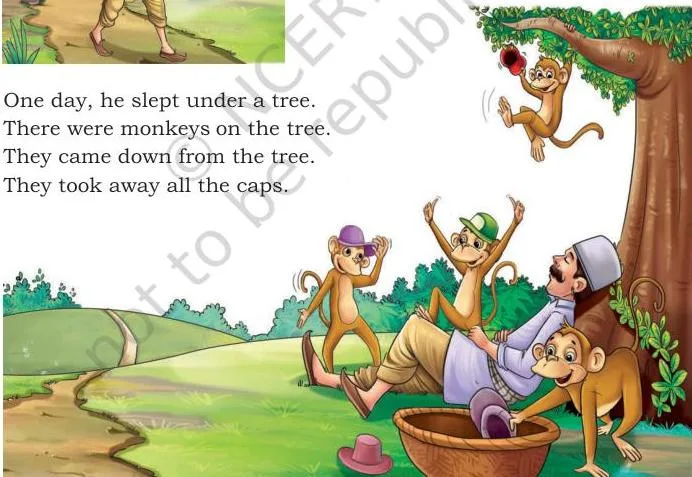
| The Cap-seller and the Monkeys | A cap-seller sleeps under a tree; monkeys take every cap and copy his gestures, so he throws his own cap into the basket and gets them all back. | Predicting at the mid-story pause, retelling from pictures, answering a ‘why’ question. |
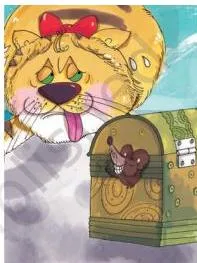
| Catch me if you can | A fat cat on a mat chases a little rat, who hides in a hat and then in a box whose lid will not open. | Rhyming words (cat, bat, fat, sat, mat, hat), first-sound listening, reading the story back alone. |
The cap-seller tale is told in short lines with a picture for almost every action. Just after the monkeys are found wearing every cap, the book stops and prints a question:
What do you think the cap-seller would do now?
The child guesses what happens next before the answer is revealed on the following lines. A note to the teacher explains that the mid-story question gives children time to reflect and guess.
The answer is the story’s joke: the monkeys copy everything the cap-seller does — shaking fists, scratching his head — so when he throws his own cap into the basket, they copy that too, and all his caps come back.
After the story come two comprehension questions: one personal (about the child’s own cap and its colour), and one ‘why’ question — why the monkeys threw the caps into the basket.
Catch me if you can runs on rhyming lines a child can join in with. A fat cat on a mat warns a little rat that she can catch it; the rat hides in a hat, then in a box, and the lid will not open — so the rat gets the last word.
After this story, the child says the first sound of each rhyming word, notices what the words share (the ending ‘at’), and then tries to read the whole story again by themselves. The chapter carries no numbered exercise set — its questions are embedded in the activities: personal ones, reasoning ones, and listening ones.
Sounds, syllables and word building
Two words used on the sound pages are worth defining for the adult: the first sound is the sound a word begins with, and a syllable is one spoken beat of a word — monkey has two beats (mon + key).
The sound pages train the child’s ear before any letters are written. A child who can hear that monkey and mango begin alike will later find the letter m easy to learn — which is why the chapter sequences sound work ahead of letter work.
The activities build a ladder:
| Activity | What the child does | Skill it trains |
|---|---|---|
| First-sound rows — cap, cat, coat | Says each row and names the sound the words start with | Hearing the first sound of a word |
| Circle the same sound | Circles the words in a row that begin like the sample, such as car and can in a row with tap and rat | Grouping words that start alike |
| Say and clap | Claps once for every word in a poem line — five claps for the line ‘butterflies, butterflies, up, up, up‘ | One word at a time in a spoken line |
| Clap the syllables | Claps once per syllable in two-syllable words: mon + key = two claps | Breaking words like monkey and basket into parts |
| Match initial syllables | Pairs words with the same first syllable, such as sand with socks | The first spoken part of a word |
| Build words from ‘at’ | Adds one starting letter to ‘at’: B + at = bat, then C, M, F, R, H | Word-building from a known ending |
The progression matters. The child first hears the shared sound inside a row, then finds it across rows, then breaks whole words into syllables, and finally builds new words by adding one starting letter to at — giving bat, cat, mat, fat, rat and hat.
The new letter always goes at the front of at, never the end. The same front-letter habit transfers to other short words a child meets while reading, which is the real skill the game teaches.
Reading the pictures: how the illustrations teach

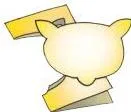
This chapter uses pictures the way other textbooks use figures — but none of its illustrations carries a printed caption. For a pre-reading child, the pictures are the lesson.
The illustration work falls into five uses:
- Story telling: the cap-seller tale is carried by its picture-strip, and the teacher is told to narrate from the pictures with voice modulation and actions, drawing attention to details in the illustrations.
- Sequencing: on the page after the story, the child writes numbers 1–4 next to pictures in story order, then retells the story in their own words.
- The letter dictionary: the A–Z pages pair every letter from A to Z with a picture whose name starts with it — Aa Ant, Bb Bee, Cc Cat, Dd Dog, Ee Elephant, Ff Fish, Gg Goat, Hh Hen, Ii Inkpot, Jj Jug, Kk Kite, Ll Lion, Mm Monkey.
- …and Nn Nest, Oo Owl, Pp Parrot, Qq Quill, Rr Rat, Ss Snake, Tt Tiger, Uu Uniform, Vv Van, Ww Whale, Xx X-ray, Yy Yak, Zz Zebra. The pages open with the prompt ‘Cats, rats, ants and more! Write their names’ and end with ‘Now write your name here’.
- The craft template: the cat mask on the last page is the picture the child cuts out for the mask-making activity — no reading needed to start.
- The explore prompt: on Let us explore, drawing insects, flowers, birds, animals and trees is the whole instruction; the child sees, draws and talks.
These pictures replace the formal captioned figures an older textbook would use: a pre-reading child cannot read a caption, so the image itself has to teach.
The poem, the talk pages and the craft activities
This half of the chapter teaches English through the body — singing, clapping, cutting and acting — so a child who cannot yet write a sentence can still use the language.
- Butterflies — the song sends the word ‘butterflies’ up, up, up; down, down, down; in, in, in; out, out, out. The book prints an invitation to replace ‘butterflies’ with anything else and try. The teacher sings with actions first, then lets children sing on their own.
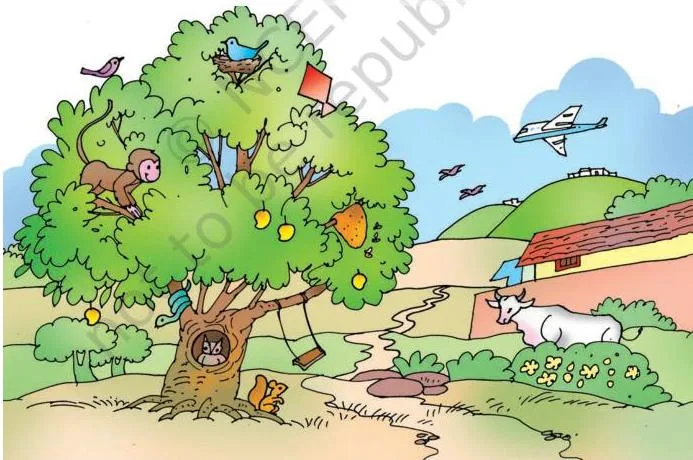
- Look up, look down — a fill-in talk frame: the teacher asks what the child sees on the tree, on the ground and in the sky, and the child completes ‘I see ____’ each time.
- Say and clap — say each poem line aloud, clapping once for every word.
- Let us write — encircle the words that contain the letter p (put, cap, pat, pink, apple) and encircle the matching letters in rows of mixed letters, building visual letter discrimination before handwriting.
- Let us listen — follow spoken action commands: catch the ball, throw the ball, hide under a table, open or close your pencil box, say hurray. Six action words — catch, throw, hide, open, say, close — are to be looked up with the teacher.
- Mask-making — the child makes the cat mask first: cut it out from the last page, make holes, tie strings. Then the child thinks through the steps for a rat mask and tells a friend how to make it. The masks are worn to enact the story.
- Let us explore — find insects, flowers, birds, animals and trees around home, draw some of them, and tell friends more about them.
Notes to the teacher — what the book is telling adults
Mridang addresses the adult on the same pages it addresses the child: the printed ‘Note to the teacher’ boxes are guidance for the grown-up. Together they describe one method — hear it, say it, repeat it.
- The mid-story question exists to give children time to reflect and guess, not to test them.
- Narrate the story from the pictures in simple English, using voice modulation and actions; point to details in the illustrations.
- Ask questions that draw answers in English. If a child answers in one word, like ‘cap’, accept it — then stretch it into the full sentence, ‘This is a cap.’
- Repeat the story after a few days to reinforce the English words.
- Clap for every word in a poem line, then for each syllable — two claps for mon + key.
- Help children number the pictures in story order and retell the story in their own words; accept non-English words in the retelling, but keep moving toward English.
- Practise phrases like ‘on the ground’ and ‘on the tree’ often, so they become automatic.
Mistakes beginners make in this chapter
The chapter’s teacher notes and activity design point to the mistakes beginners make most often. Naming them before the child makes them saves a round of frustration.
| Mistake | Correct rule | How to check your answer |
|---|---|---|
| Hunting the same sound at the end of a word — in a row like car, tap, can, rat, the target is the beginning. | Listen to the first sound: car and can start alike; tap and rat do not. | Say the row slowly twice; the child points to the word that starts the way the sample does. |
| Clapping once for a whole word — ‘monkey’ gets one clap instead of two. | Two-syllable words take one clap per part: mon + key = two claps. | Clap together and count the spoken beats; the chin drops once per syllable. |
| Writing the letter before hearing the sound. | Ear-training comes first; the sound pages precede the letter pages. | Check the order: the child names the sound before writing anything. |
| Stopping at a praised one-word answer, like ‘cap’. | Accept the word, then stretch: ‘This is a cap.’ | After the one word, the adult models the full sentence and the child repeats it. |
| Adding the extra letter at the end of ‘at’ — writing ‘bate’ instead of ‘bat’. | The new letter goes at the front: B + at = bat. | Compare the written word with the picture; the picture shows what was intended. |
Practice goals: what this chapter is building
Chapter 4 is oral, foundational work. Mastery shows up in classroom routines, not on a marks sheet. By the end of the unit a child should be able to:
- Say the shared first sound of a row — cap, cat, coat all start the same way.
- Group words by starting sound — circling car and can in a row that also holds tap and rat.
- Clap syllables in two-part words such as monkey and basket.
- Build new words from ‘at’ by adding one starting letter.
- Retell the cap-seller story from the pictures in their own words.
- Answer the printed ‘why’ question after the first story.
- Follow spoken action commands like catch, throw, hide, open and close.
- Sing and act Butterflies with up, down, in and out movements.
Textbook contents and the examinable syllabus are not always identical — if you need the list of what is formally assessed, check the current official CBSE syllabus.
End-of-chapter checklist
Run through this can-do checklist when the unit is finished; every item comes from an activity the chapter itself prints.
- Heard the cap-seller story and guessed what the cap-seller would do at the mid-story pause.
- Retold the story from the pictures in the child’s own words.
- Named the shared first sound in cap, cat, coat and monkey, mango, mouse.
- Circled the words that start alike.
- Clapped syllables in monkey and basket — two claps each.
- Built ‘-at’ words: bat, cat, mat, fat, rat, hat.
- Matched words with the same first syllable, like sand with socks.
- Sang and acted Butterflies.
- Listened and did the actions — catch, throw, hide, open, close, hurray.
- Completed the animal-homes page and shared a family animal story in English.
- Wrote their name on the letter page.
Related resources
This listing is maintained for the 2026-27 academic session using the NCERT textbook information available to us. NCERT remains the authority for confirming the latest edition.
If you want to move between the chapters without a fresh search, start from the NCERT Class 1 English Mridang book page, then use the links below.
- Previous chapter: Life Around Us (Mridang Chapter 3)
- Next chapter: A Farm (Mridang Chapter 5)
- Class 1 hub — notes for the Class 1 subjects listed on this site
- CBSE notes index — the full site index
NCERT publishes the Mridang chapter PDFs on its official Class 1 English textbook page at ncert.nic.in.
Reference: NCERT Class 1 English Mridang textbook, chapter 4, official edition on ncert.nic.in.
Sources and data verification
- This page describes the NCERT Class 1 English textbook Mridang, chapter 4 (Let Us Read), from the official NCERT PDF on ncert.nic.in.
- It covers this one chapter only — not the other chapters of Mridang, and not other Class 1 books.
- The listing is maintained from the NCERT edition of Mridang currently published on ncert.nic.in.
- NCERT settles textbook editions and PDFs; CBSE settles curriculum, syllabus and examinations.
Questions parents and teachers ask about this chapter
Why is Chapter 4 called ‘Let us read’ when it contains two different stories?
‘Let us read’ is the chapter’s title and its instruction: it tells the child what is about to happen — reading along with pictures, predicting, and retelling. Two separate stories join under the one title, and each ends with its own comprehension questions, so the chapter works as one reading unit made of two tales.
What is the question printed in the middle of the cap-seller story for?
It is a prediction pause. The book stops the story after the monkeys have taken every cap and asks, ‘What do you think the cap-seller would do now?’ The child guesses what happens next before the solution is printed, and the teacher note explains that the pause exists to give children time to reflect and guess.
Is it okay if my child answers in one word, like saying ‘cap’ instead of ‘This is a cap’?
Yes. The book tells the adult to accept a one-word answer such as ‘cap’ and then stretch it into the full sentence, ‘This is a cap.’ Accepting the word keeps the child speaking; the adult’s stretch models the complete sentence for the next turn.
What does the clapping activity in this chapter teach?
It trains the ear. The child first claps once for every word in a poem line — five claps for ‘butterflies, butterflies, up, up, up’ — and then claps once per syllable in two-syllable words like monkey (mon + key) and basket (bas + ket). Hearing that a line is made of words, and a word of parts, is preparation for reading and spelling.
Why does the book spend pages on letters with pictures, like A for ant and Z for zebra?
The letter pages pair every letter from A to Z with a picture whose name starts with it, from Aa Ant to Zz Zebra, so the child learns each letter through the sound it makes at the start of a familiar word — the same first-sound skill the story pages practise.
The pages end with the child writing their own name, which makes the alphabet personal.
Does this chapter carry exam weight for Class 1?
Chapter 4 is foundation work: it builds spoken English, phonics and early comprehension rather than exam-specific content. For anything about assessment in Class 1, check the current official CBSE syllabus — textbook contents and the examinable syllabus are not always identical.
Explore Class 1 English Books
Related chapters: