
Theorem 10.2 of NCERT Class 10 Mathematics (Chapter 10, Circles) states that tangents from an external point are equal: the two tangent segments drawn from one outside point to a circle are the same length.
The book proves this on page 149 with the RHS congruence rule, applied to the two right triangles formed by the radii, the tangents and the join to the centre.
Below you get the exact statement as printed, the book’s Fig 10.7, and a step-by-step proof you can reproduce in the exam.
The Exact NCERT Statement of Theorem 10.2
This is the theorem exactly as it is printed in the NCERT Class 10 Mathematics book.
Theorem 10.2 (NCERT Class 10 Mathematics, page 149) The lengths of tangents drawn from an external point to a circle are equal.
Source note: NCERT Class 10 Mathematics, Chapter 10 Circles, page 149.
New: practise this theorem. Drag the book’s figure and watch the numbers change, try to break the theorem on purpose, then solve fresh questions with hints.
What Theorem 10.2 Means in Plain Words
Take a circle and a point P outside it. From P you can draw two tangents, and each tangent touches the circle at exactly one point; call those points Q and R. The theorem says the two tangent segments PQ and PR have equal lengths: \(PQ = PR\).
The word external is doing real work here. Tangents exist only from a point outside the circle, and the position of P decides how many tangents there are and what their length is.
| Position of P | Tangents from P | Tangent length |
|---|---|---|
| Outside the circle (\(OP \gt r\)) | Two tangents, touching at Q and R | Equal: \(PQ = PR = \sqrt{OP^2 – r^2}\) |
| On the circle (\(OP = r\)) | One tangent, at P itself | Zero |
| Inside the circle (\(OP \lt r\)) | No tangent | Not defined — \(OP^2 – r^2\) is negative, so no real length exists |
So the edge cases fall out of the same formula: a point on the circle gives tangent length zero, and a point inside the circle gives no real tangent at all.
Fig 10.7: Reading the Figure for the Proof
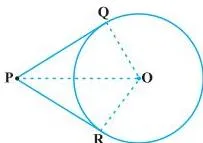
The circle’s centre is O. The point P lies outside the circle, and from P the two tangents PQ and PR touch the circle at Q and R — the points of contact lie on the circle itself.
For the proof, the book joins three segments (NCERT, p. 149): OP links the external point to the centre, and OQ and OR are the radii to the two points of contact. OP matters most: it is the side the two triangles share, the hypotenuse of both.
With these joins, PQ and PR become corresponding legs of both right triangles OQP and ORP.
Given, To Prove and Construction
The book sets the proof up in this shape, and an exam answer should follow the same three lines.
- Given: a circle with centre O, a point P outside the circle, and two tangents PQ and PR from P to the circle, touching it at Q and R.
- To prove: \(PQ = PR\).
- Construction: join OP, OQ and OR. OP is the side the two triangles share; OQ and OR are the radii to the points of contact.
Proof of Theorem 10.2, Step by Step
With the construction in place, the proof shows that the two right triangles OQP and ORP are congruent (NCERT, p. 149).
- The right angles. At Q the segment PQ is a tangent and OQ is the radius to the point of contact. By Theorem 10.1, the radius at the point of contact is perpendicular to the tangent, so \(\angle OQP = 90^\circ\). The same reasoning at R gives \(\angle ORP = 90^\circ\).
- Equal radii. OQ and OR are both radii of the same circle, so \(OQ = OR\).
- Common side. The segment OP belongs to both triangles, so \(OP = OP\).
- Congruence. Each triangle has a right angle, the same hypotenuse OP, and one equal leg \(OQ = OR\). The right angle hypotenuse side (RHS) rule therefore gives \(\triangle OQP \cong \triangle ORP\).
- CPCT — corresponding parts of congruent triangles are equal — gives \(PQ = PR\), which is exactly the statement to be proved.
The whole argument in compact form:
\[ \angle OQP = \angle ORP = 90^\circ,\quad OQ = OR,\quad OP = OP \quad \Rightarrow \quad \triangle OQP \cong \triangle ORP \quad (\text{RHS}) \]
\[ \Rightarrow \quad PQ = PR \quad (\text{CPCT}) \]
The Book’s Two Remarks after the Proof
After the proof the book adds two remarks, both on the same page (NCERT, p. 149).
Remark 1 — an alternative proof with Pythagoras. In right triangle OQP, Pythagoras gives \(OP^2 = OQ^2 + PQ^2\), so \(PQ^2 = OP^2 – OQ^2\). In triangle ORP it gives \(PR^2 = OP^2 – OR^2\). Since \(OQ = OR\), the two right-hand sides are equal, so \(PQ^2 = PR^2\) and therefore \(PQ = PR\).
This is the practical version for calculations: tangent length squared equals distance-from-centre squared minus radius squared. For example, with a circle of radius 6 cm and a point 10 cm from the centre:
\[ \text{tangent length} = \sqrt{OP^2 – r^2} = \sqrt{10^2 – 6^2}\ \text{cm} = \sqrt{64}\ \text{cm} = 8\ \text{cm} \]
So each of the two tangents from that point is 8 cm long.
Remark 2 — OP bisects the angle between the tangents. The same congruence gives \(\angle OPQ = \angle OPR\) as corresponding angles. So OP divides \(\angle QPR\) into two equal angles; the centre of the circle always lies on the line that splits the angle between the two tangents into equal halves.
Try it yourself: a live practice figure
Where the Chapter Uses Theorem 10.2
The theorem is cited again on page 150, immediately after its proof, and it does the main work in the two examples and two questions listed below (NCERT, pp. 150–151).
| Place | Page | Role of Theorem 10.2 |
|---|---|---|
| Example 2 | 150 | TP = TQ makes triangle TPQ isosceles, so its base angles are equal; the angle sum then proves \(\angle PTQ = 2\angle OPQ\). |
| Example 3 | 150–151 | TP = TQ makes triangle TPQ isosceles, and the angle-bisector remark from the proof is what lets the construction work towards the similar triangles that give TP. |
| Exercise 10.2, Q2 | 151 | Multiple choice with justification: the two tangents TP and TQ are equal, which starts the angle chase. |
| Exercise 10.2, Q3 | 151 | Multiple choice with justification: PA and PB are equal tangents, and the angle-bisector remark locates \(\angle POA\). |
All three questions of Exercise 10.2 are multiple choice with justification, so a full answer must name the theorem used as well as choose the option. Theorem 10.2 is not needed for Q1, which works from the right-angled triangle of a tangent, its radius and the join to the centre.
Does Theorem 10.2 Have a Converse?
NCERT states no converse for Theorem 10.2, so do not quote one in the exam. The closest companion result is the remark after the proof: the join from the external point to the centre bisects the angle between the two tangents.
The chapter’s other main theorem is its predecessor, Theorem 10.1, which this proof uses to establish the two right angles.
Common Mistakes in the Proof of Theorem 10.2
Every mistake below looks plausible in an exam and then the proof simply fails. The rule used here is RHS — a precise, named congruence rule, in the same spirit as the SAS similarity criterion for triangles. A vague “two sides and an angle” claim is not a proof.
| Mistake | Correct rule | How to check your answer |
|---|---|---|
| Claiming congruence by SSA — two sides and an angle — instead of RHS | RHS needs the angle to be the right angle and the equal sides to be the hypotenuse and one leg; SSA with any other angle is not a valid rule | Both triangles have the right angle at Q and R, so the equality used is genuinely RHS, not SSA |
| Forgetting that OQ and OR are equal | Both are radii of the same circle, and all radii of a circle are equal | Label every side that ends at the centre as a radius before comparing the triangles |
| Placing the right angle at P | The right angle is at the point of contact, where the tangent meets the radius (Theorem 10.1) | The right angle is between a radius and a tangent — it can never sit at the external point P |
| Writing the congruence with mismatched vertex order | In \(\triangle OQP \cong \triangle ORP\), the order pairs O with O, Q with R, and P with P | Read CPCT from your written order: it must give \(PQ = PR\); any other pair means the order is wrong |
Frequently Asked Questions
How do you prove that tangents from an external point are equal?
Join the centre O to the external point P and to the points of contact Q and R. Then \(\angle OQP = 90^\circ\) and \(\angle ORP = 90^\circ\) by Theorem 10.1, \(OQ = OR\) as radii, and OP is common. So \(\triangle OQP \cong \triangle ORP\) by RHS, and CPCT gives \(PQ = PR\).
Why are the two tangents from an external point equal in length?
Each tangent, together with its radius and the join to the centre, forms a right triangle. The two right triangles are congruent — same hypotenuse OP, same radius — and congruent triangles have equal corresponding sides, so the tangent sides PQ and PR must match.
Equivalently, both tangents have the same length \(\sqrt{OP^2 – r^2}\), because OP and the radius are the same for both.
Why does the proof of Theorem 10.2 use RHS congruence?
Because the figure supplies exactly the conditions RHS needs: each triangle already has a right angle at the point of contact, the two hypotenuses are the same segment OP, and one leg is the equal radius. Nothing else has to be measured.
RHS is also the precise statement, whereas a loose “two sides and an angle” claim (SSA) is not a valid congruence rule.
What is the tangent length from a point 10 cm away from the centre of a 6 cm radius circle?
8 cm. Using the Pythagoras form of the proof, the tangent length is \(\sqrt{OP^2 – r^2} = \sqrt{10^2 – 6^2}\ \text{cm} = \sqrt{64}\ \text{cm} = 8\ \text{cm}\). Both tangents from that point have this same length by Theorem 10.2.
Does NCERT Class 10 Circles state the converse of Theorem 10.2?
No. The book gives no converse for Theorem 10.2. The related fact it does state is the remark that the join from the external point to the centre bisects the angle between the two tangents.
What is the angle bisector remark after Theorem 10.2 in the NCERT book?
It says the segment from the external point to the centre divides the angle between the two tangents into two equal parts. In the book’s notation, \(\angle OPQ = \angle OPR\). Example 3 and Exercise 10.2 Q3 build on this remark.
Related Resources
This listing is maintained for the 2026-27 academic session using the NCERT textbook information available to us. NCERT remains the authority for confirming the latest edition.
For the full chapter with its exercises, open the NCERT Class 10 Maths Circles chapter page. The proof above leans on the chapter’s earlier Theorem 10.1, and the Class 10 Maths theorems hub groups the chapter’s theorems for quick revision.
Revision notes covering this theorem alongside the rest of the year’s work sit in the CBSE Class 10 Mathematics notes, inside the Class 10 study notes and the main CBSE notes hub.
To read the theorem, its proof and Fig 10.7 in the original printed layout, open the official NCERT PDF of Chapter 10, Circles (file jemh110) on the NCERT website.
Reference: NCERT Class 10 Mathematics textbook, chapter 10, Theorem 10.2, official edition on ncert.nic.in.
Explore Class 10 Mathematics
Class 10 Mathematics on NCERTTextbooks:
Related chapters: