
This is the official Indian Constitution Class 8 chapter — Chapter 1 of the NCERT Social and Political Life (Civics) textbook for Class 8, 2026-27 edition. The chapter runs from page 3 to page 17 of the book and explains why countries need a constitution and what the key features of the Indian Constitution are.
The official NCERT PDF is right here, and below it you will find a plain-language walkthrough of everything the chapter contains.
Download the Indian Constitution Class 8 Chapter 1 PDF
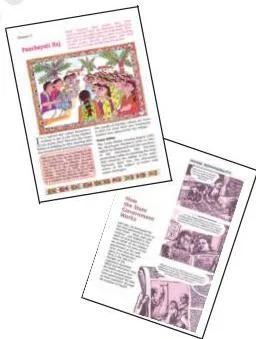
The official file is the free NCERT PDF of Class 8 Social and Political Life, published on ncert.nic.in. Chapter 1, The Indian Constitution, begins on page 3 of the book and runs to the chapter exercises and glossary on pages 15–17, including the three classroom storyboards, the Nepal example, and the Constituent Assembly photographs.
Open the official Indian Constitution Class 8 chapter PDF from NCERT to read the chapter in the textbook format, with the original images and margins. The 2026-27 edition is the one this page is based on.
What Is Inside Chapter 1: A Quick Look
Before you read, here is a map of the chapter so you know where each idea lives. The table below is generated directly from the book and is the single place where the chapter’s totals appear.
| Chapter contents | Count |
|---|---|
| Printed pages in the book | 16 |
| Chapter sections | 8 |
| Figures indexed | 9 |
| Exercise questions | 6 |
| Tables in the chapter | 3 |
The chapter moves through five parts: Why Does a Country Need a Constitution? (the football analogy, Nepal’s story and three storyboards), The Indian Constitution: Key Features (five features, page 9 onwards), Fundamental Rights (page 13), Exercises (page 15), and the Glossary (page 17).
What This Chapter Covers: Football, Constitutive Rules and a Written Constitution
This section is the chapter’s opening idea, and everything else builds on it. The chapter starts with football because it wants you to see that a game is defined by its rules — and so is a society.
If players start holding the ball and passing it with their hands, they are not playing football any more. A rule like this does not just regulate the game; it makes the game what it is. The textbook calls such rules constitutive rules (NCERT, p. 3).
A society also has constitutive rules that define it and separate it from other kinds of societies. In a large society where many different communities live together, these rules are formed through consensus — agreement among people — and in modern countries that consensus is written down. That written document is a Constitution (NCERT, p. 3).
This one idea explains the chapter’s whole plan: because a constitution defines a society the way rules define a game, a major change in a society’s nature demands a change in its constitutive rules. That is why Nepal, moving from monarchy to democracy, needed a new constitution — more on that below.
Why Does a Country Need a Constitution? The Chapter’s Four Answers
This is the chapter’s central question, and the book gives four separate answers. Each one is also a reason you can quote in an exam answer, and each is tied to an example in the chapter.
- It lays down the ideals of the country. A constitution tells us what kind of country we aspire to live in — the fundamental nature of our society (NCERT, p. 4). The example is Nepal, which wrote a new constitution after its people’s movement succeeded in ending the King’s powers, because the old 1990 document did not reflect the democratic ideals they had fought for (NCERT, p. 6).
- It defines the nature of the political system. In a democracy, the constitution lays down the guidelines for how decisions are made. Nepal’s earlier constitution said the country was to be ruled by the King and his council of ministers; a democratic constitution places that power differently (NCERT, p. 6).
- It protects minorities from the tyranny of the majority. Every society is prone to a majority continuously enforcing decisions that exclude minorities. The constitution contains rules that prevent this (NCERT, p. 8). The basketball storyboard on page 8 is the chapter’s example.
- It saves us from ourselves. At times we may feel strongly about something that goes against our larger interests — for example, people upset with party politics might come to want a strong dictator. A good constitution does not allow such whims to change its basic structure or easily remove the provisions that protect citizens’ rights and freedom (NCERT, p. 9). The Shabnam storyboard on page 9 is the everyday example.
One important caution the book gives: while all democratic countries are likely to have a constitution, it does not follow that every country with a constitution is democratic (NCERT, p. 4). Keep this warning in mind — it is the easiest mark to lose.
Key Features of the Indian Constitution: Federalism to Secularism
The chapter then asks what ideals a constitution translates into. It lists five key features of the Indian Constitution, each one a solution to a problem the members of the Constituent Assembly were trying to solve: keeping India’s diversity while preserving unity, ending poverty through reform, and letting people choose their representatives (NCERT, p. 10).
1. Federalism. This means more than one level of government. India has governments at the state level and at the centre, and Panchayati Raj is the third tier (NCERT, p. 11).
Because India has so many communities, decisions could not all be made by people sitting in Delhi; each state has autonomy on certain issues, while subjects of national concern follow central laws. Under federalism, states are not merely agents of the central government — they draw their authority from the Constitution itself.
2. Parliamentary Form of Government. The Constitution guarantees universal adult suffrage — every citizen has the right to vote and can also contest elections, whatever their social background. The Constituent Assembly believed the freedom struggle had prepared the masses for this, and that it would break the hold of traditional caste, class and gender hierarchies.
Elected representatives are accountable to the people (NCERT, p. 12).
3. Separation of Powers. The Constitution creates three organs of government: the legislature (elected representatives), the executive (the smaller group that implements laws and runs the government) and the judiciary (the system of courts).
Each organ exercises different powers, so each acts as a check on the others — this prevents any one branch from misusing power and keeps the balance between all three (NCERT, p. 12).
4. Fundamental Rights. This section is called the conscience of the Indian Constitution (NCERT, p. 13). Colonial rule created a suspicion of the State in the minds of the nationalists, so they wanted written rights that would guard against the arbitrary and absolute exercise of State power. Fundamental Rights protect citizens against the State, against other individuals, and minorities against the majority.
5. Secularism. A secular state is one that does not officially promote any one religion as its state religion. The chapter promises you will read more about this in the following chapter (NCERT, p. 14).
State versus government. The word State in this chapter does not mean state governments. Government is responsible for administering and enforcing laws, and it can change with elections. The State is the political institution that represents a sovereign people occupying a definite territory — the Indian State, the Nepali State.
The government is only one part of the State, so the two words cannot be used interchangeably (NCERT, p. 13).
Fundamental Rights versus Directive Principles. Besides Fundamental Rights, the Constitution has a section called Directive Principles of State Policy. These were designed to ensure greater social and economic reform, and to serve as a guide for the independent Indian State to make laws and policies that reduce the poverty of the masses (NCERT, p. 14).
Rights are claims you can enforce; Directive Principles are aims the State should follow.
The Six Fundamental Rights at a Glance
You need to be able to identify which Fundamental Right is violated in a given situation — the exercises and the board both test this. Here is each right paired with the chapter’s own violation examples from page 14.
| Fundamental Right | What it protects | Chapter example of a violation |
|---|---|---|
| Right to Equality | All persons are equal before the law; no discrimination on grounds of religion, race, caste, gender or place of birth; untouchability is abolished. | A government that refuses to promote a woman officer of the armed forces because she is a woman. |
| Right to Freedom | Freedom of speech and expression, forming associations, moving freely and residing anywhere in the country, and practising any profession. | A politician who does not allow labourers from other states to work in his state. |
| Right against Exploitation | Prohibits human trafficking, forced labour, and employment of children under 14 years of age. | A 13-year-old child working in a carpet factory. |
| Right to Freedom of Religion | Every person may practise, profess and propagate the religion of their choice. | Any State action that forces or forbids a religion (the book’s example is the ban on untouchability under secularism). |
| Cultural and Educational Rights | All minorities, religious or linguistic, may set up their own educational institutions to preserve and develop their culture. | A group denied permission to open a Telugu-medium school in Kerala. |
| Right to Constitutional Remedies | Citizens may move the court if any Fundamental Right is violated by the State. | This is the right you use to get the other five enforced. |
Dr Ambedkar described the object of Fundamental Rights as two-fold: every citizen must be in a position to claim those rights, and the rights must be binding on every authority that has the power to make laws (NCERT, p. 14).
Reading the Storyboards: Three Classroom Examples and What They Prove
The chapter uses three illustrated classroom situations to make three abstract ideas concrete. When you revise, ask yourself for each one: which reason for having a constitution does this picture prove?
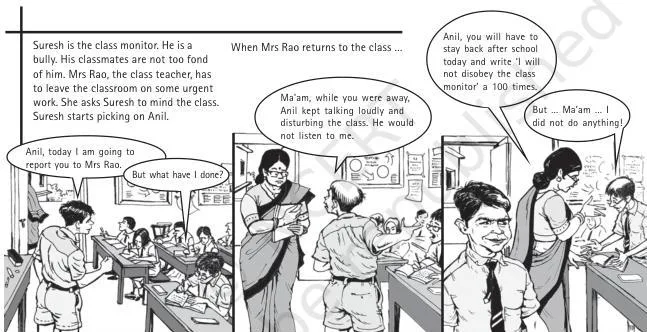
The first storyboard (NCERT, p. 7) shows Suresh, the class monitor, wrongly picking on Anil. The chapter’s point: we choose leaders to exercise power responsibly, but there is always the possibility that they will misuse their authority. The Constitution guards against this misuse — in the Indian Constitution, many of these safeguards are in the section on Fundamental Rights.
The book then gives a quick self-test: in which of three situations is a minister misusing power? Only the threats to use his security staff or the police are misuse; refusing a project for sound technical reasons is a proper decision.
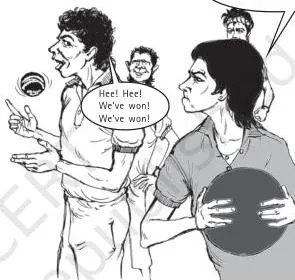
The second storyboard (NCERT, p. 8) is about basketball: an issue is settled by a show of hands, and the girls lose because there are more boys in the class. The textbook calls the problem tyranny of the majority — a majority continuously enforcing decisions that exclude minorities and go against their interests.
A constitution contains rules to ensure that minorities are not excluded from what is routinely available to the majority. This can be inter-community domination (one community over another) or intra-community domination (within the same community).
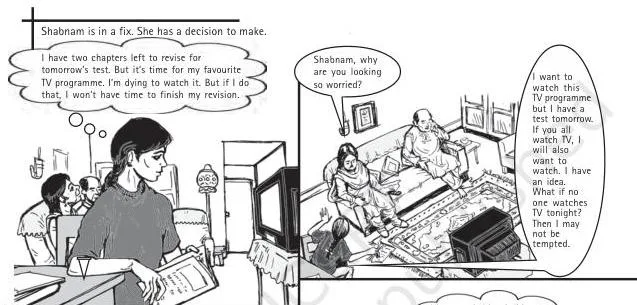
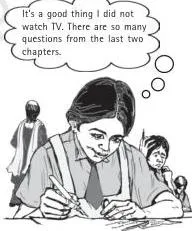
The third storyboard (NCERT, p. 9) shows Shabnam deciding to revise her chapters instead of watching TV. The chapter asks why she was happy about that choice — because she protected her own larger interest against a tempting short-term one.
At the national level, this is why a constitution protects us against decisions we might take in the heat of the moment, such as wanting a strong dictator when party politics turns bitter. A good constitution does not allow such whims to change its basic structure.
The Constituent Assembly: Who Wrote the Indian Constitution
This section connects the document to its makers. The chapter places the Constitution in the history of the anti-colonial struggle, because that struggle shaped Indian democracy.
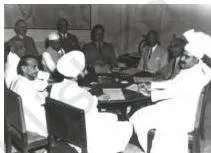
The demand for a Constituent Assembly was made by the Indian National Congress in 1934. The Assembly convened in December 1946 and worked until November 1949, drafting a constitution for independent India. Around 300 members took part (NCERT, pp. 5, 10). After 150 years of British rule, the members approached the task with the idealism that the freedom struggle had produced.
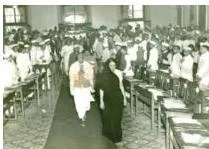
The Assembly was writing the Constitution at a time of great turmoil: the partition of India and Pakistan was imminent, some Princely States were undecided about their future, and the socio-economic condition of the masses was dismal (NCERT, p. 10). Despite this, the members worked with an extraordinary sense of unity, discussing every provision in detail and reaching decisions through consensus.
The final document reflects a respect for maintaining diversity while preserving national unity, a concern for eradicating poverty through socio-economic reform, and a conviction that the people must choose their representatives.
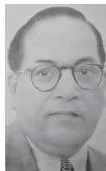
Dr Bhimrao Ambedkar is known as the Father of the Indian Constitution (NCERT, p. 11).
Dr Ambedkar believed his participation in the Constituent Assembly helped the Scheduled Castes get safeguards in the draft constitution, but he also warned that laws alone were not enough while the administration of those laws lay in the hands of ‘caste Hindu officers’. He therefore urged Scheduled Castes to join the government and the civil services (NCERT, p. 11).
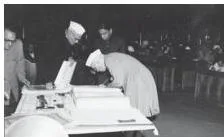
The Constitution was signed at the Assembly’s final session on 24 January 1950. Among those who signed were Prime Minister Jawaharlal Nehru, Dr Rajendra Prasad (President of the Assembly), and Sardar Vallabhbhai Patel, the Deputy Prime Minister (NCERT, p. 15).
Key Words You Need: Constitution, State and the Glossary Terms
Several words in this chapter are used with precise meanings. Here they are in plain words, so the arguments read more easily.
| Term | Plain meaning |
|---|---|
| Constitution (p. 3) | A written document containing the rules a society agrees on, which define it and set out how it is to be governed. |
| Constitutive rules (p. 3) | Rules that make a game or a society what it is; change them and you change the game itself. |
| State (p. 13) | The political institution representing a sovereign people in a definite territory — not the same as a government, which can change with elections. |
| Arbitrary (p. 17) | Left to one’s judgment or choice; not fixed. Used of rules that are not fixed or decisions with no basis. |
| Ideal (p. 17) | A goal or principle in its most excellent or perfect form. |
| Indian national movement (p. 17) | The movement of thousands of men and women against British rule, culminating in India’s independence in 1947. |
| Polity (p. 17) | A society that has an organised political structure — India is a democratic polity. |
| Sovereign (p. 17) | In this chapter, an independent people. |
| Human trafficking (p. 17) | Illegal trade in human beings, particularly women and children. |
| Tyranny (p. 17) | The cruel and unjust use of power or authority. |
The point of the State figure above is simple: when the Constitution speaks of the State, it means the whole political institution — legislature, executive and judiciary together — not just the ruling government of the day. An exam answer that treats them as synonyms loses the mark.
Common Mistakes Students Make in This Chapter
These five errors cost students marks year after year. Each one comes from a point the chapter itself warns about.
| Mistake | Correct rule | How to check your answer |
|---|---|---|
| Every country with a Constitution is democratic. | All democratic countries are likely to have a Constitution, but the reverse is not true (NCERT, p. 4). | Ask: does the Constitution give real power to the people? A monarchy can have a constitution too. |
| State and government are the same thing. | Government administers and enforces laws and changes with elections; the State is the permanent political institution representing a sovereign people (NCERT, p. 13). | If the ruling party loses an election, the government changes — the State does not. |
| Fundamental Rights protect only against the State. | They protect citizens against the State and against other individuals, and minorities against the majority (NCERT, p. 13). | Re-read the basketball and carpet-factory examples — both involve non-State wrongdoing. |
| Fundamental Rights and Directive Principles are the same. | Fundamental Rights are enforceable claims of citizens; Directive Principles guide the State towards social and economic reform (NCERT, p. 14). | Rights → you can go to court. Directive Principles → the State should aim at them. |
| Minority is only about numbers. | The real issue is domination — a minority is a group that can be excluded or dominated by a majority, not just a smaller count (NCERT, p. 8). | Would the group suffer if the majority always wins? Then it is a minority in the chapter’s sense. |
The chapter also has a classroom discussion task on Fundamental Duties (NCERT, p. 15): find out what the 11 Fundamental Duties include and why it is important for citizens in a democracy to observe them. It is designed for class discussion, not as a scored exercise question.
Working Through the Exercise Questions
The six exercise questions at the end of the chapter (NCERT, pp. 15–17) are of three types: direct concept questions (1, 3), comparison and identification questions (2, 4, 6), and a significance-table question (5). Here is what each one is really asking.
Question 1 — Why does a democratic country need a Constitution?: This is the whole chapter in one answer. State the four purposes: it lays down the ideals of the country, defines the nature of the political system, protects minorities from the tyranny of the majority, and saves us from ourselves. A full answer names all four and gives one example for each.
Question 2 — The two Nepal Constitutions.: The question gives you two articles and asks who exercises ‘Executive Power’ in each.
| 1990 Constitution of Nepal, Article 35 | 2015 Constitution of Nepal, Article 75 |
|---|---|
| Executive power is vested in His Majesty (the King) and the Council of Ministers. | Executive power is vested in the Council of Ministers, pursuant to the Constitution and law. |
The difference: in 1990, final authority rested with the King; in 2015, it rests with the elected government. The change of wording is the change from monarchy to democracy — Nepal had to change its constitutive rules to become the society its people had fought for (NCERT, p. 6).
Question 3 — What would happen if there were no restrictions on the power of elected representatives? Draw on the class monitor storyboard: power would be misused, and misuse of authority results in gross injustice (NCERT, p. 7). Elected leaders could act arbitrarily and harm citizens. That is why the Constitution contains safeguards — in India, mainly in the Fundamental Rights.
Question 4 — Identify the minority in four situations.: Use the chapter’s definition of minority as a group that can be dominated, not just a smaller number. For each situation name the group and the reason its views matter:
- 30 teachers, 20 male — women teachers are the minority; their views matter because the majority must not decide school matters alone.
- City where 5% are Buddhists — Buddhists are the minority; they must not be excluded from what is routinely available to others.
- Factory mess, 80% vegetarian — non-vegetarians are the minority; their dietary needs must still be respected.
- Class of 50, 40 from well-off families — students from less well-off families are the minority; the majority must not impose choices that ignore their situation.
Question 5 — The significance table.: This is the question students find hardest, so use this two-sentence method. Sentence one states what the feature is; sentence two states the problem it solves. For example: Federalism means more than one level of government. It solves the problem of India’s vast diversity, because decisions can be made at the state and local levels instead of only in Delhi. For Separation of Powers, say that three organs check one another and it prevents any one branch from misusing power. For Fundamental Rights, say they guarantee citizens against arbitrary State power and against majority domination. For Parliamentary Government, say representatives are elected by universal adult suffrage and are accountable to the people.
Question 6 — Border states (map work).: This exercise asks you to name the Indian states sharing borders with Bangladesh, Bhutan and Nepal. The map-based information is part of the chapter’s exercise material, so read the outline map of India given with the question carefully — the chapter does not print the answer in words. Check your answers with your teacher or an atlas before the test.
One final note: textbook contents and the examinable syllabus are not always identical, so always check the current official CBSE syllabus for what is examinable this session. No one can promise you which question will appear — preparation, not prediction, is the safe route.
Recap: The Indian Constitution in Five Points
If you have only two minutes, read these five points. They carry the chapter’s whole argument.
- Constitutive rules make a game what it is; a Constitution does the same for a society. If the rules change, the game changes — as Nepal showed when democracy replaced monarchy (NCERT, p. 3).
- A Constitution serves four purposes: it lays down ideals, defines the political system, protects minorities from the tyranny of the majority, and saves us from ourselves (NCERT, pp. 4–9).
- The five key features are Federalism, Parliamentary Form of Government, Separation of Powers, Fundamental Rights, and Secularism (NCERT, pp. 9–14).
- The six Fundamental Rights are the conscience of the Constitution — they guard against the arbitrary exercise of State power and protect minorities against the majority (NCERT, p. 13).
- India’s Constitution was written by a Constituent Assembly of around 300 members that met from December 1946 to November 1949, with Dr Ambedkar as its most important figure and the final signing on 24 January 1950 (NCERT, pp. 5, 10, 15).
Related Chapters and Resources
This chapter sets up ideas you will use all year. Chapter 2, Understanding Secularism, takes up the promise made on page 14 that secularism will be studied in detail — you can follow that thread through the Class 8 social science notes. For a related civics topic from this class, see the notes on reshaping India’s political map, which connects to the border-states exercise.
The Class 8 notes hub and the main CBSE notes index will help you find every chapter in one place. The official source for the PDF used on this page is Class 8 Social and Political Life on ncert.nic.in.
| What the chapter holds | Count | Where it is used |
|---|---|---|
| Printed pages | 16 | |
| Figures with NCERT captions | 9 | |
| Tables | 3 | |
| Exercise questions | 6 | answered in our NCERT Solutions |
| Official NCERT PDF | Download the chapter PDF | the chapter exactly as NCERT publishes it |
Reference: NCERT Class 8 Social and Political Life textbook, chapter 1, official edition on ncert.nic.in.
Sources and Data Verification
Here is exactly what this page is based on, so you can verify it yourself.
- Textbook: NCERT Social and Political Life for Class 8, 2026-27 edition, Chapter 1, The Indian Constitution, pages 3–17.
- Coverage: this page describes the NCERT textbook chapter listed above. It does not describe the full CBSE syllabus, which may include additional material set by the board.
- Authority: NCERT settles textbooks, editions and official PDFs; CBSE settles curriculum, syllabus and examinations. For the current examinable syllabus, see the official CBSE documents.
- Review: no external review process is claimed; the facts above are taken directly from the NCERT edition named.
FAQ: The Indian Constitution Class 8
Why does a democratic country need a Constitution?
A democratic country needs a Constitution for four reasons: it lays down the ideals of the country, defines the nature of the political system, protects minorities from the tyranny of the majority, and saves us from ourselves (NCERT, pp. 4–9).
Who wrote the Indian Constitution and when did it take effect?
The Constituent Assembly, with around 300 members, drafted the Constitution between December 1946 and November 1949. The final copy was signed on 24 January 1950, and the chapter presents Dr B. R. Ambedkar as the Father of the Indian Constitution (NCERT, pp. 5, 10, 11, 15).
What are the six Fundamental Rights in the Indian Constitution?
The six are: Right to Equality, Right to Freedom, Right against Exploitation, Right to Freedom of Religion, Cultural and Educational Rights, and Right to Constitutional Remedies (NCERT, pp. 13–14).
What is the difference between the State and the government?
The government administers and enforces laws and can change with elections. The State is the political institution that represents a sovereign people in a definite territory; the government is only one part of the State, so the two terms are not interchangeable (NCERT, p. 13).
Why did Nepal need a new Constitution in 2015?
Nepal moved from monarchy to democracy after a long people’s movement. Its 1990 Constitution placed executive power with the King, which did not reflect the democratic ideals the people had fought for, so Nepal adopted a new Constitution in 2015 with executive power vested in the Council of Ministers (NCERT, pp. 5–6).
Are Fundamental Rights and Directive Principles of State Policy the same thing?
No. Fundamental Rights protect citizens against the arbitrary and absolute exercise of State power. Directive Principles of State Policy are a separate section designed to ensure social and economic reform and to guide the State in reducing mass poverty (NCERT, p. 14).
Explore Class 8 Social Science Books
- Next: Reshaping India’s Political Map
Related chapters:
- Natural Resources and Their Use
- Introduction: How, When and Where
- Resources