
Looking for the NCERT “Resources” class 8 chapter — Chapter 1 of the Geography book Resources and Development (2026-27 edition), about six printed pages? The official PDF is right here, followed by a section-by-section explanation of what the chapter teaches and how to answer its exercises.
Download the Official NCERT PDF
This chapter is pages 1–6 of the NCERT Class 8 Geography book Resources and Development (2026-27 edition).
Open the NCERT Class 8 Geography Chapter 1 Resources PDF to read the chapter exactly as printed, then return here for the section-by-section explanation of what it means.
The same file carries the end-of-chapter exercises, which are worked through further down this page. All NCERT textbook files, including this one, are published on the official NCERT website, which is the authority for textbook editions and PDFs.
Chapter at a Glance
Chapter 1 teaches what a resource is and how the same substance can become a resource in one age and not in another.
NCERT frames the whole chapter as a conversation in one household — Amma, Mona and Raju. Amma’s answers build the definitions, while small “Let’s do” boxes ask you to find your own examples, and “Amma’s List” feeds into the classification of resources.
The chapter ends with conservation, sustainable development, and a set of exercises.
The table below lists what the chapter file contains — its sections, its illustrations and its activities — so you can see its shape at a glance.
What This Chapter Covers, in Order
If you are following along in the PDF, here is where every idea sits.
- Page 1 — What is a resource? Mona and Raju are helping Amma clean the house and notice that everything around them has a use. Amma defines a resource, and the chapter draws out utility and value, the two ideas that make a substance a resource. Two boxes appear here: a glossary entry for patent and a “Let’s do” task to list five resources used at home and five in the classroom.
- Page 2 — What turns a substance into a resource. The chapter introduces time and technology as the two factors, with the discovery of fire, the invention of the wheel and the technology of hydroelectricity as examples. “Amma’s List” then leads into the classification of resources into natural, human made and human. Natural resources split into renewable and non-renewable, and the page closes with why resources are distributed unequally.
- Page 3 — Human made and human resources. Iron ore becomes a resource only when people learn to extract iron from it, which leads to buildings, bridges, roads and machinery. People themselves are called human resources, and the chapter defines stock of resource and human resource development. A “Read and Ponder” box explains that humans are interdependent.
- Pages 4–5 — Conserving resources. The chapter moves to Mona’s nightmare: all water dried up and all trees cut down. It defines resource conservation and sustainable development, lists three duties and six principles of sustainable development, then moves into the exercises.
- Pages 5–6 — Exercises. Four short questions, a “Tick the correct answer” set, a 100-word activity on Abdur Rahim Khankhana’s couplet about water, and a “For Fun” section that asks you to compare prehistoric and future uses of wind.
Key Concepts: What This Chapter Asks You to Understand
The whole chapter runs on five linked ideas. If you can explain each in your own words, you can answer nearly anything the chapter asks: what makes a resource, what turns a substance into a resource, how resources are classified, why people matter most, and why we must conserve.
Utility and Value: What Makes a Thing a Resource
This is the chapter’s opening idea: nothing is a resource until it satisfies a need, and the need is what gives it value.
Anything that can be used to satisfy a need is a resource (NCERT, p. 1). The chapter builds a chain: use gives utility; utility gives value. Utility is usability — water you drink, a rickshaw you ride, the textbook you study from all have it.
Value means worth, and the sharp point is that worth is not the same as money. Metals have economic value; a beautiful landscape may have none. Both satisfy human needs, so both are resources (NCERT, p. 1).
Some things become economically valuable only later. A grandmother’s home remedies have no commercial value today, but if a medical firm patents them, they can become valuable. Patent means the exclusive right over an idea or invention (NCERT, p. 1).
The activity on page 2 asks you to circle the items in Amma’s List that have no commercial value. Notice that things like intelligence, old folk songs, a clean environment and affection from friends and family are not bought and sold — yet each satisfies a need.
Time and Technology: How Substances Become Resources
This is the chapter’s answer to “How does something become a resource?”: a substance becomes a resource when people need it and have the know-how to use it.
Time and technology are two important factors that can change substances into resources, and both are related to people’s needs (NCERT, p. 2). Technology is the application of the latest knowledge and skill in doing or making things (NCERT, p. 2).
The chapter’s three examples: the discovery of fire led to cooking; the invention of the wheel led to newer modes of transport; the technology to create hydroelectricity turned fast-flowing water into an important energy resource.
This is why the “For Fun” exercise on page 6 works. Wind on a high windy plateau is available in every era, but what you can do with it depends on the technology of your time. The same substance — wind, water, sunlight — is a resource in one age and merely weather in another.
The Three Types of Resources
Once you know what makes a resource, the chapter sorts all resources into three broad types. This is the classification that almost every exercise in the chapter returns to.
Resources are generally classified into natural, human made and human (NCERT, p. 2).
| Resource type | Where it comes from | How it becomes a resource | Examples |
|---|---|---|---|
| Natural | Drawn from nature | Used without much modification, sometimes with tools and technology | Air, water in rivers and lakes, soils, minerals (NCERT, p. 2) |
| Human made | Natural substances whose original form has been changed | Changed by people into something new | Buildings, bridges, roads, machinery, vehicles; technology itself (NCERT, p. 3) |
| Human | People themselves | Knowledge, skill and technology let people create more resources | People, with their number and abilities (NCERT, p. 3) |
Inside natural resources there is a second split — renewable and non-renewable — and this one matters most for conservation.
| Type | What it means | Examples | Effect of overuse or exhaustion |
|---|---|---|---|
| Renewable | Renewed or replenished quickly | Solar energy, wind energy, water, soil, forests (NCERT, p. 2) | Careless use can affect their stock; drying up of natural water sources is already a major problem (NCERT, p. 2) |
| Non-renewable | Limited stock; can be renewed only over thousands of years, far beyond human life spans | Coal, petroleum, natural gas (NCERT, p. 2) | Once exhausted, they stay exhausted for human lifetimes (NCERT, p. 2) |
The distribution of natural resources depends on physical factors like terrain, climate and altitude. Because these factors differ so much over the earth, the distribution of resources is unequal (NCERT, p. 2).
Human Resources and Human Resource Development
The chapter calls people the most important resource. A mineral deposit is only potential until someone with skill turns it into something useful.
People can make the best use of nature to create more resources when they have knowledge, skill and technology, which is why human beings are a special resource (NCERT, p. 3). Human resources refers to the number (quantity) and abilities (mental and physical) of people (NCERT, p. 3).
Stock of resource is the amount of a resource available for use. Human resource development is improving people’s skills so they can create more resources. Education and health are what make people a valuable resource (NCERT, p. 3).
The “Read and Ponder” box adds the interdependence point: farmers provide food grains for everyone, and scientists find ways to improve farm production (NCERT, p. 3). This box is where exercise question (iii) — “Why are human resources important?” — draws its answer.
Conservation and Sustainable Development
The chapter’s final idea is a warning and a promise: careless use can drain even renewable resources, but careful use keeps them available for the future.
Mona’s nightmare shows all water dried up and all trees cut down. Amma’s reply is the book’s warning: even renewable resources can become very scarce, and non-renewable ones can definitely get exhausted (NCERT, p. 4).
Resource conservation means using resources carefully and giving them time to renew. Sustainable development means balancing the need to use resources with conserving them for the future (NCERT, p. 4).
Each person can contribute by reducing consumption, recycling and reusing. In the story, the children make packets and shopping bags from old newspapers and bamboo sticks.
The chapter lists three duties: all uses of renewable resources should be sustainable, the diversity of life on the earth should be conserved, and damage to natural environmental systems should be minimised (NCERT, p. 4).
The six principles below turn those duties into everyday practice (NCERT, p. 5).
| Principle of sustainable development (NCERT, p. 5) | What it asks of you, in plain words |
|---|---|
| Respect and care for all forms of life | Treat every living thing as worth protecting, not only the useful ones. |
| Improve the quality of human life | Development should raise living standards, not merely take from nature. |
| Conserve the earth’s vitality and diversity | Keep natural systems healthy and protect nature’s variety. |
| Minimise the depletion of natural resources | Use resources — especially non-renewable ones — as slowly and sparingly as possible. |
| Change personal attitude and practices towards the environment | Reduce, reuse, recycle; individual habits matter. |
| Enable communities to care for their own environment | Local people should be able and encouraged to protect their own surroundings. |
The Two Illustrations in This Chapter
The chapter carries two illustrations, and both belong to the conservation idea. Each caption restates part of the definition of sustainable development, so learning the images means learning the definitions.
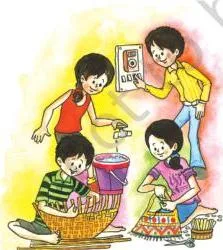
This first illustration sits beside the definition of sustainable development on page 4. Its caption restates that definition: carefully utilising resources so that, besides meeting the requirements of the present, we also take care of future generations.
A definition-as-caption: NCERT is making the balance between present needs and future generations visual. When question (iv) asks for sustainable development, this caption is the whole answer.

The second illustration accompanies the principles of sustainable development, and its caption is the sixth principle itself: enable communities to care for their own environment.
The point of that principle is scale. Sustainable development is not only a national policy; it works when communities — villages, neighbourhoods, school groups — have the ability and the responsibility to look after their own surroundings, the way the children in the chapter make and give away shopping bags to save resources.
Definitions: Every Term NCERT Defines in This Chapter
This chapter packs its definitions into a conversation, so they are easy to miss while you follow the story. This table collects every term NCERT defines in Chapter 1 so you can revise them without rereading.
| Term | Meaning in simple words | NCERT page |
|---|---|---|
| Resource | Anything that can be used to satisfy a need. | 1 |
| Utility | Usability; what makes an object or substance a resource. | 1 |
| Value | Worth; the worth that use gives a thing. | 1 |
| Patent | The exclusive right over an idea or invention. | 1 |
| Technology | Application of the latest knowledge and skill in doing or making things. | 2 |
| Natural resources | Drawn from nature and used without much modification. | 2 |
| Renewable resources | Resources that get renewed or replenished quickly. | 2 |
| Non-renewable resources | Resources with a limited stock that take thousands of years to replenish. | 2 |
| Human made resources | Natural substances whose original form has been changed — buildings, bridges, roads, machinery, vehicles. | 3 |
| Human resources | People: their number (quantity) and abilities (mental and physical). | 3 |
| Stock of resource | The amount of a resource available for use. | 3 |
| Human resource development | Improving people’s skills so they can create more resources. | 3 |
| Resource conservation | Using resources carefully and giving them time to renew. | 4 |
| Sustainable development | Balancing the need to use resources with conserving them for future generations. | 4 |
Common Mistakes Students Make in This Chapter
This chapter trips readers because its definitions are buried inside a friendly dialogue, so the exceptions in Amma’s answers are easy to skip. Four misunderstandings come up again and again.
| Mistake | Correct rule | How to check your answer |
|---|---|---|
| “A resource must have commercial value.” | Value means worth, not money. A beautiful landscape has no commercial value but satisfies a need, so it is still a resource (NCERT, p. 1). | Ask: does this thing satisfy a need? If yes, it is a resource whether or not anyone pays for it. |
| “Renewable means unlimited, so I can use it freely.” | Careless use of renewable resources like water, soil and forests affects their stock; drying up of natural water sources is already a major problem (NCERT, p. 2). Even renewable resources can become very scarce (NCERT, p. 4). | Ask: would heavy overuse by everyone change how much is available? If yes, it needs conserving. |
| “Non-renewable means it can never be renewed.” | These resources can be renewed or replenished, but only over thousands of years — far beyond human life spans — so we treat them as non-renewable (NCERT, p. 2). | Ask: how long would replenishment take — a few seasons or thousands of years? |
| “Human made and human resources are the same thing.” | Human made resources are changed natural substances — buildings, bridges, roads, machinery. Human resources are people themselves, with their number and abilities (NCERT, p. 3). | Ask: is this a thing someone built, or a person’s skill, number and ability? They belong to different categories. |
Working Through the Exercises at the End of the Chapter
The chapter ends with three exercise blocks on page 5 and a “For Fun” page on page 6. The four short questions are direct concept questions — each repeats a definition from the chapter. The tick questions test whether you can apply the definitions rather than repeat them.
The four short-answer questions (page 5)
1(i) Why are resources distributed unequally over the earth? Distribution follows physical factors such as terrain, climate and altitude. These factors differ so much across the earth that resources are spread unequally (NCERT, p. 2).
1(ii) What is resource conservation? Using resources carefully and giving them time to renew themselves is resource conservation (NCERT, p. 4).
1(iii) Why are human resources important? People with knowledge, skill and technology can make the best use of nature to create more resources. Humans are also interdependent — farmers feed everyone, and scientists improve crop production — so each person’s abilities contribute (NCERT, p. 3).
1(iv) What is sustainable development? It balances the need to use resources today with conserving them so future generations can meet their needs too (NCERT, p. 4).
Tick the correct answer (page 5)
(i) (c) quantity. Utility and value are the two criteria the chapter names; quantity is never part of the definition, however much of the substance exists (NCERT, p. 1).
(ii) (a) medicines to treat cancer. Medicines are natural substances changed by human knowledge into something new. Spring water and tropical forests are used as nature provides them, so they are natural (NCERT, pp. 2–3).
(iii) (a) those which have limited stock. That is the chapter’s definition: limited stock, replenished only over thousands of years. Option (b) describes human made resources; option (c) does not match the chapter’s criterion (NCERT, p. 2).
Activity: Rahim’s couplet about water (page 5)
The lines are by Abdur Rahim Khankhana, one of the nine gems of Akbar’s court: “Rahiman paani raakhiye, bin paani sab soon” — keep water, for without water there is nothing; without water the pearl, the swan and the dough cannot exist.
The resource is water, a renewable natural resource. For the 100-word answer, build four moves: what the poet tells us to do, what resource he means, what disappears without it, and why conserving it matters.
The poet’s own examples — the pearl, the swan, the dough — show that nothing survives without water. Add your own: crops fail, drinking water runs out, daily life stops (NCERT, pp. 2, 4).
For Fun: prehistoric winds, future winds (page 6)
This exercise is the time-and-technology idea from page 2 in disguise. In prehistoric times the wind on a high windy plateau is there, but the uses are limited to what people of that age can manage — think of drying, cooling or helping things move.
In the year 2138, the same wind can be turned into electricity because the technology exists to convert moving air into energy, just as technology turned fast-flowing water into hydroelectricity (NCERT, p. 2). Same substance, different technology — that is why wind is an important resource now.
The stone, leaf, straw and twig table works the same way. The stone row shows one object with many uses — toy, tool, decoration piece, weapon — and you fill similar rows for the leaf, the straw and the twig (NCERT, p. 6).
One honest note: textbook contents and the examinable syllabus are not always identical — check the current official CBSE syllabus for what is being assessed this session.
Revision Summary: The Chapter in Six Steps
If you can rebuild this chain from memory the night before a test, you know the chapter.
- Anything that can be used to satisfy a need is a resource (p. 1).
- Use gives utility; utility gives value; value is worth, and worth is not always money (p. 1).
- Time and technology turn substances into resources — fire, the wheel and hydroelectricity show how (p. 2).
- Resources are natural, human made or human; natural resources split into renewable and non-renewable (pp. 2–3).
- Human beings are the most important resource; education and health build human resource development (p. 3).
- Use resources carefully and give them time to renew — that is conservation. Balancing present and future use is sustainable development, guided by three duties and six principles (pp. 4–5).
Related Resources
This page is part of the NCERT Class 8 Social Science library — the Geography book Resources and Development, where this is Chapter 1. Chapter 2 of the same book, “Land, Soil, Water, Natural Vegetation and Wildlife Resources”, continues the conservation theme, and the book page below lists every chapter.
Continue your revision with these pages:
- Class 8 Geography book Resources and Development — all chapters of this book, including Chapter 2 on land, soil, water, natural vegetation and wildlife resources
- Class 8 hub — every NCERT Class 8 book indexed on this site
- Class 8 Social Science notes — revision notes for this subject
- Class 8 notes — revision notes across Class 8 subjects
- CBSE notes index — find your subject and class
- Reshaping India’s Political Map notes — if you are also revising the other Class 8 Social Science material
Sources and Data Verification
- The chapter described on this page is Chapter 1, “Resources”, of the NCERT Class 8 Geography textbook Resources and Development, 2026-27 edition.
- This page covers that single NCERT book; it does not describe the other Class 8 Social Science books — History or Social and Political Life.
- It is maintained for the current academic session using the NCERT information available to us.
- NCERT settles textbooks, editions and PDFs; CBSE settles the curriculum, syllabus and examinations.
| What the chapter holds | Count | Where it is used |
|---|---|---|
| Printed pages | 6 | |
| Figures with NCERT captions | 2 | |
| Tables | 2 | |
| Activities | 2 | |
| Official NCERT PDF | Download the chapter PDF | the chapter exactly as NCERT publishes it |
Reference: NCERT Class 8 Resources and Development (Geography) textbook, chapter 1, official edition on ncert.nic.in.
Frequently Asked Questions
What is a resource in Class 8 Geography?
A resource is anything that can be used to satisfy a need (NCERT, p. 1). Water, electricity, a rickshaw, vegetables and a textbook are all resources because each has a use.
What are the three types of resources in Class 8?
Resources are classified into natural, human made and human (NCERT, p. 2). Natural resources come from nature; human made resources are natural substances changed by people; human resources are people themselves, with their number and abilities.
What is the difference between renewable and non-renewable resources?
Renewable resources get renewed or replenished quickly — solar and wind energy are examples (NCERT, p. 2). Non-renewable resources have a limited stock and would take thousands of years to replenish, which is far beyond human life spans; coal, petroleum and natural gas are examples (NCERT, p. 2).
Why are human beings considered the most important resource?
People can make the best use of nature to create more resources when they have knowledge, skill and technology (NCERT, p. 3). Their skills transfer physical material into valuable resources, so people are called a special resource (NCERT, p. 3).
What is sustainable development in Class 8 Geography?
Sustainable development means balancing the need to use resources with conserving them for future generations (NCERT, p. 4). It asks that we utilise resources carefully so that, besides meeting present requirements, we also take care of the needs of the future.
Why are resources distributed unequally over the earth?
The distribution of resources depends on physical factors such as terrain, climate and altitude (NCERT, p. 2). These factors differ greatly over the earth, so resources are spread unequally.
Explore Class 8 Social Science Books
- Next: Reshaping India’s Political Map
Related chapters:
- Natural Resources and Their Use
- Introduction: How, When and Where
- The Indian Constitution