
This page covers the Madam Rides the Bus unit in NCERT’s Words and Expressions 2 workbook for Class 10 English — the practice book that sits beside the First Flight textbook. The official PDF of the unit is below, followed by a task-by-task walkthrough of the reading passages, vocabulary, grammar, listening, speaking and writing work.
Jump straight to the block where you are stuck from the contents.
Madam Rides the Bus Class 10: official NCERT PDF download
The official file, which contains the complete workbook unit exactly as printed — the Let’s Begin discussion, both reading texts, every exercise and the project — is the Madam Rides the Bus Class 10 Words and Expressions 2 PDF published on the NCERT website.
To confirm you are looking at the current edition, browse the English textbooks section of the official NCERT portal at ncert.nic.in.
The rest of this page explains what each block of the unit actually asks you to do, so keep the PDF open alongside.
What this unit contains, block by block
This is a practice workbook unit built around the First Flight story, and it moves from reading into grammar, editing, speaking and writing. The tasks are labelled EXTRAPOLATION — the workbook’s way of saying they extend the story into new practice.
| Block | What it asks you to do |
|---|---|
| LET’S BEGIN | Recall Valli’s bus ride and discuss what she saw; then share a journey of your own by bus, bicycle, boat or train |
| TEXT I | Read the passage ‘Pedalling through the Golden Years’ and answer the comprehension questions |
| TEXT II | Read the poem ‘Going Down Hill on a Bicycle, A Boy’s Song’ and answer six questions |
| VOCABULARY | Find five words from the First Flight story that match the given meanings |
| GRAMMAR | Complete six sentences using phrasal verbs made from the verbs and particles given |
| FUN FACTS | Learn the difference between allusion and illusion |
| EDITING | Add capital letters and full stops and correct spelling in a paragraph on the Sundarbans |
| LISTENING | Listen to a passage on Mizoram read aloud and answer the questions; try the tongue twister |
| SPEAKING | Turn Valli’s bus conversations into a role-play script; practise polite requests and question tags |
| WRITING | Write a debate paragraph on whether children of Valli’s age can travel alone |
| IDIOM | Use the idiom turn a blind eye in a paragraph |
| PROJECT | Prepare travel tips for five modes, make a ticket collage and write a paragraph on travelling with a ticket |
The unit’s opening page, Let’s Begin, is where the first illustration belongs. It asks two discussion questions — what exciting things Valli saw from the bus, and whether the excitement was the same on the return journey — then asks you to write a paragraph from your discussion.
Read the figure below as part of that instruction: it marks the moment the unit moves from recalling the story to writing about it.

Text I: ‘Pedalling through the Golden Years’ explained
Text I is a short passage titled ‘Pedalling through the Golden Years’, written by Vishav Driman for India Travel360. It tells how Vishav (65) and her husband Kamal Jeet (69), a retired couple from Dehradun, took up cycling and set out to explore Uttarakhand by bicycle.
The ride that stays with them starts at Ghanta Ghar in Dehradun and passes through Kimadi, Hathi Paon, Mussoorie and Chaar Dukaan before reaching George Everest point — a route of roughly 100 km. The couple describe it as one of the few Uttarakhand trails that gives a cyclist everything: steep slopes, sharp curves, endless hills, lush forests and off-road stretches.
Q1. What does ‘when our peers were slowing down…’ mean?
Answer: It means people of the author’s own age were settling into a quiet retirement — resting and watching sunsets from their front porch. The author uses the contrast deliberately: while her peers slowed down, she and her husband found a new passion, cycling, and filled their retirement with activity instead.
Q3. What passion prompted the couple to take the journey?
Answer: The passion was exploring the state they had lived in all their lives but never had time to really see. Short daily rides extended into longer ones, then into organised cycling events, and finally into the ambition to ride across Uttarakhand. Admiration from family and neighbours pushed the idea from a hobby into a project.
Q4. What is the most thrilling way to enjoy Uttarakhand?
Answer: Cycling. The author gives sensory reasons: sunlight filtering through the trees, a cool breeze gently caressing the face, and views of sal forests spread over the mountains and valleys. She calls the whole experience inexplicable — something that cannot be put into words.
Q5. Which trail holds a special place in the couple’s hearts?
Answer: The route from Ghanta Ghar through Kimadi, Hathi Paon, Mussoorie and Chaar Dukaan up to George Everest point. This roughly 100 km ride is one of the few in Uttarakhand that offers every element a cyclist expects.
Q6. What does a cyclist expect, and did the couple get it?
Answer: A cyclist expects steep slopes, sharp curves, endless hills, lush forests and off-road experiences. Yes — the 100 km ride delivered all of them, which is exactly why the couple call it special. The passage presents this trail as the complete Uttarakhand cycling experience.
Text II: ‘Going Down Hill on a Bicycle’, stanza by stanza
Text II is the poem ‘Going Down Hill on a Bicycle, A Boy’s Song’ by Henry Charles Beeching. It describes the rush of riding a bicycle downhill and turns that rush into a moment of bird-like freedom.
- Stanza 1: With lifted feet, still hands and a heedful mind, the boy darts down the hill. The air rushes past, speed builds, and the heart lifts so high that the lungs laugh and the throat cries out.
- Stanza 2: The boy calls to a bird — ‘O bird, see; see, bird, I fly.’ For a golden moment he feels he shares the bird’s feathery life in air.
- Stanza 3: He asks whether anything in a world full of bliss can match this, and declares it is more than skating, bound steel-shod to the level ground.
- Stanza 4: The speed slackens and he floats a while in his ‘airy boat’; when the wheels nearly stop, his feet fall back to the treadles, the pedals.
- Stanza 5: The longest hill must end in a vale, but whoever climbs with toil shall ‘find wings waiting there’ — the effort of the climb is repaid by the joy of the descent.
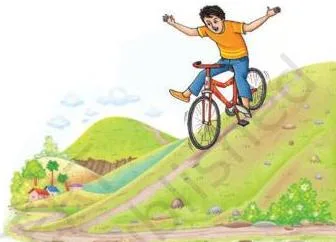
The illustration above sits beside the poem’s closing line, ‘Shall find wings waiting there.’ It is a picture of the poem’s promise: the climb is worth it because the descent gives you wings. Use it when you answer Q6 — the illustration and the final couplet say the same thing.
Q1. The poem describes the ________ of going downhill on a bicycle.
Answer: (c) excitement. The poem is built on speed, the lifted heart and the cry of joy — that is excitement, not mere enjoyment or satisfaction.
Q2. Which lines depict the freedom of a bird?
Answer: The lines ‘O bird, see; see, bird, I fly’ and ‘For a golden moment share / Your feathery life in air!’ The boy feels he has borrowed the bird’s own freedom.
Q3. What does the boy share with the bird, and what is the golden moment?
Answer: He shares the experience of flying. The golden moment is the instant of full speed when he feels he is living a feathery life in air — a moment of perfect freedom that the bird knows every day.
Q4. What does ‘full of bliss’ mean? Can the boy find this bliss?
Answer: It means full of happiness and joy. The poem’s question is triumphant: the boy asks whether the world holds anything like this, then answers himself — he has just found it on the bicycle. The bliss is real and reachable; it is the joy of the ride itself.
Q5. What is the comparison in the third stanza?
Answer: The comparison is between riding downhill and skating. The ride is ‘more than skating, bound steel-shod to the level ground’ — a skater stays on flat ground, while the boy is airborne. Watch out: the bird comparison belongs to stanza 2; the third stanza is the skating one.
Q6. What do the last two lines mean? What is ‘toil’ and what is the reward?
Answer: ‘Who climbs with toil, wheresoe’er, / Shall find wings waiting there’ means that anyone who puts in the effort of the climb will be rewarded. Toil does mean dedication, determination and will power, and the reward is the joy and freedom of the downhill flight — the ‘wings’ waiting at the top.
The effort is not wasted; it is exactly what makes the descent glorious.
Vocabulary in this unit: every Look Up word, explained
The unit asks you to look up words in three places: after Text I, after Text II, and in the Vocabulary block for the First Flight story. One table gathers all of them, with the meaning each word carries in this unit and an original example sentence.
| Word | Meaning in this unit | Example sentence |
|---|---|---|
| acclimatised (Text I) | become used to a new climate or conditions | Within a few weeks the riders were acclimatised to the cold mountain winds. |
| cyclotrons (Text I) | organised group cycling events | The couple began entering cyclotrons across the city and met many fellow riders. |
| extended (Text I) | made longer | Their short daily rides extended into day-long journeys. |
| strenuous (Text I) | demanding great physical effort | Cycling at high altitude is a strenuous activity at any age. |
| venture (Text I) | set out somewhere new or risky | They decided to venture beyond the city and explore the mountain trails. |
| caressing (Text I) | touching gently | A cool breeze caressing their faces made the climb pleasant. |
| daunting (Text I) | seeming difficult or intimidating | The idea of crossing the state seemed daunting, but they were determined. |
| encapsulates (Text I) | sums up or captures completely | That route encapsulates every thrill a cyclist looks for. |
| inexplicable (Text I) | impossible to describe in words | The joy of that ride was inexplicable to anyone who had not been there. |
| picturesque (Text I) | visually charming, like a picture | The trail passed through picturesque villages such as Kimadi and Chaar Dukaan. |
| heedful (Text II) | careful and attentive | He rode downhill with a heedful mind, watching the road. |
| poised (Text II) | balanced, ready to move | With lifted feet and still hands, he was poised for the descent. |
| slackens (Text II) | becomes slower | The speed slackens as the road levels out. |
| treadles (Text II) | the pedals of the bicycle | His feet dropped back to the treadles when the wheels slowed. |
| vale (Text II) | a valley | Every hill, however long, must end in a vale. |
| inquisitive (First Flight) | curious, eager to know | Valli was an inquisitive child who noticed every detail of the ride. |
| intricate (First Flight) | having many fine, complicated parts | The old woman’s questions were intricate — she wanted every street and house number. |
| mesmerizing (First Flight) | holding attention completely | The moving view from the window was mesmerizing to Valli. |
| immense (First Flight) | extremely large | The town appeared immense to the eight-year-old. |
| hardly (First Flight) | barely or scarcely; a negative word | Valli could hardly wait for the bus to start. |
One word needs a special note. Cyclotrons in this passage are organised cycling events — the couple participate in city cyclotrons as riders. In physics a cyclotron is a particle accelerator, but that meaning has no place here; the context, cycling events held in the city, settles it.
Hardly is a negative adverb even though it does not look like one. It means barely or scarcely: ‘Valli could hardly wait’ means she could almost not wait. Do not read it as a positive word.
Grammar in this unit: phrasal verbs
A phrasal verb is a verb joined with a small word such as up, on, off or out; together the two words make one new meaning. The unit’s own examples are picked up and get on — picked and get change meaning when up and on join them.
The exercise gives you six verbs (break, drive, get, fill, wake, turn) and six particles (out, down, off, on, in, up). Each verb takes one particle to complete one sentence. Here is the completed answer key.
| Phrasal verb | Meaning | How it completes the sentence |
|---|---|---|
| turn on | switch on | It was evening. She turned on the light. |
| wake up | rouse from sleep | Do not wake up Ramesh. He was studying late at night yesterday. |
| break down | stop working, of a vehicle or machine | The school bus broke down and had to be towed to the garage for repair. |
| drive off | leave in a vehicle | They got in the car and drove off. |
| get out (of) | leave a car | She hurt herself as she was getting out of the car. |
| fill in | complete, of a form | You have to fill in the form yourself. |
One vehicle rule matters: you get on a bus but you get out of a car. Use get off for buses and trains, never for a car. The exercise itself sets this up — the bus in the unit’s example uses get on, while the car in sentences (d) and (e) uses drove off and getting out.
Allusion or illusion: sorting the Fun Facts pair
The Fun Facts box exists because allusion and illusion sound alike but mean opposite things.
- Allusion = a reference, usually indirect, to a person, text, event or idea. Example: ‘The poet’s allusion to the bird makes the boy’s freedom vivid.’
- Illusion = a mirage, a hallucination or a magic trick — something that deceives the eye. Example: ‘The pool of water on the hot road was an illusion.’
A quick check: an allusion is a mention; an illusion is a deception of the senses.
Editing practice: the Sundarbans paragraph
The editing task asks you to add capital letters and full stops and to correct spelling in a paragraph about the Sundarbans. It is a mechanics task — fix the mechanics, never change the meaning or the order of ideas.
The photograph above marks the topic before you read the passage: the Sundarbans, a UNESCO World Heritage Site at the south-eastern tip of the 24 Paraganas district, about 110 km from Kolkata. Knowing the subject in advance tells you which words are likely to need capitals — Sundarbans, UNESCO, the river names — before you even begin editing.
| Kind of error | Words most often affected | Fix it like this |
|---|---|---|
| Capitalisation | sundarbans, unesco, ganga, brahmaputra, meghna, royal bengal tiger, godkhali, 24 Paraganas | Capitalise the first letter of every proper noun: Sundarbans, UNESCO, Ganga, Brahmaputra, Meghna, Royal Bengal Tiger. |
| Punctuation | long stretches with no full stop | Find where one idea ends and the next begins, put a full stop there, and start the new sentence with a capital. |
| Spelling | mangrov / mangroove, singl, reserv | Write the correct forms: mangrove, single, reserve. |
Two quick examples of the fixes: ‘unesco’ becomes UNESCO, and ‘mangrov plants’ becomes mangrove plants. The task does not ask you to rewrite the paragraph — just to correct it.
Listening: the Mizoram passage, decoded
The listening task is a short passage about Mizoram read aloud — by your teacher, or by a sibling or friend if you are working alone — with questions to answer as you listen.
- Mi means human beings and Zo means hill; a Mizo is a dweller of a hill, and Mizoram means the land of the hill-dwellers.
- Mizoram is an expanse of blue-green hills, broken lengthwise into five major mountain ranges that descend from south to north; the hills are rugged and uneven in height.
- Aizawl, the capital, is built in tiers along the hill.
- The three main festivals are Mim Kut, Chapchar Kut and Pawl Kut, tied to agricultural activities; the Mizos enjoy them with singing and dancing.
- Mizo dances are folk and community dances passed down through generations — they are meant for community participation, not for stage performance.
Question 5 asks for the statement that is not true. The wrong one is (e): ‘They love to dance and not so much to sing.’ The passage says the Mizos love to dance as much as they love to sing, so the ‘not so much’ part makes the statement false.
The listening block also carries a tongue twister to practise: ‘We surely shall see the sun shine soon.’
Speaking: dialogues, role play and question tags
This is the largest practical section of the unit. It turns Valli’s bus conversations into a scripted role play, then practises polite requests and question tags.
The unit lists words like commandingly (in the tone of giving a command), haughtily (with pride or superiority), smilingly, irritably (in an annoyed way) and curtly (in a short, rude way). Each one is an acting cue: it tells you the mood and intention behind the line.
When you fill the blanks in the Valli dialogue, keep the adverb in view — a haughty line and an irritated line are very different performances.
The Vineet and Ashima dialogue shows the question tag pattern. A positive statement takes a negative tag: ‘It’s cold today, isn’t it?’ and ‘You have room heaters, don’t you?’ A negative statement takes a positive tag: ‘Coal-fires aren’t very convenient, are they?’ The tag repeats the auxiliary verb and flips its sign.
The pair-work clues give the skeleton of a polite request: open with ‘Excuse me…’, state the request with ‘I wonder if you could…’, accept or refuse politely, and close with thanks. The same shape is used for the kitchen, the railway station, a hospital, a playground and asking someone to open a door.
Writing and project tasks in this unit
The unit ends with a connected set of writing tasks — each one asks for an opinion supported by reasons, not just an answer.
The debate question is whether children of Valli’s age can travel alone in a bus or auto rickshaw. One side says yes: freedom teaches responsibility, and the conductor and passengers can keep an eye on a child. The other side says no: children are innocent and vulnerable, and safety is of utmost concern.
The unit’s points also ask what education children should be given — a strong paragraph answers that too, by mentioning knowing the route, avoiding strangers and asking the conductor for help.
Structure your paragraph as stand → reason → example → concession. Start with your position, support it with a reason, point to Valli — she knew her route and had saved the fare herself — then concede the safety point and say how the risk can be managed. End with your opinion in one sentence.
The unit also asks you to use the idiom turn a blind eye — to deliberately ignore a situation or fact. Example: ‘A responsible conductor does not turn a blind eye to a child travelling alone.’
The associated paragraph asks whether domestic animals should be let loose to walk freely on roads where vehicles ply, and who is responsible for the death of the young cow.
The project has two parts. First, prepare travel tips for five modes of travel — train, bus, boat, motorbike and trek — modelled on the passage’s tips for cycling: a hand pump, extra tubes and a puncture kit; safety gear; dry food, water and Oral Rehydration Salts; and a first-aid kit with pain killers, muscle-relaxing balms and band-aids.
Second, collect tickets — train, bus, flight, platform, zoo, cinema, metro — and make a collage. Study the information on each ticket and draw a table for the PNR number, time of departure, time of arrival, confirmed/wait-listed/RAC status, seat number, food preferences, price and number of passengers.
Then compare the tickets and write a paragraph on ‘Why it is essential to travel with a ticket’ — the paragraph should give reasons, not just a list.
The three figures in this unit and how to use them
Three illustrations appear in this unit, and each one belongs to a specific task. Use the map below so none of them distracts you.
| Figure | Where it sits | What it marks | How to use it |
|---|---|---|---|
| Let’s Begin illustration | Opening discussion | The instruction to discuss Valli’s ride with a classmate | Pair it with the two questions — what Valli saw, and whether the return was the same — then write the paragraph |
| Bird illustration | Beside the poem | The closing line ‘Shall find wings waiting there’ | Connect it to Q6: the illustration shows the poem’s promise that effort earns the joy of flight |
| Sundarbans photograph | Beside the editing passage | The UNESCO World Heritage Site the passage describes | Fix the topic in your mind before you correct capitals, spellings and full stops |
Common mistakes students make in this unit
This unit has a small set of traps, and they appear in the same places each time. Name them before you make them.
| Mistake | Correct rule | How to check your answer |
|---|---|---|
| Answering the poem’s Q5 with the bird comparison | The third stanza compares downhill cycling with skating on level ground; the bird comparison belongs to stanza 2 | Re-read the stanza the question names before you write |
| Writing ‘get off the car’ | Use get on/off for buses and trains; use get into/out of for cars | Ask what vehicle it is: bus or train → on/off; car → in/out |
| Reading ‘hardly’ as a positive word | Hardly means barely or scarcely — it carries a negative meaning | Replace it with ‘almost not’ and see if the sentence still makes sense |
| Swapping allusion and illusion | Allusion is a reference; illusion is a mirage, hallucination or magic trick | Ask: is the sentence about a mention, or about deceiving the eye? |
| Leaving proper nouns lowercase in the editing task | Sundarbans, UNESCO, Ganga, Brahmaputra, Meghna and Royal Bengal Tiger take capitals | Tick every proper noun in your corrected version |
| Forgetting the speech adverbs in the Valli script | Each adverb (haughtily, irritably, curtly) sets the tone of the line | Read every line aloud — does it sound like its adverb? |
How this unit prepares you for the Class 10 English paper
Words and Expressions 2 is the practice workbook beside First Flight, so its tasks rehearse the same skills that appear in the English paper. No task here is a prediction of a question — the value is in the transferable skill.
| Task in this unit | Skill it practises | Where the skill shows up |
|---|---|---|
| Phrasal verbs (Grammar block) | Choosing the right verb + particle combination | Grammar and vocabulary items in the paper |
| Editing: the Sundarbans paragraph | Capital letters, full stops, spelling | Editing and omission tasks |
| Look Up vocabulary: Text I, Text II, story words | Understanding words in context | Reading comprehension |
| Text I and Text II comprehension questions | Locating and justifying answers from a passage | Unseen passage questions |
| Debate: children travelling alone | Setting out an opinion with reasons and a concession | Long writing tasks |
| Paragraph: travelling with a ticket | Organising a short formal paragraph | Short writing tasks |
| Listening: Mizoram | Listening for specific facts | Listening tasks where the school assesses them |
Textbook contents and the examinable syllabus are not always identical — check the current official CBSE syllabus before you decide what to revise. This page describes the workbook unit as published by NCERT, not a marks or question prediction.
Madam Rides the Bus unit: revision summary
The whole unit in one breath:
- LET’S BEGIN recalls Valli’s first bus ride and asks what she saw going and coming back.
- TEXT I is a retired Dehradun couple’s cycling adventure — a 100 km ride through Uttarakhand’s mountain trails.
- TEXT II is Henry Charles Beeching’s poem on the excitement and freedom of riding downhill.
- VOCABULARY pulls five words from the First Flight story: inquisitive, intricate, mesmerizing, immense, hardly.
- GRAMMAR practises phrasal verbs: turn on, wake up, break down, drive off, get out, fill in.
- FUN FACTS separates allusion (a reference) from illusion (a mirage, hallucination or magic trick).
- EDITING fixes capitals, full stops and spellings in a paragraph on the Sundarbans.
- LISTENING describes Mizoram — its name, capital, three festivals and community dances.
- SPEAKING builds a Valli role play from speech adverbs, plus polite requests and question tags.
- WRITING and PROJECT end with a debate on children travelling alone, the idiom turn a blind eye, travel tips and a ticket collage.
Related NCERT resources
This listing is maintained for the 2026-27 academic session using the NCERT textbook information available to us. NCERT remains the authority for confirming the latest edition.
The workbook unit assumes you have read the First Flight story — open it if any task refers to Valli. The story page is Madam Rides the Bus in First Flight, and a neighbouring chapter page is Mijbil the Otter.
For the rest of your Class 10 English work, browse the Class 10 English notes hub; for other subjects, use the Class 10 study material hub. The CBSE notes homepage lists every class and subject covered on this site.
Sources and data verification
This page describes the NCERT Class 10 English Words and Expressions 2 textbook unit on Madam Rides the Bus, in the official edition published on ncert.nic.in. It covers this single unit only; the First Flight textbook, the other Words and Expressions 2 units and other Class 10 subjects are separate books not described here.
The listing is maintained for the current academic session using the NCERT information available to us. NCERT settles textbooks, editions and PDFs; CBSE settles the curriculum, syllabus and examinations.
| What the chapter holds | Count | Where it is used |
|---|---|---|
| Printed pages | 16 | |
| Figures with NCERT captions | 3 | |
| Tables | 1 | |
| Official NCERT PDF | Download the chapter PDF | the chapter exactly as NCERT publishes it |
Reference: NCERT Class 10 English textbook Words and Expressions 2, unit on Madam Rides the Bus, official edition on ncert.nic.in.
Frequently asked questions
Where can I download the Madam Rides the Bus unit of Words and Expressions 2 Class 10?
The official NCERT file is the Madam Rides the Bus Class 10 Words and Expressions 2 PDF at the top of this page, and it contains the whole unit as printed. If your school uses a different edition, check the English section of the official NCERT portal at ncert.nic.in for the current file.
Is Madam Rides the Bus in First Flight or Words and Expressions 2?
Both, in different roles. The story is a chapter in First Flight; Words and Expressions 2 is the practice workbook that builds tasks on it. The two texts in this unit are new passages, not the story itself — read the First Flight chapter first, because the workbook assumes you know Valli’s bus journey.
What is the comparison in the third stanza of Going Down Hill on a Bicycle?
The third stanza compares riding downhill with skating: the ride is ‘more than skating, bound steel-shod to the level ground’. A skater stays on flat ground, but the boy is moving through the air. The bird comparison is in stanza 2, not stanza 3 — that is the common mix-up.
What are the answers to the phrasal verbs exercise?
(a) turned on, (b) wake up, (c) broke down, (d) drove off, (e) getting out, (f) fill in. The pairings are turn–on, wake–up, break–down, drive–off, get–out and fill–in.
How should I prepare for the writing task on children travelling alone?
Take a clear stand first, then support it with reasons: supporters point to responsibility and the safety net of the conductor and passengers; opponents point to the vulnerability of young children. Use the unit’s points — freedom, safety, education — and structure the paragraph as stand, reason, example and concession. End by naming the education children need to travel safely.
Explore Class 10 English Books
Related chapters:
- A Letter to God
- A Triumph of Surgery
- A Letter to God