
This page gives you Unit 3 of the NCERT Class 10 English workbook Words and Expressions 2 — the unit called Two Stories About Flying. It starts from the two flying stories in First Flight and adds a new reading text, grammar, listening and writing tasks. The official unit PDF is right here, with a plain-language walkthrough of everything in it.
Download the Official NCERT Unit PDF
This is a workbook unit, so the PDF is the whole unit as printed: the warm-up questions on the flying stories, the reading text, every exercise table, both riddles and the project.
Open the Two Stories About Flying Class 10 NCERT PDF on the official NCERT textbook portal to download the current edition of Words and Expressions 2 — it is the printed unit, with every exercise, table and image as NCERT published it.
What Is Inside This Unit
This is a workbook unit, not a new prose chapter of First Flight. It starts with warm-up questions on the two flying stories, gives you a short new story to read, then moves through vocabulary, grammar, editing, listening and writing tasks before closing with a neighbourhood project.
The contents table on this page shows what the unit holds — its sections, figures and activities — so you can see the shape of the file at a glance. The parts run in this order:
- Let’s Begin — multiple-choice questions on ‘His First Flight’ and a question-writing task on ‘The Black Aeroplane’.
- Text I: All about a Dog — the new reading text by A. G. Gardiner, with the ‘Look Up and Understand’ word list.
- Vocabulary — making adverbs, opposites with prefixes, and twelve phrasal verbs.
- Grammar — active and passive voice, comma use, and unscrambling sentences.
- Editing — a paragraph to punctuate with capital letters, commas and full stops.
- Listening — two riddles solved aloud with think-aloud protocol.
- Article Writing — a 120–150 word article on rules.
- Project — collecting and presenting neighbourhood riddles.
What Unit 3 Asks You to Do
The unit’s exercises follow one clear path. Here is the order, and what each stage expects you to produce.
- Re-read ‘His First Flight’ and, in groups of four, answer the multiple-choice questions about the young seagull — why he was afraid to fly, how he finally flew, and which statements about him are true or false.
- Re-read ‘The Black Aeroplane’ and write at least five multiple-choice questions of your own, based on events, people, reasons and results. Swap them with a partner and answer each other’s.
- Read ‘All about a Dog’ by A. G. Gardiner and note the new words in ‘Look Up and Understand’ — bitterly, embittered, evidently, malice, avalanche, imperiously, imperturbably, indignant, quarterdeck.
- Complete the story-sequence box, narrating the story in the correct order.
- Finish the vocabulary tasks: turn five words into adverbs, build antonym pairs with im-, il- and in-, and find meanings for twelve phrasal verbs.
- Finish the grammar tasks: rewrite sentences in the passive voice in three tenses, place commas in two positions, and unscramble the five sentences about Amelia Earhart.
- Edit the paragraph on UFO sightings, adding capital letters, commas and full stops.
- Read the two riddles aloud and solve them with think-aloud protocol.
- Write an article of about 120–150 words on ‘Rules are meant to be observed in spirit not only in letter’.
- Collect 10–15 riddles from elders in your neighbourhood and present them to the class as a chart with an oral presentation.
Key Ideas in the Unit
The whole unit turns on one argument: rules are necessary, but not every rule should be applied mechanically. ‘All about a Dog’ sets that argument on a bitterly cold night, in the last bus of the day.
A woman in sealskin boards with a little Pekinese dog. The conductor — the narrator reads him as the type of man H. G. Wells called the Resentful Employee — orders her to take the dog out. She refuses. He stops the bus and will not move it until the dog is gone.
The standoff drives the whole story. Passengers side with the woman and protest; a policeman decides the conductor has his rules on his side; one by one, passengers give up or slip away. The woman finally takes the dog upstairs — then the engine stops, she steals back down, and the struggle begins all over.
Only the narrator, the last passenger left, puts the story into words. Some rules are hard and fast, like the rules of the road, because breaking them endangers life and limb. Others are rules for guidance, to be applied or set aside as common sense dictates — and the dog rule is one of those.
The narrator’s conclusion is the unit’s central line: rules are meant to be observed in the spirit, not in the letter. The conductor has kept the rule and broken its spirit — the rule exists for the comfort of passengers, not as a whip in his hand.
Alongside the story, the unit practises four language ideas: phrasal verbs as single meaning units, active and passive voice, opposites made with prefixes, and the comma’s two jobs. Each is explained below with worked examples, so you can attempt the exercises with the rule in front of you.
The Two Figures in the Unit, Explained

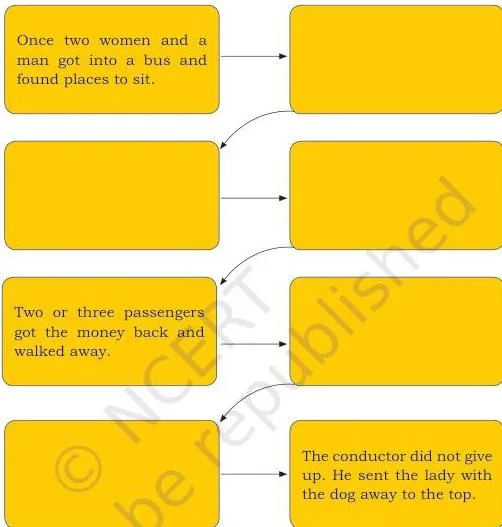
The unit carries two images. The first is an illustration of the standoff; the second is a task box for retelling. Both are explained here so they support the reading instead of sitting unexplained.
The conductor’s victory, in one image
The illustration freezes the moment the story keeps returning to. The bus has stopped; the conductor paces the pavement outside, and the little dog sits blinking at the dim lights, unaware of the rumpus it has caused.
The caption’s comparison of the conductor to a captain on the quarterdeck in the hour of victory tells you how he sees himself — triumphant, in command, with the law on his side.
That is why the image matters for the story: everything is stopped, both sides wait, and one man’s rigid triumph holds a whole bus of passengers hostage on a freezing night.
The story-sequence box: what it is for
The second image is not decoration; it is an exercise. The unit asks you to complete the box narrating the story in the correct sequence. A clean way to do that is to track the six turning points of the story:
- The sealskin lady boards the bus with her dog; the conductor orders her to take it out.
- She refuses; he stops the bus and waits on the pavement, determined to enforce the rule.
- Passengers protest, some leave, and the police watch from the street.
- The lady finally gives in and takes the dog to the top of the bus.
- The engine stops; the lady steals back down into the bus.
- The engine is fixed, the conductor sees the dog again, and the struggle starts all over.
Terms You Need for the Exercises
These are the terms the exercises assume you can handle. Each one is defined plainly, with a fresh example you will not find in the workbook.
Adverbs: what they are and how to spell them
An adverb tells you how an action is done. The unit’s examples are bitterly, imperturbably, violently and evidently — all words from ‘All about a Dog’. The vocabulary exercise asks you to make adverbs from five words, spelling them correctly; three rules cover all five:
- Most words just add -ly: indignant → indignantly; threatening → threateningly.
- Words ending in -y after a consonant change the y to i and add -ly: angry → angrily; hurry → hurriedly. Never write ‘angryly’ or ‘hurryly’.
- Words ending in -e just add -ly: vague → vaguely.
Prefixes that make opposites
A prefix is a few letters added to the front of a word that change its meaning. The unit uses im-, il- and in- to build opposites (antonyms): the key example is immovable — im- + movable, meaning not movable.
- im- goes before p, b and m: possible → impossible; balance → imbalance; mobile → immobile; movable → immovable.
- il- goes before l: logical → illogical.
- in- goes before most other letters: secure → insecure.
Phrasal verbs: verbs that carry a second meaning
A phrasal verb is a verb joined to a preposition or an adverb, and the pair usually means something different from the original verb alone. The unit starts from walk away — in ‘The Black Aeroplane’ — which means to move away from.
The exercise then lists twelve phrasal verbs to find and use; here they are with plain meanings and fresh sentences.
| Phrasal verb | Plain meaning | Original sentence |
|---|---|---|
| walk in | enter, usually casually | He walked in without knocking and took a seat. |
| walk out | leave, often in protest | The delegates walked out of the meeting. |
| take away | remove something from a place | The waiter took away our empty plates. |
| take up | begin a hobby or activity | She took up painting during the holidays. |
| take in | deceive; absorb; understand | Do not be taken in by his smooth talk. |
| take out | remove; take someone out | He took out his pen and signed the form. |
| give away | hand over free; reveal a secret | Her smile gave away her secret. |
| give in | stop resisting; yield | After an hour of argument, he gave in. |
| give up | stop trying; abandon | Never give up because one attempt failed. |
| put in | install; submit; contribute | We put in a new ceiling fan last week. |
| put away | store in its proper place | Put away your books before dinner. |
| put out | extinguish; publish; inconvenience | The guard put out the campfire before leaving. |
Active and passive voice
The unit defines the two voices with a single comparison. Active voice is used when the subject does the action: Ramesh painted the walls. Passive voice is used when the subject receives the action: The walls were painted by Ramesh.
The worked example below turns three active sentences into the passive — one in each tense the exercise asks for: simple present, simple past and present perfect.
| Tense | Active sentence | Passive sentence | Passive frame |
|---|---|---|---|
| Simple Present | The watchman locks the main gate at night. | The main gate is locked at night (by the watchman). | is/are + past participle |
| Simple Past | The storm damaged several houses near the coast. | Several houses near the coast were damaged by the storm. | was/were + past participle |
| Present Perfect | The committee has chosen Ritu as the head girl. | Ritu has been chosen as the head girl (by the committee). | has/have been + past participle |
Notice the agent. The unit’s rule: add by + agent only when it adds specific information. ‘By the watchman’ is dropped because the important idea is that the gate is locked, not who locks it; ‘by the storm’ is kept because the cause matters.
Commas: the two jobs this unit practises
The comma appears in the unit twice. Its first job is to set off a dependent clause at the start of a sentence — ‘Before the sun rose, the farmers were already in the field.’ Its second job is to sit before or after quotation marks — ‘I’ll come,’ she said, or She said, ‘I’ll come.’
Think-aloud protocol
Think-aloud protocol means speaking out every idea that comes to your mind while you solve a problem. The listening section tells you to read each riddle aloud and say your thoughts as they occur, so your reasoning stays visible and easy to check.
The Riddles and the Project
This section makes the listening activity usable in one sitting: the method, a complete solution to Riddle 1, a strategy for Riddle 2, and what the project expects.
Riddle 1: the farmer, the goat, the cabbage and the wolf
Start with think-aloud. Read the riddle aloud and name the two constraints: the boat holds the farmer plus one item, and the goat cannot be left alone with the cabbage or with the wolf. The goat is the only item that is dangerous with both the others, so it must travel first and be brought back in the middle.
The full crossing takes seven trips:
- Take the goat across the river.
- Return alone — the wolf and cabbage are a safe pair to leave behind.
- Take the wolf across. Wolf and goat are together on the far bank only while you are there, so it is safe.
- Bring the goat back. The wolf now waits with the cabbage, which is harmless.
- Take the cabbage across and leave it with the wolf.
- Return alone, leaving the goat on the near bank.
- Take the goat across.
The two constraints make the solution tricky: the goat must never be left with the cabbage, and the wolf must never be left with the goat. Every step above checks both banks after the move — that is the habit think-aloud trains.
Riddle 2: humans and monkeys
The second riddle adds more constraints, and the real work is in testing moves rather than memorising one route. The decisive rule: humans must never be outnumbered by monkeys on either bank.
After every attempted crossing, count the humans and monkeys on each bank; if a bank has more monkeys than humans, that move fails. The boat holds two, only humans and the big monkey can row, and monkeys may jump out when the boat reaches a bank. Test moves aloud in both directions until every constraint holds.
The project
The unit closes with a speaking and presentation project. Go around your neighbourhood and talk to people, especially elders, and collect riddles and puzzles in their languages.
The project has four parts: ask how and why such riddles could have emerged; collect at least 10–15 riddles and write them in an order with that information; find out more about each riddle; and present the result to the class as a chart with an oral presentation.
Common Mistakes in Unit 3 and How to Fix Them
These are the errors students make most often in this unit’s exercises, with the rule that fixes each one. Use the third column to check your own attempt before you move on.
| Mistake | Correct rule | How to check your answer |
|---|---|---|
| Spelling adverbs wrongly, e.g. ‘angryly’ or ‘hurryly’ (Vocabulary, Ex. 1). | In words ending in -y after a consonant, change y to i and add -ly: angry → angrily, hurry → hurriedly. Other words just add -ly: indignant → indignantly. | Say the base word aloud. If it ends in -y, the adverb ends in -ily, never -yly. |
| Reading phrasal verbs literally, e.g. thinking ‘walk out’ only means leaving a room (Vocabulary, Ex. A). | A phrasal verb works as a single meaning unit: walk out = leave in protest; take in = deceive or absorb; give up = stop trying. | Test the literal meaning in your sentence. If it sounds odd, use the phrasal meaning from the table above. |
| Adding by + agent to every passive sentence (Vocabulary, Ex. B). | Add by + agent only when it carries specific information, as in ‘The Taj Mahal was built by Shah Jahan’. Leave it out when the doer is obvious or unimportant. | Ask: does the agent tell the reader something new? If not, drop it. |
| Choosing the wrong prefix, e.g. ‘inlogical’ instead of ‘illogical’ (Vocabulary, Ex. 2 and 3). | im- goes before p, b and m; il- goes before l; in- goes before most other letters. | Look at the first letter of the base word, apply the rule, and say the new word aloud. |
| Forgetting the tense while building the passive (Vocabulary, Ex. B). | Match the helping verb to the active sentence’s tense: simple present = is/are; simple past = was/were; present perfect = has/have been — always with the past participle. | Underline the tense of the active sentence first, then check the passive frame. |
| Losing track of the riddle’s constraints (Listening). | In Riddle 1 the goat cannot be left alone with the cabbage or the wolf; in Riddle 2 humans must never be outnumbered by monkeys on a bank. | After every proposed trip, check both banks against the constraint before moving on. |
Using This Unit for Exam Practice
Use this unit as language practice, not as a prediction of specific exam questions. The passive-voice frames, phrasal-verb meanings, prefix spelling and the editing paragraph are the kinds of tasks that keep appearing in CBSE Class 10 English practice material. Do each exercise once in the workbook, then again from memory a week later.
The article task — ‘Rules are meant to be observed in spirit not only in letter’ — is a 120–150 word writing exercise built on the story’s own argument. The unit suggests the process approach: plan, draft, revise, edit before the final copy.
Textbook contents and the examinable syllabus are not always identical, so check the current official CBSE syllabus before you decide what to revise.
Unit 3 in One Screen
This workbook unit has no printed summary, so here is the recap to revise from the night before.
| Area | What you take away |
|---|---|
| Big idea | Rules are observed in the spirit, not only in the letter. Hard-and-fast rules protect safety; guidance rules are applied with common sense and goodwill. |
| Story skill | Narrate ‘All about a Dog’ in the correct sequence. |
| Grammar toolkit | Adverb spelling, prefixes im-/il-/in-, phrasal verbs, active-passive voice, comma placement. |
| Thinking habit | Think-aloud — speak every idea while solving a puzzle. |
| Writing habit | Process approach: plan, draft, revise, edit, then write a 120–150 word article. |
Related NCERT Resources
This listing is maintained for the 2026-27 academic session using the NCERT textbook information available to us. NCERT remains the authority for confirming the latest edition.
If you are also working on the First Flight text, these pages sit alongside this unit.
- Class 10 English notes — chapter-wise notes for the reader and workbook.
- Class 10 notes hub — study pages across subjects.
- CBSE notes home — find notes by class and subject.
- Nelson Mandela: Long Walk to Freedom — Class 10 English notes.
- From the Diary of Anne Frank — Class 10 English notes.
To confirm the current edition of the workbook, open the official NCERT textbook portal and check Words and Expressions 2 against the file your school uses.
Sources and Data Verification
This page describes Unit 3, ‘Two Stories About Flying’, of the NCERT Class 10 English workbook Words and Expressions 2, official NCERT edition. It is maintained for the current academic session using the NCERT information available to us, and it covers this unit only — not the full CBSE Class 10 English syllabus.
NCERT settles textbook editions and PDFs; CBSE settles the syllabus and examinations. If your copy of the workbook differs from what is described here, check the official NCERT PDF before revising.
| What the chapter holds | Count | Where it is used |
|---|---|---|
| Printed pages | 14 | |
| Figures with NCERT captions | 2 | |
| Tables | 3 | |
| Official NCERT PDF | Download the chapter PDF | the chapter exactly as NCERT publishes it |
Frequently Asked Questions
Is ‘Two Stories About Flying’ in Words and Expressions 2 the same as the chapter in First Flight?
No — not the same file. Unit 3 works with the two flying stories you read in First Flight — ‘His First Flight’ and ‘The Black Aeroplane’ — but this file is the workbook companion, not the reader. It adds its own reading text, ‘All about a Dog’, plus exercises, riddles and a writing task.
Keep the First Flight chapter for the stories and this unit for the practice.
What is the main point of the story ‘All about a Dog’?
The story argues that rules should be observed in the spirit, not only in the letter. The conductor enforces the letter of a dog rule — stopping the bus on a bitter night and tormenting passengers — while breaking its spirit.
The narrator separates hard-and-fast rules like the rules of the road from guidance rules like the dog rule, which should be applied with common sense and goodwill.
How do you solve the farmer, goat, cabbage and wolf riddle?
In seven trips:
- Take the goat across.
- Return alone.
- Take the wolf across.
- Bring the goat back.
- Take the cabbage across.
- Return alone.
- Take the goat across.
The goat is the pivot — it cannot be left alone with the cabbage or the wolf, so it crosses first and returns in the middle.
Which grammar points does Unit 3 practise?
Unit 3 practises making adverbs with correct spelling, forming opposites with the prefixes im-, il- and in-, learning twelve phrasal verbs, changing active sentences into the passive in three tenses, placing commas in two positions, and editing a paragraph for capital letters, commas and full stops.
How long should the article in this unit be?
About 120–150 words. The topic is ‘Rules are meant to be observed in spirit not only in letter’. The unit asks you to explain the statement and suggest how rules can be implemented in true spirit, using ideas such as gender, the environment, traffic rules and self-discipline, and to follow the process approach to writing.
What does think aloud protocol mean?
It means speaking out every idea that comes to your mind while you solve a problem. The listening section asks you to read each riddle aloud and say your thoughts as they occur, so your reasoning stays visible and you can check each move against the constraints.
Reference: NCERT Class 10 English textbook, chapter 3, official edition on ncert.nic.in.
Explore Class 10 English Books
Related chapters:
- A Letter to God
- A Triumph of Surgery
- A Letter to God