
The NCERT Class 10 Mathematics theorem that the tangent is perpendicular to the radius is Theorem 10.1 of Chapter 10 (Circles), on the printed pages 146–147 of the textbook. This page gives you the exact statement, the book’s own figure (Fig. 10.5), and a step-by-step proof you can write straight into an exam answer.
Theorem 10.1: the exact statement as printed on NCERT page 146
Theorem 10.1 (NCERT Class 10 Mathematics, page 146) The tangent at any point of a circle is perpendicular to the radius through the point of contact.
New: practise this theorem. Drag the book’s figure and watch the numbers change, try to break the theorem on purpose, then solve fresh questions with hints.
The statement is printed on NCERT page 146, and the proof runs on to page 147, where Fig. 10.5 appears. When you write the theorem in an exam, copy the words exactly as printed above, then set up the Given and To prove lines as shown below.
What the theorem means in plain words
Page 146 sets up three ideas before the theorem. A secant is a line that cuts the circle at two points. A tangent is the limiting position of a secant: slide a secant parallel to itself (Activity 2, page 146) and its two intersection points move closer until they merge into one.
At that position the line no longer cuts the circle — it only touches it. The book puts it as a tangent being the secant at the moment the two ends of the chord become a single point.
The single shared point is the point of contact. The theorem concerns OP, the radius that ends at the point of contact P, and says this radius meets the tangent XY at a right angle (\(90^\circ\)). Notice what it does not say: it does not say every radius is perpendicular to the tangent.
In fact the proof shows every other segment from the centre O to the tangent line is longer than OP, hence slanted.
The figure for Theorem 10.1: Fig. 10.5, tangent XY at point P
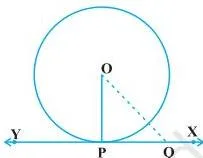
Fig. 10.5 shows a circle with centre O, the tangent line XY touching the circle at P, a point Q on XY different from P, and the segment OQ joining the centre to Q. Q lies outside the circle, so in the diagram OQ is visibly longer than the radius OP.
That visible gap is exactly what the proof converts into the inequality \(OQ \gt OP\).
How to draw Fig. 10.5 in an exam
- Draw a circle with centre O and mark a point P on it.
- Draw the radius OP.
- Through P draw the line XY perpendicular to OP — this line is the tangent.
- Mark a point Q on XY away from P, and join OQ.
- Draw the right-angle symbol at P between OP and XY, and label O, P, Q, X, Y.
Drawing the tangent as the perpendicular to OP at P is the reliable order — it guarantees your figure matches the theorem.
Given, to prove, construction: how the book sets up the proof
- Given: a circle with centre O and a tangent XY to the circle at a point P (NCERT, p. 146).
- To prove: \(OP \perp XY\).
- Construction: take a point Q on XY other than P, and join OQ (NCERT, p. 147).
That join of OQ is the only construction line in the proof — do not invent another one in an exam.
The strategy in one sentence: show \(OQ \gt OP\) for every point Q of the tangent except P, so OP is the shortest distance from O to the line XY, and the shortest distance from a point to a line is along the perpendicular.
Proof of Theorem 10.1, step by step
- State the given. XY is a tangent to the circle with centre O at the point P, and OP is the radius through the point of contact. This is exactly the situation the theorem describes (NCERT, p. 146).
- Make the construction. Choose a point Q on the line XY with \(Q \neq P\), and join OQ (NCERT, p. 147). The argument works for any Q you pick.
- Q must lie outside the circle. Why? — If Q lay inside the circle, the line XY would pass through an interior point and would cut the circle at two points, so it would be a secant, not a tangent. That contradicts the given, so Q has to be outside the circle.
- Compare OQ with the radius. The circle is exactly the set of points whose distance from O equals the radius OP. Anything outside the circle is farther from O than any point on the circle, so (NCERT, p. 147):
\[ OQ \gt OP \]
- Let Q be arbitrary. Steps 2–4 did not depend on which Q was chosen, so \(OQ \gt OP\) holds for every point of the line XY except P. Hence OP is the shortest of all the distances from O to the points of the line XY (NCERT, p. 147).
- Apply the shortest-distance result. Theorem A1.7 of the appendix says the shortest distance from a point to a line is the perpendicular distance. Since OP is that shortest distance,
\[ OP \perp XY \]
Therefore OP is perpendicular to XY, which is what we needed to prove.
The two remarks NCERT prints after the proof
Page 147 appends two remarks worth memorising with the theorem:
- Remark 1: at any point of a circle there can be one and only one tangent. Reason: the tangent at P must be perpendicular to OP, and only one line through P is perpendicular to OP.
- Remark 2: the line containing the radius through the point of contact is sometimes called the normal to the circle at that point.
Try it yourself: a live practice figure
Where the chapter uses Theorem 10.1 after the proof
The theorem is load-bearing: nearly every later proof and example in Chapter 10 starts from its right angle. Each use is named here, not solved.
- Proof of Theorem 10.2 (NCERT, p. 149): the proof joins the centre to the two points of contact and uses Theorem 10.1 to mark \(\angle OQP\) and \(\angle ORP\) as right angles; those two \(90^\circ\) angles make the RHS congruence comparison possible.
- Example 1 — concentric circles (NCERT, pp. 149–150): a chord AB of the larger circle touches the smaller circle at P. Theorem 10.1 gives \(OP \perp AB\), and only then does the Class 9 chord-bisection result turn that perpendicular into AP = PB.
- Example 2 — two tangents from an external point (NCERT, p. 150): Theorem 10.1 supplies \(\angle OPT = 90^\circ\), which the solution combines with the isosceles triangle TPQ to prove \(\angle PTQ = 2\angle OPQ\).
- Example 3 — chord of length 8 cm in a circle of radius 5 cm (NCERT, p. 150): the tangents at the ends P and Q of the chord meet at T, and the same right-angle tangent–radius geometry runs through the figure used in the solution.
- Exercise 10.1, Question 3 (NCERT, p. 147): a tangent PQ to a circle of radius 5 cm with \(OQ = 12\) cm — a direct application of the right angle at the point of contact. Named here only, not solved.
Is there a converse of Theorem 10.1 in the book?
No. The NCERT book prints no separate converse of Theorem 10.1. The closest companion statements already in the chapter are:
- Remark 1 (NCERT, p. 147): one and only one tangent can be drawn at any point of a circle.
- Activity 2 (NCERT, p. 146): a tangent is the limiting position of a secant whose two chord endpoints coincide.
The chapter’s other theorem, Theorem 10.2 — tangents from an external point are equal, is proved right after this one and leans on the right angle Theorem 10.1 provides.
Common mistakes when proving or applying Theorem 10.1
These are the errors that cost marks in exams and in the chapter’s later examples.
| Mistake | Correct rule | How to check your answer |
|---|---|---|
| Writing that every radius of the circle is perpendicular to the tangent. | Only the radius through the point of contact is perpendicular. The proof shows every other segment from O to the tangent is longer (\(OQ \gt OP\)), hence slanted. | Ask: does the radius end at the point of contact? Only OP does. |
| Skipping the reason Q lies outside the circle. | Q must lie outside; otherwise XY passes through an interior point, cuts the circle twice and becomes a secant — contradicting the given. | Before you write \(OQ \gt OP\), answer the book’s “Why?” in one line. |
| Mixing up Theorem 10.1 with the Class 9 theorem that the perpendicular from the centre to a chord bisects the chord. | Theorem 10.1 supplies the right angle; the bisection comes from the Class 9 result. Example 1 uses both in that order: first \(OP \perp AB\), then AP = PB. | Which step needs the right angle, and which needs the bisection? Keep them separate. |
| Saying a tangent touches the circle at two points. | A tangent has exactly one common point with the circle — the point of contact (NCERT, p. 146). | Count the common points: a tangent has one, a secant has two. |
| Ending the proof without the conclusion line. | Close with “Therefore OP is perpendicular to XY” and name Theorem A1.7, the shortest-distance result. | The last line of your proof must state \(OP \perp XY\). |
Questions students search about this theorem
Why is the tangent perpendicular to the radius?
Because the radius through the point of contact is the shortest possible distance from the centre to the tangent line. Every other point Q of the tangent lies outside the circle, so \(OQ \gt OP\); the shortest distance from a point to a line is the perpendicular (Theorem A1.7), so \(OP \perp XY\).
Why does Q have to lie outside the circle in the proof of Theorem 10.1?
If Q lay inside the circle, the line XY would pass through an interior point and cut the circle at two points — that makes it a secant. A tangent has exactly one common point with the circle, so every point of the tangent except P must be outside.
Is there a converse of the tangent-radius theorem in the NCERT book?
No. NCERT prints no separate converse. The closest companion statements are Remark 1 on page 147 (one and only one tangent at each point of a circle) and Activity 2 on page 146 (a tangent as the limiting position of a secant).
What is the normal to a circle at the point of contact?
The line containing the radius through the point of contact is called the normal to the circle at that point (Remark 2, NCERT, p. 147). It is the line perpendicular to the tangent at P.
How many tangents can be drawn at a single point of a circle?
Exactly one (Remark 1, NCERT, p. 147). The tangent at P must be perpendicular to OP, and only one line through P is perpendicular to OP, so no second tangent can exist at P.
Where is Theorem 10.1 used later in Chapter 10?
In the proof of Theorem 10.2 (it provides the two right angles at the points of contact) and in Examples 1, 2 and 3 on pages 149–150, where the \(90^\circ\) angle between tangent and radius is the starting point of each solution.
Related resources
This listing is maintained for the 2026-27 academic session using the NCERT textbook information available to us. NCERT remains the authority for confirming the latest edition.
Continue revising from the official book and the theorem pages on this site:
- NCERT Class 10 Maths Chapter 10, Circles — the chapter page with the full text and figures.
- Class 10 Maths theorems hub — the hub where this site’s Class 10 theorem pages live.
- Theorem 10.2 — tangents from an external point are equal — the sibling theorem proved immediately after this one.
- Class 10 Mathematics notes and the Class 10 hub for chapter-wise revision, with the notes index at the site’s CBSE notes.
- SAS similarity criterion — another Class 10 theorem page on this site, from the Triangles chapter.
The official NCERT Class 10 Mathematics Chapter 10 (Circles) PDF on ncert.nic.in is the authoritative printed source — open it to check the statement, the proof and Fig. 10.5 exactly as published. This page follows the same official edition, pages 146–150. Textbook contents and the examinable syllabus are not always identical — check the current official syllabus.
Reference: NCERT Class 10 Mathematics textbook, chapter 10, Theorem 10.1, official edition on ncert.nic.in.
Explore Class 10 Mathematics
Class 10 Mathematics on NCERTTextbooks:
Related chapters:
Official source: download the NCERT textbook free from ncert.nic.in.