
The SSS similarity criterion (Theorem 6.4, NCERT Class 10 Mathematics, chapter 6, Triangles, printed pages 88–89) says: if the three sides of one triangle are proportional to the three sides of another, then the triangles are similar. This page gives the exact statement, the book’s own figure, and a proof that answers every Why? and How? step the book leaves open.
Theorem 6.4: the exact NCERT statement
Here is the statement exactly as NCERT prints it on printed page 88 — you can verify it in your own copy of the book:
Theorem 6.4 (NCERT Class 10 Mathematics, page 88) If in two triangles, sides of one triangle are proportional to (i.e., in the same ratio of) the sides of the other triangle, then their corresponding angles are equal and hence the two triangles are similar.
NCERT names this the SSS (Side–Side–Side) similarity criterion for two triangles.
New: practise this theorem. Drag the book’s figure and watch the numbers change, try to break the theorem on purpose, then solve fresh questions with hints.
What the SSS similarity criterion means in plain words
Line up two triangles so the sides of the first pair off with the sides of the second in order. If every side of the first triangle is the same fraction of its paired side in the second, the two triangles have the same shape — all three pairs of matching angles are equal, and the triangles are similar.
Three phrases in the theorem carry the meaning:
- Proportional (in the same ratio) — the three quotients \(\frac{AB}{DE}\), \(\frac{BC}{EF}\) and \(\frac{CA}{FD}\) all equal one number \(k\).
- Corresponding angles — the angles at matching corners: \(\angle A\) with \(\angle D\), \(\angle B\) with \(\angle E\), \(\angle C\) with \(\angle F\).
- Similar — same shape, possibly different size; one triangle is a scaled copy of the other.
The ratio pattern the theorem uses is
\[ \frac{AB}{DE} = \frac{BC}{EF} = \frac{CA}{FD} \]
All numerators are sides of \(\triangle ABC\), all denominators sides of \(\triangle DEF\), in the same cyclic order. The vertex order fixes which sides pair up, so always write the similarity as \(\triangle ABC \sim \triangle DEF\), keeping the matching vertices in the same positions.
Before stating the theorem, the book checks it by measurement. Activity 5 on printed page 88 asks you to draw triangles with sides 3, 6, 8 cm and 4.5, 9, 12 cm — every ratio is \(2/3\), and measuring the six angles gives \(\angle A = \angle D\), \(\angle B = \angle E\), \(\angle C = \angle F\).
Now try a fresh pair with different numbers. Take a triangle with sides 6, 8, 10 and one with sides 9, 12, 15:
\[ \frac{6}{9} = \frac{2}{3}, \qquad \frac{8}{12} = \frac{2}{3}, \qquad \frac{10}{15} = \frac{2}{3} \]
All three ratios equal \(2/3\), so by Theorem 6.4 the corresponding angles are equal and the two triangles are similar — the second is an enlargement of the first.
Fig. 6.26: the book’s figure for Theorem 6.4
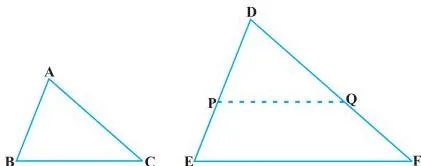
The figure on printed page 89 is drawn for the case where the common ratio is less than 1, so \(\triangle ABC\) is the smaller triangle and \(\triangle DEF\) the larger one. The proof works on the larger triangle.
Three marks carry the whole construction:
- Point P on side DE, placed so that \(DP = AB\).
- Point Q on side DF, placed so that \(DQ = AC\).
- Segment PQ, joining P and Q and running parallel to \(EF\).
Read the correspondence point by point: vertex \(D\) of the large triangle stands in for \(A\), \(P\) for \(B\), and \(Q\) for \(C\). The angles of \(\triangle ABC\) therefore sit in exactly the same corners as the angles of \(\triangle DPQ\).
The equal lengths \(DP = AB\) and \(DQ = AC\), with \(BC = PQ\) proved later, make \(\triangle ABC \cong \triangle DPQ\). The parallel pair \(PQ \parallel EF\) creates \(\angle P = \angle E\) and \(\angle Q = \angle F\), the bridge that connects the copy to the original large triangle.
To redraw the figure in an exam: draw the larger triangle \(DEF\), mark \(P\) on \(DE\) so that \(DP = AB\), mark \(Q\) on \(DF\) so that \(DQ = AC\), and join \(PQ\). That is the entire setup.
Given, to prove, construction: how the book sets up the proof
The proof is built on three statements, exactly as the book lays them out:
| Setup | Statement |
|---|---|
| Given | \(\frac{AB}{DE} = \frac{BC}{EF} = \frac{CA}{FD}\), written as less than 1 (printed page 88) |
| Construction | Cut \(DP = AB\) from \(DE\), cut \(DQ = AC\) from \(DF\), and join \(PQ\) (printed page 89) |
| To prove | \(\angle A = \angle D\), \(\angle B = \angle E\), \(\angle C = \angle F\), hence \(\triangle ABC \sim \triangle DEF\) |
Why the book writes the ratio as less than 1. It is a convenience, not part of the criterion. With the ratio below 1, \(AB\) is shorter than \(DE\) and \(AC\) shorter than \(DF\), so the cut points \(P\) and \(Q\) fall inside the segments instead of beyond them.
If the ratio were greater than 1, you would swap the two triangle names and cut in the other triangle. The criterion itself only needs the sides proportional — the size of the common ratio never matters.
Proof of Theorem 6.4 with every Why and How answered
The idea: copy the smaller triangle onto the sides of the larger one, show the copy is congruent to the original, then let the parallel line carry the angles across. Every question the book leaves open is answered in place.
Step 1 — set up the copy.
The construction has cut \(DP = AB\) on \(DE\), \(DQ = AC\) on \(DF\), and joined \(PQ\), making \(\triangle DPQ\) a candidate copy of \(\triangle ABC\).
Step 2 — show \(PQ \parallel EF\).
How?
— \(DP = AB\) and \(DQ = AC\) by construction, so the two ratios at vertex \(D\) are equal to the given ratio:
\[ \frac{DP}{DE} = \frac{AB}{DE} = \frac{AC}{DF} = \frac{DQ}{DF} \]
Call this common value \(k\).
Then \(DP = k \cdot DE\) and \(DQ = k \cdot DF\), so the leftover parts satisfy \[ \frac{DP}{PE} = \frac{k}{1-k} = \frac{DQ}{QF} \]
Thus \(P\) and \(Q\) divide sides \(DE\) and \(DF\) of \(\triangle DEF\) in the same ratio, and by the converse of the Basic Proportionality Theorem (Theorem 6.2), \(PQ \parallel EF\).
Step 3 — prove the copy is similar to \(\triangle DEF\).
How?
— since \(PQ \parallel EF\), corresponding angles give \(\angle P = \angle E\) and \(\angle Q = \angle F\), and \(\angle D\) is common.
So \(\triangle DPQ \sim \triangle DEF\) by the AAA similarity criterion (Theorem 6.3), which gives \[ \frac{DP}{DE} = \frac{DQ}{DF} = \frac{PQ}{EF} \]
Step 4 — bring the given ratio back in.
Why?
— \(DP = AB\) makes \(\frac{DP}{DE} = \frac{AB}{DE}\), and the given condition says \(\frac{AB}{DE} = \frac{BC}{EF}\).
Together with Step 2’s equality \(\frac{DP}{DE} = \frac{DQ}{DF}\):
\[ \frac{DP}{DE} = \frac{DQ}{DF} = \frac{BC}{EF} \]
Step 5 — why \(BC = PQ\).
Why?
— Step 3 gave \(\frac{PQ}{EF} = \frac{DP}{DE}\), while Step 4 gave \(\frac{DP}{DE} = \frac{BC}{EF}\).
Hence \(\frac{PQ}{EF} = \frac{BC}{EF}\), and equal fractions with the same denominator \(EF\) force \(PQ = BC\).
Step 6 — why \(\triangle ABC \cong \triangle DPQ\).
Why?
— \(AB = DP\) and \(AC = DQ\) by construction, and \(BC = PQ\) from Step 5.
Three pairs of equal sides make the triangles congruent by the SSS congruence rule from Class IX.
Step 7 — transfer the angles and finish.
How?
— congruence gives \(\angle A = \angle D\), \(\angle B = \angle P\), \(\angle C = \angle Q\).
Step 3 gave \(\angle P = \angle E\) and \(\angle Q = \angle F\).
Therefore \(\angle A = \angle D\), \(\angle B = \angle E\) and \(\angle C = \angle F\); the corresponding angles are equal, so \(\triangle ABC \sim \triangle DEF\).
Hence proved. Proportional sides force equal corresponding angles — that is exactly the SSS similarity criterion.
The proof in one table, for quick revision:
| Step | Key result | Tool used |
|---|---|---|
| 1 | Copy of \(\triangle ABC\) built on \(\triangle DEF\): \(DP = AB\), \(DQ = AC\), join \(PQ\) | Construction |
| 2 | \(\frac{DP}{PE} = \frac{DQ}{QF}\), so \(PQ \parallel EF\) | Converse of BPT (Theorem 6.2) |
| 3 | \(\angle P = \angle E\), \(\angle Q = \angle F\), so \(\triangle DPQ \sim \triangle DEF\) | AAA similarity (Theorem 6.3) |
| 4 | \(\frac{DP}{DE} = \frac{BC}{EF}\) | Given ratio + construction |
| 5 | \(BC = PQ\) | Compare ratios from steps 3 and 4 |
| 6 | \(\triangle ABC \cong \triangle DPQ\) | SSS congruence (Class IX) |
| 7 | \(\angle A = \angle D\), \(\angle B = \angle E\), \(\angle C = \angle F\) | Congruence + parallel-line angles |
Try it yourself: a live practice figure
Where the book uses Theorem 6.4 next
The Remark on printed page 89. The book points out that for two polygons, either condition alone — equal corresponding angles, or proportional corresponding sides — is not enough to guarantee similarity. Two rectangles, for example, all have four right angles, yet their sides need not be proportional.
On the strength of Theorems 6.3 and 6.4, though, you can now say: for triangles, one condition implies the other, so it is not necessary to check both.
The bridge to Theorem 6.5 (printed page 90). The same cut-and-compare construction returns at once. Activity 6 draws triangles with \(AB = 2\) cm, \(\angle A = 50^\circ\), \(AC = 4\) cm and \(DE = 3\) cm, \(\angle D = 50^\circ\), \(DF = 6\) cm.
Here \(\frac{AB}{DE} = \frac{AC}{DF} = \frac{2}{3}\) and the included angles are equal. You again cut \(DP = AB\), \(DQ = AC\) and join \(PQ\), which sets up Theorem 6.5, the SAS similarity criterion.
The converse of SSS similarity and the other similarity criteria
Printed page 88 opens the topic with a question: if the sides of a triangle are proportional to the sides of another triangle, are their corresponding angles equal? Theorem 6.4 answers yes — that is the whole point of the SSS similarity criterion.
The reverse direction — equal corresponding angles force the sides to be proportional — is what Theorem 6.3 establishes. Together the two theorems say that for triangles, “angles equal” and “sides proportional” are two faces of one condition (Remark, printed page 89).
- Theorem 6.1 — the Basic Proportionality Theorem (Thales’ theorem): read the BPT theorem page.
- Theorem 6.2 — the converse of the Basic Proportionality Theorem, the step that turns \(\frac{DP}{PE} = \frac{DQ}{QF}\) into \(PQ \parallel EF\) inside this proof: read the converse of BPT page.
- Theorem 6.3 — the AAA similarity criterion, applied in Step 3 of this proof: read the AAA similarity criterion page.
- Theorem 6.5 — the SAS similarity criterion, the next theorem in the book: read the SAS similarity criterion page.
Common mistakes when proving or applying the SSS similarity criterion
The most common confusion, similarity versus congruence, disappears once the two conditions sit side by side:
| Point of comparison | SSS similarity (Theorem 6.4) | SSS congruence (Class IX) |
|---|---|---|
| Condition on the sides | Three pairs are proportional — one common ratio \(k\), any positive number | Three pairs are equal — the ratio is exactly 1 |
| Result for the triangles | Similar: same shape, possibly different size | Congruent: same shape and same size |
| What you verify | \(\frac{AB}{DE} = \frac{BC}{EF} = \frac{CA}{FD}\) | \(AB = DE\), \(BC = EF\), \(CA = FD\) |
Five mistakes decide most of the marks in this proof:
| Mistake | Correct rule | How to check your answer |
|---|---|---|
| Treating SSS similarity like SSS congruence | Similarity only needs a common ratio; congruence is the special case where the ratio is 1 | Write the three ratios: all equal means similar; all equal to 1 means congruent |
| Writing the similarity statement with mismatched vertex order, e.g. \(\triangle ABC \sim \triangle EDF\) | The vertex order fixes the pairing: \(\triangle ABC \sim \triangle DEF\) means \(A \leftrightarrow D\), \(B \leftrightarrow E\), \(C \leftrightarrow F\) | The pairs in your ratio pattern must match the order in the similarity statement |
| Assuming one condition is enough for any polygon | Theorems 6.3 and 6.4 make one condition imply the other for triangles only | Is the shape a triangle? For other polygons, check both conditions |
| Citing the converse of BPT before the ratio is established | First prove \(\frac{DP}{PE} = \frac{DQ}{QF}\), then conclude \(PQ \parallel EF\) | In your written proof, the ratio line must come before the parallel line |
| Comparing the wrong sides: \(\frac{AB}{BC} = \frac{DE}{EF}\) | Pair each side of \(\triangle ABC\) with its corresponding side of \(\triangle DEF\): \(\frac{AB}{DE} = \frac{BC}{EF} = \frac{CA}{FD}\) | All numerators are sides of one triangle, all denominators sides of the other, in the same order |
Questions students ask about the SSS similarity criterion
What is the exact statement of Theorem 6.4, the SSS similarity criterion?
The book’s exact wording is shown in the block at the top of this page (NCERT printed page 88). In plain words: the three sides of one triangle match the three sides of the other in one common ratio, and that alone guarantees all matching angles are equal and the triangles are similar.
The book calls this the SSS (Side–Side–Side) similarity criterion.
How is the SSS similarity criterion different from SSS congruence?
Congruence is similarity with the ratio equal to 1. SSS congruence needs the three pairs of sides equal, while SSS similarity only needs them proportional, by any common ratio. Sides 6, 8, 10 and 9, 12, 15 give similar triangles, not congruent ones.
Why does the proof of Theorem 6.4 cut DP = AB and DQ = AC, and why is PQ parallel to EF?
The cuts copy the two sides around \(A\) of the smaller triangle onto the two sides around \(D\) of the larger one, making \(\triangle DPQ\) a copy of \(\triangle ABC\).
Since \(\frac{DP}{DE} = \frac{DQ}{DF}\), the two points split the sides in the same ratio, so by the converse of the Basic Proportionality Theorem, \(PQ \parallel EF\) (printed page 89).
Why does the remark on page 89 say only one condition is needed for two triangles to be similar?
Theorem 6.3 makes equal angles force proportional sides, and Theorem 6.4 makes proportional sides force equal angles. For triangles, each condition implies the other, so checking one is enough. For other polygons the two conditions are independent — two rectangles all have equal angles but need not have proportional sides.
Where in the Triangles chapter does the book use Theorem 6.4 after stating it?
The Remark on printed page 89 combines Theorem 6.4 with Theorem 6.3 to justify checking one condition for triangles. Then Activity 6 on printed page 90 repeats the same cut-and-compare construction to lead into Theorem 6.5, the SAS similarity criterion.
Related pages and sources
This listing is maintained for the 2026-27 academic session using the NCERT textbook information available to us. NCERT remains the authority for confirming the latest edition.
Continue with the chapter or jump to a neighbouring theorem:
- NCERT Class 10 Maths Chapter 6 (Triangles) textbook page — the chapter’s contents and structure.
- Theorem 6.3: the AAA similarity criterion — the theorem applied in Step 3 of this proof.
- Theorem 6.5: the SAS similarity criterion — the next theorem in the book.
- Class 10 Mathematics notes and theorem pages.
- All Class 10 notes and the full CBSE notes library.
- Other Class 10 maths theorem pages: prove that root 2 is irrational and the tangent perpendicular to radius theorem.
Open the official NCERT chapter file of Class 10 Mathematics (Triangles) at ncert.nic.in to check Theorem 6.4 on printed pages 88–89 and to compare Fig. 6.26 against the printed book.
This page follows the current NCERT edition of the Class 10 Mathematics textbook as published on ncert.nic.in. Textbook contents and the examinable syllabus are not always identical — check the current official syllabus.
Reference: NCERT Class 10 Mathematics textbook, chapter 6, Theorem 6.4, official edition on ncert.nic.in.
Explore Class 10 Mathematics
Class 10 Mathematics on NCERTTextbooks:
Related chapters: