
This page is about Wit and Wisdom Class 8 — Chapter 1 of the NCERT English textbook Poorvi, a 48-page unit in the official edition for the current academic session. You will find the official Wit and Wisdom Class 8 PDF in the next section, followed by a plain-English map of the four texts, their exercises and the skills they train.
Download the Official Chapter PDF
Get the official Wit and Wisdom Class 8 PDF directly from the NCERT textbook portal — the current NCERT edition of the chapter, and the file every classroom copy is printed from.
Opening the portal gives you a choice of NCERT textbooks for every class and subject, so keep the link handy in case you need any other chapter of Poorvi later.
Chapter 1 at a Glance
The table below shows what the chapter holds — its sections, figures and activity blocks — so you know what is inside the file before you open it.
| What the chapter holds | Count |
|---|---|
| Chapter sections and sub-sections | 37 |
| Illustrations | 8 |
| Discussion prompts | 10 |
| Skill tasks (Let us blocks) | 15 |
| Numbered exercise questions | None — the unit uses activity blocks instead |
What Is Inside Wit and Wisdom
Wit and Wisdom is designed as a skills unit: each reading text is followed by the same chain of activity blocks, so one chapter takes you from reading to discussion, grammar, listening, speaking, writing and exploration in a fixed order.
- Before-reading activities: choosing qualities of a witty person and answering four riddles (p. 1, answers on p. 16); naming garden items from a list (p. 17); sorting six situations into knowledge or wisdom (p. 27).
- Four reading texts: a Tenali Rama story on p. 2, the poem A Concrete Example on p. 17, the sonnet A Sea of Foliage on p. 26, and the two-scene play Wisdom Paves the Way on p. 27.
- Skill blocks after each text: Let us discuss, think and reflect, learn, listen, speak, write and explore — each one trains a separate ability.
- Listening transcripts (pp. 46-48): the teacher’s copy of the three listening tasks, including the Rock Garden of Chandigarh passage on p. 47.
Each Text in the Chapter, Explained
This section explains the four texts in order, so you know what the chapter is about even before you open the PDF. The page numbers let you jump straight to each text in your own book.
The Wit That Won Hearts: A Yawn and a Plate of Paddy Seeds
The first text, on pages 2-6, is a story set in the court of King Krishnadeva Raya of Vijayanagara (ruled 1509-29 CE). The empire’s fame rested on wealth and culture, and the court held eight celebrated poets called the Ashtadiggajas, among them Allasani Peddana and Tenali Ramakrishna (p. 2). Tenali was valued less for rank than for quick wit.
The quarrel the story turns on is tiny. The king writes a poem, recites it to Queen Thirumalambal after a tiring day, and she yawns — not once, but several times. The king reads the yawn as disrespect, storms off and refuses to speak to her, leaving the palace corridors quiet and forlorn (pp. 3-4).
The queen finally asks Tenali Rama for help.
Tenali’s solution is a small performance. The next morning the court is discussing how to improve paddy cultivation. Rama steps forward with a plate of paddy seeds and promises a crop three times the normal yield (p. 5). Courtiers snigger; the king calls the claim absurd.
Then Rama turns the point: the problem is not the seed but the person who sows it — what if the one sowing has a habit of yawning? The court bursts into laughter and the king, caught off guard, yawns himself. At that moment realisation lands: yawning, as the text puts it, is “as natural as breathing” (p. 6).
The king apologises to the queen that same evening, and Rama is rewarded.
Why does this work as wit and not trickery? The speech never lectures the king. A minister who told him “you are wrong” would have met a wall of pride. Instead Rama stages a moment in which the king catches himself doing the very thing he punished.
The lesson arrives sideways — the meaning of wit: clever humour that resolves a conflict without humiliating anyone.
Three Kinds of If-Clauses, From Page 11
The Let us learn block after this story is the chapter’s one grammar point that asks you to compare three structures side by side. Students make a characteristic error here: treating all if sentences as the same. They are not, and the tense in the if-clause tells you which one you have.
| Type | Pattern | What it means | Clue to spot it | New example |
|---|---|---|---|---|
| 1. Real / possible | If + simple present, will + verb | The condition may or may not be fulfilled; it refers to a possible future action | Present tense in the if-clause; will in the main clause | If it rains tomorrow, we will stay indoors. |
| 2. Hypothetical / unreal | If + simple past (were), would + verb | An imaginary situation now; it is not true at the moment | Were or a past-tense verb in the if-clause; would in the main clause | If I had a bicycle, I would cycle to school. |
| 3. Impossible past | If + past perfect, would have + past participle | A past situation that cannot be changed in the present | Had + past participle in the if-clause; would have + past participle in the main clause | If she had revised, she would have passed. |
The text’s own example of type 1 is “If you like, I will try my best to resolve this matter”; the queen’s “If I had known… I would have chosen another day” is type 3. Identify the tense before you choose the main clause, and these items take seconds.
A Concrete Example: The Joke Is in the Title
The second text, pages 17-20, is a poem by Reginald Arkell. Mrs Jones’s garden is full of stones: an odd path, a lily pond, a rockery and a sundial with a strange device (p. 17). Between the stones she plants tiny flowers so small that the speaker suspects they must have been planted with a pin.
When Mrs Jones points out a flower, the joke lands: the speaker has been standing on it all along. The title is a pun — “concrete” can mean the grey building material or something clear and definite — and the poem is a concrete (clear) example of Mrs Jones’s unusual way of gardening (p. 20).
The exercises around the poem (pp. 19-20) ask you to name its devices: the refrain “My next-door neighbour, Mrs. Jones” opens each stanza; the situation is ironic because the flower is under the speaker’s own feet; and the poem is full of imagery and alliteration. The tone is humorous, amusing and light-hearted — never mocking.
A Sea of Foliage: Toru Dutt’s Garden in a Sonnet
The third text, on page 26, is much shorter: a 14-line sonnet by Toru Dutt in which a garden becomes a “sea of foliage” — but not a dull, unvaried green. The whole poem is built on sharp contrasts.
Light-green tamarinds stand among mango clumps of deep green; palms rise like grey pillars; red seemul flowers lean over quiet pools, startling like a trumpet’s sound; bamboo ranges catch the moonlight and turn a white lotus into a cup of silver. The poem closes by calling the garden a “primeval Eden.”
There is no exercise block after this poem; it is placed as pure reading for imagery. The best way to study it is to list every colour word and every comparison as you read, since that is the entire effect of the piece.
Wisdom Paves the Way: Four Clues About a Camel
The main text of the second half, pages 27-41, is a two-scene play. Four young men — Ram Datt, Shiv Datt, Har Datt and Dev Datt — have walked ten days from their village towards Ujjain, hoping the king will give them work (pp. 28-29). On the road they come across a camel’s fresh tracks and study them closely.
Each man notices one detail the others miss (pp. 33-35):
- Ram Datt: only three feet left clear prints, so the camel is lame in one leg.
- Shiv Datt: leaves were nibbled only on the left of the road, so the camel cannot see the right side — it is blind in the right eye.
- Har Datt: small drops of blood from mosquito bites, so the camel’s tail is short and could not swish the pests away.
- Dev Datt: forefeet prints are deep and hind feet faint, so the camel is drawing up its hind legs against stomach pain.
When the merchant hears these details, he jumps to the wrong conclusion: only thieves could know so much about an unseen camel. He drags the four men to the king (pp. 31-32). The king listens to each man’s evidence step by step, finds every claim rests on an observation, clears them and makes all four his advisers (p. 35).
The play is the chapter’s definition of wisdom: knowledge applied with judgement. Each young man saw the same facts anyone could see; the wise part was deciding what the facts mean and combining them into a chain of reasoning.
The Big Ideas: Wit, Wisdom and Observation
These are the ideas the chapter returns to in every text, and they are also the vocabulary of its questions. Learn them with their home texts and you have most of the comprehension answers ready.
| Idea | What it means | Where the chapter shows it |
|---|---|---|
| Wit | Quick, clever humour that resolves a conflict | Tenali’s paddy-seed speech turns the court’s laughter into the king’s apology (p. 6) |
| Wisdom | Using knowledge with good judgement | The page 27 definition; the four young men read tracks and earn the king’s respect (pp. 33-35) |
| Observation | Reading small evidence carefully | Every camel clue (pp. 33-35); the speaker who misses the flower underfoot (p. 18) |
| Beauty in the unexpected | Value found where others see nothing | Mrs Jones’s stony garden (p. 17); Nek Chand’s Rock Garden built from waste (p. 47) |
Sorting the Six Situations: Knowledge or Wisdom (p. 27)
On page 27 the book asks you to sort six situations into knowledge or wisdom. The labels alone are not enough — the reason matters, because the same skill can sit on either side depending on whether a judgement is involved.
| Situation (p. 27) | Knowledge or wisdom | Why |
|---|---|---|
| 1. Riya’s plant care grew a healthy vegetable garden | Knowledge | She applied learned facts about plants; expertise produced the result. |
| 2. Mr Kumar values family time over wealth | Wisdom | A choice about what matters, not a fact anyone can teach. |
| 3. Karuna’s programming expertise built a successful app | Knowledge | A developed skill based on information. |
| 4. Rohan made a timetable after understanding time management | Wisdom | He judged his own habits and acted on the idea. |
| 5. Ramesh chose to forgive his friend | Wisdom | Forgiveness is a judgement about people, not a fact. |
| 6. Ms Vajayanthi lectured on Indian Classical music | Knowledge | The lecture shares information and expertise. |
The rule of thumb: if the situation is about choices and judgement, it is wisdom; if it is about using what you have learned, it is knowledge.
Worked Example: Read the Evidence Like the Four Young Men
Here is a fresh situation that uses the same evidence rules as the camel scene. Try it before reading the reasoning. Situation: on the way to school, four friends notice the trail of a stray dog that crossed the lane early that morning. These are the facts they see:
- Three paw prints are clear; the print of the right forefoot is almost invisible.
- The trail bends sharply away from one house gate, though the road itself is clear.
- Beside a low wall, fresh scratches sit about 30 cm above the ground; the dog’s prints stop there and then turn back.
- The trail ends at a gap in a fence, with a tuft of brown fur caught on a loose nail.
Step 1 — describe each clue exactly. A faint print in the middle of a clear trail means that paw barely touched the ground. Deduction: the dog protects that leg — it is hurt or lame. This mirrors Ram Datt’s three-clear-footprints clue.
Step 2 — ask what would explain the clue. The trail turns away from the gate even though the way is open. Deduction: the dog avoids that house — it has probably been chased off there before. Evidence can describe habits as well as looks.
Step 3 — connect the clue to the action. Scratches 30 cm up the wall, with the trail stopping and turning, mean the dog stood on its hind legs to look over the wall. Deduction: it paused to check the way before deciding.
Step 4 — follow the trail to its end. Fur caught on a nail at the gap means the dog squeezed through. Deduction: it left the lane through that fence gap.
The combined picture: a brown stray dog, limping on its right foreleg, nervous of one particular house, curious enough to stop and look over a wall, that left the lane through the fence gap.
Then comes the honesty check that turns observation into wisdom: every statement must trace to exactly one piece of evidence, and no piece of evidence may be ignored. Remove one clue and the picture collapses into guesswork — which is precisely what the king admired in the four young men.
Reading the Illustrations: What Each Figure Shows
The illustrations in this chapter carry clues that match the text. Each one below comes with its official caption and a note on what to look for as you read.
This illustration opens the story on page 2. It sets the grandeur of Krishnadeva Raya’s empire — the wealth and culture that explain why eight great poets, the Ashtadiggajas, flourished in one court. Read it as the backdrop for everything that follows.
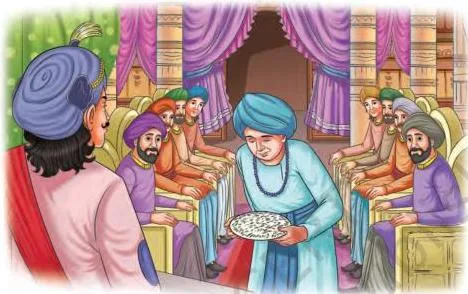
Found on page 5, this shows the busy court at the moment Tenali steps forward with his plate of seeds. Notice the ministers and courtiers around the throne — their expressions make sense of the sarcasm and snickers that greet Rama’s claim.
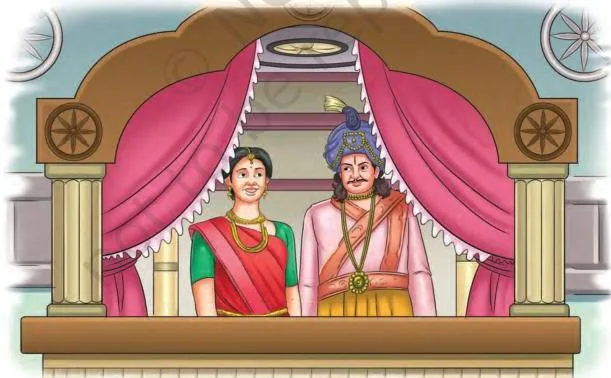
This close-up on page 6 is the turning point of the story. The king has just yawned; look at the change across his face as he connects Tenali’s words to his own quarrel. Capturing that shift is the whole point of the drawing.

This drawing on page 20 sits beside the exercise on puns. It shows the wordplay at the heart of the chapter: “getting to the point” means both settling an argument and reaching the pencil’s tip. If you can explain the drawing, you can explain a pun.
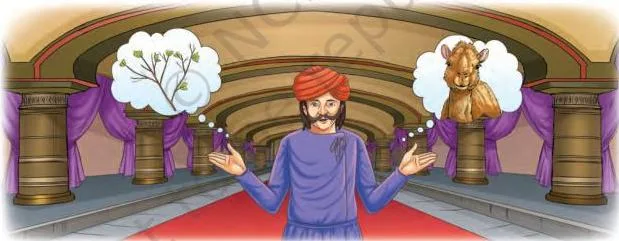
This page 34 illustration is the visual evidence for Shiv Datt’s deduction. The untouched leaves on the right are the whole argument — a camel that could see that side would have eaten there too. It is the clearest example of the chapter’s read-the-evidence method.

This image on page 37 accompanies the extract question about the phrase “press on.” The drawing shows the four men striding towards the city with their minds set — which is exactly what the phrase means: to keep going despite difficulty. The correct option is B, “moving forward with determination.”
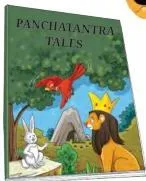
The illustration on page 45 belongs to the Let us explore task, where the book sends you to the library to read more stories of wit and wisdom. It shows classic collections such as Gopal the Jester, Panchatantra Tales, Tenali Rama and Vikramaditya and Betal.

This page 47 picture matches the listening passage about Nek Chand’s Rock Garden of Chandigarh — 40 acres of sculptures built from waste materials, with about 5,000 statues bordering it. Listen for exactly these details: the task asks for answers in one to three words.
Words to Know From This Chapter
The chapter prints a margin meaning for each word below, and comprehension questions use these words directly. Learn them grouped by the text where they appear.
Words from The Wit That Won Hearts (pp. 2-6)
| Word | What it means |
|---|---|
| renowned | well known and respected |
| illustrious | famous and admired |
| patron | a supporter, especially of the arts |
| eminent | famous and respected |
| insurmountable | impossible to overcome |
| trivial | unimportant |
| forlorn | lonely and sad |
| distraught | extremely upset |
| vague | unclear |
| strategy | a careful plan |
| profusely | in large amounts |
| bustling | busy and full of activity |
| intricately | in a detailed, complicated way |
| exquisite | fine and attractive |
| ornate | heavily decorated |
| gnawed | (here) bothered or nagged at |
| yield | (here) the harvest from a crop |
| sarcasm | mockery |
| snickers | quiet, suppressed laughter |
| absurd | illogical |
| unfazed | not worried |
Words from Wisdom Paves the Way (pp. 28-35)
| Word | What it means |
|---|---|
| resolute | determined |
| astray | lost, off the correct path |
| deduce | to work something out by reasoning |
| discern | to see or notice something clearly |
| insight | a clear, deep understanding |
| flawless | perfect |
| chastened | feeling sorry after being corrected |
| counsel | advice |
| beacon | a guiding light |
| indignant | angry at something unfair |
Mistakes Students Make With This Chapter
Most marks are lost here not on the stories but on misreading them. The five misreadings below keep appearing; fix them before you write an answer.
| Mistake | Correct rule | How to check your answer |
|---|---|---|
| Tenali’s paddy seeds were a lie or a fraud | He never sells the seeds or claims they work; the plate is a device that lets the king see his own unfairness by yawning himself | Ask who gets blamed in Rama’s speech — the sower, not the seed; the story ends with an apology, not a harvest |
| The queen deliberately insulted the king’s poem | She was exhausted and yawned naturally; the text calls yawning a natural reflex, and Rama says it is “as natural as breathing” (p. 6) | Rectify the false statement on p. 7 — the queen never spoke against the poem’s quality |
| The poem mocks Mrs Jones | The tone is humorous, amusing and light-hearted; the speaker is puzzled, not cruel | The p. 19 option set lists “mocking” as a wrong choice; the correct set is (ii), (iv) and (v) |
| Knowledge and wisdom are the same thing | Knowledge is facts and information; wisdom is using that knowledge with good judgement (p. 27) | Sort the six situations on p. 27 — anything about a choice or judgement is wisdom |
| All “if” sentences are the same conditional | Page 11 gives three different patterns with three different meanings | Check the tense of the if-clause first — present, past or past perfect decides the main clause |
From Exercises to Skills: How to Use This Chapter for Practice
This is a skills chapter: every Let us block trains one ability. Use the map below to revise the skill you are weakest in without re-reading everything.
| Skill block | Where it appears | What it trains |
|---|---|---|
| Let us discuss | pp. 7, 19, 32, 36 | Reading comprehension — correcting false statements, completing summaries, sequencing events |
| Let us think and reflect | pp. 7-8, 20, 37-38 | Extract-based questions, inference, multiple-choice questions, open answers |
| Let us learn | pp. 9-11, 21-22, 39-41 | Vocabulary, compound words, synonyms, conditionals, noun forms, modals |
| Let us listen | pp. 12, 23, 42 | Listening for detail — choosing options, exact-word answers, matching speakers |
| Let us speak | pp. 13-14, 23-24, 43 | Intonation, question words, sentence stress, formal and informal apologies |
| Let us write | pp. 15-16, 25, 44 | Narrative essay, notice, formal letter of complaint |
| Let us explore | pp. 16, 25, 44-45 | Limericks, library reading, Amrit Udyan, herbarium, staging a play |
One honest note before you plan revision: textbook contents and the examinable syllabus are not always identical, so check the current Class 8 English syllabus on the official CBSE website before deciding what to prioritise.
The Chapter in 60 Seconds
Use this table the night before a test — one row per text, with the page to flip to and the single takeaway that matters.
| Text | Type | Where | Takeaway |
|---|---|---|---|
| The Wit That Won Hearts | Story | p. 2 | Wit resolves a quarrel without humiliating anyone — the lesson arrives sideways. |
| A Concrete Example | Poem | p. 17 | The whole joke sits in the pun of the title. |
| A Sea of Foliage | Sonnet | p. 26 | Imagery turns a garden into a paradise — follow the colours and contrasts. |
| Wisdom Paves the Way | Play | p. 27 | Observation plus reasoning becomes wisdom, and the king rewards it. |
Where to Go Next
For the rest of the book, the Class 8 English book page lists every Poorvi chapter with its PDF, and the Class 8 hub collects notes for all subjects in one place. For revision across classes, start from the CBSE notes home page.
If you are using the earlier Honeydew textbook alongside Poorvi, the Honeydew book’s chapter 2 notes are on this site too. The complete set of current NCERT textbooks is published officially on the NCERT textbook portal.
| What the chapter holds | Count | Where it is used |
|---|---|---|
| Printed pages | 48 | |
| Figures with NCERT captions | 8 | |
| Tables | 18 | |
| Official NCERT PDF | Download the chapter PDF | the chapter exactly as NCERT publishes it |
Reference: NCERT Class 8 English (Poorvi) textbook, chapter 1, official edition on ncert.nic.in.
Sources and Data Verification
This listing is maintained for the 2026-27 academic session using the NCERT textbook information available to us. NCERT remains the authority for confirming the latest edition.
- This page describes the NCERT Class 8 English book Poorvi, Chapter 1 Wit and Wisdom, in the official NCERT edition.
- It covers only this chapter — not the whole book, nor the complete CBSE scheme of studies.
- Page numbers follow the printed chapter and may shift slightly in later printings.
- This listing is maintained for the current academic session using the NCERT information available to us.
- NCERT settles textbooks, editions and official PDFs; CBSE settles the curriculum, syllabus and examinations.
Common Questions About This Chapter
Where can I get the official Wit and Wisdom Class 8 chapter PDF?
The official PDF is on the NCERT textbook portal, linked at the top of this page. It is the full first chapter of Poorvi, word-for-word the printed edition.
What are the four main texts in Wit and Wisdom Class 8?
The Tenali Rama story The Wit That Won Hearts (p. 2), the poem A Concrete Example (p. 17), the sonnet A Sea of Foliage (p. 26) and the play Wisdom Paves the Way (p. 27).
What is the difference between knowledge and wisdom in this chapter?
The book defines them on page 27: knowledge is learning facts and information, while wisdom is using that knowledge with good judgement. Riya’s plant knowledge is knowledge; Ramesh’s choice to forgive is wisdom.
How did the four young men in Wisdom Paves the Way know the camel was lame, blind, short-tailed and in pain?
From the tracks and the trail, not from seeing the camel (pp. 33-35): three clear footprints meant lameness; leaves eaten only on the left meant blindness in the right eye; blood drops from mosquito bites meant a short tail that could not swish them away; deep forefeet and faint hind feet meant stomach pain.
What are the answers to the riddles in the pre-reading activity?
The answers are printed on page 16: 1. Words, 2. The future, 3. Time, 4. A secret.
What literary devices are used in A Concrete Example?
The poem uses a pun in the title, a refrain (“My next-door neighbour, Mrs. Jones”), situational irony (the flower is under the speaker’s feet), imagery of the garden and alliteration (pp. 19-20). Its tone is humorous and light-hearted, not mocking.
Explore Class 8 English Books
- Next: Before you read
Related chapters:
- Notes for the Teacher
- How the Camel got his hump
- Children at work