
This page is for Class 8 NCERT English — the supplementary reader It So Happened, Chapter 1, Rudyard Kipling’s fable “How the Camel Got His Hump”, in the current NCERT edition.
The official NCERT PDF of the reader, with this chapter inside it, is right below. After that come the story retold, the word meanings the book supplies, suggested answers to both Comprehension Check blocks, and the discussion points from the closing Exercise.
Download the official Class 8 It So Happened Chapter 1 PDF
“How the Camel Got His Hump” is the opening story of the Class 8 English supplementary reader It So Happened.
Open the NCERT Class 8 English It So Happened Chapter 1 How the Camel Got His Hump PDF to read the official file on ncert.nic.in — the download holds the whole reader, with this story at its start, so you also get the chapters that follow.
If you want to check the current list of Class 8 English titles first, the official NCERT textbook portal lists every textbook NCERT publishes, including It So Happened and the other Class 8 readers.
Chapter 1 at a glance: what is inside the file
The chapter table on this page lists how much the file holds — its parts, checks, figures and questions — so those counts are not repeated here. What helps before you read is knowing where each part sits in the story:
- The story opens with the animals just beginning to work for Man.
- Part I introduces the idle Camel and his one-word answer to every request.
- A Comprehension Check follows the first part.
- Part II brings the Djinn and the hump.
- A second Comprehension Check follows the second part.
- The chapter closes with an Exercise for group discussion and a Think it Over box.
How the story goes: Part I and Part II
This is a story chapter, so the quickest way to understand it is to follow the plot first, then the ideas and the language. Two short parts carry the whole tale.
Part I — the Camel refuses to work
When the world was new, the animals worked for Man — all except one. A Camel lived in the middle of a Howling Desert because he did not want to work. He ate sticks, thorns and prickles, and whenever anyone spoke to him he answered only “Humph!
” Three animals came to him in turn, each carrying the object of his own task:
| Animal | Task the Camel is invited to share | Object it carries |
|---|---|---|
| Horse | “Come out and trot like the rest of us” | Saddle on his back |
| Dog | “Come and fetch and carry like the rest of us” | Stick in his mouth |
| Ox | “Come and plough like the rest of us” | Yoke on his neck |
The Camel said “Humph!” to each of them, and one by one the Horse, the Dog and the Ox went away and told Man.
At the end of the day Man called the Three together and said he was sorry for them: the “Humph-thing” in the Desert plainly could not work, so they must work double time to make up for him. This made the Three very angry, and they held a panchayat on the edge of the Desert.
The Camel came along chewing cud, laughed at them, said “Humph!” and went away again. Then the Djinn, the spirit in charge of All Deserts, arrived rolling in a cloud of dust.
The Horse asked the Djinn whether it was right for anyone to be idle. Certainly not, said the Djinn.
The Horse described a thing in the middle of the Desert with a long neck and long legs that had done no work at all since Monday morning and would not trot; the Ox added that it would not plough either and only said “Humph!”.
The Djinn knew at once that it was his own Camel, and told the Three he would “humph” him.
Part II — the Djinn and the hump
The Djinn wrapped himself in his dust-cloak and walked across the Desert. He found the Camel looking at his own reflection in a pool of water.
Sitting with his chin in his hand, the Djinn told the Camel that his idleness had given the Three extra work ever since Monday morning. The Camel’s answer was a third “Humph!”. The Djinn warned him not to say it again — he might say it once too often — but the Camel said it anyway.
The moment he did, his back, which he was so proud of, puffed up into a great big hump. “That’s your very own humph that you’ve brought upon your very own self,” said the Djinn — his lazy word had become a lump on his back.
Today was Thursday, and the Camel had done no work since Monday, when the work began. So he had missed Monday, Tuesday and Wednesday — three days.
The Camel complained that he could not work with a hump on his back. The hump has a purpose, said the Djinn: because the Camel missed those three days, he can now work for three days without eating, living on his hump.
The Djinn told him not to say that no one ever did anything for him, and ordered him to go to the Three and behave. The Camel went — but from that day to this he has never caught up with the three days he missed, and he has never yet learned how to behave.
The ideas the story works with
This section pulls out what a Class 8 reader is expected to take from the chapter — the values the story carries under its comedy.
- Idleness versus doing your share. The Camel refuses every task, and the cost falls on others: the Horse, the Dog and the Ox work double time to cover his share. The story makes the point through consequences, not lectures.
- A make-believe origin tale. The closing Exercise asks directly, “Can this story be factually true?” The honest answer is no. It is a fable — an invented, playful explanation of why camels have humps, told as if it were ancient history.
- The dignity of all work. The Think it Over box turns the tale into a value: there is no such thing as menial work, all work is dignified, and a person who struggles is better than one who never attempts. The box even carries a reflection from the American writer William Faulkner on what eight hours of work a day does to people — a nudge that the point is balance, not just effort.
- The playful ending. Kipling observes that real camels still seem idle and ill-mannered, so the Camel “has never yet learnt how to behave.” The word yet keeps the joke open — the lesson may still arrive.
Word meanings the book gives you
The reader explains three words itself, in notes at the foot of the page, and every one of them matters for understanding the story. The table collects them for quick revision.
| Word | Meaning the book gives | Where you meet it |
|---|---|---|
| Djinn | Pronounced “jin”, and also spelt genie, genii, jinnee, djinni or djinny — a spirit with strange powers that can take any form, human or animal | Glossary note on the opening page |
| I’ll humph him | I’ll deal with him appropriately; I’ll set him right | Note attached to the first Comprehension Check |
| remonstrated | Protested or complained | Part II, when the Djinn takes the Camel to task |
You also meet ordinary words doing story work:
- Howling Desert — the empty, lonely place the Camel chooses to live in.
- panchayat — a council; the animals hold their own village meeting on the edge of the Desert.
- chewing cud — slowly bringing swallowed food back up to chew again; the detail shows how relaxed the Camel is while the Three are angry.
- fetch and carry — the Dog’s job of bringing things when told.
- trot — to move at a steady pace faster than walking.
- plough — to turn over the soil for planting.
The pun that runs the whole story. The Camel’s only word, “Humph!”, is a sound of refusal. When the Djinn’s magic takes effect, that sound becomes a physical thing — the hump on his back.
The Djinn even says it out loud: “That’s your very own humph that you’ve brought upon your very own self.” The story adds that people now call it “hump” instead of “humph” so as not to hurt his feelings — wordplay that is the point of the chapter’s title.
Confusing the two spellings loses the joke, so keep them apart when you write.
Reading the two illustrations
The chapter is illustrated with captioned scenes, each picture carrying a line of the story itself. Reading them as part of the plot makes the scenes easier to remember.
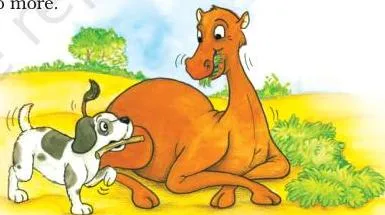
The first illustration belongs to the Dog’s visit early in Part I. The stick in the Dog’s mouth is the emblem of his task — fetching and carrying.
The caption is the Dog’s own line, so the picture freezes the exact moment each animal’s work is named; it pairs with the Dog’s visit rather than the Horse’s or the Ox’s.
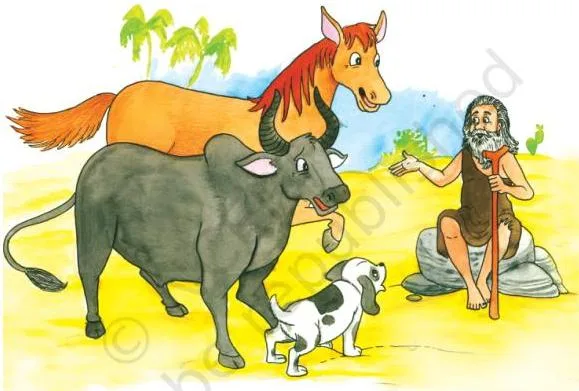
The second illustration shows the end of the day, when Man calls the Three together. It sits at Part I’s turning point.
This is the scene where the Camel’s idleness becomes the others’ burden — Man says the Camel can’t work, or he would have been there by now, so the Three must work double time. That announcement is what makes them angry enough to hold the panchayat.
Comprehension Check questions, with suggested answers
The chapter puts a short check after each part. Work out your own answer before reading these — then compare your reasons, not just your conclusion.
First Comprehension Check (after Part I)
1. What tasks were assigned to the dog and the ox? The Dog was to fetch and carry, and the Ox was to plough. The Horse’s own task, named alongside them, was to come out of the desert and trot.
2. Why did the camel live in the middle of the desert? He lived there because he did not want to work. The desert let him keep his distance from Man and from the animals who had taken up their shares of work.
3. What made the dog, the horse and the ox very angry? The Camel refused to work at all, and Man then made the Three work double time to make up for his share. Their anger came from paying for someone else’s idleness.
4. How did the Djinn know the horse was complaining against the camel? The Horse described the creature — a thing in the middle of the Desert with a long neck and long legs that had done no work since Monday morning. The Djinn recognised his own Camel from the description alone.
Second Comprehension Check (after Part II)
1. The camel was looking at his own reflection in the pool. What does it suggest about him? It suggests vanity and self-satisfaction. While the other animals were working double time, the Camel was admiring himself instead of doing anything useful — a picture of idleness comfortable with itself.
2. The camel said “Humph” repeatedly. How did it affect him? Saying it once too often finally caught up with him: his back, which he was so proud of, puffed up into a great big hump. His own lazy word became the lump on his back.
3. What, according to the Djinn, was the use of the “humph”? The hump had a purpose: because the Camel had missed the three days of work, he could now work for three days without eating, living on his hump. In the Djinn’s words, it was a help, not a hindrance.
4. “…he has never yet learnt to behave.” What is the writer’s opinion about the camel? It is a playful opinion: Kipling suggests that real camels are still idle and ill-mannered, the way the story’s Camel was. The word yet keeps the joke open — the writer pretends the lesson might still arrive.
Misreadings students make with this story
Because the story is short and funny, its subtler points get misread easily. The most common mistakes come from taking the comedy literally.
| Misreading | What is actually going on | Where the story shows it |
|---|---|---|
| The hump is a punishment for laziness | The hump is a tool, not a penalty — the Djinn says “That has a purpose”: it lets the Camel work three days without eating | Djinn’s speech at the end of Part II |
| The Djinn is a villain | The Djinn holds the Camel accountable but also provides for him — “don’t you ever say I never did anything for you” | End of Part II |
| “Humph” and “hump” are just the same word spelled two ways | They are a deliberate pun — the lazy sound becomes the lump on the back | “That’s your very own humph that you’ve brought upon your very own self” |
| The ending is a sad moral | The ending is gently comic — Kipling is observing that real camels still seem idle and ill-mannered | Final paragraph of Part II |
| Answers work without story evidence | An answer earns its strength by tying back to the text — e.g. the Djinn recognises the Camel because the Horse describes his long neck and long legs | Horse’s complaint to the Djinn in Part I |
Using the chapter for exams and group discussion
The chapter teaches you how to use it. Each half closes with a Comprehension Check of recall questions that ask for reasons, so the right way to revise is to cover the story and answer those checks from memory.
The closing Exercise then shifts to group discussion — prompts about whether the story could be true, what it is about, how active or idle you were over the weekend, and which kind of worker you are.
The Think it Over box is your anchor for discussion: all work is dignified, there is no such thing as menial work, and the person who struggles is better than the person who never attempts. Those values give you a position to argue from.
Here is an original model answer for the worker question you could adapt in your own words:
Model answer — which kind of worker are you? I belong to the first category: those who prefer to do today what they can do today.
The Camel is the cautionary example of the second kind — he keeps putting off the trotting, fetching and ploughing he is invited to share, so the Three work double time to cover him, and the Camel ends up with a hump he never chose.
The exercise’s joke, “check your back”, makes the point without preaching: nobody grows a real hump for idling, but putting work off leaves its mark anyway, because the work waits for you and so do the people counting on you.
The Camel never catches up with the three days he missed, which is the story’s way of saying that the debts of idleness are repaid later, and at a higher cost.
One honest caution for exam preparation: textbook contents and the examinable syllabus are not always identical, so check the current official syllabus for what is assessable. This page makes no promise about which question will appear.
Quick recap: the story and its takeaways
A short list of points holds the whole chapter in one scan:
- The Camel lives in the middle of a Howling Desert because he does not want to work, and answers everyone with “Humph!”
- The Horse (saddle), the Dog (stick) and the Ox (yoke) each invite him to share their work.
- Man tells the Three they must work double time to cover the Camel’s share.
- The Three are angry and hold a panchayat on the edge of the Desert.
- The Djinn, in charge of All Deserts, arrives in a cloud of dust and hears the complaint.
- The Camel says “Humph!” once too often, and his proud back puffs up into a great big hump.
- The hump has a purpose: he can work three days without eating, living on it, because he missed the three days since Monday.
- The Camel joins the Three, but never catches up with the missed days and never learns to behave.
The takeaways from the closing Think it Over box: all work is dignified, and the one who struggles is better off than the one who never attempts. Keep those two lines beside the plot and you have the chapter.
Other Class 8 English chapters on this site
This story opens the reader It So Happened; the next story in the book is Children at Work. For the rest of the Class 8 English syllabus, use these pages:
- Class 8 English book page — the hub for both Class 8 readers
- Class 8 hub — all Class 8 subjects in one place
- CBSE notes index — study notes across classes and subjects
- Class 8 Honeydew Chapter 2 — the Honeydew reader is covered separately from It So Happened
Sources and data verification
This listing is maintained for the 2026-27 academic session using the NCERT textbook information available to us. NCERT remains the authority for confirming the latest edition.
This page describes Chapter 1 of the NCERT Class 8 English supplementary reader It So Happened, in the current NCERT edition published by NCERT. It covers Chapter 1 only, not the whole book or the other Class 8 English readers.
- NCERT publishes the textbook and its official PDF; the download links on this page point to ncert.nic.in, the authority for editions and files.
- CBSE settles the examinable curriculum and syllabus — textbook contents and the examinable syllabus are not always identical.
- This page is maintained for the current academic session.
| What the chapter holds | Count | Where it is used |
|---|---|---|
| Printed pages | 6 | |
| Figures with NCERT captions | 2 | |
| Exercise questions | 4 | answered in our NCERT Solutions |
| In-text questions | 8 | |
| Official NCERT PDF | Download the chapter PDF | the chapter exactly as NCERT publishes it |
Chapter-wise notes for this subject are not published yet. The unit-wise syllabus on this page is complete and verified against the official CBSE curriculum document.
Reference: NCERT Class 8 English textbook, chapter 1, official edition on ncert.nic.in.
Frequently asked questions
What is the moral of the story How the Camel Got His Hump?
The story’s lesson is that everyone should do their share of work: when the Camel refuses, the other animals pay by working double time, and the Camel himself never catches up with the days he lost.
The chapter’s Think it Over box adds that all work is dignified and that a person who struggles is better than one who never attempts.
Why did the camel keep saying Humph?
“Humph!” was the Camel’s only answer to every request — it meant, in effect, that he would not trot, fetch and carry, or plough. Saying it once too often is also what finally makes his back puff up into a hump, so his lazy word literally becomes the lump on his back.
What did the Djinn do when the camel refused to work?
The Djinn warned the Camel not to say “Humph!” again, but the Camel said it anyway, and his proud back puffed up into a great big hump.
Rather than leaving him helpless, the Djinn explained the hump’s purpose: the Camel could now work three days without eating, living on his hump, because he had missed the three days since Monday.
Who wrote How the Camel Got His Hump?
The story is by Rudyard Kipling, and the NCERT reader prints it as abridged — shortened from the original. The book credits the writer with the note “RUDYARD KIPLING (abridged)” at the end of the story.
Is How the Camel Got His Hump a true story?
No — it is a fable, a make-believe origin tale that playfully explains why camels have humps. The chapter’s own closing exercise asks “Can this story be factually true?”, and the honest answer is no: the story is an invention told for its humour and its values, not a factual account.
Why does the story say the camel has never caught up with the three days?
The Camel did no work from Monday morning until Thursday, so he missed three days of work.
The Djinn’s hump lets him work three days without eating to cover those missed days, but the story’s final line says he has never yet caught up with them — Kipling’s playful way of suggesting that real camels still seem to be making up for that slow start.
Explore Class 8 English Books
- Next: Before you read
Related chapters:
- Notes for the Teacher
- Wit and Wisdom
- Children at work