
This page is about Chapter 4 of the NCERT Class 10 Democratic Politics book, titled Political Parties. The chapter runs from printed pages 47 to 62 of the textbook, and this page offers the official NCERT PDF right here, then explains the chapter’s ideas so you can revise without hunting through the book.
NCERT Democratic Politics Class 10 Chapter 4 Political Parties PDF — the official file from ncert.nic.in, so you can read the chapter exactly as the textbook prints it.
Chapter at a glance: sections, figures and exercises







The table below is rendered from the source chapter record. It lists how much the chapter holds — its sections, figures and exercise questions — so you know what the PDF contains before you open it.
| What is in the chapter | Count in the NCERT book |
|---|---|
| Printed pages | 17 (pages 46–62 of the book) |
| Chapter sections | 14 |
| Figures | 11 |
| Worked examples | 0 |
| Exercise questions | 11 |
What this chapter covers, from parties to reform
This quick map shows you the order in which the chapter builds its argument, so you can jump straight to any topic. Each bullet names the printed page where that idea starts.
- Why we need parties, and what they are — the chapter opens by observing that parties are the most visible institution in a democracy, yet also the most criticised (p. 47). It defines a political party and lists its three components (pp. 47–48).
- The seven functions of parties — contesting elections, offering policy choices, making laws, forming governments, opposing, shaping public opinion and giving citizens access to government (pp. 48–49).
- Why representative democracy cannot work without parties — the “no party” thought experiment and the panchayat panel example (p. 49).
- How many parties a democracy should have — one-party, two-party and multiparty systems, and why a party system cannot simply be chosen (pp. 50–51).
- Survey evidence on trust and participation — people trust parties less but are joining them more (p. 52).
- National and State parties — the six per cent recognition rule, the six national parties the book lists, and why State parties are not always regional in ideology (pp. 53–56).
- The four challenges — lack of internal democracy, dynastic succession, money and muscle power, and no meaningful choice (pp. 57–58).
- Reform measures and their limits — the anti-defection law, affidavits, Election Commission orders, and the two citizen-based routes to reform (pp. 59–61).
For the full set of chapters in this book, see the Class 10 Social Science book page.
Key concepts in this chapter, explained simply
A political party is simply a group of people who come together to contest elections and hold power. The whole chapter grows out of that one sentence — so this section explains each load-bearing idea in plain words, with the NCERT page to follow along on.
What a political party is, and its three components
A party is a team that contests elections and wants to run the government (NCERT, p. 47). Its members agree on policies and programmes they believe promote the collective good, and they try to persuade voters that their policies are better than the other parties’ policies.
Because every party stands for only a part of society, the chapter introduces the idea of partisanship: a party is known by which part it stands for, which policies it supports and whose interests it upholds (p. 47). A political party has three components — the leaders, the active members and the followers (pp. 47–48).
The seven functions of political parties
This is one of the most examinable lists in the chapter, so learn it as a set. Parties perform these seven functions (pp. 48–49):
- Parties contest elections. In most democracies, elections are fought mainly among party candidates. Methods of choosing candidates differ: in the USA, members and supporters choose them; in India, top party leaders choose them.
- Parties put forward policies and programmes. A party groups a vast number of opinions into a few basic positions, and a government bases its policies on the line taken by the ruling party.
- Parties make laws. Laws are formally debated in the legislature, but most members belong to a party and follow its leadership.
- Parties form and run governments. Parties recruit and train leaders, then make them ministers.
- Parties play the role of opposition. Losing parties voice different views and criticise the government’s failures.
- Parties shape public opinion. They raise and highlight issues, and many pressure groups are extensions of parties.
- Parties provide access to government machinery and welfare schemes. An ordinary citizen finds it easier to approach a local party leader than a government officer.
Why representative democracy needs parties
The chapter’s argument is that parties are a necessary condition for democracy (p. 49). Imagine elections with only independent candidates: no one can promise major policy changes, a government may form, but no one is responsible for how the country is run.
Even in non-party panchayat elections, the village splits into factions, each putting up a “panel” of candidates — which is exactly what a party does. Large societies need an agency to gather different views, bring representatives together and support or restrain the government. Parties are that agency.
One-party, two-party and multiparty systems
India has more than 750 parties registered with the Election Commission, but only a handful are serious contenders (p. 50). The chapter compares the three systems a country can develop:
| Party system | How it works | Example in the chapter | Trade-off the chapter names |
|---|---|---|---|
| One-party system | Only one party is allowed to control and run the government | China | Not a democratic option, because there is no free competition for power |
| Two-party system | Power usually changes between two main parties; others win only a few seats | USA, United Kingdom | The chapter does not claim it is ideal — it just describes how it works |
| Multiparty system | Several parties compete and may come to power alone or in alliance | India | Often appears messy and can seem unstable, but it allows a variety of interests and opinions to be represented (p. 51) |
The chapter’s key warning: a party system is not something any country can choose (p. 51). It evolves slowly, depending on a society’s divisions, its history and its electoral system. India has a multiparty system because its social and geographical diversity is too large for two or even three parties to absorb.
As the book puts it, no system is ideal for all countries and all situations.
When several parties in a multiparty system join hands to contest elections, the arrangement is called an alliance or a front. The 2004 parliamentary elections in India saw three major alliances — the National Democratic Alliance, the United Progressive Alliance and the Left Front (p. 51).
The recognition rule, and how a party becomes a State or national party
Every party must register with the Election Commission of India, which gives special facilities — including a unique election symbol — to large and established parties. Such parties are called recognised political parties (p. 53). The rule the chapter gives has two parts:
- A party that secures at least six per cent of the total votes in a State Legislative Assembly election and wins at least two seats is recognised as a State party.
- A party that secures at least six per cent of the total votes in Lok Sabha elections or Assembly elections in four States, and wins at least four seats in the Lok Sabha, is recognised as a national party.
According to the Election Commission’s 2023 notification, the book lists six recognised national parties: the Aam Aadmi Party, the Bahujan Samaj Party, the Bharatiya Janata Party, the Communist Party of India-Marxist, the Indian National Congress and the National People’s Party (pp. 53–56).
The chapters also profiles each of these parties, including their founding and support base — the National People’s Party, for example, was the first party from North East India to attain national party status.
Worked example: applying the six per cent rule
Suppose a party called the Rashtriya Mazdoor Suraksha Party (RMSP) wins 8.2% of the votes and 3 seats in a State Legislative Assembly election.
- Vote test: 8.2% is above the 6% minimum — passed.
- Seat test: 3 seats is above the required 2 — passed.
- Conclusion: RMSP is recognised as a State party in that State.
Now, in the next Lok Sabha election RMSP wins 6.4% of the total votes nationwide but only 2 Lok Sabha seats. Does it become a national party?
- Vote test: 6.4% is above 6% — passed.
- Seat test: a national party needs at least 4 Lok Sabha seats; RMSP has only 2 — failed.
- Conclusion: RMSP stays a State party. The percentage requirement is the same (6%); what differs is the venue and the number of seats.
The four challenges to political parties
The chapter groups popular dissatisfaction with parties into four problem areas (pp. 57–58). Each challenge is named with the specific downside the book points to:
| Challenge | Specific downside the chapter names |
|---|---|
| 1. Lack of internal democracy | Power concentrates in one or a few leaders; no membership registers, no organisational meetings, no regular internal elections. Personal loyalty to the leader matters more than loyalty to party principles. |
| 2. Dynastic succession | Top positions stay controlled by one family, so ordinary workers have few ways to rise, and people without adequate experience or popular support reach positions of power. |
| 3. Growing role of money and muscle power | Parties nominate candidates who can raise money; rich donors influence policies; in some cases parties support criminals who can win elections. |
| 4. No meaningful choice to voters | Ideological differences between parties have declined; the same set of leaders keeps shifting from one party to another, so voters who want genuinely different policies have no option. |
How can parties be reformed?
The chapter describes three measures already in place, and their honest limits (pp. 59–60):
- The Constitution was amended to stop defection. An MLA or MP who changes parties loses the seat in the legislature. This brought defection down, but it made dissent harder — MPs and MLAs must now accept whatever the party leaders decide.
- The Supreme Court made affidavits compulsory. Every candidate must now file an affidavit giving details of property and pending criminal cases. This made a lot of information public, but there is no system to check whether the information is true.
- The Election Commission ordered parties to hold organisational elections and file income tax returns. Parties have started doing so, but sometimes it is a mere formality.
The chapter also lists reform suggestions that have not yet been accepted (pp. 60–61): a law regulating the internal affairs of parties, about one-third of tickets to women candidates plus quotas in decision-making bodies, and state funding of elections.
It warns that legal solutions have limits: over-regulation can push parties to find ways to cheat, and parties will not pass a law they dislike.
Finally come the two citizen-based routes to reform (p. 60): people can put pressure on parties through petitions, publicity and agitations, and — more directly — people who want better parties can join them. The chapter’s closing line is its philosophy: the problem of bad politics can be solved by more and better politics.
Reading the chapter’s cartoons and survey graphs
This chapter is full of cartoons and data graphs, and the book uses each one to make a specific point. This section decodes every figure in the printed chapter so you do not skip them.
This cartoon opens the chapter on page 47 and states the criticism the chapter sets out to answer: “Parties are partial, partisan and lead to partitions.” The chapter then spends the next pages showing why this view misses the essential functions parties perform.
When you read the cartoon, notice the words partial and partisan — they are the chapter’s bridge into the meaning of partisanship.
These photographs from Tamil Nadu illustrate why parties are the most visible institution in a democracy — their campaign writing used to cover walls during elections. The chapter notes that parties called wall writing their cheapest campaign method, and that the Election Commission has now banned it. Visibility, the chapter reminds you, is not the same as popularity.
This diagram on page 49 condenses the “necessity” argument: as societies became large and complex, they needed an agency to gather different views, bring representatives together and form responsible governments. That agency is the political party — which is why the book says parties are a necessary condition for a democracy.
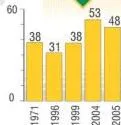
This graph uses survey data to challenge the claim that Indians are turning away from parties. It shows that party identification has gone up in India: the proportion of people who say they feel close to a party rose over the survey rounds, despite fluctuations (p. 52).
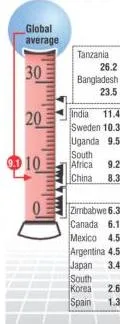
The second survey finding is comparative: party membership is higher in South Asia than in the rest of the globe. The chapter reports that the proportion of Indians who say they are members of a party is higher than in advanced countries such as Canada, Japan, Spain and South Korea. Low trust, in other words, has not meant low participation.
The third graph shows the time trend: party membership has risen in India over the last three decades. Taken together, the three graphs make the chapter’s central evidence point — people do not trust parties much, but they are identifying with them and joining them more than before.
This map sits with the party profiles. The chapter uses it to show where the major State and national parties have their base — for example, the Communist Party of India-Marxist enjoys strong support in West Bengal, Kerala and Tripura among the poor, factory workers, farmers, agricultural labourers and the intelligentsia (p. 55).
Reading it with the profiles helps you connect each party to its region.
This cartoon on page 57 is the chapter’s case study for the money and muscle power challenge. Berlusconi was not only Italy’s Prime Minister but also one of its top businessmen, controlling TV channels, a major publishing company, a football club and a bank.
The image makes the worry concrete: when the same person holds political power and concentrated media and business power, elections stop being a fair contest.
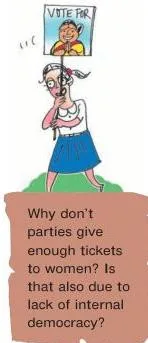
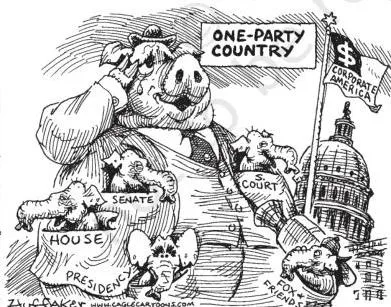
This cartoon illustrates the meaningful choice challenge on page 58. The chapter’s point is not that every politician is corrupt — it is that ideological differences between parties have shrunk, so voters who want genuinely different policies may find no option.
The caption question printed beside the cartoon asks whether people contest elections only to make money, and the chapter itself answers that many politicians are genuinely committed to public well-being.
This cartoon on page 59 shows the anti-defection rule: an MLA or MP who changes parties loses the seat in the legislature. The chapter welcomes the drop in defection but adds the side effect you must remember — dissent inside parties became more difficult, because legislators now have to accept whatever the party leadership decides.
The final cartoon sums up the chapter’s hopeful answer on page 60: ordinary citizens can pressure parties through petitions, publicity and agitations, and they can join parties to improve them from inside. Reform is not only a legal question — it is also a question of public participation.
Definitions the chapter gives you
The chapter defines several terms formally, and exam answers are expected to use them correctly. This table gives each term in plain words with the NCERT page:
| Term | Plain explanation | NCERT page |
|---|---|---|
| Partisan / partisanship | A partisan is strongly committed to one party or faction; partisanship means taking a side and being unable to take a balanced view of an issue. | p. 48 |
| Ruling party | The political party that runs the government. | p. 49 |
| Alliance or front | Several parties joining hands to contest elections and win power together. | p. 51 |
| Recognised party | A party the Election Commission recognises because it meets fixed criteria of votes and seats; recognised parties get facilities such as a unique election symbol. | p. 53 |
| State party | A party that secures at least 6% of the votes in a State Assembly election and wins at least two seats. | p. 53 |
| National party | A party that secures at least 6% of the votes in Lok Sabha elections or Assembly elections in four States and wins at least four Lok Sabha seats. | p. 53 |
| Defection | Changing party allegiance from the party on which a person was elected to a different party. | p. 59 |
| Affidavit | A signed document in which a person makes a sworn statement about personal information (such as property and criminal cases). | p. 60 |
Common mistakes students make with this chapter
Most lost marks in this chapter come from a handful of confusions. Each row names the mistake first, then the correction straight from the book, and finally where to verify it.
| Mistake | Correct rule from the chapter | How to check your answer |
|---|---|---|
| Believing parties exist only to divide people | Parties do reflect divisions, but they also perform essential functions — contesting elections, making laws, forming governments — without which democracy cannot work (pp. 47–49). | You can quote any two of the seven functions and connect them to the “necessity” argument (p. 49). |
| Thinking a two-party system could simply be adopted | A party system is not chosen; it evolves over time from a society’s divisions, history and electoral system (pp. 50–51). | Look for the phrase “party system is not something any country can choose” at p. 51. |
| Assuming a multiparty system is automatically worse | No system is ideal for every country; multiparty systems may look messy, but they let a variety of interests and opinions be represented (p. 51). | India’s diversity is the chapter’s reason for its multiparty system — cite p. 51. |
| Assuming State parties are always regional in ideology | Some State parties are all-India parties that simply succeeded in only some States; others are conscious of their State identity (p. 55). | The chapter names the Samajwadi Party and Rashtriya Janata Dal as national-level organisations that happen to be State parties — p. 55. |
| Concluding low trust means people have stopped participating | Survey evidence shows party membership in India is higher than in several advanced countries and has risen steadily (p. 52). | Check the data graphs on p. 52 for the upward-trend lines. |
| Treating the anti-defection law as an unqualified success | It reduced defection, but it also made dissent more difficult — MPs and MLAs must accept party decisions (p. 59). | The chapter says both effects in the same paragraph — do not quote one without the other. |
| Confusing the criteria for a State party with a national party | Both require 6% of votes, but a State party needs two Assembly seats, while a national party needs four Lok Sabha seats (p. 53). | Write both criteria side by side and compare the seat requirement. |
How the chapter’s exercises test these ideas
The chapter ends with eleven exercises. This mapping connects each one to the section where its answer is built, so revision becomes targeted instead of random.
| Exercise | What it tests | Where to find the answer |
|---|---|---|
| Q1. Functions of political parties | Direct concept | Pages 48–49 (the seven functions) |
| Q2. Challenges faced by parties | Direct concept | Pages 57–58 (the four challenges) |
| Q3. Reforms to strengthen parties | Direct concept | Pages 59–61 (anti-defection law, affidavit, EC orders, and the suggestions) |
| Q4 and Q5. Definition and characteristics of a party | Direct concept | Pages 47–48 (definition and three components) |
| Q6. Fill in the blank | Direct concept | Page 47 (the definition of a political party) |
| Q7. Alliance matching | MCQ | Pages 50–51 (alliances and fronts) and the national party profiles on pp. 53–56 (e.g. UPA, NDA, Left Front) |
| Q8 and Q9. Party founders and philosophy | MCQ | Page 54 (BSP founder Kanshi Ram; BJP’s guiding philosophy of integral humanism) |
| Q10. Statements on parties | Reasoning over statements | Page 52 (trust) and p. 49 (necessity) — statement C is wrong because parties are necessary |
| Q11. Passage: Muhammad Yunus enters politics | Applied reasoning | Pages 49 and 59–61 — use the necessity argument and the reform discussion to defend a position |
One caution: textbook contents and the examinable syllabus are not always identical, so check the current official CBSE syllabus for what is examinable this session. The official PDF linked above is the source for the chapter text itself.
One page revision summary of the chapter
Recap the whole argument in the order the book builds it — in about two minutes of reading.
- What a party is: a group that contests elections and holds power; three components — leaders, active members, followers (pp. 47–48).
- Seven functions: contest elections, offer policies, make laws, form governments, oppose, shape public opinion, give access to government (pp. 48–49).
- Necessity: parties are a necessary condition for representative democracy; without them no one is responsible for running the country (p. 49).
- Three party systems: one-party (China), two-party (USA, UK), multiparty (India); a system evolves and cannot be chosen (pp. 50–51).
- Recognition rule: 6% of votes plus 2 seats for a State party; 6% plus 4 Lok Sabha seats for a national party (p. 53). Six national parties are listed under the 2023 ECI notification.
- Four challenges: lack of internal democracy, dynastic succession, money and muscle power, no meaningful choice (pp. 57–58).
- Reforms: anti-defection amendment, candidate affidavits, EC orders on internal elections — plus proposals like one-third tickets for women and state funding of elections (pp. 59–61).
- Two citizen routes: pressure parties from outside and join them from inside (p. 60).
Related NCERT Class 10 social science pages
Continue with the chapters that sit beside this one in the book, or move to the class-level notes.
- Class 10 Social Science book page — all the chapters of this subject in one place.
- Class 10 hub — notes and resources for every subject in Class 10.
- CBSE notes home — browse notes across all classes.
- Money and Credit notes — the economics chapter on money, credit and banks.
- Minerals and Energy Resources notes — the geography chapter on India’s mineral and energy wealth.
| What the chapter holds | Count | Where it is used |
|---|---|---|
| Printed pages | 17 | |
| Figures with NCERT captions | 11 | |
| Tables | 2 | |
| Exercise questions | not fully captured | our text of this chapter is incomplete; the printed book has more |
| Official NCERT PDF | Download the chapter PDF | the chapter exactly as NCERT publishes it |
Reference: NCERT Class 10 Democratic Politics textbook, chapter 4, official edition on ncert.nic.in.
Sources and data verification
This listing is maintained for the 2026-27 academic session using the NCERT textbook information available to us. NCERT remains the authority for confirming the latest edition.
This page is maintained against a fixed, named source so you can check any claim yourself.
- The page follows the NCERT Class 10 Democratic Politics textbook, Chapter 4 (Political Parties), official edition published on ncert.nic.in.
- Page numbers refer to the printed NCERT pages 47 to 62, which the official PDF reproduces.
- NCERT settles textbooks, editions and the official PDFs; CBSE settles the curriculum, syllabus and examinations.
- Textbook contents and the examinable syllabus are not always identical — confirm the current official syllabus before the exam.
Frequently asked questions about this chapter
Which chapter in Democratic Politics Class 10 is Political Parties?
Political Parties is Chapter 4 of the NCERT Democratic Politics textbook for Class 10, printed on pages 47 to 62. The official PDF is linked at the top of this page.
What are the functions of political parties in a democracy?
Parties perform seven functions: they contest elections, put forward policies and programmes, make laws, form and run governments, play the role of opposition, shape public opinion, and give citizens access to government machinery and welfare schemes (NCERT, pp. 48–49).
How are national parties and State parties different?
Both must secure at least 6% of the total votes. A State party wins at least two seats in a State Legislative Assembly election; a national party wins at least four Lok Sabha seats, with the vote test met in Lok Sabha elections or Assembly elections in four States (p. 53).
How many national parties does the Class 10 book list?
The book lists six recognised national parties as per the Election Commission of India’s 2023 notification: AAP, BSP, BJP, CPI(M), INC and the National People’s Party (pp. 53–56).
Why do we need political parties in a democracy?
Because parties are a necessary condition for representative democracy. They group many opinions into a few policy positions, form a responsible government, and give citizens a way to support or remove that government (p. 49).
What are the four challenges faced by political parties?
The four challenges are: lack of internal democracy, dynastic succession, the growing role of money and muscle power, and the failure to offer voters a meaningful choice (pp. 57–58).
Explore Class 10 Social Science Books
Related chapters: