
This is the official NCERT Class 8 Mathematics Chapter 1, Fractions in Disguise, from the Ganita Prakash Part-II textbook — a 32-page chapter that teaches percentages from scratch.
The chapter covers what per cent means, fraction-to-percentage conversion, finding a percentage of a quantity, and percentages in comparison, profit and loss, tax, growth and decline. The official PDF from ncert.nic.in is right below.
Official Fractions in Disguise Class 8 Chapter PDF
The official edition of this chapter is published on ncert.nic.in, the NCERT textbook portal. The file below is the exact printed chapter — all 32 pages, including every section, figure and question set.
To read or save the complete chapter for offline revision — every section, figure and question set — download the Fractions in Disguise Class 8 chapter PDF from the NCERT textbook portal.
Chapter at a Glance: What Is Inside
The table below lists how much the 32-page chapter holds — sections, figures, in-text questions and formulas — so you know what is waiting inside the file.
| What the chapter holds | Count |
|---|---|
| Sections and subheadings | 26 |
| Figures (bar models, diagrams, graphs) | 24 |
| In-text questions across the Figure it Out sets | 45 |
| Formulas and equations | 53 |
The chapter has two numbered sections — 1.1 Fractions as Percentages (page 1) and 1.2 Percentage of Some Quantity (page 6). Both carry the same ideas into applications: comparing proportions, profit and loss, taxes, growth and compounding, and decline. It closes with a summary on page 31 and the chess puzzle Peaceful Knights on page 32.
What This Chapter Covers, Topic by Topic
Use this map to jump straight to the page you need while revising. Each row names the topic, its pages and what it teaches.
| Topic | Pages | What it teaches |
|---|---|---|
| Meaning of per cent; fraction to percentage | 1–3 | Per cent means out of hundred; two methods convert any fraction to a percentage; percentages are fractions with denominator 100. |
| Why 100 is the chosen denominator | 4 | Base-10 numbers link percentages to decimals easily (31% = 0.31); 100 is round and easy to grasp mentally. |
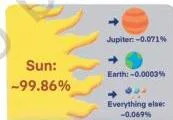
| Percentages around us | 5 | Real-life percentages: body water, ice-cream air, the Sun’s share of the Solar System’s mass. |
| Percentage of a quantity; free-hand computations | 6–8 | \(y\%\) of \(z\) is \(\frac{y}{100} \times z\); build 5%, 10%, 20%, 25% mentally; the FDP trio 50% = 1/2 = 0.5. |
| Ratios as percentages; estimation first | 9–10 | Ratio → fraction → percentage (2:7 gives 22.22%); estimate before calculating. |
| Percentages greater than 100 | 10–11 | A percentage is a multiplier; 120% means 1.2 times, 250% means 2.5 times. |
| Comparing proportions | 14 | Convert scores from different totals to percentages before comparing them. |
| Percentage increase and decrease | 15–16 | Change ÷ original base × 100; ‘165% of’ and ‘increased by 65%’ mean the same. |
| Profit, loss, discount; gross and net profit | 16–18 | Cost price, marked price, selling price; profit and loss percentage on cost price; discounts from marked price. |
| Taxes and GST | 19 | GST is added as a percentage of the price; read the tax on a bill. |
| Interest: no compounding vs with compounding | 20–23 | \(A = p(1 + rt)\) vs \(A = p(1 + r)^t\); compounding earns interest on interest. |
| Decline and depreciation | 24–25 | Value falls by a percentage each period; depreciation is loss of value from use and age. |
| Discount traps; ‘would you rather’ choices | 25–27 | Successive discounts are not additive; markup followed by discount does not cancel. |
| Summary and puzzle | 31–32 | The chapter’s summary, then the Peaceful Knights chess puzzle. |
Key Ideas in This Chapter, Explained
The ideas below are the chapter’s core, in simpler words, with page numbers so you can follow along in your own copy. Work through them in order — each one builds on the last.
Per Cent Means ‘Per Hundred’
The word per cent comes from the Latin per centum, meaning ‘by the hundred’ or ‘out of hundred’. So 25% means 25 out of every 100 — 25 people out of 100, or 25 marks out of 100 marks (NCERT, p. 1).
A percentage is just a fraction whose denominator is 100: \(20\% = \frac{20}{100} = \frac{1}{5}\), and \(33\% = \frac{33}{100}\) (NCERT, p. 1). Once you see that, ‘a percentage of a quantity’ is ordinary fraction multiplication.

Read the collage above and you will see why percentages appear everywhere: the human body is about 60% water by weight, ice cream is 30–50% air by volume, and about 99.86% of the Solar System’s mass sits in the Sun (NCERT, p. 5).
Why exactly 100? Because our number system is base 10, percentages link cleanly with decimals — 31% = 31/100 = 0.31 — and 100 is large enough for detail yet round enough to grasp mentally (NCERT, p. 4).
From Fraction to Percentage: Two Methods
Any fraction can be expressed as a percentage, and the chapter shows two ways to do it (NCERT, p. 2). Pick whichever is faster for the numbers in front of you.
- Method 1: rewrite the fraction as an equivalent fraction with denominator 100. The book does this with \(\frac{3}{4} = \frac{3 \times 25}{4 \times 25} = \frac{75}{100} = 75\%\) (NCERT, p. 2).
- Method 2: multiply the fraction by 100. Since a fraction is ‘of a unit’ while a percentage is ‘per 100’, multiplying by 100 converts straight across (NCERT, p. 3).
Step 1: Multiply the fraction by 100.
\[ \frac{7}{16} \times 100 = \frac{700}{16} \]
Step 2: Divide 700 by 16.
\[ \frac{700}{16} = 43.75 \]
Final answer: \(\frac{7}{16} = 43.75\%\). Check: \(\frac{43.75}{100} = 0.4375 = \frac{7}{16}\).
Going the other way, a percentage is a fraction: \(36\% = \frac{36}{100} = \frac{9}{25}\). In general, \(z\%\) can be written as any fraction equivalent to \(\frac{z}{100}\) (NCERT, p. 3).
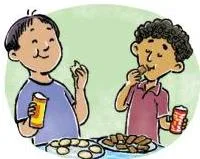
Why convert at all? Fractions hide comparison. Sugar makes up \(\frac{9}{34}\) of one biscuit variety and \(\frac{13}{45}\) of another — it is not obvious which is sweeter. Written as 26.47% and 28.88%, the answer is immediate (NCERT, p. 4).
Percentage of a Quantity: y% of z, and the FDP Trio
Once a percentage is a fraction, taking a percentage of a quantity is just fraction multiplication: \(y\%\) of a value \(z\) is \(\frac{y}{100} \times z\) (NCERT, p. 6).
Step 1: Write the percentage as a fraction of 100.
\[ 44\% \text{ of } 250 = \frac{44}{100} \times 250 \]
Step 2: Multiply as a decimal.
\[ \frac{44}{100} \times 250 = 0.44 \times 250 = 110 \]
Final answer: 44% of 250 is 110.
The same idea can be written as a proportion. The book models ‘25% sugar’ as \(\frac{25}{100} = \frac{s}{120}\), which gives \(s = \frac{25}{100} \times 120 = 30\) g of sugar in 120 g of biscuits (NCERT, p. 6).
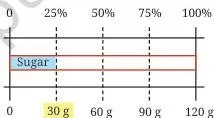
Read that bar model as: 25 units of sugar for every 100 units of biscuits is the same ratio as 30 units of sugar for 120 units of biscuits. The percentage stays fixed at 25%; the grams scale with the total.
Fractions, decimals and percentages are one family — the chapter’s FDP trio. Since \(\frac{50}{100} = \frac{1}{2} = 0.5\), multiplying a value by 0.5 does exactly the same job as taking 50% of it (NCERT, p. 8).
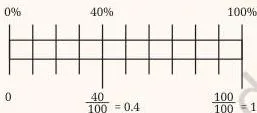
The conversion goes both ways and every form is the same quantity: the chapter’s summary gives \(\frac{4}{10} = 0.4 = 40\%\) as one example (NCERT, p. 31).
One more shortcut from the chapter: \(x\%\) of \(y\) equals \(y\%\) of \(x\), because both are \(\frac{xy}{100}\). That is why 5% of 40 and 40% of 5 both give 2 (NCERT, p. 28).
Mental Shortcuts: Work From 10%
The chapter wants you to calculate mentally first, without pen and paper (NCERT, p. 7). The trick is to build every common percentage from 10%.
- 10% of a value is one tenth of it — 10 parts out of 100.
- 20% is double 10%: 20 parts out of 100 is twice 10 parts out of 100 (NCERT, p. 7).
- 5% is half of 10%.
- 20% + 5% = 25%: \(\frac{20}{100}y + \frac{5}{100}y = \frac{25}{100}y\), so the parts add (NCERT, p. 7).
| Percentage of 340 | How to build it | Result |
|---|---|---|
| 10% | one tenth of 340 | 34 |
| 20% | double the 10% value | 68 |
| 5% | half the 10% value | 17 |
| 25% | 20% + 5% | 85 |
| 15% | 10% + 5% | 51 |
Estimate before you calculate. For \(\frac{2}{9}\): half of 9 is 4.5, so the fraction is clearly less than 50%; and since 20% of 9 is 1.8 while \(\frac{2}{9} = 2 \div 9 \approx 2.22\), it sits between 20% and 25% (NCERT, p. 9).

Ratios as Percentages
A ratio compares parts; to make it a percentage, first turn it into a fraction of the whole (NCERT, p. 9).
For a millet–water mix in the ratio 2:7, millet forms \(\frac{2}{9}\) of the mixture. So the millet percentage is \(\frac{2}{9} \times 100 = 22.22\%\), and water makes up 100% − 22.22% = 77.78% (NCERT, p. 9).
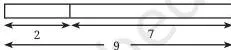
Read the bar model as: each 100 ml block contains 22.22 ml of millet, so five such blocks contain five times as much. Original follow-up: a 300 ml version of the same mixture holds \(3 \times 22.22 = 66.66\) ml of millet, about 66.7 ml.
Percentages Can Be Greater Than 100
A percentage is a multiplier, not a cap: it can pass 100%, and then it simply means ‘more than one whole’ (NCERT, p. 10).
The chapter’s shopkeeper targets ₹5,000 of sales a day. On a day he makes ₹6,000, that is \(\frac{6000}{5000} \times 100 = 120\%\) of the target — in other words, 20% over target (NCERT, p. 11).
| Phrase | Percentage meaning |
|---|---|
| ‘Half the target’ | 50% of the target = 0.5 × target |
| ‘Twice the target’ | 200% of the target = 2 × target |
Original example: a town’s population rises from 40,000 to 1,00,000. That is \(\frac{100000}{40000} \times 100 = 250\%\) of the old population — the town is 2.5 times its former size. The chapter makes the same point with a wheat harvest of 650 kg against last year’s 260 kg: 250% means 2.5 times the original value (NCERT, p. 11).
Comparing Scores Fairly
Raw scores from different totals cannot be compared directly — converting both to percentages puts them on the same scale (NCERT, p. 14).
Original example: Meera scored 21 out of 25, while Nikhil scored 33 out of 40. At first glance Nikhil’s 33 looks stronger, but:
\[ \text{Meera: } \frac{21}{25} \times 100 = 84\% \]
\[ \text{Nikhil: } \frac{33}{40} \times 100 = 82.5\% \]
Meera’s percentage is higher — she did better, even with fewer raw marks. The chapter’s own example reaches the same verdict: 42 out of 50 (84%) in English loses to 70 out of 80 (87.5%) in Science (NCERT, p. 14).
Increase, Decrease, Profit, Loss and Discount
Percentage change measures the change against the original amount — the base (NCERT, p. 15).
\[ \text{Percentage increase} = \frac{\text{amount of increase}}{\text{original base}} \times 100 \]
\[ \text{Percentage decrease} = \frac{\text{amount of decrease}}{\text{original base}} \times 100 \]
Two statements that say the same thing: ‘the population in 1991 is 165% of that in 1961’ and ‘the population increased by 65% from 1961 to 1991’. Both mean the 1991 population is \(1.65p\) if \(p\) was the 1961 population (NCERT, p. 16).
In a shop, three prices matter: the cost price (CP) the seller paid, the marked price (MP) quoted, and the selling price (SP) actually paid (NCERT, p. 16).
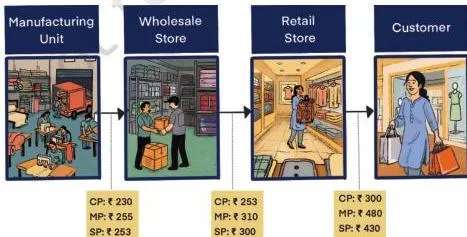
The journey diagram is worth reading carefully: the same sweater has a different ‘cost price’ at each stage — the manufacturer’s selling price becomes the wholesaler’s cost price, and so on down the chain (NCERT, p. 16).
Profit = SP − CP when SP is larger; loss = CP − SP when it is smaller. Percentage profit is \(\frac{\text{profit}}{\text{CP}} \times 100\) (NCERT, pp. 16–17).
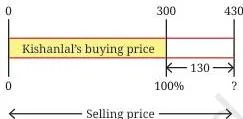
In that bar model, the cost price (₹300) is treated as 100%, and the ₹130 profit sits on top as 43.3% of it. Original example: a shopkeeper buys a chair for ₹800 and sells it for ₹960. Profit = ₹160, and profit % = \(\frac{160}{800} \times 100 = 20\%\).
Discounts work the same way. Original example: an item with MRP ₹2,400 at 30% off costs \(2{,}400 \times 0.7 = \text{₹}1{,}680\).
Gross profit is sales minus the cost of the goods; net profit is gross profit minus other expenses like transport and salaries. The chapter notes that its default ‘profit’ means gross profit (NCERT, p. 18).
Taxes are percentages too: GST is added to the price as a percentage, and the tax appears on the bill (NCERT, p. 19).
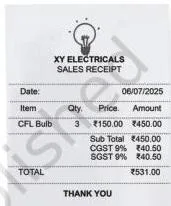
Read the bill as: the GST percentage multiplies the taxable amount, and that tax is part of the total you pay — it goes to the government, not to the shop (NCERT, p. 19).
Compounding: p(1 + rt) and p(1 + r)^t
Percentages also drive interest — the extra money a bank pays on money you deposit (NCERT, p. 20). Three terms matter: the principal is the amount deposited, the rate of interest is the percentage paid each term, and per annum (p.a.) means per year (NCERT, p. 20).
A bank can pay interest in two ways. If it pays the interest out each year, the principal never changes, so the interest is the same every year. If it adds each year’s interest back to the deposit, the principal grows — this ‘interest on interest’ is compounding (NCERT, pp. 21–22).
The chapter generalises both patterns (NCERT, p. 23). With \(p\) = principal, \(r\) = rate per term written as a fraction (10% → 0.1), and \(t\) = number of terms:
\[ \text{Without compounding: } A = p(1 + rt) \]
\[ \text{With compounding: } A = p(1 + r)^t \]
Original comparison — ₹2,000 at 10% p.a. for 2 years:
Without compounding: \(A = 2000(1 + 0.1 \times 2) = 2000 \times 1.2 = 2400\) — a gain of ₹400, i.e.
20%.
With compounding: \(A = 2000 \times 1.1 \times 1.1 = 2000 \times 1.21 = 2420\) — a gain of ₹420, i.e.
21%.
Why the difference: compounding earns interest on the first year’s interest, so the second year’s interest is calculated on ₹2,200, not ₹2,000.
Figure Walkthrough: Reading NCERT’s Bar Models
The chapter thinks in bar models — strips split into percentage parts — and exam-style questions expect you to read them. Master these four and the rest become easy (NCERT, pp. 2, 10, 11, 26).
Bar Model: 3/4 = 75% (page 2)
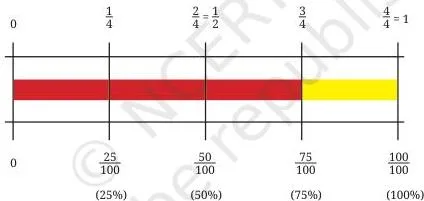
The bar is split into four equal blocks, and each block is split into 25 small parts — 100 parts in all. Shading three blocks gives 75 of the 100 parts, which reads directly as 75%. That is why \(\frac{3}{4}\) and 75% are the same quantity in two disguises (NCERT, p. 2).
Bar Model: The Cyclist (page 10)
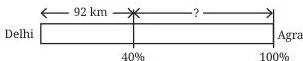
The Delhi–Agra journey bar is split into percentage-sized segments: 40% of the distance is 92 km. Half of that gives 20% = 46 km. The remaining journey is 60% = 92 + 46 = 138 km, so the whole trip is \(92 + 138 = 230\) km (NCERT, p. 10).
Bar Model: The Sales Target (page 11)
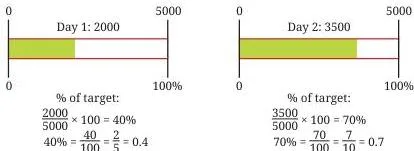
This bar passes beyond 100%. The shopkeeper’s target is ₹5,000, so the full bar is 100%. On the day he earns ₹6,000, the bar stretches to 120% — ₹1,000 is 20% of ₹5,000, so ₹6,000 is 100% + 20% = 120% of target, i.e. 20% over (NCERT, p. 11).
Bar Model: The Cake Discount (page 26)
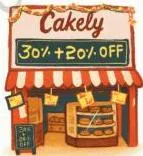
A ₹200 cake. At Cakely, 30% off drops the price to ₹140; a further 20% off drops it to ₹112. At Cakify, a straight 50% off drops it to ₹100. The two bars side by side show why successive discounts lose to one big discount (NCERT, p. 26).
Definitions: The Terms You Need
A quick glossary of every term the chapter introduces, with the page where it appears.
- Per cent — ‘out of hundred’; 25% means 25 out of every 100 (NCERT, p. 1).
- Percentage — a fraction with denominator 100; \(x\% = \frac{x}{100}\) (NCERT, p. 1).
- Base or whole — the original quantity a percentage acts on; also the reference for percentage change (NCERT, pp. 6, 15).
- Cost price (CP), marked price (MP), selling price (SP) — the price the seller paid, the price quoted, and the price actually paid (NCERT, p. 16).
- Profit and loss — profit = SP − CP when SP is larger; loss = CP − SP when CP is larger; each is written as a percentage of the cost price (NCERT, pp. 16–17).
- Discount — the reduction from the marked price; the selling price is the marked price minus the discount (NCERT, pp. 16–17).
- Gross profit and net profit — gross profit = sales − cost of goods sold; net profit = gross profit − other expenses (NCERT, p. 18).
- Principal, rate of interest, per annum — the deposited or borrowed amount; the percentage paid each term; per year (NCERT, p. 20).
- Compounding — adding each term’s interest back to the principal so the next term’s interest is larger (NCERT, p. 20).
- Depreciation — the reduction of an item’s value due to use and age (NCERT, p. 24).
Common Mistakes in This Chapter — and the Fix
These are the traps the chapter itself warns about. Each row names the mistake, why it happens, and a quick way to check your work (NCERT, pp. 6, 18, 25–27, 29).
| Mistake | Why it happens | How to check your answer |
|---|---|---|
| Comparing percentages of different wholes, e.g. judging 35% of 95 g against 25% of 120 g by the percentages alone. | A percentage is a proportion of its own whole; here the wholes differ (NCERT, p. 6). | Convert to actual amounts: 25% of 120 g = 30 g; 35% of 95 g = 33.25 g. Madhav’s biscuits contain more sugar. |
| Treating ‘30% + 20%’ as one 50% cut. | In shopping, the second discount applies to the already-reduced price (NCERT, pp. 25–26). | Step by step: ₹200 → ₹140 → ₹112. A single 50% cut gives ₹100, so 30% + 20% is costlier. |
| Believing a 50% markup followed by a 50% discount cancels out. | The markup is on the cost price, the discount on the marked price (NCERT, p. 27). | \(1.5x \times 0.5 = 0.75x\) — you end with three-quarters of the cost, a 25% loss. |
| Computing profit percentage on the selling price when the question is about the investment. | Profit percentage needs a stated base — investment or revenue (NCERT, p. 18). | For ‘what did I earn on what I invested’, use \(\frac{\text{profit}}{\text{cost price}} \times 100\). |
| Reading ‘fallen by 85%’ as ‘demand now is 85% of before’. | The fall removes 85% of the original; what remains is what is left (NCERT, p. 29). | Fallen by 85% = now 15% of the original, because \(100\% – 85\% = 15\%\). |
| Adding successive percentage changes — ‘3% then 4% = 7%’. | Each change multiplies the running total; percentages do not add (NCERT, p. 29). | \(1.03 \times 1.04 = 1.0712\), so the overall rise is 7.12%, not 7%. |
Two diagrams from the chapter make these traps visible.
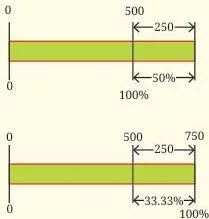
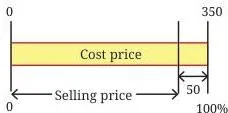
Read it as: if the question asks about the investment, the cost price is 100% and the profit percentage is measured against it; if it asks about the overall revenue, the selling price is the base (NCERT, p. 18).

Read it as a reversible statement: if Ariba has 120% of Arun’s marbles, then Arun has \(\frac{100}{120} \approx 83.3\%\) of Ariba’s — the same fact, viewed from the other side (NCERT, p. 27).
Using This Chapter for Exam Preparation
No one can promise what will appear in the exam, but this chapter is organised so you can revise it efficiently. Four things are worth knowing about how it works.
Where the Figure it Out question sets sit
The chapter’s practice lives in its Figure it Out sets, placed right after the skill they test (NCERT, pp. 3, 12, 19, 22, 24, 28).
- Page 3 — fraction-to-percentage conversions and quick comparisons without calculation.
- Page 12 — percentage of a quantity, drawing bar models, and real-life applications (paint, fodder, training time, halwa).
- Page 19 — profit margin, discount, inflation, and reverse problems that find the original price.
- Page 22 — comparing interest with and without compounding.
- Page 24 — growth and decline problems: population, bacteria, depreciation.
- Page 28 — mixed applications running to page 30: GST, successive changes, offer pricing, rectangle and graph questions.
Practise estimating first, then solving another way
The chapter repeatedly asks you to estimate before calculating (NCERT, p. 9) and to solve each problem by more than one method (NCERT, pp. 2, 10). Both habits build speed: an estimate tells you whether your exact answer is in the right neighbourhood, and a second method verifies it.
Read percentage data from graphs
This skill is practised directly with the computer-literacy graph (NCERT, p. 30). Test yourself with these statements from the question: people in their twenties are the most computer-literate; women lag behind men across age groups; more than a quarter of people in their thirties can use a computer; fewer than 1 in 10 people aged 60 and above can. Which does the graph support?
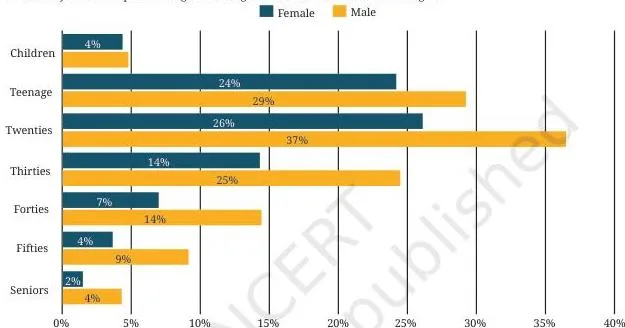
One caution: textbook contents and the examinable syllabus are not always identical. Check the current official CBSE syllabus alongside the NCERT book before you decide what to study.
Revision Summary: What NCERT Concludes
The chapter’s own summary (page 31) boils everything down to these points — restated here in plainer words, with the formulas you must carry into revision.
- Percentages are fractions with denominator 100. \(x\% = \frac{x}{100}\), and the symbol % reads as ‘per cent’ (NCERT, p. 31).
- Fraction, decimal and percentage are interchangeable: \(\frac{4}{10} = 0.4 = 40\%\).
- Find the exact number when a percentage of a total is given: \(y\%\) of \(z = \frac{y}{100} \times z\).
- Ratios become percentages by converting the ratio to a fraction of the whole first.
- Change, profit, loss and tax are all expressed as percentages of a stated base.
- Growth has two formulas. With \(p\) = principal, \(r\) = rate per term, \(t\) = number of terms:
\[ \text{Without compounding: } A = p(1 + rt) \]
\[ \text{With compounding: } A = p(1 + r)^t \]
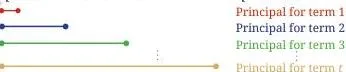
Read the formula strip as: with compounding, the principal is multiplied by \((1 + r)\) once for every term — \(t\) times in all — so the factor becomes \((1 + r)^t\) (NCERT, p. 23).
Finally, the summary pushes one skill above all: describe a situation with a rough diagram, estimate first, and do mental computation where you can (NCERT, p. 31).
Related Resources
This listing is maintained for the 2026-27 academic session using the NCERT textbook information available to us. NCERT remains the authority for confirming the latest edition.
Continue with the rest of the book and the supporting notes on this site.
- NCERT Class 8 Mathematics book (Ganita Prakash Part-II) — every chapter of this volume.
- NCERT Class 8 books hub — all subjects of Class 8.
- Class 8 mathematics notes — revision help for this and the other chapters.
- Class 8 notes hub and the CBSE notes home for the full set.
- Power Play chapter page — related Class 8 mathematics notes.
The official source remains the one to trust: the NCERT textbook portal at ncert.nic.in hosts the authorised PDF of this chapter.
Sources and Data Verification
- The figures, page references and section names on this page describe the NCERT Class 8 Mathematics textbook Ganita Prakash Part-II, Chapter 1, ‘Fractions in Disguise’, official edition published on ncert.nic.in.
- This page covers that one chapter — not the full CBSE Class 8 curriculum or the rest of the book.
- The page is maintained for the current session against the NCERT edition named above.
- NCERT settles textbook editions and official PDFs; CBSE settles the curriculum, syllabus and examinations.
| What the chapter holds | Count | Where it is used |
|---|---|---|
| Printed pages | 32 | |
| Sections in the chapter | 3 | |
| Figures with NCERT captions | 24 | |
| Tables | 7 | |
| In-text questions | 45 | |
| Official NCERT PDF | Download the chapter PDF | the chapter exactly as NCERT publishes it |



Reference: NCERT Class 8 Mathematics textbook, chapter 1, official edition on ncert.nic.in.
Frequently Asked Questions
What is the Fractions in Disguise chapter about in Class 8 maths?
It is the opening chapter of Ganita Prakash Part-II, the NCERT Class 8 Mathematics book. It teaches percentages: what per cent means, converting fractions to percentages, finding a percentage of a quantity, comparing proportions, percentage increase and decrease, profit, loss, discount, tax, and growth with and without compounding (NCERT, pp. 1–31).
How do you convert any fraction into a percentage?
Multiply the fraction by 100 (NCERT, p. 3). For example, \(\frac{7}{16} \times 100 = 43.75\%\). With friendly numbers you can instead rewrite the fraction with denominator 100, as the book does with \(\frac{3}{4} = \frac{75}{100} = 75\%\) (NCERT, p. 2).
What is the difference between p(1 + rt) and p(1 + r)t?
Both give the total amount after t terms; the difference is what happens to the interest. Without compounding, \(A = p(1 + rt)\) — the principal stays fixed, so the interest is identical every term. With compounding, \(A = p(1 + r)^t\) — each term’s interest is added to the principal, so later interest grows (NCERT, p. 23).
Why is 30% off plus 20% off not the same as 50% off?
Because the second discount applies to the already-reduced price. On a ₹200 cake, 30% off gives ₹140, then 20% off gives ₹112, while a single 50% cut gives ₹100 (NCERT, p. 26). In shopping, ‘30% + 20%’ means successive discounts, not addition.
Is profit percentage calculated on the cost price or the selling price?
Both bases are used, for different questions. Use the cost price when asking what you earned on your investment; use the selling price (revenue) when asking what share of sales is profit (NCERT, p. 18). This chapter’s default ‘profit’ is gross profit, so its percentage uses the cost price.
Where can I download the official Fractions in Disguise Class 8 chapter PDF?
From the official NCERT textbook portal at ncert.nic.in. Use the download link at the top of this page — the Fractions in Disguise Class 8 chapter PDF — to open the chapter from the authorised source.
Explore Class 8 Mathematics Books
- Previous: Comparing Quantities
- Next: The Baudhāyana-Pythagoras Theorem
Related chapters:
- A Square and a Cube
- Rational Numbers
- Power Play