
The SAS Similarity Theorem (Theorem 6.5) is one of the similarity criteria in Class 10 Maths chapter 6 (Triangles): NCERT prints the statement on page 90 and proves it on pages 90–91. This page gives the book’s exact statement, its proof figure (Fig 6.28), and a step-by-step proof that answers the two guided prompts the book leaves for you.
The statement of the SAS similarity theorem, exactly as NCERT prints it
Theorem 6.5 appears on printed page 90 of the NCERT Class 10 Mathematics textbook, in chapter 6 (Triangles). This is the sentence to reproduce in the exam, word for word:
Theorem 6.5 (NCERT Class 10 Mathematics, page 90) If one angle of a triangle is equal to one angle of the other triangle and the sides including these angles are proportional, then the two triangles are similar.
New: practise this theorem. Drag the book’s figure and watch the numbers change, try to break the theorem on purpose, then solve fresh questions with hints.
What the SAS similarity criterion means, in plain words
Take two triangles. If one angle of the first triangle equals one angle of the second, and the two sides that form that angle are in the same ratio in both triangles, then the triangles are similar — that is this theorem (NCERT, p. 90).
The load-bearing word is included. Angle A sits between sides AB and AC; angle D sits between sides DE and DF. The two sides you put into the ratio must be the two sides that enclose the equal angle, not any other pair.
Before stating the theorem, the book runs a motivating activity (NCERT, p. 90) with Fig 6.27: two triangles with \(\frac{AB}{DE} = \frac{AC}{DF}\) (each equal to \(\frac{2}{3}\)) and \(\angle A = \angle D\).
Measuring \(\angle B\), \(\angle C\), \(\angle E\) and \(\angle F\) gives \(\angle B = \angle E\) and \(\angle C = \angle F\), so the triangles are similar by the AAA criterion. Theorem 6.5 turns that single observation into a general result.
The figure NCERT uses for the theorem: Fig 6.28
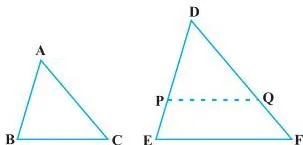
Fig 6.28 (NCERT, p. 90) is the proof figure. It shows triangle ABC and a larger triangle DEF, chosen so that \(\frac{AB}{DE} = \frac{AC}{DF}\) and \(\angle A = \angle D\). The ratio is taken less than 1, which means the sides of ABC are shorter than the matching sides of DEF — so ABC fits inside DEF.
That is why the construction works. A point P is cut on side DE so that DP = AB, and a point Q is cut on side DF so that DQ = AC, then PQ is joined. Triangle DPQ is an exact copy of ABC sitting inside DEF; the rest of the proof shows this copy lines up with DEF.
Given, to prove and construction
- Given: in triangles ABC and DEF, \(\frac{AB}{DE} = \frac{AC}{DF}\) \((\lt 1)\) and \(\angle A = \angle D\).
- To prove: \(\Delta ABC \sim \Delta DEF\).
- Construction: cut \(DP = AB\) on side DE and \(DQ = AC\) on side DF, then join PQ.
This construction is the whole trick of the proof: the cut points place a copy of ABC inside DEF, so the remaining work is just comparing angles.
Proof of Theorem 6.5, step by step
The book’s proof is guided: it states two key facts and asks (How?) why they hold, then asks (Why?) the final similarity follows. Answering those prompts in order gives a complete exam-ready proof.
- Set up the given facts and the construction. We have \(\frac{AB}{DE} = \frac{AC}{DF}\) \((\lt 1)\) and \(\angle A = \angle D\). We cut \(DP = AB\) on DE, \(DQ = AC\) on DF, and join PQ.
- Show \(\Delta ABC \cong \Delta DPQ\). How? — By construction \(DP = AB\) and \(DQ = AC\), and the angles between these pairs are equal because \(\angle A = \angle D\). The SAS congruence rule therefore gives \(\Delta ABC \cong \Delta DPQ\), and congruence gives \(\angle B = \angle P\) and \(\angle C = \angle Q\).
- Show \(PQ \parallel EF\). How? — Since \(DP = AB\) and \(DQ = AC\), the given ratio \(\frac{AB}{DE} = \frac{AC}{DF}\) becomes \(\frac{DP}{DE} = \frac{DQ}{DF}\). Points P and Q divide the two sides of triangle DEF in the same ratio, so by the converse of the basic proportionality theorem, \(PQ \parallel EF\).
- Transfer the angles. Because \(PQ \parallel EF\), corresponding angles are equal: \(\angle P = \angle E\) and \(\angle Q = \angle F\).
- Chain the equalities. From steps 2 and 4, \(\angle B = \angle P = \angle E\) and \(\angle C = \angle Q = \angle F\). Together with the given \(\angle A = \angle D\), all three pairs of corresponding angles match.
- Conclude similarity. Why? — All three pairs of corresponding angles are equal, so the AAA similarity criterion applies and \(\Delta ABC \sim \Delta DEF\).
One detail the book leaves silent: fixing the ratio below 1 makes ABC the smaller triangle, so the cut points P and Q actually lie on the sides of DEF. If the ratio were greater than 1, swap the labels on the two triangles and run the same argument.
Try it yourself: a live practice figure
Where the book uses Theorem 6.5 after the proof
Two examples in the chapter apply the SAS criterion directly, and they show the two exam patterns to recognise. The table also names the contrast examples, so you can see why each criterion is chosen.
| Example | Pages | Criterion used | Pattern |
|---|---|---|---|
| Example 4 | 91 | AAA | Parallel lines give equal angles |
| Example 5 | 91–92 | SSS | All three sides proportional |
| Example 6 | 92 | SAS | Product equality turned into a ratio, plus the included angle |
| Example 7 | 92–93 | AA | Right angles plus a common angle |
| Example 8 | 93–94 | SAS, then SSS | Similarity carried through medians |
Example 6 (NCERT, p. 92) is the direct application. The given product equality \(OA \cdot OB = OC \cdot OD\) is rewritten as the ratio \(\frac{OA}{OC} = \frac{OD}{OB}\), the vertically opposite angles \(\angle AOD = \angle COB\) supply the equal included angle, and the SAS similarity criterion gives \(\Delta AOD \sim \Delta COB\).
Example 8 (NCERT, pp. 93–94) is the second pattern. Starting from \(\Delta ABC \sim \Delta PQR\), with CM and RN the medians, part (i) proves \(\Delta AMC \sim \Delta PNR\) by SAS similarity: the medians halve AB and PQ, so the side ratio survives, and the angle between the halved side and the adjacent side is already equal from the original similarity.
A quick worked check on fresh triangles
Take \(\Delta XYZ\) and \(\Delta UVW\) with \(XY = 4\text{ cm}\), \(XZ = 6\text{ cm}\), \(UV = 6\text{ cm}\), \(UW = 9\text{ cm}\), and \(\angle X = \angle U = 50^\circ\). Then \(\frac{XY}{UV} = \frac{4}{6} = \frac{2}{3}\) and \(\frac{XZ}{UW} = \frac{6}{9} = \frac{2}{3}\).
The equal angle sits between the two sides used in each triangle, so by the SAS similarity criterion \(\Delta XYZ \sim \Delta UVW\) with scale factor \(\frac{2}{3}\), which also gives \(\angle Y = \angle V\) and \(\angle Z = \angle W\).
Exercise 6.3 begins on page 94. Its first question shows pairs of triangles and asks you to state which are similar, name the similarity criterion used, and write the pairs in symbolic form — recognising SAS similarity is part of that task (NCERT, p. 94).
Related criteria: AAA, SSS and the theorems the proof leans on
Theorem 6.5 sits inside a chain of results from the same chapter. The Basic Proportionality Theorem (Thales Theorem) and its converse give the tool that justifies \(PQ \parallel EF\) inside this proof. The AAA similarity criterion is what the page 90 activity uses and what closes the proof. The SSS similarity criterion is the sibling that covers the sides-only route.
The chapter prints no separate converse for Theorem 6.5. The converse direction is immediate from what similar triangles mean — all corresponding angles equal and all sides proportional — a fact the book itself relies on in Example 8.
Choosing between AAA, SSS and SAS similarity
| Criterion | Data you need | Quickest in this situation |
|---|---|---|
| AAA similarity | Two equal angles (the third follows automatically) | Parallel lines, alternate or corresponding angles, or a common angle in the figure |
| SSS similarity | All three sides proportional | The side lengths of both triangles are given |
| SAS similarity | Two sides proportional and the included angle equal | A product equality (like Example 6) or medians halving sides (Example 8) |
Mistakes that cost marks in SAS similarity questions
| Mistake | Correct rule | How to check your answer |
|---|---|---|
| Using an angle that is not included between the two proportional sides. | The equal angle must sit between the two sides you compare — the sides "including these angles" in the statement. | Name the angle and the two sides that form it. If the equal angle touches a side you did not use, the criterion is not SAS. |
| Asserting \(PQ \parallel EF\) with no reason. | The parallelism follows from the converse of the basic proportionality theorem applied inside triangle DEF. | Write \(\frac{DP}{DE} = \frac{DQ}{DF}\) first; only then state \(PQ \parallel EF\). |
| Confusing SAS congruence with SAS similarity. | Congruence is the special case where the common ratio equals exactly 1; similarity accepts any equal ratio. | Ask whether the triangles are the same size. If not, the result is similarity, not congruence. |
| Writing the similarity statement with the wrong vertex order. | \(\Delta ABC \sim \Delta DEF\) pairs A with D, B with E and C with F, and that pairing decides which sides go into the ratio. | Check that the first letters name the equal angles; the side pairs then follow automatically. |
| Pairing the wrong sides in the ratio. | The condition is \(\frac{AB}{DE} = \frac{AC}{DF}\), not \(\frac{AB}{DF} = \frac{AC}{DE}\). | In each triangle, the two ratio sides must be the two sides that form the equal angle. |
| Forgetting to name the criterion. | The full name is the SAS similarity criterion; questions that say "write the similarity criterion used" want this name. | End the answer with one sentence explicitly naming the criterion. |
Questions students ask about the SAS similarity theorem
What is the SAS similarity theorem?
It is Theorem 6.5 of NCERT Class 10 Maths chapter 6 (Triangles): when one angle of a triangle equals one angle of another, and the sides including these angles are proportional, the two triangles are similar. The name SAS (Side-Angle-Side) describes the data used — two sides and the angle between them.
What is the difference between SAS similarity and SAS congruence?
Both need two sides and the included angle. Congruence insists the two sides are exactly equal, so the ratio is 1. Similarity accepts any equal ratio — a triangle enlarged to double size is similar, not congruent. Congruence is similarity with scale factor 1.
Why does the equal angle have to be included between the two proportional sides?
Because the proof places a copy of ABC inside DEF at the equal angle D, and the two sides that meet at D are the ones that carry the ratio. If the equal angle were not included, you would be comparing two sides and a non-included angle — the SSA case — which does not guarantee similarity.
How do you show that PQ is parallel to EF in the proof of Theorem 6.5?
By construction \(DP = AB\) and \(DQ = AC\), so the given ratio \(\frac{AB}{DE} = \frac{AC}{DF}\) becomes \(\frac{DP}{DE} = \frac{DQ}{DF}\). P and Q therefore divide DE and DF in the same ratio, and the converse of the basic proportionality theorem says the line joining them is parallel to the third side, EF.
Which questions in Exercise 6.3 ask you to use the SAS similarity criterion?
Question 1 of Exercise 6.3 (page 94) is the recogniser question: it shows pairs of triangles and asks you to state which are similar, name the criterion used, and write the pairs in symbolic form. SAS similarity is one of the criteria you must recognise there; which pairs use it depends on the measurements in the figure.
Match each pair against the Example 6 pattern — proportional sides plus an equal included angle.
Related resources
This listing is maintained for the 2026-27 academic session using the NCERT textbook information available to us. NCERT remains the authority for confirming the latest edition.
For the full chapter, open the Triangles 6 chapter page. For the wider set of Class 10 material, use the Class 10 Mathematics notes hub, the Class 10 section or the CBSE notes home. The sibling theorems of this chapter are the Basic Proportionality Theorem (Thales Theorem), its converse, the AAA similarity criterion and the SSS similarity criterion.
Other theorem pages on this site include proving root 2 is irrational and the tangent perpendicular to radius theorem.
The statement, figure and proof above follow the official edition of the NCERT Class 10 Mathematics textbook on ncert.nic.in, where Theorem 6.5 appears on printed page 90 of chapter 6 (Triangles) and the proof continues to page 91.
Textbook contents and the examinable syllabus are not always identical — check the current official CBSE syllabus for what is examined this session.
Reference: NCERT Class 10 Mathematics textbook, chapter 6 (Triangles), Theorem 6.5, official edition on ncert.nic.in.
Explore Class 10 Mathematics
Class 10 Mathematics on NCERTTextbooks:
Related chapters: