
If you searched for the AAA similarity criterion, this is the page for it: Theorem 6.3 of NCERT Class 10 Mathematics, chapter 6 (Triangles), printed on page 87 of the book.
The theorem’s exact statement, Fig. 6.24 and the guided proof below are the book’s own. Every (Why?) and (How?) checkpoint in that proof is answered below in the book’s order, so you can reproduce it in an exam. This page is maintained for the current academic session from the official NCERT edition.
The Exact Statement of Theorem 6.3 (AAA Similarity Criterion)
Theorem 6.3 is printed on page 87 (NCERT, p. 87) of the NCERT Class 10 Mathematics textbook, chapter 6 (Triangles). The book calls it the AAA (Angle–Angle–Angle) criterion of similarity. Here is the statement exactly as printed:
Theorem 6.3 (NCERT Class 10 Mathematics, page 87) If in two triangles, corresponding angles are equal, then their corresponding sides are in the same ratio (or proportion) and hence the two triangles are similar.
The proof the book gives for this theorem is guided: it stops at four checkpoints marked (Why?) and (How?) and leaves the reasoning to you. Every checkpoint is answered below. Also note what the statement does not claim — the sides are never said to be equal; only their ratio is fixed.
New: practise this theorem. Drag the book’s figure and watch the numbers change, try to break the theorem on purpose, then solve fresh questions with hints.
What the AAA Criterion Means in Plain Words
The theorem makes three claims, in order:
- Equal angles are given: the three pairs of corresponding angles match — \(\angle A = \angle D\), \(\angle B = \angle E\), \(\angle C = \angle F\).
- The ratios follow: the corresponding sides satisfy \(\frac{AB}{DE} = \frac{BC}{EF} = \frac{CA}{FD}\) — one common ratio for all three pairs.
- The conclusion: the two triangles are similar — same shape, different size.
Why should equal angles force proportional sides? Scaling a triangle — multiplying every side by the same factor — keeps every angle unchanged. The criterion is the reverse: if the three angles match, one triangle is a scaled copy of the other, so each side of the smaller triangle is the same fraction of its matching side in the larger one.
Self-check with fresh numbers. Draw a triangle with sides 2, 3 and 4 units, then a second triangle with the same three angles and sides 4, 6 and 8 units. You have scaled the first by factor 2, so the angles are unchanged and the ratios come out equal:
\[ \frac{2}{4} = \frac{3}{6} = \frac{4}{8} = \frac{1}{2}. \]
This is the AAA similarity criterion working in the easiest possible case.
The Book’s Figure 6.24 and How to Read It
The proof is drawn on Fig. 6.24 (NCERT, p. 87): two triangles of different sizes, ABC and DEF, with matching angle marks at the three corresponding pairs of vertices.
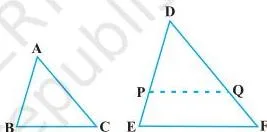
Read the figure from left to right: ABC is the smaller triangle, DEF the larger one. The matching angle marks show which vertices correspond — A with D, B with E, C with F — exactly the equalities \(\angle A = \angle D\), \(\angle B = \angle E\), \(\angle C = \angle F\) that the theorem assumes.
Everything that follows happens inside DEF: a point P is cut on side DE and a point Q on side DF so that \(DP = AB\) and \(DQ = AC\), then \(PQ\) is joined. Triangle DPQ is the bridge that carries ABC’s side lengths into DEF.
Given, To Prove and the Construction
This is the frame the book sets up on page 87; an examiner expects to see it written out before any reasoning.
- Given: triangles ABC and DEF with \(\angle A = \angle D\), \(\angle B = \angle E\) and \(\angle C = \angle F\).
- To prove: \(\frac{AB}{DE} = \frac{BC}{EF} = \frac{CA}{FD}\), hence \(\triangle ABC \sim \triangle DEF\).
- Construction: on DE cut \(DP = AB\); on DF cut \(DQ = AC\); join \(PQ\).
The construction creates a new triangle DPQ inside DEF whose two sides match ABC’s sides AB and AC. The angle between those two sides is \(\angle D\), which equals \(\angle A\) by the given condition. That match is what starts the proof.
Proof of Theorem 6.3 — Every Step Answered
The book’s proof on page 87 asks you to justify four jumps, marked (Why?) and (How?). They are answered below in exactly that order (NCERT, p. 87).
Step 1 — a congruent pair. \(\triangle ABC \cong \triangle DPQ\).
Why? — By the SAS congruence rule. Two sides match: \(DP = AB\) and \(DQ = AC\) by the construction. The included angles match too: the angle between DP and DQ is \(\angle D\), and the angle between AB and AC is \(\angle A\), with \(\angle A = \angle D\) given. Two sides and the included angle agree, so the triangles are congruent.
Step 2 — the parallel line. \(\angle B = \angle P = \angle E\), and so \(PQ \parallel EF\).
How? — Congruent triangles have equal corresponding parts, so \(\angle B = \angle P\). The given condition says \(\angle B = \angle E\). Therefore \(\angle P = \angle E\). Now \(\angle P\) and \(\angle E\) are corresponding angles made by the lines \(PQ\) and \(EF\) with the transversal \(DE\). Equal corresponding angles mean the two lines are parallel, so \(PQ \parallel EF\).
Step 3 — the ratio from the Basic Proportionality Theorem. \(\frac{DP}{PE} = \frac{DQ}{QF}\).
Why? — Because \(PQ \parallel EF\), the line PQ cuts sides DE and DF of triangle DEF at P and Q. The Basic Proportionality Theorem (Theorem 6.1) — applied inside triangle DEF to the parallel line PQ — gives \(\frac{DP}{PE} = \frac{DQ}{QF}\).
Step 4 — the algebra that converts the ratio. \(\frac{AB}{DE} = \frac{AC}{DF}\).
Why? — This is the step students get stuck on, so here is the working. Let the common ratio from Step 3 be \(k\):
\[ \frac{DP}{PE} = \frac{DQ}{QF} = k, \quad\text{so}\quad DP = k \cdot PE \quad\text{and}\quad DQ = k \cdot QF. \]
Since P lies on DE and Q lies on DF, \(DE = DP + PE = (k+1) PE\) and \(DF = DQ + QF = (k+1) QF\). Therefore \[ \frac{DP}{DE} = \frac{k \cdot PE}{(k+1) \cdot PE} = \frac{k}{k+1} \quad\text{and}\quad \frac{DQ}{DF} = \frac{k \cdot QF}{(k+1) \cdot QF} = \frac{k}{k+1}. \]
So \(\frac{DP}{DE} = \frac{DQ}{DF}\). Substituting \(DP = AB\) and \(DQ = AC\) from the construction gives \[ \frac{AB}{DE} = \frac{AC}{DF}. \]
Step 5 — the book’s ‘Similarly’.
Repeating the identical argument from another equal angle pair — say \(\angle B = \angle E\) instead of \(\angle A = \angle D\) — produces \(\frac{AB}{DE} = \frac{BC}{EF}\). Chaining the two results gives all three ratios equal:
\[ \frac{AB}{DE} = \frac{BC}{EF} = \frac{AC}{DF}. \]
Equal corresponding angles are given, and equal corresponding side ratios are now proved — both halves of the definition of similarity hold, so \(\triangle ABC \sim \triangle DEF\).
How this is asked in exams. Board questions usually hand you two triangles and ask you to recognise and apply the criterion by naming the equal angle pairs. Because the book leaves the reasons blank, you may also be asked to fill in the (Why?) / (How?) steps — so practise writing the proof above from memory, construction first.
Try it yourself: a live practice figure
Why Two Equal Angles Are Enough (The Book’s AA Remark)
Checking three pairs of angles is slow, and the book’s remark at the end of page 87 cuts the job to two pairs (NCERT, p. 87). If \(\angle A = \angle D\) and \(\angle B = \angle E\), then the angle sum property — the angles of a triangle add to \(180^\circ\) — forces the third pair:
\[ \angle C = 180^\circ – \angle A – \angle B = 180^\circ – \angle D – \angle E = \angle F. \]
So the book restates Theorem 6.3 at the top of page 88: if two angles of one triangle are respectively equal to two angles of another triangle, the two triangles are similar. That is the AA similarity criterion (NCERT, p. 88).
AA is not a separate theorem — it is Theorem 6.3 in the form you will use in most questions. Once two angle pairs match, the third pair matches for free.
Where the Book Uses Theorem 6.3 Next
Theorem 6.3 carries the rest of the chapter. Three places to notice:
- Page 88 — the AA restatement. The criterion is immediately reissued as the AA similarity criterion, the version used in almost every later example.
- Page 89 — one condition becomes enough. The book remarks that for triangles, equal angles and proportional sides imply each other: with Theorem 6.3 and the SSS similarity criterion (Theorem 6.4) together, you never have to check both conditions (NCERT, p. 89).
- The criteria sequence. AAA is the first of the chapter’s three similarity criteria; it is followed by Theorem 6.4, then the SAS similarity criterion (Theorem 6.5).
The Converse of AAA: What Activity 5 Shows
If equal angles force proportional sides, do proportional sides force equal angles? For triangles, yes — and the book tests the idea in Activity 5 on page 88 before proving it as a theorem (NCERT, p. 88). The book’s activity draws:
- triangle ABC with AB = 3 cm, BC = 6 cm, CA = 8 cm;
- triangle DEF with DE = 4.5 cm, EF = 9 cm, FD = 12 cm.
Each ratio comes out the same:
\[ \frac{AB}{DE} = \frac{3}{4.5} = \frac{2}{3}, \quad \frac{BC}{EF} = \frac{6}{9} = \frac{2}{3}, \quad \frac{CA}{FD} = \frac{8}{12} = \frac{2}{3}. \]
Measuring the angles then gives \(\angle A = \angle D\), \(\angle B = \angle E\), \(\angle C = \angle F\). That observation is what the book next proves as the SSS similarity criterion (Theorem 6.4).
But the converse fails outside triangles. The remark on page 89 warns that for polygons other than triangles, neither equal corresponding angles nor proportional sides alone is sufficient (NCERT, p. 89). Classic example: every rectangle has four right angles, yet a 2-by-3 rectangle and a 1-by-5 rectangle are not similar because the side ratios differ. Equal angles alone would wrongly pair them.
Common Mistakes in the AAA Proof and Its Use
These errors cost marks on exactly this theorem:
| Mistake | Correct rule | How to check your answer |
|---|---|---|
| Writing ‘congruent’ — treating AAA as though it proved equality of sides. | AAA guarantees only the ratio, never equal lengths. Write \(\triangle ABC \sim \triangle DEF\). | Are the two triangles visibly different in size? If yes, the symbol must be \(\sim\), not \(\cong\). |
| Quoting \(\frac{AB}{DE} = \frac{AC}{DF}\) before proving \(PQ \parallel EF\). | The ratio step rests on the Basic Proportionality Theorem, and BPT needs the parallel line first. | Does your written proof state ‘\(PQ \parallel EF\)’ with its reason before the ratio line? |
| Treating AA and AAA as two different theorems. | AA is AAA with the third angle pair forced by the angle sum property — both are Theorem 6.3. | Check the theorem number in your notes; the chapter has only one of these. |
| Applying AAA to quadrilaterals or other polygons. | The criterion is for triangles only; the remark on page 89 says so explicitly. | Is the shape a triangle? If not, equal angles prove nothing. |
| Confusing AAA with its converse. | AAA: equal angles given → sides proportional. SSS (Theorem 6.4): proportional sides given → angles equal. The direction is reversed. | Ask which condition the question hands you — angle pairs or side ratios. |
| Omitting the construction when writing the proof. | The proof opens with the construction — cut \(DP = AB\), cut \(DQ = AC\), join \(PQ\). Nothing follows without it. | Do points P and Q and the segment PQ appear in your proof before the first congruence? |
Questions Students Ask About the AAA Criterion
Why is AAA a similarity criterion but not a congruence rule?
Because equal angles fix the shape but never the size. Two triangles with the same three angles have their sides in one common ratio, but that ratio could be any positive number, so the actual lengths stay unknown. Congruence needs a matching side pair — SAS, ASA, SSS or RHS from Class IX — to force equal lengths; AAA cannot do that.
Are AA and AAA similarity criteria the same?
Yes. Both names refer to Theorem 6.3. Once two pairs of corresponding angles are equal, the angle sum property makes the third pair automatically equal, and the book prints the two-angle version as the AA similarity criterion on page 88.
Is the converse of the AAA similarity criterion true?
Yes, for triangles. The book checks it in Activity 5: triangles with sides 3, 6, 8 cm and 4.5, 9, 12 cm have every ratio equal to two-thirds, and the measured angles come out equal. That result is then proved as Theorem 6.4 (SSS).
Why is PQ parallel to EF in the proof of Theorem 6.3?
Because of equal corresponding angles. Congruence of \(\triangle ABC\) and \(\triangle DPQ\) gives \(\angle B = \angle P\), and the given condition gives \(\angle B = \angle E\), so \(\angle P = \angle E\). These are corresponding angles made by \(PQ\) and \(EF\) with the transversal \(DE\), and equal corresponding angles mean the lines are parallel.
Can the AAA criterion be used for quadrilaterals and other polygons?
No. The book’s remark on page 89 says that for polygons other than triangles, neither equal corresponding angles nor proportional sides alone is sufficient (NCERT, p. 89). The standard counterexample is two rectangles with equal angles but different side ratios.
What is the difference between Theorem 6.3 (AAA) and Theorem 6.4 (SSS)?
The direction is reversed. AAA (Theorem 6.3) takes equal angles as given and proves the sides are proportional. SSS (Theorem 6.4) takes proportional sides as given and proves the angles are equal. On page 89 the book notes that for triangles, one condition implies the other, so only one needs checking.
Related Resources: The Chapter and the Other Similarity Theorems
This listing is maintained for the 2026-27 academic session using the NCERT textbook information available to us. NCERT remains the authority for confirming the latest edition.
Everything around Theorem 6.3 in one place:
- NCERT Class 10 Maths, Chapter 6 — Triangles: the chapter page for this book.
- Class 10 Maths theorems hub: every theorem in the book, chapter by chapter.
- Theorem 6.1 — Basic Proportionality Theorem (Thales’ theorem): the result Step 3 of this proof leans on.
- Theorem 6.2 — converse of the Basic Proportionality Theorem: the theorem just before this one.
- Theorem 6.4 — SSS similarity criterion: the converse of AAA, proved right after.
- Theorem 6.5 — SAS similarity criterion: the last of the three criteria.
- Broader revision: the Class 10 Mathematics notes hub, the Class 10 revision hub and the CBSE notes index.
To see Theorem 6.3 in its original context, open the official NCERT Class 10 Mathematics chapter 6 (Triangles) PDF on ncert.nic.in — the chapter file in which the theorem appears on printed page 87; note that the PDF’s own page numbers differ from the printed ones. The NCERT official site, ncert.nic.in, is the authority for the textbook edition this page quotes.
Sources and the boundary of this page. The statement of Theorem 6.3, Fig. 6.24 and the guided proof are from printed page 87 of the NCERT Class 10 Mathematics textbook; the AA restatement and Activity 5 are from page 88; the remark about polygons is from page 89.
NCERT settles textbook content, editions and official PDFs, while CBSE settles the curriculum and examinations — and textbook contents and the examinable syllabus are not always identical, so check the current official syllabus.
Reference: NCERT Class 10 Mathematics textbook, chapter 6, Theorem 6.3, official edition on ncert.nic.in.
Explore Class 10 Mathematics
Class 10 Mathematics on NCERTTextbooks:
Related chapters: