
The converse of the basic proportionality theorem is Theorem 6.2 in the NCERT Class 10 Mathematics textbook: a line that divides any two sides of a triangle in the same ratio is parallel to the third side.
This page gives you the book’s own statement from printed page 82, the figure that goes with it, and a proof you can reproduce in the exam — with every guided “Why?” step answered. You also get a map of where the chapter uses the theorem next and the mistakes that cost marks.
Theorem 6.2 exactly as the NCERT book states it
This is the sentence the book prints as Theorem 6.2 on page 82 of the current NCERT Class 10 Mathematics textbook (NCERT, p. 82). Learn it word for word — it is the statement you write when a question asks for the theorem.
Theorem 6.2 (NCERT Class 10 Mathematics, page 82) If a line divides any two sides of a triangle in the same ratio, then the line is parallel to the third side.
New: practise this theorem. Drag the book’s figure and watch the numbers change, try to break the theorem on purpose, then solve fresh questions with hints.
Everything else on this page — the figure, the proof and the guided “Why?” steps — follows the book’s treatment of this theorem on the same printed page.
What the converse of BPT means in plain words
Take a triangle \(ABC\). A line runs from a point \(D\) on side \(AB\) to a point \(E\) on side \(AC\). The condition is that the two parts of \(AB\) divided by each other equal the two parts of \(AC\) divided by each other:
\[ \frac{AD}{DB} = \frac{AE}{EC} \]
The conclusion is that the line \(DE\) itself is parallel to the third side \(BC\).
The two ratios must be measured from the same vertex. \(AD\) and \(AE\) both start at \(A\), and \(DB\) and \(EC\) continue on the same two sides — that is why \(AD/DB\) pairs with \(AE/EC\) and never with \(EC/AE\).
This is the reverse direction of Theorem 6.1. BPT says “if the line is parallel, then the ratios are equal”; the converse says “if the ratios are equal, then the line is parallel”.
The NCERT figure for Theorem 6.2 (Fig. 6.12)
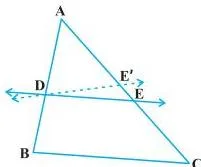
The figure on page 82 shows the triangle \(ABC\), with \(D\) marked on side \(AB\), \(E\) marked on side \(AC\), and the segment \(DE\) joining them. The four segments \(AD\), \(DB\), \(AE\) and \(EC\) are exactly the four lengths that appear in the ratio \(\frac{AD}{DB} = \frac{AE}{EC}\).
The line \(DE’\) parallel to \(BC\) is drawn inside the proof, not as a second figure in the book. The printed figure shows only the triangle, the two cut sides and the segment \(DE\).
Given, to prove and the construction NCERT uses
Given: in \(\triangle ABC\), \(D\) lies on \(AB\) and \(E\) lies on \(AC\) such that \[ \frac{AD}{DB} = \frac{AE}{EC} \]
To prove: \(DE \parallel BC\).
Construction (assumption for the indirect proof): suppose \(DE\) is not parallel to \(BC\). Then draw \(DE’\) parallel to \(BC\), meeting \(AC\) at \(E’\). These are the only points and lines the proof uses — \(D\), \(E\), \(E’\) and the segment \(DE’\).
Why prove it indirectly? The condition gives only a ratio, so there is nothing to extend directly. The book assumes the opposite of what it wants to prove and forces a contradiction.
Proof of Theorem 6.2: the three “Why?” steps answered
The book prints the proof on page 82 with three guided “Why?” questions (NCERT, p. 82). Each is answered in order below, then the contradiction is made explicit.
Step 1: Apply Theorem 6.1 in \(\triangle ABC\) to the line \(DE’\), which is parallel to \(BC\) and cuts \(AB\) at \(D\) and \(AC\) at \(E’\).
\[ \frac{AD}{DB} = \frac{AE’}{E’C} \]
Why?
— because the basic proportionality theorem says a line drawn parallel to one side of a triangle divides the other two sides in the same ratio, and here \(DE’ \parallel BC\).
Step 2: The given condition says \(\frac{AD}{DB} = \frac{AE}{EC}\), and Step 1 says \(\frac{AD}{DB} = \frac{AE’}{E’C}\).
\[ \frac{AE}{EC} = \frac{AE’}{E’C} \]
Why?
— because both ratios equal the same third quantity \(\frac{AD}{DB}\): the given condition makes the first equal to it, and Step 1 makes the second equal to it, so the two are equal to each other.
Step 3: Add 1 to both sides of \(\frac{AE}{EC} = \frac{AE’}{E’C}\).
\[ \frac{AE}{EC} + 1 = \frac{AE’}{E’C} + 1 \]
\[ \frac{AE + EC}{EC} = \frac{AE’ + E’C}{E’C} \]
\[ \frac{AC}{EC} = \frac{AC}{E’C} \]
So \(EC = E’C\).
Since \(E\) and \(E’\) both lie on the same segment \(AC\), equal distances from \(C\) put them at the same point: \(E’ = E\).
Why?
— because a point on a segment is uniquely fixed by its distance from an endpoint: \(EC\) and \(E’C\) are both measured from \(C\) along \(AC\), so equal lengths mean the two points coincide.
Step 4: Since \(E\) and \(E’\) coincide, the line \(DE’\) is the line \(DE\).
But \(DE’\) was drawn parallel to \(BC\), so \(DE\) is parallel to \(BC\).
This contradicts the assumption that \(DE\) was not parallel to \(BC\), so that assumption must be false.
Hence proved. \(DE \parallel BC\), which is exactly the claim of Theorem 6.2. Notice this is an indirect proof — the book assumes the opposite and shows it is impossible.
Try it yourself: a live practice figure
Where the chapter uses Theorem 6.2 next
The theorem is used immediately after it is proved. Page 83 carries Example 3, page 84 carries Exercise 6.2 Question 2, and page 85 carries Questions 5, 6, 8 and 10 (NCERT, pp. 83–85). The table names each place and the strategy it tests — practise the details in your textbook.
| Place | What it asks | How Theorem 6.2 is used |
|---|---|---|
| Example 3 (p. 83) | \(\frac{PS}{SQ} = \frac{PT}{TR}\) and \(\angle PST = \angle PRQ\); prove that \(\triangle PQR\) is isosceles | Theorem 6.2 first gives \(ST \parallel QR\); corresponding angles and the given angle equality then force \(PQ = PR\) |
| Ex. 6.2, Q2 (p. 84) | For three sets of lengths \(PE, EQ, PF, FR\), state whether \(EF \parallel QR\) | A direct converse check: compare the two ratios from vertex \(P\) |
| Ex. 6.2, Q5 (p. 85) | \(DE \parallel OQ\) and \(DF \parallel OR\); show that \(EF \parallel QR\) | Given two pairs of parallel lines; the question closes by invoking Theorem 6.2 |
| Ex. 6.2, Q6 (p. 85) | \(AB \parallel PQ\) and \(AC \parallel PR\); show that \(BC \parallel QR\) | Same shape as Q5; the question ends by invoking Theorem 6.2 |
| Ex. 6.2, Q8 (p. 85) | Line joining the midpoints of two sides of a triangle | Each half is in ratio 1 : 1; Theorem 6.2 makes the joining line parallel to the third side — the midpoint theorem |
| Ex. 6.2, Q10 (p. 85) | Diagonals of a quadrilateral intersect with \(\frac{AO}{BO} = \frac{CO}{DO}\); show that ABCD is a trapezium | Theorem 6.2 is invoked to establish the parallel sides that make ABCD a trapezium |
The theorem’s work continues without a break: the next section, criteria for similarity of triangles, begins on the same printed page 85 (NCERT, p. 85), right after Exercise 6.2.
The converse, and how it sits beside the chapter’s other theorems
Theorem 6.1 and Theorem 6.2 are the two directions of the same idea. The table lays them side by side.
| Theorem 6.1 (BPT) | Theorem 6.2 (converse of BPT) | |
|---|---|---|
| What is given | A line drawn parallel to one side of a triangle | A line that divides two sides in the same ratio |
| What you conclude | The other two sides are divided in the same ratio | The line is parallel to the third side |
| Direction of the argument | Parallel line gives equal ratios | Equal ratios give a parallel line |
| When the question uses it | A parallel line is already given | Equal ratios are given, or must be tested |
A converse is never automatic. The book does not take the reverse direction of Theorem 6.1 for granted — it proves it separately by contradiction, which is why the proof contains the three guided “Why?” steps.
The chapter’s other named theorems follow the same shape of statement, proof and figure. Browse them directly:
- Theorem 6.1: Basic Proportionality Theorem (Thales Theorem)
- Theorem 6.3: AAA similarity criterion
- Theorem 6.4: SSS similarity criterion
- Theorem 6.5: SAS similarity criterion
Common mistakes in proving and applying Theorem 6.2
These are the errors that actually cost marks on this proof and on the ratio-based parallel checks in Exercise 6.2.
- Reversing the implication. If the given is a parallel line, the conclusion is equal ratios — that is Theorem 6.1’s job. If the given is equal ratios, the conclusion is a parallel line — that is Theorem 6.2’s job. Do not quote one where the other is needed.
- Pairing the ratios in the wrong order. \(\frac{AD}{DB}\) must be paired with \(\frac{AE}{EC}\), both measured from vertex \(A\). Pairing it with \(\frac{EC}{AE}\) inverts the second ratio and destroys the equality.
- Skipping the “add 1 to both sides” step. This is the step students most often miss. It turns \(\frac{AE}{EC} = \frac{AE’}{E’C}\) into \(\frac{AC}{EC} = \frac{AC}{E’C}\), which is what produces \(EC = E’C\) and the contradiction that ends the proof.
- Forgetting the uniqueness argument. Equal distances \(EC\) and \(E’C\) only force \(E = E’\) because both points lie on the same segment \(AC\).
- Cross-multiplication slips. Two ratios are equal exactly when the cross products are equal: \(\frac{AD}{DB} = \frac{AE}{EC}\) means \(AD \times EC = AE \times DB\).
- Using the theorem when the line does not cut two sides. Theorem 6.2 needs a point on each of the two sides of the triangle, not a line that touches only one side or meets an extension.
| Mistake | Correct rule | How to check your answer |
|---|---|---|
| Quoting Theorem 6.2 when the given is a parallel line | A given parallel line produces ratios through Theorem 6.1 | Ask what the question gives: a parallel line points to 6.1, equal ratios to 6.2 |
| Writing \(\frac{AD}{DB}\) against \(\frac{EC}{AE}\) | Pair \(\frac{AD}{DB}\) with \(\frac{AE}{EC}\) — both start at vertex \(A\) | Read each ratio from the same vertex and confirm both numerators are the “from A” segments |
| Jumping to \(EC = E’C\) without the intermediate step | Add 1 to both sides to get \(\frac{AC}{EC} = \frac{AC}{E’C}\) first | Write the line \(\frac{AE+EC}{EC} = \frac{AE’+E’C}{E’C}\) before concluding |
| Comparing ratios by eye | Cross-multiply: \(AD \times EC\) must equal \(AE \times DB\) | Two ratios are equal iff their cross products are equal |
Practical check to build confidence: take \(AD = 2\) cm, \(DB = 4\) cm, \(AE = 3\) cm and \(EC = 6\) cm. Then \[ \frac{AD}{DB} = \frac{2}{4} = \frac{1}{2}, \qquad \frac{AE}{EC} = \frac{3}{6} = \frac{1}{2} \]
The two ratios match, so by Theorem 6.2 the line joining the two division points is parallel to \(BC\). This is the same routine Exercise 6.2 Question 2 runs for its three sets of lengths (NCERT, p. 84).
Questions students ask about the converse of the basic proportionality theorem
What is the converse of the basic proportionality theorem?
It is Theorem 6.2: a line that divides any two sides of a triangle in the same ratio is parallel to the third side (NCERT, p. 82). In \(\triangle ABC\), if \(D\) lies on \(AB\), \(E\) lies on \(AC\), and \(\frac{AD}{DB} = \frac{AE}{EC}\), then \(DE \parallel BC\).
How does Theorem 6.2 differ from the basic proportionality theorem (Theorem 6.1)?
Theorem 6.1 starts from a line parallel to one side and concludes the other two sides are divided in the same ratio. Theorem 6.2 starts from equal ratios and concludes the line is parallel to the third side — the reverse direction. Both are proved separately in the book.
Why does the proof of Theorem 6.2 draw the line DE’ parallel to BC?
Because the theorem’s condition is a ratio, not a parallel line, so there is nothing to extend directly. The proof assumes \(DE\) is not parallel to \(BC\), draws the auxiliary line \(DE’ \parallel BC\), and shows \(E’\) must coincide with \(E\). That contradiction proves the assumption false.
When should I use Theorem 6.2 instead of Theorem 6.1 in a question?
Choose by what is given. A line already known to be parallel → Theorem 6.1 gives equal ratios. Ratios given equal, or to be tested → Theorem 6.2 decides whether the joining line is parallel. Example 3 on page 83 uses Theorem 6.2 in exactly this second way.
How do I check whether a line divides two sides of a triangle in the same ratio?
Write both ratios from the same vertex and compare. For \(\triangle ABC\) with \(D\) on \(AB\) and \(E\) on \(AC\), check whether \(\frac{AD}{DB} = \frac{AE}{EC}\) by cross-multiplying: \(AD \times EC\) must equal \(AE \times DB\).
Is the proof of Theorem 6.2 expected in the Class 10 exam?
The book prints the full proof with guided “Why?” steps and does not mark it as outside the examination point of view, so the proof is part of the chapter’s teaching.
For the weight it carries in any given year, check the current official syllabus — textbook contents and the examinable syllabus are not always identical.
Related resources, sources and page references
This listing is maintained for the 2026-27 academic session using the NCERT textbook information available to us. NCERT remains the authority for confirming the latest edition.
Place this theorem in its context: it is part of Chapter 6 (Triangles) of the Class 10 NCERT Maths book. The Class 10 Maths theorems hub gathers every theorem page in the book, from Chapter 1’s root 2 is irrational theorem to the Chapter 10 tangent perpendicular to radius theorem — each follows the same “book statement, figure and proof” shape.
The Class 10 Mathematics notes hub, the Class 10 notes index and the main CBSE notes index show where this theorem page sits among the other study pages.
For the authoritative source, open the official NCERT page for Chapter 6 (Triangles) of the Class 10 Mathematics textbook, which carries Theorem 6.2 exactly as printed on page 82. To confirm the edition and the full chapter list, use the official index of the current Class 10 Mathematics textbook on ncert.nic.in.
The statement, figure and page numbers on this page come from the current NCERT Class 10 Mathematics textbook, chapter 6; Fig. 6.12 and the proof are on printed page 82. Textbook contents and the examinable syllabus are not always identical — check the current official syllabus.
Reference: NCERT Class 10 Mathematics textbook, chapter 6, Theorem 6.2, official edition on ncert.nic.in.
Explore Class 10 Mathematics
Class 10 Mathematics on NCERTTextbooks:
Related chapters: