
Looking for the Basic Proportionality Theorem — the result NCERT Class 10 Mathematics prints as Theorem 6.1 on page 80 of Chapter 6 (Triangles)? This page gives the book’s own statement, its figure Fig. 6.10, and the proof from printed pages 80–81, rewritten step by step with the reason for every move.
Use it to learn the proof, to revise it the night before the exam, or to check exactly what the book expects you to write. Everything follows the current NCERT Class 10 Mathematics textbook, and every page number cited here is the printed book’s page.
The Statement NCERT Prints for Theorem 6.1
NCERT prints this result as Theorem 6.1 on page 80 of the Class 10 Mathematics textbook (NCERT, p. 80), as the first theorem of the chapter’s proof-based section. The book places the statement and its proof together, with the proof running across printed pages 80 and 81.
Theorem 6.1 (NCERT Class 10 Mathematics, page 80) If a line is drawn parallel to one side of a triangle to intersect the other two sides in distinct points, the other two sides are divided in the same ratio.
New: practise this theorem. Drag the book’s figure and watch the numbers change, try to break the theorem on purpose, then solve fresh questions with hints.
The rest of this page explains what the statement means, walks through that proof step by step, and shows where the chapter uses the theorem afterwards.
What the Theorem Means in Plain Words
Look at triangle ABC and a line that crosses through it: D is the point where the line meets side AB, E is the point where it meets side AC, and the line itself runs parallel to BC.
The theorem says those two cuts are in step with each other — the piece of AB that starts at A, compared with the piece of AB left below D, equals the piece of AC that starts at A, compared with the piece of AC left below E.
\[ \frac{AD}{DB} = \frac{AE}{EC} \]
The order rule. Both ratios must read in the same direction, both starting at vertex A. Whatever segment you place on top for side AB decides the segment you place on top for side AC:
- Top for AB: AD — the piece of AB that starts at A.
- Top for AC: AE — the piece of AC that starts at A.
AD goes with AE on top, DB with EC below. Swapping the order on one side only (for example \( \frac{AD}{DB} = \frac{EC}{AE} \)) breaks the correspondence.
The points must be distinct. The statement says the line meets the two sides “in distinct points”. If the parallel line passed through A, it would meet both sides at the same point A — no side would actually be divided into two parts, and the ratios would have no meaning. The distinct-point condition rules exactly that out.
A worked application. Take AB = 9 cm, AC = 12 cm and AD = 3 cm, with \( DE \parallel BC \). Then \( DB = 9 – 3 = 6 \) cm, so \[ \frac{AD}{DB} = \frac{3}{6} = \frac{1}{2} \]
Let AE = x cm. Since the whole of AC is 12 cm, \( EC = 12 – x \), and the theorem gives \[ \frac{x}{12-x} = \frac{1}{2} \Rightarrow 2x = 12 – x \Rightarrow 3x = 12 \Rightarrow x = 4 \]
So AE = 4 cm and EC = 8 cm. Check: \( \frac{4}{8} = \frac{1}{2} \), the same ratio as AD over DB.
Naming note. The printed book calls this result Theorem 6.1. Students and exam papers usually call it the Basic Proportionality Theorem or Thales’ theorem; BPT is the short form used in question papers.
The Figure the Proof Uses (Fig. 6.10)
This is the book’s figure for Theorem 6.1, printed on page 80 (NCERT, p. 80):
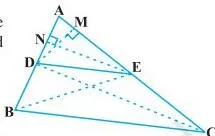
What to look for: triangle ABC with side BC at the base, the point D on AB, the point E on AC, and the segment DE drawn parallel to BC.
The proof will add four more lines to this same figure — the joins BE and CD, and the perpendiculars DM (from D down to AC) and EN (from E down to AB). Those perpendiculars are the whole trick: each one becomes the height of two different triangles, which lets the proof compare areas.
Given, To Prove and the Construction
The book sets up the proof in exactly this order (NCERT, p. 80):
- Given: triangle ABC in which a line parallel to side BC meets the other two sides AB and AC at D and E respectively, so \( DE \parallel BC \).
- To prove: \( \frac{AD}{DB} = \frac{AE}{EC} \).
- Construction: join BE; join CD; draw \( DM \perp AC \) and \( EN \perp AB \).
Why this construction? The joins BE and CD create the triangles whose areas we compare. Each perpendicular then supplies a height for two triangles at once, which is what turns area ratios into side ratios.
Proof of Theorem 6.1 — Step by Step
Notation first: the book writes the area of triangle ADE as ar(ADE), a notation recalled from Class IX (NCERT, p. 80). The plan of the proof is to write each area as \( \frac{1}{2} \times \text{base} \times \text{height} \), divide two pairs of areas, and then use one equal-area fact to finish.
Step 1 — write the areas on side AB.
Take AD as a base.
AD lies on AB, and EN is perpendicular to AB, so EN is the height of triangle ADE above that base:
\[ \text{ar(ADE)} = \frac{1}{2} AD \times EN \]
Now take DB as a base.
DB also lies on AB, and the perpendicular from E to AB is still EN — the same height:
\[ \text{ar(BDE)} = \frac{1}{2} DB \times EN \]
Step 2 — write the areas on side AC.
Here DM is the height, because DM is perpendicular to AC:
\[ \text{ar(ADE)} = \frac{1}{2} AE \times DM \quad \text{and} \quad \text{ar(DEC)} = \frac{1}{2} EC \times DM \]
Step 3 — divide the areas.
\[ \frac{\text{ar(ADE)}}{\text{ar(BDE)}} = \frac{\frac{1}{2} AD \times EN}{\frac{1}{2} DB \times EN} = \frac{AD}{DB} \quad (1) \]
\[ \frac{\text{ar(ADE)}}{\text{ar(DEC)}} = \frac{\frac{1}{2} AE \times DM}{\frac{1}{2} EC \times DM} = \frac{AE}{EC} \quad (2) \]
In each ratio the factor \( \frac{1}{2} \) and the common height cancel, leaving only the side segments.
This is the reason for the construction: EN is the shared height of triangles ADE and BDE because both bases lie on AB, and DM is the shared height of triangles ADE and DEC because both bases lie on AC.
Step 4 — the equal-area bridge.
Triangle BDE and triangle DEC sit on the same base DE, and their third vertices B and C lie on the line BC, which is parallel to DE.
Two triangles on the same base and between the same parallels have equal areas, so \[ \text{ar(BDE)} = \text{ar(DEC)} \quad (3) \]
Step 5 — combine (1), (2) and (3).
The denominators on the left of (1) and (2) are equal by (3), so the two left-hand fractions are equal, and therefore \[ \frac{AD}{DB} = \frac{AE}{EC} \]
Hence proved.
Step 4 is the heart of the proof: without it, the two area ratios cannot be joined. The book spells out the same reason — same base DE, between the same parallels BC and DE (NCERT, p. 80).
Try it yourself: a live practice figure
Where the Book Uses Theorem 6.1 Next
After page 80 the chapter leans on the theorem immediately, in examples and exercises alike:
- Example 1 (NCERT, p. 82): starts from \( \frac{AD}{DB} = \frac{AE}{EC} \) and proves the whole-side form \( \frac{AD}{AB} = \frac{AE}{AC} \). The bridge is the add-1 step: invert the ratio, add 1 to both sides, and the whole sides AB and AC appear. This is why the two forms are connected but not identical.
- Example 2 (NCERT, p. 83): a trapezium ABCD with AB ∥ DC and EF ∥ AB. Joining diagonal AC creates two triangles, and Theorem 6.1 is applied once in triangle ADC and once in triangle CAB to show \( \frac{AE}{ED} = \frac{BF}{FC} \).
- Example 3 (NCERT, p. 83): uses the converse, Theorem 6.2, instead — from \( \frac{PS}{SQ} = \frac{PT}{TR} \) it concludes ST ∥ QR.
- Exercise 6.2, questions 5–10 (NCERT, p. 85): all six questions apply BPT or its converse. Question 7 begins “Using Theorem 6.1, prove that a line drawn through the mid-point of one side of a triangle parallel to another side bisects the third side”, and question 8 begins “Using Theorem 6.2, prove that the line joining the mid-points of any two sides of a triangle is parallel to the third side” — the theorem named is the whole method.
- Section 6.4 (NCERT, p. 85): Criteria for Similarity of Triangles starts right after; the same ratio idea carries into the similarity criteria.
These are named here so you can see how far the theorem reaches — solving them belongs to the exercises, not to this page.
The Converse (Theorem 6.2) and Related Theorems
Page 81 asks whether the converse of Theorem 6.1 also holds, and Activity 3 tests it: draw an angle XAY, mark equal steps along both rays, join the matching points, and the joining lines come out parallel every time (NCERT, p. 81). That observation becomes Theorem 6.2.
Theorem 6.2 reverses the direction of Theorem 6.1: where Theorem 6.1 assumes a parallel line and concludes a ratio, Theorem 6.2 assumes the same ratio and concludes the line is parallel to the third side. Its proof is written on page 82 and works by contradiction, leaving three “Why?” checkpoints that are all answered on the converse of the Basic Proportionality Theorem page.
The three criteria that follow build the rest of the chapter’s theory; each has its own page: Theorem 6.3 (AAA similarity), Theorem 6.4 (SSS similarity) and Theorem 6.5 (SAS similarity).
Common Mistakes in Proving and Applying Theorem 6.1
| Mistake | Correct rule | How to check your answer |
|---|---|---|
| Writing the ratio in the wrong order, e.g. \( \frac{AD}{DB} = \frac{EC}{AE} \). | Both ratios read from the same vertex A — the segment placed on top for AB decides the segment placed on top for AC. | The top segments AD and AE must both start at A; the bottom segments DB and EC must both be the remaining parts. |
| Applying BPT when no line is known to be parallel. | The theorem needs \( DE \parallel BC \) (or the equivalent) to be given or already proved. | Look for “parallel” in the given; if there is none, BPT cannot start. |
| Treating \( \frac{AD}{DB} = \frac{AE}{EC} \) and \( \frac{AD}{AB} = \frac{AE}{AC} \) as the same expression. | They are equivalent but not identical — the add-1 step of Example 1 (invert, add 1 to both sides) converts one into the other. | Use the first form when the divided parts are given; use the second when whole sides AB and AC are involved. |
| Forgetting that D and E must be distinct points. | A line through A meets both sides only at A, so no side is divided at all. | Each of D and E should lie strictly between the vertex and the far end of its side. |
| Applying BPT in the wrong triangle. | Pick the triangle whose two sides the parallel segment actually cuts — Example 2 applies the theorem once in triangle ADC and once in triangle CAB. | Name the two sides the parallel line meets; those two sides carry the ratio. |
| In the proof, not being able to justify \( \text{ar(BDE)} = \text{ar(DEC)} \). | The two triangles share base DE and lie between the same parallels DE and BC, so their areas are equal. | Write that sentence; it is the book’s own justification on page 80. |
Questions Students Search About BPT
What is the BPT theorem?
The Basic Proportionality Theorem (BPT) says that if a line is drawn parallel to one side of a triangle so that it meets the other two sides at distinct points, those two sides are divided in the same ratio. NCERT prints it as Theorem 6.1 on page 80 of Class 10 Mathematics.
How do I prove the basic proportionality theorem in the exam?
Follow the book’s construction: join BE and CD, then draw \( DM \perp AC \) and \( EN \perp AB \).
Write each area as \( \frac{1}{2} \times \text{base} \times \text{height} \), divide the pairs to get \( \frac{AD}{DB} \) and \( \frac{AE}{EC} \), and finish with ar(BDE) = ar(DEC), since both triangles sit on the same base DE between the same parallels BC and DE.
Is the basic proportionality theorem the same as Thales’ theorem?
Yes — the Basic Proportionality Theorem and Thales’ theorem are two names for the same result. NCERT prints it as Theorem 6.1, and BPT is just the short form used in question papers.
What is the converse of the basic proportionality theorem?
The converse is Theorem 6.2 on page 82. It goes the other way: Theorem 6.1 assumes a parallel line and concludes a ratio, while Theorem 6.2 assumes the same ratio and concludes the line is parallel to the third side. Its proof, with the three “Why?” checkpoints answered, is on the converse’s own page.
When do I write AD/DB = AE/EC and when AD/AB = AE/AC?
\( \frac{AD}{DB} = \frac{AE}{EC} \) is the form Theorem 6.1 proves directly, built from the divided parts. \( \frac{AD}{AB} = \frac{AE}{AC} \) is the whole-side form: invert the first ratio, add 1 to both sides, and the whole sides appear — exactly the add-1 step in Example 1 on page 82. Use whichever form the given segments match.
Which NCERT questions in Chapter 6 use Theorem 6.1?
Example 1 (p. 82) and Example 2 (p. 83) apply Theorem 6.1, and Example 3 uses its converse. In Exercise 6.2 (p. 85), questions 5 to 10 are BPT and converse applications — question 7 says “Using Theorem 6.1” and question 8 says “Using Theorem 6.2”.
Related Resources and Source
This listing is maintained for the 2026-27 academic session using the NCERT textbook information available to us. NCERT remains the authority for confirming the latest edition.
- Chapter 6 (Triangles) — the full chapter page with all its sections.
- Converse of the Basic Proportionality Theorem (Theorem 6.2) — statement, proof and the three “Why?” checkpoints answered.
- Theorem 6.3 (AAA), Theorem 6.4 (SSS) and Theorem 6.5 (SAS) — the similarity criteria pages.
- Theorems hub for Class 10 Mathematics — every theorem in the book, one page each.
- Class 10 Mathematics notes, Class 10 notes and the full notes library — chapter-wise study pages.
- Related theorem pages on this site: why \( \sqrt{2} \) is irrational and the tangent perpendicular to the radius theorem.
To verify the statement and proof against the official source, open the NCERT PDF of Class 10 Mathematics Chapter 6 (Triangles) at ncert.nic.in — Theorem 6.1 appears there on printed pages 80 and 81 of the chapter file.
Reference: NCERT Class 10 Mathematics textbook, Chapter 6, Theorem 6.1, official edition on ncert.nic.in.
All page numbers cited on this page are the printed book’s pages, not PDF page numbers. Textbook contents and the examinable syllabus are not always identical — check the official CBSE syllabus for what is examinable in the current academic session.
Explore Class 10 Mathematics
Class 10 Mathematics on NCERTTextbooks:
Related chapters: