
Here is the official NCERT Celebrating Festivals Class 3 chapter — Chapter 3 of the Our Wondrous World (EVS) textbook — as a full PDF from ncert.nic.in. It is an 11-page, picture-led chapter that runs from page 33 to page 44.
The chapter follows Rishi’s bus journey to a Himalayan village and the spring festivals his family talks about. The official file is below; after it, this page explains what the chapter contains, the activity answers and the fill-in-the-blank solutions.
Download the official NCERT PDF
The official file for this chapter is the NCERT Class 3 Our Wondrous World Chapter 3 Celebrating Festivals PDF from ncert.nic.in — a printable 11-page chapter that matches the printed book exactly, including every picture, table and activity.
Chapter 3 Celebrating Festivals: at a glance
The table below lists what this chapter holds; the notes after it explain what those numbers mean in the classroom.
| What the chapter holds | Count |
|---|---|
| Pages in the chapter PDF | 11 |
| Textbook pages | 33–44 |
| Activities | 3 |
| Tables in the chapter | 3 |
| Discussion question sets | 2 |
| Illustrations (no printed captions) | 20 |
| Fill-in-the-blank sentences | 5 |
The chapter is short and activity-heavy: much of the learning happens in its three activities and two group discussions rather than in long reading. This is the current NCERT Class 3 EVS textbook (Our Wondrous World), official edition; the counts above describe the NCERT chapter, not the CBSE syllabus.
What this chapter covers
This section walks through the chapter in the order a child meets it, so you can follow on your own copy. Each item names the part and the textbook page.
- “Festival of Flowers” (pp. 33–34): Rishi, from Jammu, travels by bus with his parents to visit Mama and Mami in a small Himalayan village; the roads have hairpin turns and the hills are covered with flowers.
- Discuss (p. 35): four conversation starters — bus travel experiences, trees and flowers seen, safety while travelling, and safety on a bicycle or on foot.
- Activity 1 and Draw (p. 36): match six road signboards with their meanings, then draw three more signs you have seen.
- The garden and the lunch (pp. 37–38): rose, marigold and hibiscus in Mama’s garden, Nonikaa naming the tulip, and a Kashmiri meal of haakh with hot rice.
- Spring celebrations (pp. 38–39): the Kashmir tulip festival, Rishi’s mustard-and-buransh doorstep festival, and Chiya’s account of Vishu in Kerala.
- Sing and Enjoy! and Write (p. 40): a spring poem, and a seasons table to complete by asking elders about festivals and special food.
- Activity 3 (p. 41): match festival foods with the festivals they belong to.
- A. Discuss, B. Write, Fill in the blanks, C. Draw (pp. 42–43): group questions on transport and safety, writing about relatives, a five-sentence fill-in exercise and drawing school signboards.
- Do you know? (p. 43): a note on the Himalayas and Mount Everest, about 8,848 metres high.
- Sarhul: A Spring Festival (p. 44): the closing reading on Jharkhand’s spring festival.
Big ideas in Celebrating Festivals Class 3
This section pulls together what the chapter wants a Class 3 child to carry away. The table maps the spring festivals by region; the points after it add the other big ideas.
| Region | Spring festival | What the chapter tells us |
|---|---|---|
| Kashmir | Tulip festival | Nonikaa mentions it at lunch; it happens at this time of year (NCERT, p. 38) |
| Jammu — Rishi’s home | Spring festival of mustard and buransh flowers | flowers are placed at each home’s doorstep; elders give blessings, toffees and sweets (NCERT, p. 38) |
| Kerala | Vishu | Vishu Kani is made with yellow amaltas flowers, fruits and vegetables (NCERT, p. 39) |
| Jharkhand | Sarhul | a procession to the sakhua tree with offerings to Earth and Sun (NCERT, p. 44) |
Spring is a celebration of nature. Mami says this directly (NCERT, p. 39): after harsh winters, the sun shines, flowers bloom, grass grows and new leaves appear. Every festival in the chapter is spring’s welcome in a different region.
Festivals come with special food and dress. The Write task on page 40 asks about festival food and dress, and Activity 3 matches seven foods to seven festivals (NCERT, p. 41).
Travel means noticing — and staying safe. Rishi watches roads, trees and flowers from the bus, and the Discuss questions on page 35 turn that looking into safety talk.
Visiting relatives makes warm memories. The story is a family visit from start to finish, and the B. Write task on page 42 asks the child to name relatives they have visited.
Activity 3 answers: which food goes with which festival
Activity 3 on page 41 asks children to match each festival food with the festival it belongs to. The book prints the first match as an example: Thekua belongs to Chhath Puja.
| Food | Festival it matches | What the food is |
|---|---|---|
| Thekua | Chhath Puja — printed as the example | a wheat-and-jaggery snack made for Chhath |
| Pitha | Bihu | a rice cake |
| Plum Cake | Christmas | a Christmas fruit cake |
| Gujiya | Holi | a sweet dumpling |
| Sadya | Onam | the Kerala feast |
| Holige | Ugadi | a sweet flatbread |
| Seviyan | Eid-ul-Fitr | thin sweet vermicelli |
The book prints only the first match as an example; the other six rows are the conventional answers this activity expects.
Road signboards in Activity 1: what each sign says
Road signs are picture messages that tell travellers what to do before they reach the danger point. The chapter puts them in the middle of Rishi’s journey, and Activity 1 on page 36 asks children to match each sign picture with its meaning.
| Sign (Column B meaning) | What it tells a traveller |
|---|---|
| No Parking | Do not stop or leave a vehicle here |
| No Horn Please | Do not sound the horn |
| Speed Breaker | Slow down — a hump across the road lies ahead |
| No U-Turn | You may not turn the vehicle around here |
| Men at Work | Workers are on the road — go slowly and carefully |
| School Ahead | Slow down — a school is coming up |
The six meanings are printed on page 36; the sign pictures themselves are only in the book’s copy. The Discuss questions on page 35 ask how to stay safe while travelling, riding a bicycle and walking — the book leaves the answers to class discussion.
- Bus journey: stay seated while the bus moves, keep hands inside, and get on or off only when the bus has stopped.
- Bicycle ride: wear a helmet, ride on the correct side, slow down at turns and obey signs such as No U-Turn and Speed Breaker.
- Walking: use the footpath, cross at a safe place and look both ways before crossing.
The chapter also asks for drawings: three road signs the child has seen (p. 36), and school-area signs such as library, toilet and drinking water point (p. 43). The sign designs are not printed in the text, so children copy the shapes from the pictures in the book.
Pictures to look for in your copy of the chapter

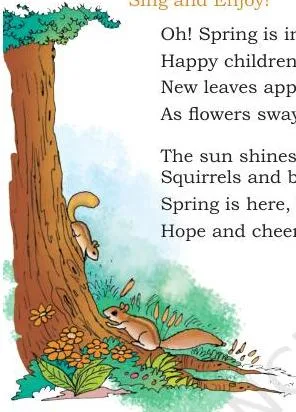
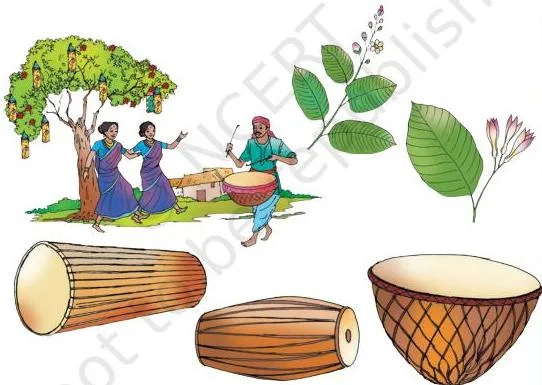
This chapter’s illustrations sit inside the story, so the words around them tell you what to look at. The pointers below help a child find the meaning carried by each picture.
- Page 36: the signboard pictures beside the Column A list — the six signs Activity 1 asks you to match.
- Page 37: the row of colourful flowers in Mama’s garden; rose, marigold and hibiscus are the ones Rishi can name.
- Page 38: Nonikaa pointing out the tulip, and mustard and buransh flowers placed at doorsteps for Rishi’s spring festival.
- Page 39: the Vishu Kani arrangement of yellow amaltas flowers, fruits and vegetables.
- Page 44: the Sarhul procession walking to the sakhua tree, with drums.
The text never names these pictures separately — the story words act as their captions. Use the pointer on the page, read the sentence it belongs to, and the picture makes sense.
Festival words in this chapter, explained
These are the chapter’s special words, with the page where each appears. Most come from the story; two come from the closing Sarhul reading.
| Term | What the chapter tells us | Page |
|---|---|---|
| tulip | the garden flower Nonikaa names for Rishi | 38 |
| haakh | a Kashmiri leafy vegetable eaten with hot rice | 38 |
| buransh | the red spring flowers (Rhododendron) at Rishi’s place | 38 |
| amaltas | the yellow flowers used to make Vishu Kani | 39 |
| Vishu and Vishu Kani | Kerala’s spring festival; Vishu Kani is the auspicious ritual on the first day of the Malayali new year, when sighting auspicious items at sunrise is said to bring a fruitful year | 39 |
| sakhua tree | the tree the Sarhul procession walks to, carrying germinated grains and sakhua flowers | 44 |
| Sarhul | Jharkhand’s spring festival, with offerings to Earth and Sun and singing and dancing to dhol and nagada | 44 |
| Himalayas | “home of snow”; Mount Everest, about 8,848 metres, lies in Nepal | 43 |
Fill in the blanks: answers and what the sentences teach
The chapter closes with a five-sentence fill-in exercise (pp. 42–43) that retests the story. Use it as a self-check: read each sentence, find the missing word in the story, then compare with the answers below.
- “Chiya and Nonikaa live in a small village near the mountains.” The story’s first page says the cousins live in a small village near the mountains (p. 33).
- “The bus went along the hairpin roads where the hills were covered with colourful flowers.” Rishi notes that the roads have hairpin turns (p. 33).
- “Rishi and his family walked to his Mama’s house through a narrow mud road.” The broad concrete road later becomes a narrow mud road (p. 37).
- “The red flowers that bloom in spring are called buransh.” Rishi shares this name at lunch (p. 38).
- “Haakh is a kind of leafy vegetable eaten with hot rice.” Mami serves haakh with hot rice (p. 38).
What students mix up in this chapter
Four mix-ups come up again and again with this chapter. Each row names the mistake, the correction and a way to check it.
| Mix-up | What is right | How to check your answer |
|---|---|---|
| Food–festival pairs swapped, e.g. Gujiya put with Eid-ul-Fitr | Gujiya belongs to Holi, Seviyan to Eid-ul-Fitr, Plum Cake to Christmas, Sadya to Onam, Pitha to Bihu, Holige to Ugadi (p. 41) | Say the food’s name with its festival until the pair sounds natural; recheck the table on page 41 |
| Tulip and buransh swapped | the tulip is the Kashmir garden flower Nonikaa names; buransh is the red spring flower at Rishi’s place (pp. 37–38) | ask who names which flower in the story |
| No Horn Please read as No Parking | the horn sign tells drivers to be quiet; No Parking tells them not to stop and leave the vehicle (p. 36) | look at the two meanings: one is about sound, the other about stopping |
| Thinking one festival belongs everywhere | spring festivals differ by region — the Kashmir tulip festival, Rishi’s mustard-and-buransh festival, Vishu in Kerala, Sarhul in Jharkhand (pp. 38–39, 44) | ask “which region celebrates this festival?” for every festival you name |
How this chapter is used in school
This is a Class 3 EVS chapter, so teachers check it through conversation and small tasks rather than marks-heavy tests. The parts usually checked are listed below.
- matching the six road signboards with their meanings (Activity 1, p. 36)
- answering the Discuss questions on travel and safety (pp. 35 and 42)
- completing the seasons table by asking elders (Write, p. 40)
- matching festival foods (Activity 3, p. 41)
- filling the five blanks and retelling how Rishi’s family celebrated spring (pp. 42–43)
Practical tips: do the seasons table at home with your family before the class discussion, practise naming the six road signs aloud, and keep the five fill-in-the-blank answers handy. Textbook contents and the examinable syllabus are not always identical — check the current official syllabus.
The chapter in one page: quick recall
The chapter has no printed summary box, so this is a recall sheet built from the story itself. Running through it aloud the night before school takes under a minute.
- Who: Rishi, his parents, Mama, Mami, Mamaji and cousins Chiya and Nonikaa.
- Where: from Jammu to a small village in the Himalayas.
- How: by bus along hairpin roads, then on foot along a narrow mud road.
- What he saw: tulips, rose, marigold and hibiscus in the garden; mustard and buransh flowers at doorsteps; yellow amaltas for Vishu Kani.
- What he ate: haakh, a leafy vegetable, with hot rice.
- Festivals named: the Kashmir tulip festival, Rishi’s mustard-and-buransh spring festival, Vishu in Kerala, Sarhul in Jharkhand.
- Activities asked: match signboards, fill the seasons table, match festival foods, fill the blanks and draw signs.
Related NCERT Class 3 resources
This listing is maintained for the 2026-27 academic session using the NCERT textbook information available to us. NCERT remains the authority for confirming the latest edition.
Continue with the chapter before or after this one, or browse the full Class 3 set. The links below are the related NCERT Class 3 pages on this site.
- Going to the Mela — the previous chapter’s page.
- Life Around Us — the next chapter’s page.
- Class 3 Environmental Studies (EVS) chapters — the book’s own page.
- NCERT Class 3 hub — all Class 3 subjects.
- CBSE notes home — every class and subject.
Sources and data verification
The descriptions on this page come from the official NCERT Class 3 Our Wondrous World textbook, English edition, Chapter 3, Celebrating Festivals. This page covers that one chapter only, not other Class 3 books or subjects, and it is maintained for the current academic session using the NCERT edition listed above.
NCERT settles textbook editions and PDFs; CBSE settles curriculum, syllabus and examinations.
| What the chapter holds | Count | Where it is used |
|---|---|---|
| Printed pages | 11 | |
| Figures with NCERT captions | 3 | |
| Tables | 3 | |
| Activities | 3 | |
| Official NCERT PDF | Download the chapter PDF | the chapter exactly as NCERT publishes it |
Reference: NCERT Class 3 Our Wondrous World textbook, chapter 3, official edition on ncert.nic.in.
Questions students ask about this chapter
Why are different festivals celebrated in spring across India in this chapter?
The chapter’s point is that the same season is enjoyed in different ways in different parts of India. In Kashmir, Nonikaa mentions the tulip festival; in Kerala, Chiya’s friend Unni celebrates Vishu; and in Jharkhand, Sarhul is celebrated around the sakhua tree (NCERT, pp. 38–39, 44).
What is the Sarhul festival celebrated in Jharkhand?
Sarhul is Jharkhand’s spring festival (NCERT, p. 44). People wear their traditional clothes and walk in a procession to the sakhua tree, carrying freshly germinated grains and sakhua flowers. Offerings are made to the Earth and the Sun, and people celebrate by singing and dancing to drums such as the dhol and nagada.
Which food is matched with which festival in Activity 3 of Celebrating Festivals?
Thekua–Chhath Puja is the printed example; the expected answers are Pitha–Bihu, Plum Cake–Christmas, Gujiya–Holi, Sadya–Onam, Holige–Ugadi and Seviyan–Eid-ul-Fitr (NCERT, p. 41). Only the first pair is printed in the book — the rest are the conventional matches this activity expects.
What are the fill in the blanks answers in the Celebrating Festivals chapter?
Mountains, hairpin, mud, buransh and haakh (NCERT, pp. 42–43). Each answer comes straight from the story: the village is near the mountains, the roads have hairpin turns, the walk to Mama’s house is on a narrow mud road, buransh is the red spring flower, and haakh is the leafy vegetable eaten with hot rice.
Which road signs do students match in Activity 1 of this chapter?
Six signs, matched to their meanings on page 36: No Parking, No Horn Please, Speed Breaker, No U-Turn, Men at Work and School Ahead. Activity 1 asks children to match each sign picture in Column A with the correct meaning in Column B (NCERT, p. 36).
Explore Class 3 Environmental Studies Books
- Previous: Going to the Mela
- Next: Life Around Us
Related chapters:
- Our Families and Communities
- Plants and Animals Live Together
- Living in Harmony