
This is the Going to the Mela Class 3 chapter — Chapter 2 of the NCERT Class 3 Environmental Studies textbook Our Wondrous World, a 15-page story chapter about two families who travel to a mela. The official NCERT PDF of the chapter is right below. The rest of this page explains what is inside the chapter and how its activity blocks work.
Download the Going to the Mela Class 3 chapter PDF
Open the Going to the Mela Class 3 chapter PDF from the official NCERT portal when you want the chapter in its printed form — the full story, the pictures and every activity block exactly as they appear in the book. NCERT publishes the Class 3 Our Wondrous World textbook PDFs on this portal, so this link is the chapter’s official source.
Chapter 2 at a glance
The chapter teaches through a story rather than through formal lessons, and the table below shows how much of it there is — the blocks inside the story and the activities that close it.
One thing to know before opening the file: the chapter has no numbered exercise set. Its work comes through Discuss, Write, Find out, Draw, match-the-pictures and role play blocks printed inside the story, and in the closing activities A to D on pages 32–33.
What Going to the Mela covers
The blocks below follow the chapter in order, with the printed page where each one appears. This is a handy map for finding a single activity quickly.
| Chapter block | Printed page | What happens in it |
|---|---|---|
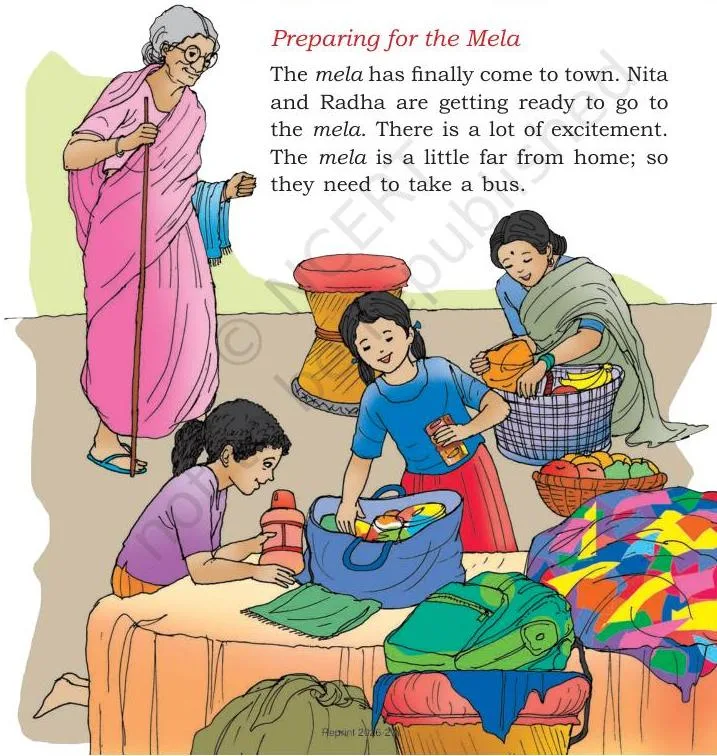
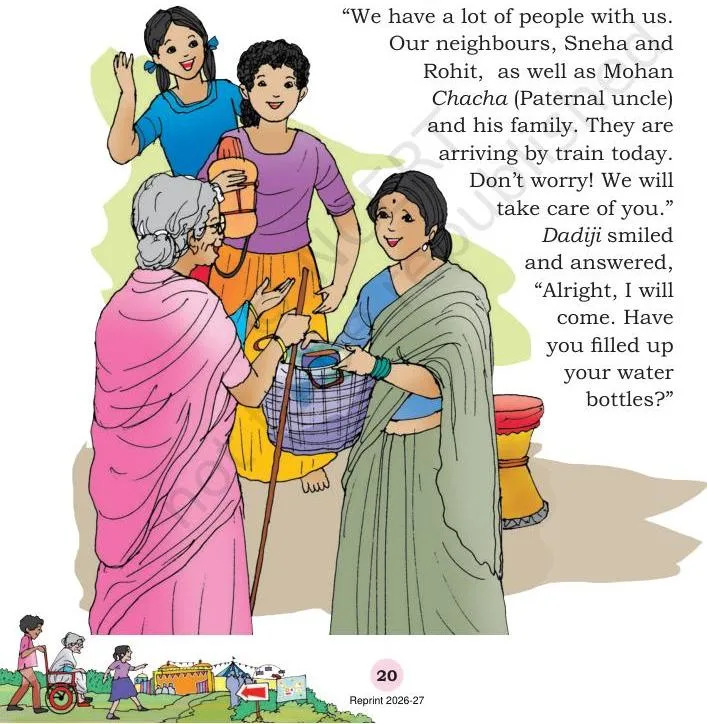
| Preparing for the Mela | pp. 18–20 | The children get ready; Dadiji agrees to join; neighbours and Mohan Chacha’s family are part of the plan; water bottles and a special bag are packed. |
| Discuss | p. 21 | Children talk about how they prepare themselves for a trip. |
| On the Way to the Mela | pp. 22–23 | The bus journey: walking carefully, helping Dadiji board, the reserved seat, the tickets and the safety rules. |
| Discuss and Write | p. 24 | Children talk about local transport and write about a trip they have taken. |
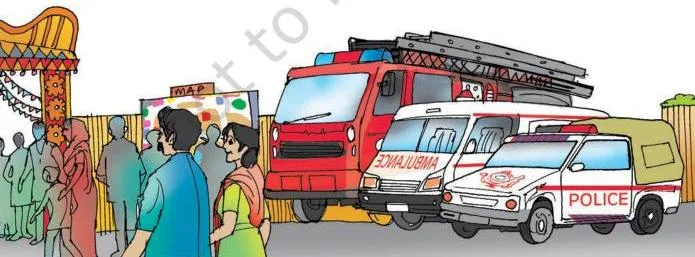
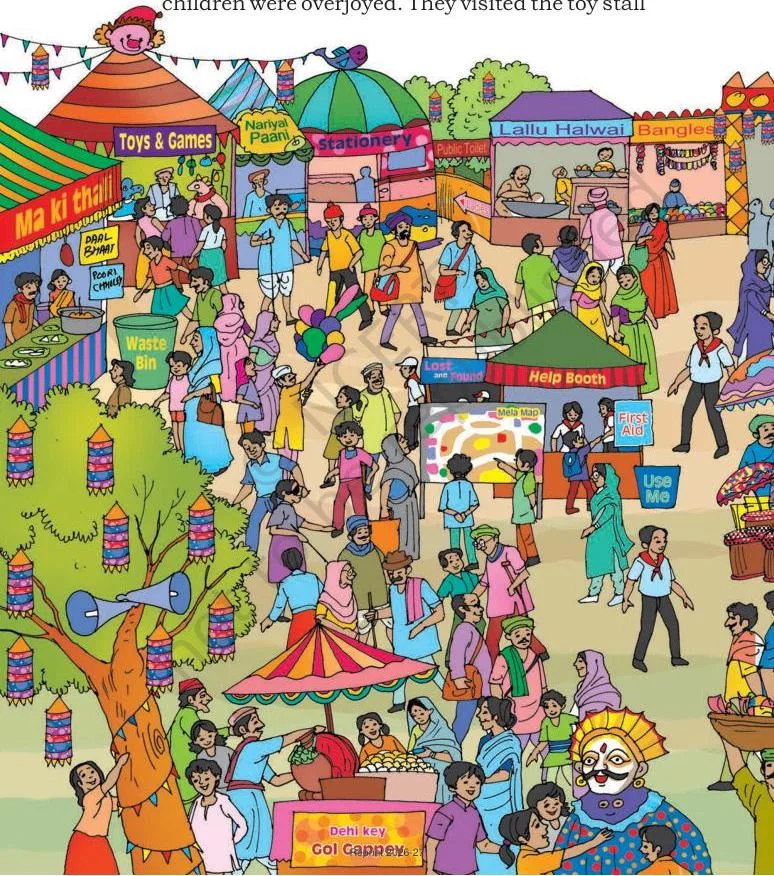
| At the Mela | pp. 25–28 | The parade ground: map, ambulance, police jeep, fire engine, Lost and Found booth, wheelchair, stalls, rides and the magic show. |
| Do you know? | p. 28 | The Kumbh Mela — the world’s biggest gathering. |
| Write | pp. 28–29 | Questions on the Lost and Found booth, the police dog, and the child’s own mela memories. |
| Sharing Experience and Find out | p. 29 | Imagine yourself in the story; ask elders about melas; find out why fire engines and ambulances are present. |
| Reading a Sketch | p. 30 | Four questions: find the two houses, decide which is closer to the parade ground, trace a route. |
| Draw | p. 31 | Sketch the route from home to school. |
| Activities A to D | pp. 32–33 | Discuss, match pictures with mela helpers, draw vehicles, and organise a mock mela. |
Most of these blocks ask children to talk or write about their own lives, so the chapter works best when a child has a trip or a mela to draw on. The story itself stays simple — the ideas below are what it is really teaching.
Key ideas: preparation, travel and the mela
The story carries five ideas that a Class 3 child is meant to take away. Each one is explained below in plain language, with the pages where it appears in the book.
Planning a trip together (NCERT, pp. 18–20)
The first lesson is that going anywhere needs a little planning, and planning works best when everyone helps.
- Before leaving: water bottles are filled and a special bag is packed, so nobody is thirsty or without the things they need.
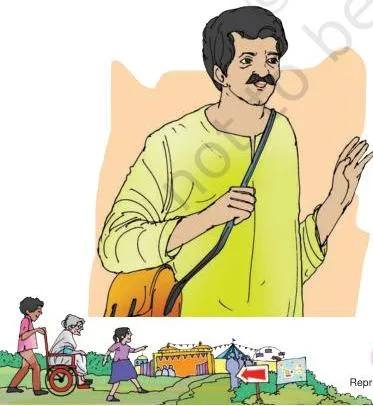
- Who is coming: neighbours Sneha and Rohit join the family, and Mohan Chacha’s family arrives by train and meets everyone at the mela ground.
- The plan: Dadiji agrees to come only after she is promised help, and Nita’s father calls the neighbours so everyone is ready on time.
In class, the point to name is that a good trip starts with caring and coordination, not just with leaving the house.
Staying safe on the road and in the bus (NCERT, pp. 22–23)
The second lesson is road and bus safety, and the chapter teaches it through the journey itself.
- Nita holds Dadiji’s hand, and everyone walks carefully while keeping an eye on vehicles in both directions.
- The conductor and Nita’s father help Dadiji get on the bus, and she sits in the seat reserved for older people.
- Rohit’s father asks for five full and four half tickets — five adults paid full fare and four children paid half fare, nine people in the group.
- The three bus rules for children: sit on your seat, do not jump around, and keep your hands and head inside the window.
The ticket line is also a quiet counting moment: five full plus four half makes nine travellers.
Who helps us at a big gathering (NCERT, pp. 25, 28)
The third lesson is that a huge crowd is organised so that help stays near.
- A map at the entrance shows the stalls and their locations.
- An ambulance, police jeep and fire engine wait next to it, ready for any emergency.
- A Lost and Found booth with volunteers helps people who lose a family member or a belonging.
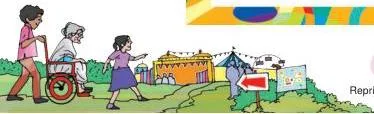
- Mohan Chacha and Rohit fetch a wheelchair so Dadiji can enjoy the mela without her legs hurting.
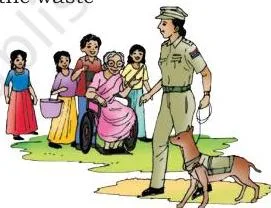
- As they leave, a police dog is walking with the police officer.
Fun, food and keeping clean (NCERT, pp. 26–27)
The fourth lesson pairs fun with cleanliness: a whole day of enjoyment still ends with washed hands and a dustbin used properly.
- Stalls: the children buy spinning tops, puppets, phirkis and dolls, while Sneha and Radha buy bangles and trinkets.
- Rides and shows: the merry-go-round and the giant wheel, and then the magic show.
- Food: gol gappas, chaat, chhole kulche, hot jalebis with rabri and kulfi — eaten only after washing hands at the water point.
- Waste: all of it goes into the dustbin, not on the mela ground.
Kumbh Mela, the world’s biggest gathering (NCERT, p. 28)
The “Do you know?” box widens the story into a fact about the largest fair of all.
- The Kumbh Mela is called the world’s biggest festival and the largest gathering of mankind.
- It is held once every 12 years.
- It takes place on the banks of the Ganga, Yamuna, Godavari and Shipra rivers.
- The four cities are Haridwar, Prayagraj, Nashik and Ujjain.
Reading a Sketch: the chapter’s map exercise

The chapter’s most skill-based activity is the Reading a Sketch exercise on page 30 — a first lesson in reading a simple map. The sketch itself is printed in the textbook, so keep page 30 of your copy (or of the PDF above) open while you work through the method below.
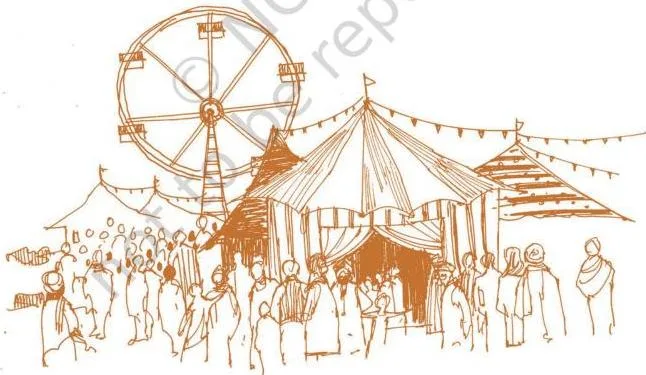
A sketch is a simple drawing of a place that shows where things are, as if you were looking down from above. The chapter’s sketch shows the area around the mela: the two families’ houses, the police station and the parade ground, joined by roads.
- Read the labels first. Find and circle Rohit and Sneha’s house, then Nita and Radha’s house — that is exactly what the first two questions ask.
- Compare distances. The third question asks whose house is closer to the parade ground. “Closer” means shorter distance on the map, so compare how far each house is from the ground along the roads.
- Trace the route. For the last question, put your finger on the police station and follow the road to the parade ground, naming every place you pass.
The Draw task on page 31 turns the same skill around: the child sketches the route from home to school that they follow every day. If a child can read the sketch on page 30, they can draw one like it themselves.
Words in this chapter
The story uses a few words a Class 3 child may not have met before. Understanding them makes both the story and the exercises easier.
| Word | Simple meaning |
|---|---|
| mela | a fair; a big open-air gathering for fun, food, rides and shopping. |
| bus | a large vehicle that carries many passengers along a fixed route. |
| autorickshaw | a three-wheeled vehicle that carries a small number of passengers for short trips. |
| full ticket / half ticket | full price for adults; the cheaper fare that children pay. |
| parade ground | a large open ground where a mela or event can be held. |
| Lost and Found booth | a help point where people can report things or family members they have lost. |
| volunteer | a person who helps at an event without being paid. |
| wheelchair | a chair on wheels for someone whose legs hurt or who cannot walk far. |
| spinning top | a toy that spins on its pointed base. |
| phirki | a small toy that spins; one of the toys the children buy at the stall. |
| puppet | a doll made to move with strings or by hand; a puppeteer performs with it. |
| merry-go-round | a fairground ride with seats that goes round and round. |
| giant wheel | a tall fairground wheel with seats that carries riders up and around. |
| police dog | a trained dog that works alongside a police officer. |
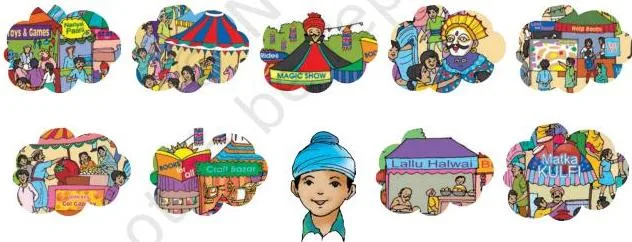
The match-the-pictures exercise on page 32 asks the child to pair nine helpers with what they do. These are the people a child would meet at a mela.
| Person at the mela | What they do |
|---|---|
| Volunteer | helps visitors and runs help points such as the Lost and Found booth. |
| Firefighter | puts out fires and helps in emergencies. |
| Halwai (confectioner) | makes and sells sweets. |
| Toy seller | sells toys at a stall. |
| Puppeteer | performs with puppets. |
| Bangle seller | sells bangles at a stall. |
| Police officer | keeps people safe and maintains order. |
| Medical attendant | gives medical help and first aid. |
| Mehendi artist | applies mehendi (henna) designs on hands. |
What children often mix up in this chapter
A few ideas in this chapter are easy to misunderstand. Here is each one with the correction from the story, and a quick way to check it.
| What children sometimes think | What the story shows | How to check |
|---|---|---|
| The Lost and Found booth is a shop. | It is a help point run by volunteers for people separated from their family or belongings (NCERT, pp. 25, 28). | Ask: what would you do there if you lost your way? The booth helps, it does not sell. |
| The fire engine and ambulance are decoration. | They are parked at the entrance to reach an emergency quickly in a big crowd (NCERT, p. 25). | The Find out question on page 29 asks why they are present — the answer is fast help. |
| The police dog is a pet. | It accompanies and helps the police officer on duty (NCERT, pp. 25, 28). | Look at the scene: the dog is walking with the officer, not playing. |
| “Five full and four half tickets” means five people. | Five adults paid full fare and four children paid half fare — nine people in the group (NCERT, p. 23). | Add \(5 + 4 = 9\). |
| Waste can be dropped anywhere at the mela. | All waste goes into the dustbin to keep the ground clean (NCERT, p. 27). | After eating, the children make sure every bit of waste is in the dustbin. |
| “Closer” on the sketch means first in the story. | On a sketch, closer means shorter distance between two places on the map (NCERT, p. 30). | Compare the road lengths on the sketch, not the order of events. |
How the chapter’s questions are used in class
This chapter has no long question paper. Its work is the question blocks printed inside the story, and each block asks the child to do something different.
| Question block | What it asks the child to do |
|---|---|
| Discuss (pp. 21, 24, 32) | Talk about their own experience: preparing for a trip, local transport, caring for elders, safety during travel. |
| Write (pp. 24, 28–29) | Write short paragraphs: a trip they have taken, the purpose of the Lost and Found booth, the role of the police dog. |
| Find out (p. 29) | Ask elders how melas were different when they were young, and think about why fire engines and ambulances are present. |
| Draw (p. 31 and Activity C, p. 33) | Sketch the route from home to school; draw and label vehicles seen around the school and home. |
| Role play (Activity D, p. 33) | Plan and run a mock mela in class — stalls, games and roles — using toys, puppets, play money and clay models. |
A teacher or parent checking the child’s work would look for three things: can the child name the bus safety rules; can they explain why the Lost and Found booth and the emergency vehicles are there; and can they read the sketch — find the houses, compare distances and trace a route.
One honest note: textbook contents and the examinable syllabus are not always identical, so check the current official syllabus for how this chapter is assessed in your school.
Going to the Mela: a quick recap
If a child can retell this chapter in order, they have understood it. Here is the flow in six steps, each with the lesson the story is carrying.
- Prepare. Water bottles are filled and a special bag packed; neighbours and Mohan Chacha’s family join the plan, and Dadiji agrees to come. Lesson: plan the trip together.
- Travel safely. The children hold Dadiji’s hand and watch the traffic; she gets help boarding, takes the reserved seat, and the tickets are five full and four half. Lesson: care for elders and follow the bus rules.
- Arrive at the parade ground. A map shows the stalls; an ambulance, police jeep and fire engine wait; the Lost and Found booth has volunteers; a wheelchair helps Dadiji move. Lesson: helpers stay ready at big gatherings.
- Enjoy. The toy stall, the bangles, the merry-go-round, the giant wheel and the magic show. Lesson: mela fun.
- Eat cleanly. Hands are washed before eating; the family enjoys gol gappas, chaat, chhole kulche, jalebis with rabri and kulfi; all waste goes in the dustbin. Lesson: hygiene while having fun.
- Leave. Dadiji points out the police dog accompanying the police officer. Lesson: the helpers are there until the end.
Related resources
This listing is maintained for the 2026-27 academic session using the NCERT textbook information available to us. NCERT remains the authority for confirming the latest edition.
The pages below are the rest of the Class 3 picture: the book, the class, the chapters beside this one, and the official source of the PDF.
- Our Wondrous World Class 3 Environmental Studies — the book page for every chapter in this textbook.
- Class 3 hub — all NCERT Class 3 subjects covered on this site.
- CBSE notes home — notes across all classes and subjects.
- Our Families and Communities (Chapter 1) — the chapter that comes before Going to the Mela.
- Celebrating Festivals (Chapter 3) — the chapter that comes next.
- ncert.nic.in — the official NCERT portal where the Class 3 textbook PDFs, including this chapter, are published.
Sources and data verification
This page describes one specific book, and nothing more than that:
- Which book: the NCERT Class 3 Environmental Studies textbook Our Wondrous World, Chapter 2, “Going to the Mela”. Page references follow the printed NCERT edition.
- What it covers: this chapter only. It does not describe other Class 3 books, subjects or chapters.
- Session: this page is maintained for the current academic session using the NCERT information available to us.
- Who settles what: NCERT settles textbooks, editions and PDFs; CBSE settles curriculum, syllabus and examinations. This page makes no claim of independent syllabus alignment or expert review.
| What the chapter holds | Count | Where it is used |
|---|---|---|
| Printed pages | 15 | |
| Figures with NCERT captions | 12 | |
| Activities | 2 | |
| Official NCERT PDF | Download the chapter PDF | the chapter exactly as NCERT publishes it |
FAQ: Going to the Mela Class 3 questions answered
Quick answers to the questions children, parents and teachers ask about this chapter.
What is the story of Going to the Mela about?
It follows Nita and Radha’s family and their neighbours Sneha and Rohit to a mela. They travel by bus with Dadiji, meet Mohan Chacha’s family at the mela ground, buy toys, take rides, watch a magic show, wash hands before eating, and put all waste in the dustbin before leaving.
What safety rules does the chapter teach while travelling to the mela?
Walk carefully while keeping an eye on traffic, and hold Dadiji’s hand (NCERT, pp. 22–23). Inside the bus, children must sit on their seats, not jump around, and keep their hands and head inside the window.
Why are a fire engine, an ambulance and a Lost and Found booth at the mela?
So help can reach quickly if anything goes wrong in a big crowd. The ambulance and fire engine answer emergencies, and the Lost and Found booth — run by volunteers — helps people separated from their family or belongings (NCERT, pp. 25, 28–29).
What is the Kumbh Mela and where is it held?
The Kumbh Mela is described in the chapter as the world’s biggest festival and the largest gathering of mankind (NCERT, p. 28). It is held once every 12 years on the banks of the Ganga, Yamuna, Godavari and Shipra rivers, in Haridwar, Prayagraj, Nashik and Ujjain.
How should we care for elders like Dadiji on a trip?
The story shows it at every step: Nita holds Dadiji’s hand while walking, the conductor and her father help her board, she sits in the seat reserved for older people, and Mohan Chacha and Rohit fetch a wheelchair so her legs do not hurt (NCERT, pp. 22–23, 25).
What is the Reading a Sketch activity in this chapter?
On page 30, the child studies a sketch of the mela area, finds and circles the two families’ houses, works out whose house is closer to the parade ground, and traces the route from the police station to the parade ground, naming the places passed.
The Draw task on page 31 is the same skill in reverse: sketching the route from home to school.
Reference: NCERT Class 3 Environmental Studies textbook, chapter 2, official edition on ncert.nic.in.
Explore Class 3 Environmental Studies Books
- Previous: Our Families and Communities
- Next: Celebrating Festivals
Related chapters:
- Life Around Us
- Plants and Animals Live Together
- Living in Harmony