
The Story of Indian Farming is Chapter 1 of the NCERT Class 7 Social Science textbook Exploring Society: India and Beyond — Part 2 (running title: India and the World: Land and the People). The chapter runs to 28 printed pages, and the official PDF is linked below.
Below the download you will find what the chapter actually contains — a section-by-section map, the key ideas explained figure by figure, definitions, common mistakes, and a complete key to the end-of-chapter matching exercise. This is the first chapter of the book in print order, so parents and teachers can identify it instantly.
The Story of Indian Farming Class 7 Social Science Chapter 1 PDF is the official NCERT edition, free to download from the ncert.nic.in portal — 28 printed pages of the full chapter, with its figures and the end-of-chapter activities and questions exactly as published. No login is required; the file is public.
Chapter at a Glance
The chapter runs across 28 pages. The table below shows what it holds.
What This Chapter Covers: From Ancient Fields to Modern Farms
One opening image carries the chapter’s whole argument. Fig 1.1 is a six-panel collage: oxen pulling a plough beside a farmer on a tractor, women transplanting rice seedlings by hand beside a transplanter, a threshing machine separating wheat from its stalk, and vegetable boats on Dal Lake.
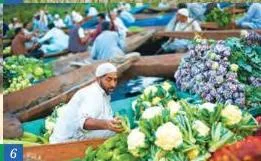
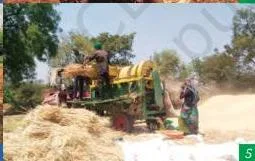
The collage pairs traditional and modern at every step — and that pairing is the chapter’s subject. Indian agriculture today is not old or new but both at once; the same crop can be planted by hand or by machine depending on region and resources (NCERT, p. 1).
Page 2 puts this in numbers. Agriculture is one of the oldest occupations of humankind. A little over 18 per cent of India’s gross domestic product (2022–2023) comes from agriculture and allied activities, and about 46 per cent of the working population depends on them for a livelihood.
The chapter builds its story in a clear order. Use this map to follow along in your book:
- India’s agricultural landscape — what the term “agriculture” includes, pages 2–3
- Echoes from the past — archaeological evidence and ancient texts, pages 3–5
- Climate, monsoons and the kharif–rabi–zaid seasons, pages 6–9
- Soil: formation, the six soil types, soil conservation, pages 10–14
- Water: rain-fed versus irrigated agriculture, pages 15–18
- Seeds: inherited knowledge and bought seeds, pages 18–19
- Traditional systems, the Green Revolution, sustainable farming, pages 19–24
- The government’s role and farmers’ challenges, pages 24–26
- Summary and questions, pages 26–28
The Three Big Questions That Frame the Chapter
The chapter opens with three framing questions, and its sections exist to answer them. Read the chapter as an argument rather than a list of facts, and it becomes much easier to recall.
- What are the main characteristics of Indian agriculture? — answered across the whole chapter, from the opening landscape (page 2) to the closing summary (page 26).
- How are farming, climate, soil, and water interrelated? — answered by the climate section (pages 6–9), the soil section (pages 10–14), and the water section (pages 15–18).
- How can traditional practices and contemporary ones complement each other? — answered by the traditional farming systems section (pages 19–20) and the Green Revolution and sustainable pathways section (pages 21–24).
Echoes from the Past: Farming in Ancient India
This section answers one question: how old is farming in India? The chapter’s answer is “very old”, and it proves it with archaeological sites before moving to written texts.
Rice grains found in the Ganga Plain date to the 7th or 8th millennium BCE, though the chapter cautions that systematic rice cultivation may have taken a few more millennia to master. At Mehrgarh, barley and millets are dated to the 7th millennium BCE.
Later, barley and wheat became the staple crops of the Harappans, with rice present at several sites by the 3rd millennium BCE (NCERT, pp. 3–4).
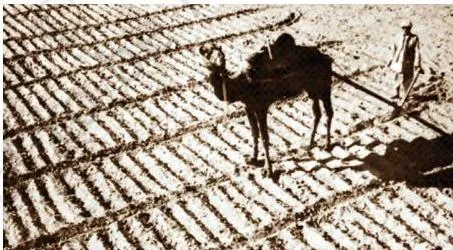
Fig 1.2 is the chapter’s evidence figure, and it rewards a careful look. Archaeologists at Kalibangan in Rajasthan found furrows cut at right angles to each other, dated to around 2800 BCE.
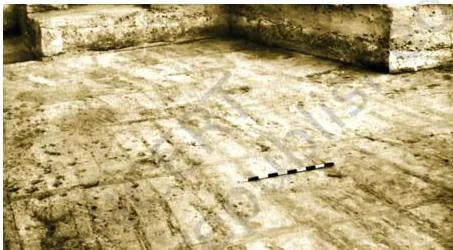
Perpendicular furrows mean two crops were sown in the same field at the same time, with rows running in different directions. That is intercropping — defined in the margin as growing two or more different crops simultaneously. The bottom panel shows the same practice photographed in the 1960s, about 4,800 years after Kalibangan.
A farming technique outliving civilisations is the point (NCERT, p. 4).
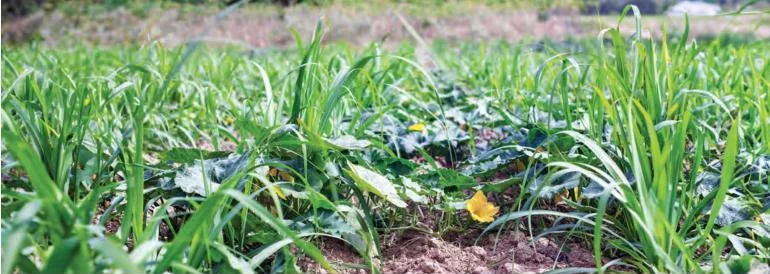
Fig 1.3 shows intercropping today: sugarcane grown along with pumpkin (NCERT, p. 5). From around 3500 BCE, the pre-urban phase of the Sindhu-Sarasvati civilisation also domesticated cattle, asses, sheep, goats, dogs, pigs, and fowl.
Then come the texts. Kautilya’s Arthashastra, the Sangam literature of the early Tamils, Amarakosha, Krishiparashara, Varahamihira’s Brihatsamhita, and Surapala’s Vrikshayurveda all carry writing on agriculture, horticulture, and plant biodiversity. The book’s example: the Brihatsamhita describes a grafting method still in use today.
Grafting joins one plant with another so the two grow as one, combining desirable traits such as pest resistance or sweeter fruit (NCERT, p. 5).
Climate, Monsoons, and the Three Cropping Seasons
This is the chapter’s longest section, and its logic is simple: regions differ in rain, sunshine and temperature, so they grow different crops at different times of year.
The chapter recalls the seven climate types from Part 1 of this textbook — from alpine in the Himalayas to tropical in eastern India — and adds that India is divided into 15 agroclimatic zones. Each zone combines climate, soil, terrain and vegetation, and the categorisation helps agencies plan what, when and how to grow (NCERT, p. 6).
The monsoon is the engine. The southwest monsoon brings rain from June to September and drives the kharif crops of northern and central India. The northeast monsoon, October to December, brings rain to the east and south.
Coastal plains such as Malabar (Kerala) and Coromandel (Tamil Nadu) receive rain from both monsoons — which is why southern farmers can grow crops in the period between them, while northern farmers irrigate from groundwater, rivers, canals, ponds, and soil moisture in the dry season (NCERT, p. 7).
Xuanzang, the Chinese pilgrim who travelled in India in the 7th century, noticed this diversity: climates and soils differ by situation, so the produce varies. The chapter uses his observation as its own evidence of India’s climatic diversity.
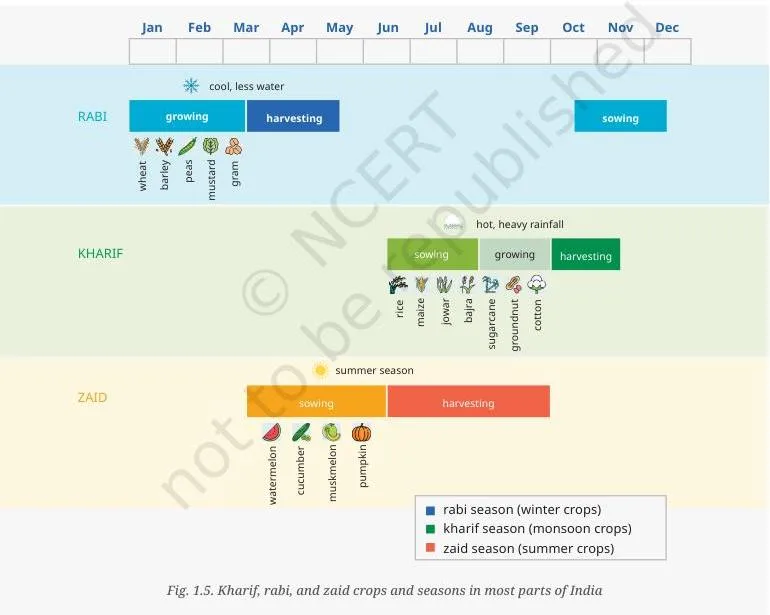
Fig 1.5 is the single image to remember for the seasons. It lays out the kharif, rabi and zaid calendar for most of India. Farmers have followed this rhythm for centuries, and the chapter calls it one of the factors that keeps food available all year round.
The terms are of Arabic origin and have been in use since Mughal times (NCERT, p. 8).
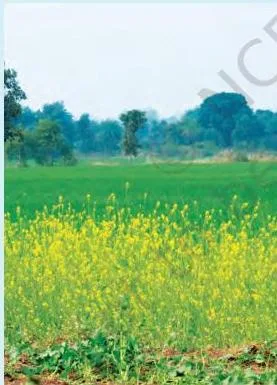
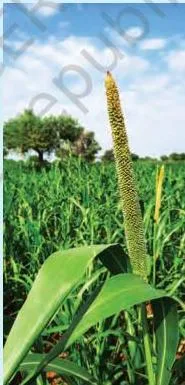
Fig 1.6 shows mustard in the foreground and wheat behind — both rabi crops. Fig 1.7 shows pearl millet, a kharif crop. The table below puts the three seasons side by side.
| Season | When it falls | How water is supplied | Example crops in the chapter | Older name (NCERT, p. 9) |
|---|---|---|---|---|
| Kharif | Monsoon season — June to September in northern and central India | Rain from the southwest monsoon | Pearl millet; see Fig 1.5 for others | Kedara (wet crops) |
| Rabi | Winter | Groundwater, river, canal and pond water, and moisture held in the soil | Mustard, wheat | Haimana (winter crops) |
| Zaid | Summer — the exercise on page 27 defines it as crops grown in summer | Not named in the chapter | See Fig 1.5 in your book | Graishmika (summer crops) |
Each season carries its own risk. Kharif crops depend on the timely arrival of the monsoon, and excessive rain destroys crops. The Arthashastra’s ideal rainy season — one-third of the rain at the start and end of the season, two-thirds in the middle — makes sense once you see the crop cycle; the book asks you to work out why (NCERT, p. 10).
Soil: How It Forms, What It Holds, and How Farmers Protect It
Soil matters here because it decides which crops a region can grow, and because it forms over an almost unimaginable timescale. This section covers how soil forms, what types India has, and how farmers keep it healthy.
Soil is the thin upper layer of the Earth’s crust that supports plant life — the farmer’s most essential resource. Fig 1.8 shows its formation: weathering breaks down bedrock into particles, and decaying organic matter mixes in. The caption carries the key timescale: the process ranges from a century to several millennia (NCERT, p. 10).
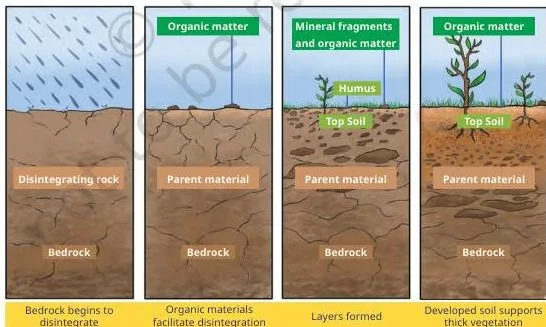
The margin definitions on page 12 name the pieces: weathering is the breakdown of rocks into soil particles by physical, chemical or biological means; silt is the fine, dust-like sediment larger than clay but smaller than sand, easily carried by rivers; bedrock is the original rock from which soils derive.
India’s soils fall into six major types: alluvial, black, red, laterite, desert, and mountain or alpine soil (NCERT, p. 11). The chapter’s exercise supplies two facts worth memorising: alluvial soil is rich in nutrients deposited by rivers, and alpine soil is thin, rough and rocky, found in mountainous regions.
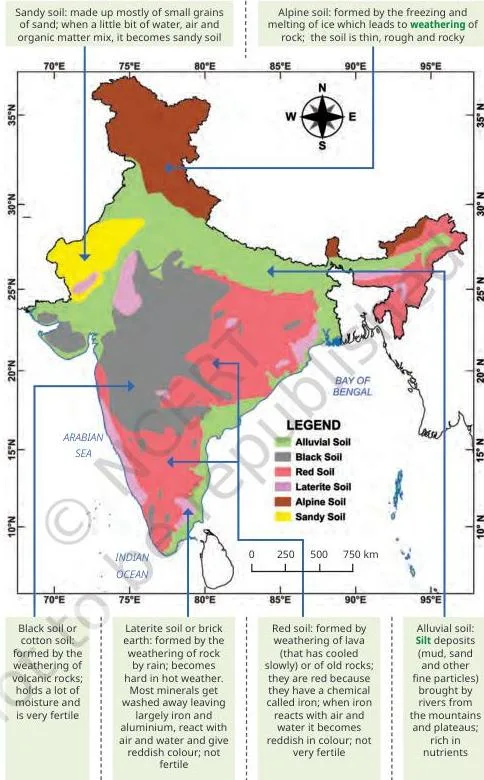
Read Fig 1.9, the soil map, with its own warning: the map is simplified, and most regions have local variations. Use it for the broad pattern, not for your home district. Fig 1.10 in your book shows crops grown on different soils, with a note that they are not on their ideal soil — efficient irrigation can grow them anyway.
You need not remember all those details (NCERT, p. 13).
Healthy soil is a living ecosystem: bacteria, fungi, earthworms, insects, minerals, humus, water and air. To protect it, farmers use two toolkits:
- Traditional methods: crop rotation (different crops in different seasons, so the soil does not lose specific nutrients), multiple cropping (several crops in one field, lowering pest risk), contour ploughing (ploughing along the natural curves of a slope to stop rainwater erosion), and organic fertilisers such as cow dung.
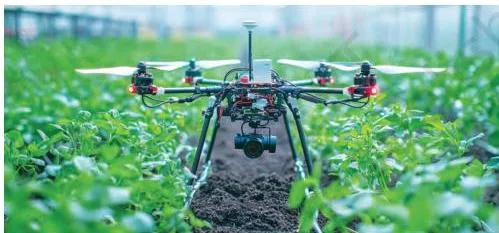
- Contemporary methods: terracing in hilly areas, afforestation, mulching, and very precise application of fertilisers. The chapter even shows a drone assessing soil moisture in a greenhouse (Fig 1.12).
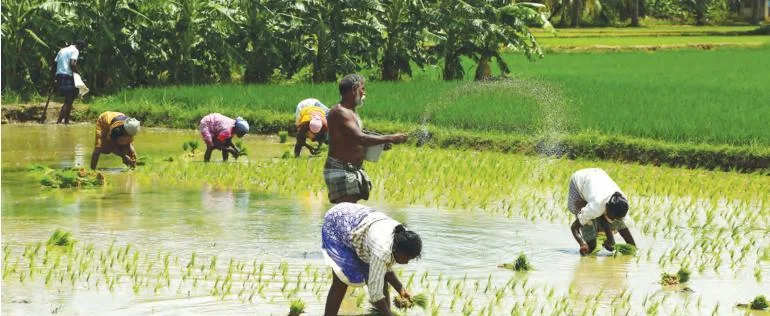
Fig 1.11 shows one practice doing three jobs at once: banana trees on the bunds of paddy fields act as windbreakers, hold the soil in place, and give farmers an extra crop. Panchagavya — a fermented mix of five cow products: dung, urine, milk, curd and ghee — works as a biofertiliser that boosts growth and disease resistance (NCERT, p. 14).
Water: When Rain Is Enough and When It Isn’t
Water is the biggest dividing line in Indian farming. Whether a farm depends on rain alone or has irrigation decides what it can grow and how much risk it carries.
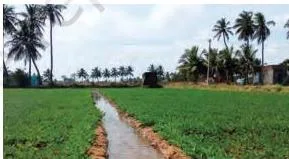
Rain-fed agriculture relies entirely on rainfall, so its risks are drought and unpredictable monsoons. Farmers adapt by choosing drought-resistant crops and using traditional water-harvesting techniques (NCERT, p. 15). Fig 1.4 in the book shows an irrigated peanut crop in south India as the contrast.
Irrigated agriculture supplies water artificially. The chapter’s central point is that irrigation is ancient, not modern. Water structures exist from the time of the Indus civilisation, and a rich regional vocabulary grew up around them — kull, kund, ahar, pokhar, khadin, arakere, kolam, surangam, tadagam, eri.
The list itself is the evidence: every region had its own answer for storing and moving water.
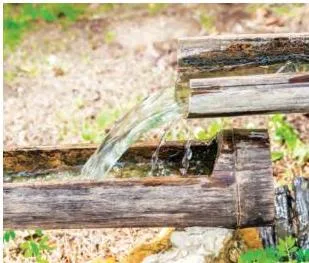
Two traditional systems get special treatment. Phad systems in Maharashtra use small community-managed canals to divert river water to fields. Bamboo drip irrigation, in parts of northeastern India, pipes water from springs to fields through bamboo channels (NCERT, p. 16). Fig 1.14 shows the bamboo channels at work.
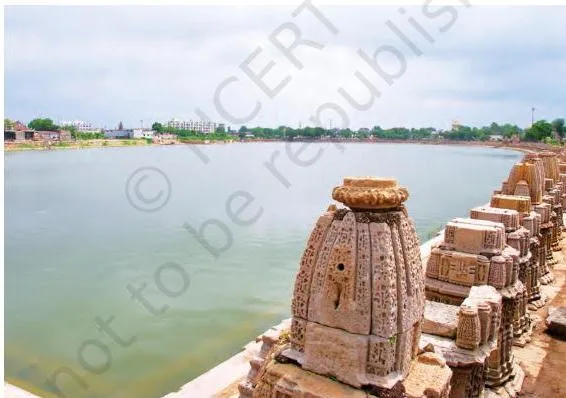
The book also reminds you that water bodies were treated as sacred — the 11th-century Munsar Lake in Gujarat, built by Queen Minaldevi, is one example (Fig 1.13). And you have already met the grandest ancient structure: Kallanai, the anicut built by Karikala across the Kaveri about 1,800 years ago, still irrigates thousands of hectares (NCERT, p. 17).
Modern irrigation works on the same goal with more precision. Drip irrigation — also called trickle irrigation — delivers water slowly and directly to the roots through a network of tubes and emitters.
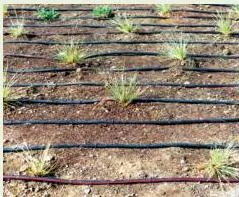
The THINK ABOUT IT scene on page 18 describes the idea: small pipes with tiny holes near the base of plants drip water steadily onto the roots only. That targeted delivery wastes very little. Sprinklers do the reverse — water is sprayed into the air and falls over crops like artificial rain (Fig 1.16).
Both matter because groundwater reserves in many parts of India are fast decreasing (NCERT, p. 18).
Seeds: Old Knowledge, New Questions
Seeds are where the chapter’s oldest and newest worlds meet: a family’s seed store and a seed company’s packet sit in the same story.
Traditionally, seeds were passed down through families, preserved at the community level, and shared — in some regions women carry seeds as part of the gifts they bring to their marital home. High-yielding seeds were carefully selected and saved for the next planting season (NCERT, p. 18).
The Arthashastra’s recipes show how old this care is: cotton seeds smeared with cow dung; cereals, beans and pulses soaked in dew and sun-dried before planting. Modern research continues the same line — ICAR has developed beejamrit, a paste of cow dung, urine and other materials that coats seeds before planting, protects them from spoiling, and reduces germination time (NCERT, pp. 18–19).
Ancient Indian farmers also invented a seed drill that combined soil preparation, seed planting, and closing the furrow in one operation — saving the labour of a three-step job. The modern turn is the chapter’s closing point: bought, scientifically developed seeds give higher yields and pest resistance, but the seeds the plant produces are often not suitable for replanting.
Farmers must buy again — a dependency critics question (NCERT, p. 19).
Traditional Farming Systems: Soil as a Living System
This section rewires how you think about traditional farming. Its claim is that traditional methods treat soil as a living system, not just dirt to stand crops in.
Traditional agriculture considers the plant and the whole soil ecosystem as one system. Bacteria and fungi in the soil convert nutrients into forms plants can absorb, and the plants feed those organisms energy through their roots (NCERT, p. 20).
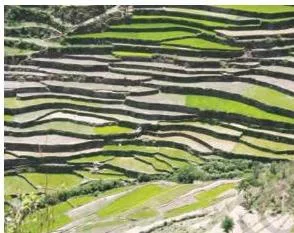
- Terrace farming — farmers cut steps into hillsides to create flat land, slowing water runoff and preventing soil erosion. Fig 1.17 shows it in Uttarakhand.
- Kulagar — from the Konkani words kula (family) and agar (storehouse). A homestead system in the Konkan Plains of Goa where families grow food crops, cash crops, fruits, vegetables, spices and medicinal plants around the home, with a structured irrigated design.
- Gokrishi — a holistic cycle: cows provide manure for the soil and bullocks plough the fields.
Then comes the chapter’s strongest number. ICAR has documented almost 5,000 traditional practices and tested over a hundred of them — more than 85 per cent were validated by modern science. That is the direct answer to anyone who calls traditional farming unscientific (NCERT, p. 20).
The Green Revolution and the Search for Sustainable Farming
This section covers the twentieth-century turn to modern farming and the twenty-first-century search for a way back. Both halves are needed to understand Indian agriculture today.
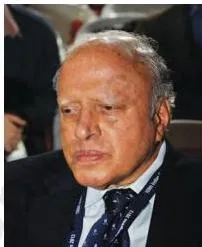
The Green Revolution of the 1960s and 1970s introduced high-yielding varieties of seeds, increased irrigation, chemical fertilisers and pesticides, and mechanised equipment. Food grain production rose sharply — wheat and rice especially — and India achieved self-sufficiency in food. Fig 1.18 shows M.S. Swaminathan, called the architect of the Green Revolution (NCERT, p. 21).
A stamp released to mark the wheat revolution even carries a bar graph (Fig 1.19).
The costs took decades to become visible, and the chapter lists them plainly: long-term impoverishment of the soil, depletion of groundwater, contamination of the soil and water by pesticides and fertilisers, and damage to human and animal health — including the multiplication of cancer cases in rural areas that scientific studies have established (NCERT, pp. 21–22).
Sustainable farming tries to keep the productivity and cut the damage. The chapter’s examples: organic farming (compost, seed cake and animal manure instead of chemicals), neem-based pesticides that are far less harmful than chemical ones, and Sikkim — the world’s first 100 per cent organic state, which banned chemical fertilisers and pesticides in 2014 (NCERT, p. 22).
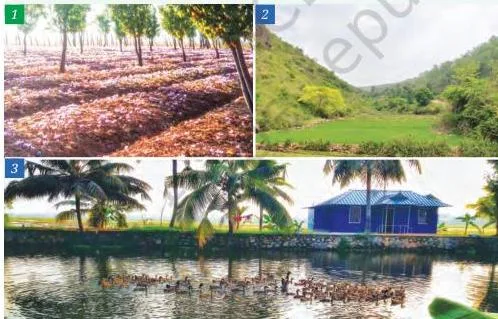
Fig 1.20 is the proof that traditional systems can be globally significant. The FAO has recognised three Indian agricultural heritage systems: saffron crocus fields in Kashmir, Odisha’s integrated forest-and-land system, and Kerala’s below-sea-level paddy, fishing and livestock system (NCERT, p. 23).
The chapter states the trade-off honestly. Modern methods are highly productive but pollute water and disrupt ecosystems by harming pollinators like bees. Traditional methods are more resilient and work with nature, but may yield less. The challenge is balance. One surprise closes the section: soil is not absolutely essential for plants.
Hydroponics grows them in nutrient-rich water solutions, minerals given directly to the roots — an option for urban farming and poor soils. Fig 1.21 in your book shows vegetables grown this way (NCERT, p. 24).
The Government’s Role and the Challenges Farmers Face
The last stretch of the chapter looks beyond the farm: what the government does to support farmers, and the pressures that push some farmers out of farming.
The government’s support system includes access to seeds, fertilisers and pesticides; weather-forecast information; research and training; electricity at lower prices for irrigation; and crop insurance through the Pradhan Mantri Fasal Bima Yojana. It also purchases important crops so farmers get fair prices, and promotes cold storages and digital market access (NCERT, p. 24).
Fig 1.22 shows the crop-insurance scheme as one example of financial support.
Then come the hard realities. Landholdings shrink as land divides among family members; the average holding is about three-fourths of a hectare — roughly the size of a football field. One hectare is \(10,000\) square metres; the older acre (about \(4,047\) square metres) is still widely used in India (NCERT, p. 25).
Small farms bring small incomes, and machinery designed for large farms is expensive to buy or rent. Climate change brings untimely rains and more extreme events — severe droughts and heavy rainfall — raising the risk of crop destruction.
In hard times farmers take loans that become debt traps; according to some estimates the chapter cites, as many as 2,300 farmers a day have been compelled to abandon agriculture (NCERT, p. 26).
The Ganga basin is the chapter’s case study in what is at stake. Over 500 million people depend on it.
- Causes of stress: global warming is melting Himalayan glaciers at an unprecedented rate; much water is diverted to irrigation; agriculture and industry pump out huge amounts of groundwater; and hundreds of dams interfere with the river’s natural flow.
- Effects on agriculture: the river increasingly cannot replenish itself, parts are un-navigable in summer, and farming in the basin becomes less and less sustainable — threatening the livelihood of millions and India’s food production.
- Where solutions must come from: the chapter says solutions exist but leaves them open; a complete answer connects each proposed solution to the cause it addresses and explains the reasoning (NCERT, p. 26).
The Chapter’s Figures and What Each One Shows
The table below is a revision index of the chapter’s key diagrams — where each sits, what it shows, and the one point to remember. Find the figure in your book, read the takeaway, and move on.
| Figure | NCERT page | What it shows | Point to remember |
|---|---|---|---|
| Fig 1.1 | 1 | Six panels: oxen and tractor ploughing, manual and machine transplanting, machine threshing, Dal Lake vegetable boats | Indian agriculture blends traditional and modern. |
| Fig 1.2 | 4 | Perpendicular furrows at Kalibangan (c. 2800 BCE) and the same intercropping in the 1960s | Intercropping is about 4,800 years old in India. |
| Fig 1.3 | 5 | Sugarcane grown with pumpkin | Intercropping is still practised today. |
| Fig 1.5 | 8 | Calendar of kharif, rabi and zaid crops and seasons | The three-season rhythm of Indian farming. |
| Fig 1.6 | 9 | Mustard in the foreground, wheat behind | Both are rabi (winter) crops. |
| Fig 1.7 | 9 | Pearl millet | A kharif crop. |
| Fig 1.8 | 10 | Stages of soil formation | Soil takes a century to several millennia to form. |
| Fig 1.9 | 12 | Simplified map of major soil types | It is simplified; most regions have local variations. |
| Fig 1.11 | 15 | Banana trees on paddy bunds | One practice: windbreak + soil holder + extra crop. |
| Fig 1.14 | 17 | Bamboo pipes carrying spring water to fields | Traditional drip irrigation in the northeast. |
| Fig 1.15 | 18 | Drip irrigation reaching plant roots | Water delivered slowly to roots wastes less. |
| Fig 1.17 | 20 | Terrace farming in Uttarakhand | Steps on slopes stop erosion and hold water. |
| Fig 1.18 | 21 | M.S. Swaminathan | Architect of the Green Revolution. |
| Fig 1.20 | 23 | Saffron in Kashmir; integrated forest-land system in Odisha; paddy-fishing-livestock in Kerala | Three FAO-recognised heritage systems. |
| Fig 1.22 | 24 | Crop-insurance scheme graphic | One example of government financial support. |
Key Definitions From the Chapter (With Page Numbers)
The book scatters its margin definitions across the chapter. They are collected here so you can revise the vocabulary in one pass — with the page number, in case you want to quote the book in your answer.
| Term | What it means | NCERT page |
|---|---|---|
| Agriculture | From Latin agri (field) and culture (to cultivate); broadly covers farming, animal husbandry, forestry and horticulture | 2 |
| Threshing | Removing the edible grain from the straw or husk, manually or by machine | 2 |
| Pisciculture | Fish rearing | 2 |
| Intercropping | Growing two or more different crops in the same field at the same time | 4 |
| Grafting | Joining one plant with another so the two grow as one, combining desirable traits | 5 |
| Agroclimatic zones | India’s 15 regions, defined by combining climate, soil, terrain and vegetation, used to plan what, when and how to grow | 6 |
| Humus | Dark organic matter from decomposed plant and animal matter; rich in nutrients and holds moisture | 10 |
| Weathering | Breakdown of rocks and minerals into soil particles by physical, chemical or biological means | 12 |
| Silt | Fine, dust-like sediment, larger than clay but smaller than sand; easily carried by rivers | 12 |
| Bedrock | The original rock from which soils form through weathering and erosion | 12 |
| Greenhouse | Transparent glass or plastic structure that captures sunlight and heat for controlled plant growth | 15 |
| Landholding | The area of land a person owns | 25 |
| Hectare | A unit of area equal to 10,000 square metres; the acre (about 4,047 square metres) is still widely used in India | 25 |
Common Mistakes in This Chapter (and the Corrections)
Each error below shows up in real classrooms, and the book itself supplies the correction. Working through the table quickly is faster than meeting a wrong idea during a test.
| Mistake | Correct rule | How to check your answer |
|---|---|---|
| “The Indian farmer is a man.” | In rural India, more than 75 per cent of people working in agriculture are women (2025); they perform most operations from sowing to threshing. | Re-read the THINK ABOUT IT box, page 2. |
| “Agriculture means only growing crops.” | It also covers animal husbandry, forestry and horticulture, plus allied work like apiculture, fisheries, sericulture and fibre production. | Check the DON’T MISS OUT box, page 2. |
| “Kharif and zaid are the same season.” | Kharif crops grow with the monsoon rains; zaid crops grow in summer. | The matching exercise pairs kharif → monsoon crops and zaid → summer crops. |
| “Irrigation is a modern invention.” | Water structures go back to the Indus civilisation; Kallanai is about 1,800 years old; phad systems and bamboo drip irrigation are traditional. | Scan the water-structure vocabulary and examples on pages 16–17. |
| “Traditional farming is unscientific.” | ICAR tested over a hundred traditional practices; more than 85 per cent were validated by modern science. | See the ICAR figures, page 20. |
| “Soil is absolutely essential for growing plants.” | Hydroponics grows plants in nutrient-rich water solutions, minerals given directly to the roots — used in urban and poor-soil settings. | See the DON’T MISS OUT box, page 24. |
Exam Notes: How to Revise This Chapter
No study page can promise you particular questions. What it can do is show what the book itself treats as important, and how to structure the “why” answers this chapter keeps asking for.
The chapter’s closing summary block, “Before we move on …” (page 26), is its own revision checklist — seven points the book considers essential. The matching exercise (question 2, page 27) is the fastest self-test: pair all six terms without looking and you have the chapter’s vocabulary. Here is the complete answer key for that exercise.
| Column A | Correct match | Why it matches |
|---|---|---|
| (a) Kharif crops | (ii) Crops grown during the monsoon | Kharif grows on the southwest monsoon rains, June–September (p. 7) |
| (b) Rabi crops | (i) Crops during the winter | Rabi is the winter season; older name haimana = winter crops (p. 9) |
| (c) Alluvial soil | (v) Soil rich in nutrients deposited by rivers | Definition given in the exercise itself (p. 27) |
| (d) Terrace farming | (vi) Method of farming on hillsides | Steps cut into hillsides create flat farming land (p. 20) |
| (e) Alpine soil | (iii) Thin, rough, and rocky soil found in mountainous regions | Definition given in the exercise itself (p. 27) |
| (f) Zaid crops | (iv) Crops grown in summer | Zaid is the summer season; older name graishmika = summer crops (p. 9) |
Worked answer — question 1: why Kerala grows rice while Punjab grows mostly wheat.
- Name the decisive factor first: water and the monsoon climate, with soil as the second factor.
- Kerala’s side: the Malabar coast receives rain from both the southwest and northeast monsoons, so water is available across the year. Paddy needs heavy, reliable water through its growing period — Kerala provides it.
- Punjab’s side: northern rain is seasonal, so farmers irrigate from groundwater, rivers, canals, ponds and soil moisture. Wheat is a rabi (winter) crop that suits this rhythm, and the alluvial soils of the northern plains suit it.
- If the regions swapped: rice in Punjab would lack the continuous water it needs; wheat in Kerala would face more moisture and rain than it can use. Yields would collapse in both regions.
Structure for the “why” questions (questions 3 and 6). A complete answer has two steps: name the factor — water availability, monsoon climate, or soil type — then give the mechanism, the specific need of the crop that the region meets, or the process that breaks down when conditions are wrong.
Question 6 asks for challenges plus their impact on people, so link each challenge to its human consequence: crop loss leading to debt, or small holdings limiting income.
The Ganga basin (question 9). The causes, effects and solution-direction are listed in the Ganga section above. Question 9 asks your group to propose solutions and defend them, so show your reasoning for each proposal.
The skill activities feed the exercise list. The book asks you to explore the foods you eat (page 3), report on radio or TV farmer programmes (page 25), debate traditional versus modern irrigation (question 7), and write an essay on what farming might be like when you are 60 (question 8). Doing one of these prepares you for the discussion questions at the end.
One honest caveat: textbook contents and the examinable syllabus are not always identical. This chapter PDF is the full text; what your exam covers is fixed by the current official syllabus, so check that before deciding what to skip.
Revision Summary: The Chapter in Seven Points
Seven points, rebuilt from the chapter’s own closing summary, for a last read the night before.
- Indian agriculture blends traditional and modern methods and spans crops, livestock, forestry, and more.
- India’s diverse climates and the monsoons create three cropping seasons — kharif, rabi and zaid — which helps keep food available all year.
- Six major soil types influence which crops grow where; soil health is the key to flourishing and sustainable farming.
- Seeds come from family lineage or are bought as high-yielding varieties from companies; the second path sometimes creates dependence.
- Sustainable farming combines modern technology with eco-friendly practices, such as efficient irrigation.
- Farmers face small landholdings, climate change, costly equipment, and market challenges.
- The government helps through access to information, research and training, and different types of financial support.
Related NCERT Resources
This listing is maintained for the 2026-27 academic session using the NCERT textbook information available to us. NCERT remains the authority for confirming the latest edition.
For the rest of this book, open the Class 7 Social Science NCERT books page. For every subject in the class, the all Class 7 NCERT books page is the index, and the Class 7 NCERT book hub covers every class on this site.
Revising in note form? The Class 7 Social Science notes and the Class 7 notes hub cover the same material more briefly, and the CBSE notes for every class are listed there too. This chapter also refers you to the “Climates of India” chapter in Part 1 of this textbook for the seven climate types (page 6) and the monsoon system (page 7).
Sources and Data Verification
This page describes the official NCERT Class 7 Social Science textbook, Exploring Society: India and Beyond — Part 2 (running title: India and the World: Land and the People), Chapter 1, “The Story of Indian Farming”, as published on ncert.nic.in. It covers Chapter 1 only; it does not cover Parts 1 or 3 of the series, other subjects, or other editions of the book.
The page is maintained for the current academic session using the NCERT information available to this site. NCERT settles textbooks, editions and official PDFs; CBSE settles curriculum, syllabus and examinations. No claim of expert review or syllabus alignment is made here — for what is examinable, the current official syllabus is the final authority.
| What the chapter holds | Count | Where it is used |
|---|---|---|
| Printed pages | 28 | |
| Figures with NCERT captions | 23 | |
| Tables | 1 | |
| Official NCERT PDF | Download the chapter PDF | the chapter exactly as NCERT publishes it |
Reference: NCERT Class 7 Social Science textbook, chapter 1, official edition on ncert.nic.in.
Frequently Asked Questions
Where can I download The Story of Indian Farming Class 7 PDF?
The official PDF is linked in the download block at the top of this page. It is the free NCERT edition on ncert.nic.in — 28 pages with the full chapter text, figures and activities. You can also open the NCERT textbook portal directly and choose Class 7 Social Science, Part 2.
What are kharif, rabi and zaid crops in NCERT Class 7?
They are India’s three cropping seasons. Kharif crops grow with the southwest monsoon (June–September); pearl millet is an example. Rabi crops grow in winter — mustard and wheat. Zaid crops grow in summer. The older names were kedara (wet), haimana (winter) and graishmika (summer). See Fig 1.5 for the full calendar.
Which six soil types does this chapter describe?
Alluvial, black, red, laterite, desert, and mountain or alpine soil. Alluvial soil is rich in nutrients deposited by rivers; alpine soil is thin, rough and rocky in mountainous regions. The chapter’s soil map (Fig 1.9) is simplified, and most regions have local variations.
Why do farmers in Kerala grow rice while farmers in Punjab grow wheat?
Water and monsoon climate come first, soil second. Kerala’s Malabar coast gets rain from both the southwest and northeast monsoons, so paddy gets the continuous water it needs. Punjab’s rain is seasonal, so farmers irrigate from groundwater, canals and rivers, and wheat grows as a winter (rabi) crop in that rhythm.
Swap the crops and each would lack the water and timing it needs — yields would collapse.
What is the Green Revolution and what were its costs?
The Green Revolution of the 1960s–70s introduced high-yielding seed varieties, more irrigation, chemical fertilisers and pesticides, and machinery. It made India self-sufficient in food, especially wheat and rice. Its costs, visible over decades, include soil impoverishment, groundwater depletion, contamination of soil and water, damage to health, and harm to pollinators like bees.
What are the three Big Questions at the start of the chapter?
(1) What are the main characteristics of Indian agriculture? (2) How are farming, climate, soil and water interrelated? (3) How can traditional practices and contemporary ones complement each other? The chapter’s sections are arranged to answer them in order.
Explore Class 7 Social Science Books
- Previous: Understanding Markets
- Next: India and Her Neighbours
Related chapters:
- Geographical Diversity of India
- Understanding the Weather
- Climates of India