
Friendship Class 6 is Chapter 2 of the NCERT English textbook Poorvi, running from book page 39 to page 74 — about 36 printed pages. It holds three reading texts: the story “The Unlikely Best Friends”, the poem “A Friend’s Prayer” and the story “The Chair”. The official chapter PDF is right here, with a walkthrough of every text and activity below it.
Need the file itself? The Friendship Class 6 English Poorvi Chapter 2 PDF is published free on NCERT’s official website, in the Class 6 English textbooks section, where the whole current Poorvi edition is available chapter by chapter.
Chapter at a glance: what is inside the Friendship chapter
This section maps the chapter so you know what the PDF contains before you open it. The table on this page lists the chapter’s section, figure and exercise counts — the pattern below is what the numbers do not show.
Friendship has no separate numbered exercise bank at the end. Every question lives inside a repeated chain of activity blocks that follows each of the three texts:
- Let us discuss — talk about what you just read
- Let us think and reflect — answer questions on the text
- Let us learn — grammar and vocabulary drawn from the text
- Let us listen — a listening activity with a transcript at the back
- Let us speak — pair or group speaking practice
- Let us write — a short writing task
- Let us explore — something extra to find or create
After the three texts come the listening transcripts on pages 71-73, and the unit closes with Let us ponder on page 74 — a Save Water poster task that is not about friendship at all.
The three texts of the Friendship Class 6 chapter and the order to read them
This table gives the order of the three texts, with page numbers, so you can flip straight to any one of them.
| Text | Type | Pages | What it is about |
|---|---|---|---|
| The Unlikely Best Friends | Story | 39-51 | Gajaraj the royal elephant and Buntee the stray dog become friends nobody expected |
| A Friend’s Prayer | Poem | 52-58 | A prayer-poem credited to Jill Wolf on page 53, wishing the best for friends |
| The Chair | Story | 59-70 | Mario, his grandfather and the invisible chair test that separates real friends from companions |
| Listening transcripts | Recordings | 71-73 | A cow and a leopard from Vadodara, two friends who cycle and share comics, and a new student helped by Monika |
| Let us ponder | Poster task | 74 | Make a Save Water poster with a meaningful slogan |
Every text opens with “Let us do these activities before we read” — on pages 39, 52 and 59. The book expects the same reading pattern each time: prepare before reading, read, then work through the activity chain in order.
The pre-reading step matters because the questions it asks — what “unlikely” means, what you would pray for a friend, what friendship words you know — are the same ideas the activities return to.
The Unlikely Best Friends: an elephant, a dog and a caretaker who is not a friend
This guided read goes beat by beat through the first story. Follow it with the PDF open at page 39.
The engine of the story is set in its first lines. Gajaraj the elephant has the best booth in the royal stables, the king has ordered that he be well looked after, and the mahout feeds and bathes him daily. Yet Gajaraj is sad — as the book says, the mahout was “a good caretaker, but not a friend” (NCERT, p. 40).
Comforts do not make a friend; that is the idea the whole chapter rests on. The change comes when a stray dog, tired and hungry, wanders into the stable one late evening. Gajaraj pushes some of his food towards the dog, and the dog eats and falls asleep (p. 40).
Two small scenes make the friendship visible:
- At the elephant pond, Gajaraj playfully splashes the dog with his trunk and the dog yelps — he hates showers (p. 41).
- On the way home, Gajaraj picks Buntee up with his trunk and gives him a ride on his back (p. 41).
Then the conflict arrives. A farmer sees the dog, calls him Buntee, and claims him, tossing a rope round his neck to lead him home (pp. 41-42). Only when the rope pulls does Buntee realise he is leaving his friend.
Neither animal can eat after that. Gajaraj’s food stays untouched in the stable; Buntee’s stays untouched at the farmer’s house. The farmer understands and tells Buntee that if he misses his friend this much, he should go to him — then removes the rope (pp. 43-44).
Buntee licks the farmer’s hand once and runs back. The elephant lifts him in a joyous swing, the mahout brings food for both, and then speaks the closing line: it is not only Gajaraj who has found a friend — the mahout has too (NCERT, p. 44).
That answers the book’s own opening question (p. 40): “unlikely” means a friendship nobody would predict. An elephant and a stray dog are the least expected pair, yet they choose each other.
The Explore block on page 51 widens the idea: the story comes from the Jataka tales, ancient Buddhist stories of life values, and a news report tells of a real elephant-dog friendship, Tarra and Bella, at an American elephant sanctuary. The story credit is printed as Subba Rao / Kathakids.com (p. 44).
A Friend’s Prayer: what the poet asks for her friends
This section reads the poem closely and answers the book’s main question about it. The poem sits on page 53, credited to Jill Wolf.

The book’s summary task asks you to circle “prayer for” and not “speech on” (p. 54). That choice is the point: a speech talks to an audience, while a prayer is a wish offered for others. Every stanza of this poem is such a wish:
- Friendship as “the most important thing” — the poet’s first wish is that friendships always matter.
- “With special friends I feel I’m blessed” — feeling blessed leads to wanting to give your very best.
- “I want to do much more than share” — the poet wants friends’ wishes to come true, not just to share them.
- “Let me use my heart to see” — understanding a friend takes feeling, not only thinking.
- “Make no judgements from afar, but love my friends the way they are” — accept friends as they are (p. 53).
Question IV on page 54 asks why the poem is a prayer. One clear reason: it is all wishes for other people — that friendships stay important, that friends’ wishes come true, and that the poet loves her friends as they are.
The vocabulary block on page 55 follows the poem. It asks for synonyms of “blessed” — the options include grateful and thankful — and lists qualities of good friends: loyal, helpful, kind, caring, honest.
The Chair: how the invisible chair test finds real friends
This guided read covers the third text, which carries the chapter’s best-known comprehension trap. The story runs from page 59 to page 70.
Mario loves having many friends and shows off about it. His grandfather bets him a fruit chaat that most are only “companions or partners” (p. 60), then fetches a special chair from the attic — an invisible one. If Mario can sit on it at school, the magic will show who his real friends are.
At break time Mario sits in the middle of a circle and tries. He misses the invisible seat and falls onto his backside; the classmates laugh. He keeps trying and keeps falling, until suddenly he tries again and does not fall — he hangs in mid-air (pp. 61-62).
Looking around, Mario sees Guneet, Asma and Deepa holding him up. The others he counted as friends had only made fun, enjoying each fall. The story’s verdict: “A friend wouldn’t be someone who takes joy in our bad luck” (NCERT, p. 63).
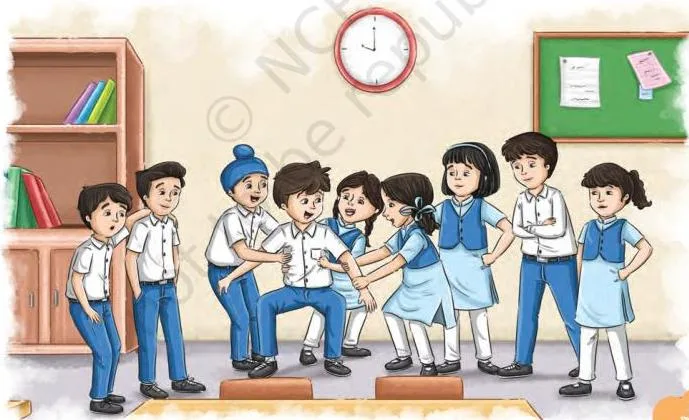
That evening the four children visit Mario’s grandfather, who has won the bet; they eat fruit chaat and hear stories. From then on, whoever passes the magic chair test becomes a friend for life (pp. 63-64).
The comprehension trap sits on page 64: “Mario successfully sat on the invisible chair on his first attempt. True or False?” The answer is False — he fell several times first, and he only stayed up because his friends held him. Holding someone up, not laughing at their falls, is what friendship means.
Language work in the chapter: opposites, past tenses, suffixes and adjectives
This section gathers the grammar and vocabulary the chapter teaches, in the order the book teaches it. There are four threads, all practised inside the activity blocks.
1. Opposites with prefixes (pages 46-47). Opposites can be made by adding letters before a word, and the prefix varies — un-, in-, dis-, mis- (unhappy, incorrect, disconnect, misuse).
The crossword “We are opposites!” is filled with opposites of story words. The grid holds words such as unkind, appeared, hate and untouched, alongside missing, relieved, sad and awake (p. 47). A follow-up paragraph on the same page asks you to complete it with some of the puzzle words.
2. Three past tenses (page 48). The book’s table sets out three forms and three building rules:
| Tense | When to use it | How it is built | Example |
|---|---|---|---|
| Simple past | Action happened earlier and is finished | Second form of the verb, or add -d / -ed | Gajaraj looked at the dog |
| Past progressive | Action was going on and did not finish | was / were + verb + -ing | Gajaraj was looking at the dog |
| Past perfect | Action was completed before another | had + third form of the verb | The mahout had served food before the dog arrived |
The task sends twenty verbs from the story into the three columns — was looking, looked, had ordered, was missing, hated, had followed, went, had remained, served, had tied and arrived are a sample (p. 48).
Here is the difference in fresh sentences. “Gajaraj looked at the dog” is simple past — the looking is finished. “Gajaraj was looking at the dog when it wagged its tail” is past progressive — the looking was going on while something else happened.
Use simple past for the completed steps of a story and past progressive for the background action in progress.
3. Neither…nor and either…or (page 49). Neither…nor connects two negative choices — both are rejected. Either…or offers a choice between two options — one of them is true. In your own words: “Neither Gajaraj nor Buntee ate that night” rejects both; “Either the elephant or the dog ate first” offers a choice.

The picture on page 49 pairs with the grammar sentence: “Either Bhavesh or Abha made this painting” — one of the two children made it, and we choose between them (p. 49).
4. Root words, suffixes and adjectives (pages 65-67). Words like friendly, suddenly, talking, carrying, called and showed split into a root word and a suffix — friend + -ly, sudden + -ly, talk + -ing.
A suffix can change spelling: magic + -al becomes magical, and the book flags exactly this in its suffix table (p. 65). Adjectives are describing words; the story calls Mario “brave and determined” (p. 66), and the matching task on page 67 pairs adjectives such as clever, tasty, heavy, slight and true with suitable nouns.
Figures in the Friendship chapter and what they are for
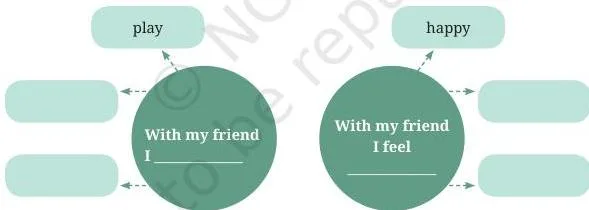
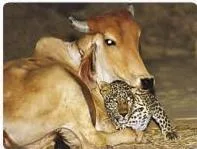



This section explains three activity pictures in the chapter and the job each one does for you. In order, they form a prepare → listen → create chain.
Page 39 — the pre-reading shapes.
Before reading “The Unlikely Best Friends”, you complete sentences in these shapes: why friends matter, what you do together and how you feel. One sentence is done as an example. The job is to prepare — the sentences you write are the ideas you carry into the story (p. 39).
Page 49 — the leopard and the cow listening fill-in.
In this Let us listen activity you hear a story called “Unlikely Friends” and fill the gap: “The leopard is a ___ animal but it became a friend of a cow” (p. 49). The transcript on page 71 is the true story of a cow and a leopard from Vadodara in Gujarat — the unlikely-friendship theme repeating in real life.
Page 74 — the Save Water poster.
The chapter ends with Let us ponder, a task separate from friendship. You discuss three points — sources of water, that without water there cannot be any life, and the value of water and the need to save it — then make a poster with a meaningful slogan (p. 74). The job is to create.
Key definitions from the chapter, in plain words
These are the terms the chapter formally teaches, defined in plain words with the NCERT page where each appears.
- Opposite (p. 46) — a word with the opposite meaning, like sad and filled with joy; opposites can be formed with prefixes such as un-, in-, dis-, mis-.
- Verb (p. 48) — a word that tells us about an action, like looked, served or gave.
- Simple past tense (p. 48) — shows an action that happened earlier and is finished; second form of the verb, or verb + -d / -ed.
- Past progressive tense (p. 48) — shows an action that was going on and did not finish; was / were + verb + -ing.
- Past perfect tense (p. 48) — shows an action that was completed; had + third form of the verb.
- Neither…nor (p. 49) — connects two negative choices; both are rejected.
- Either…or (p. 49) — offers a choice between two options; one of them is true.
- Root word (p. 65) — the base part of a word; friendly splits into root friend + suffix -ly.
- Suffix (p. 65) — letters that come after the root word; a suffix can change spelling, as magic + -al = magical.
- Adjective (p. 66) — a word that describes the quality of a person or a thing; Mario is described as brave and determined.
For the story’s everyday vocabulary — booth, stables, mahout, trunk, strayed, munching, winced — the book prints a margin glossary on pages 40-45, a running dictionary at the foot of each page.
Worth defining yourself are the two concept words behind the first story. A caretaker looks after your needs; a friend chooses you, plays with you and misses you when you are apart (p. 40).
Common mistakes in this chapter’s language work
These are the errors students actually make in this chapter, named before you make them. Each row gives the mistake, the correct rule and a way to check your work.
| Mistake | Correct rule | How to check your answer |
|---|---|---|
| Every opposite takes “un-”. | Prefixes vary: un-, in-, dis-, mis- (p. 46). | Try the word in a sentence; the puzzle on page 47 fixes the correct prefix. |
| “Looked” and “was looking” are used as if they mean the same. | Simple past = finished action; past progressive = action going on (p. 48). | If another event interrupts the action, use was / were + -ing. |
| “Neither…or” written together. | Neither…nor for two negative choices; either…or for a choice between two (p. 49). | Both options rejected? Use nor. One of two chosen? Use or. |
| Suffixes never change spelling. | Suffixes can change spelling: magic + -al = magical (p. 65). | Say the new word aloud — magical, not “magicing”. |
| Mario sat on the chair at the first attempt. | False — he fell several times; his friends held him up (pp. 61, 64). | Re-read the passage where the classmates laugh at his falls. |
| The poem is a speech on friendship. | It is a prayer — wishes offered for friends (p. 54). | The summary task circles “prayer for”, not “speech on”. |
Using the Friendship chapter for tests and homework
This section says plainly what you can prepare from this chapter. One caution first: Class 6 is assessed by schools — CBSE board examinations begin only at Class 10 — so the chapter’s weight depends on your school’s own scheme. Textbook contents and the examinable syllabus are not always identical; check the current official syllabus.
Whatever your school does, five things are safe to prepare:
- Retell each text in your own words. The “Let us think and reflect” blocks for all three texts train exactly this (pp. 45, 54, 64).
- Learn the margin vocabulary on pages 40-45 — the running glossary at the foot of each page.
- Master the four grammar threads from “Let us learn”: opposites, three past tenses, neither/either, suffixes and adjectives.
- Practise the writing tasks the chapter sets: six sentences about a friend (p. 51), an 80-word paragraph describing how a friendship started (p. 58), Mario’s message to a friend (p. 69) and an acrostic poem on FRIENDS (p. 70).
- Self-practise listening with the transcripts on pages 71-73 — the cow and leopard, Ajay and Dhiraj’s outdoor activities, and Manu and Monika’s friendship.
For chapterwise help across the book, the Class 6 English notes page collects notes for every Poorvi chapter.
What to remember from Chapter 2 Friendship
This is the night-before recap — five points carry the whole chapter.
- “The Unlikely Best Friends” — comforts do not make a friend. Gajaraj has royal comforts but no friend; he and Buntee choose each other, both stop eating when parted, and the mahout and farmer find friendship too (pp. 40-44).
- “A Friend’s Prayer” — a prayer, not a speech. Give your best for friends, use your heart to see, make no judgements, and love friends as they are (pp. 53-54).
- “The Chair” — real friends hold you up. The invisible chair test works because Guneet, Asma and Deepa catch Mario while the classmates laugh; a friend is not someone who enjoys your bad luck (pp. 60-63).
- Language threads — opposites with un-, in-, dis-, mis-; three past tenses; neither…nor and either…or; suffixes and adjectives (pp. 46-49, 65-67).
- The listening stories repeat the unlikely-friendship idea — a cow and a leopard in Gujarat, and friends who cycle and share comics (pp. 71-72).
Related resources for Class 6 English Poorvi
This listing is maintained for the 2026-27 academic session using the NCERT textbook information available to us. NCERT remains the authority for confirming the latest edition.
Chapter 1 of Poorvi is “Fables and Folk Tales”; Chapter 3 is “Nurturing Nature”. Use these links to move between chapters and around the site:
- Class 6 English Poorvi Chapter 1: Fables and Folk Tales — the previous chapter, which also uses the activity chain
- Class 6 English Poorvi Chapter 3: Nurturing Nature — the next chapter
- Class 6 English Poorvi book page — every chapter of this textbook in one place
- Class 6 hub — all NCERT Class 6 books
- Fables and Folk Tales notes and Nurturing Nature notes — chapterwise study notes for the same book
- Class 6 notes and the CBSE notes home — study material across subjects
Official sources: the NCERT official website publishes the current Poorvi edition and its official chapter PDFs; the CBSE official website publishes the current curriculum and syllabus for what is examinable this session.
Sources and data verification
Four facts about this page, plainly stated:
- This page describes the NCERT Class 6 English textbook Poorvi, Chapter 2 “Friendship”, book pages 39-74, as published on ncert.nic.in.
- It covers this one chapter only, not the rest of the book.
- It is maintained for the current academic session using the NCERT information available to us.
- NCERT settles textbook editions and official PDFs; CBSE settles curriculum, syllabus and examinations.
| What the chapter holds | Count | Where it is used |
|---|---|---|
| Printed pages | 36 | |
| Figures with NCERT captions | 12 | |
| Tables | 12 | |
| Official NCERT PDF | Download the chapter PDF | the chapter exactly as NCERT publishes it |
Reference: NCERT Class 6 English textbook (Poorvi), chapter 2, official edition on ncert.nic.in.
FAQs on Class 6 English Poorvi Chapter 2 Friendship
What is the moral of The Unlikely Best Friends?
Comforts do not make a friend — friendship is chosen. Gajaraj has royal comforts but no friend; the mahout is a good caretaker, not a friend. Only when Buntee arrives does Gajaraj have someone to play with, and both animals stop eating when they are parted (pp. 40-44).
Who are the characters in Class 6 English Poorvi Chapter 2 Friendship?
Each text has its own cast. “The Unlikely Best Friends” has Gajaraj the elephant, Buntee the dog, the mahout and the farmer. The poem has the speaker who prays for her friends. “The Chair” has Mario, his grandfather, and his three real friends — Guneet, Asma and Deepa.
How does the invisible chair test work in The Chair?
Mario tries to sit on a chair nobody can see, and he falls — with the classmates laughing. When he finally stays up, it is because Guneet, Asma and Deepa are holding him so he cannot fall. The test sorts real friends, who hold you up, from companions, who enjoy your bad luck (pp. 60-63).
Which grammar topics does the Friendship chapter teach?
Four areas: opposites formed with the prefixes un-, in-, dis- and mis- (pp. 46-47); the three past tenses — simple, progressive and perfect (p. 48); the pairs neither…nor and either…or (p. 49); and root words, suffixes and adjectives (pp. 65-67).
What does “unlikely” mean in the title “The Unlikely Best Friends”?
It means a friendship nobody would predict. An elephant and a stray dog are so different that no one expects them to become friends, yet they do (p. 40).
Where can I find the official Class 6 English Poorvi Chapter 2 Friendship PDF?
On NCERT’s official website, ncert.nic.in, which publishes the full current edition of Poorvi free. The Friendship Class 6 English Poorvi Chapter 2 PDF link near the top of this page points to that official source; the chapter covers book pages 39-74.
Explore Class 6 English Books
- Previous: Fables and Folk Tales
- Next: Nurturing Nature
Related chapters:
- Sports and Wellness
- Culture and Tradition