
This is the NCERT Class 5 Environmental Studies chapter 1, Water—The Essence of Life, from the book Our Wondrous World. The chapter runs from page 3 to page 20 and follows two friends, Afreen and Jyoti, as they watch rain slide down a window and ask where all that water comes from — and where it goes. The official chapter PDF is right below.
Download the Official Chapter PDF
Download the official Water—The Essence of Life Class 5 PDF straight from NCERT to read the complete chapter on your phone — all eighteen printed pages, from Afreen and Jyoti’s rainy-day question on page 3 to the “Let us reflect” questions on page 20.
The official edition is published by NCERT on ncert.nic.in, so the file matches the book exactly — every activity, picture and “Do you know?” box included.
Chapter at a Glance
The table below maps what the chapter holds — its sections, figures, activities and tables — so you can see the shape of the chapter before you start reading. Treat it as your map: find the activity your teacher mentioned, then jump to that part of the chapter.
What This Chapter Covers
This chapter is built around one child’s question and never really stops answering it. Once you know the route, the whole chapter is easy to follow:
- The opening question (p. 3): Afreen and Jyoti watch rain slide down the window and ask where the water comes from and where it goes.
- How little freshwater there is (pp. 3–4): most of Earth’s water is salty, and the glass-and-teaspoon picture makes the point unforgettable.
- Three forms of water (pp. 5–6): liquid rain, solid ice and snow, vapour and steam — and the steel-glass activity that shows water changing form.
- The water cycle (pp. 7–8): the sun heats water, it rises as vapour, cools into droplets, and falls back as rain, snow or hail.
- Groundwater and recharge (pp. 8–9): rain soaks into soil and is stored underground, and open ground is what lets it get there.
- Surface water and rivers (pp. 10–13): the mustard-seed activity, the map of India’s rivers, and the Follow the Flow! table.
- Life in water (pp. 14–19): the pond community, waterproof leaves, and a food chain game.
The chapter also carries “Do you know?” boxes that add real-world facts. Each one makes an idea from the page concrete:
- Johads of Rajasthan (p. 3): traditional small earthen dams that collect rainwater and recharge groundwater.
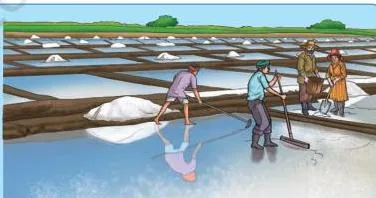
- Salt pans of Gujarat (p. 4): seawater is dried in vast flatlands to collect salt.
- Water Lake, Jammu and Kashmir (p. 5): one of Asia’s largest freshwater lakes.
- Fishing Cat and Keibul Lamjao (p. 7): a wetland cat with partially webbed paws, and the world’s only floating national park, in Manipur.
- Statue of Unity (p. 9): the world’s tallest statue, 182 metres, in India.
- Luni river and Hivare Bazar (p. 11): a river that reaches no sea, and a water-positive village in Maharashtra.
- Jal Shakti Museum (p. 13): India’s first water museum, in New Delhi.
Key Concepts in This Chapter
This chapter builds the whole water story from one rainy-day question, then keeps asking “what happens next?”. Each idea below sits on a page you can open in your own book.
Freshwater is far rarer than it looks
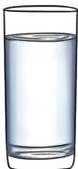
This is the chapter’s central surprise, and the picture on page 4 makes it stick. Earth’s surface is mostly water, but most of it is salty. If all the water on Earth were poured into one glass, the freshwater would fill only a teaspoon (NCERT, p. 4).
Ocean water cannot be drunk, and all living beings — people, animals, birds and plants — depend on freshwater for drinking, for growing crops and for daily life. Without water, life would not be possible (NCERT, p. 3). That is why the chapter treats water as a limited and essential resource.
Water takes three forms
Ice, liquid water and steam look different, but they are the same substance in three forms: solid, liquid and vapour. The book names them with everyday examples — liquid as rain, solid as ice and snow, vapour as steam (NCERT, p. 5).
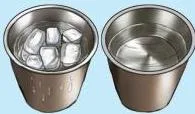
Activity 2, the steel-glass experiment, shows the changes. Put ice cubes in a steel glass and droplets appear on the outside; leave them and the ice melts; heat water and it becomes steam (NCERT, p. 6). The droplets do not leak through the glass — they condense from water vapour in the air.
The “I Observe” table on page 6 asks you to record what you see as ice melts, water boils, and water sits in sunlight for three days.
The water cycle keeps water moving
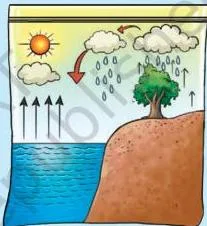
Activity 3 turns the sky into a sealed transparent bag. Draw the sun, clouds and arrows, fill the bag one-third with coloured water, seal it and leave it in sunlight. Within hours the water heats up, vapour forms, droplets appear inside the bag, and they fall back down.
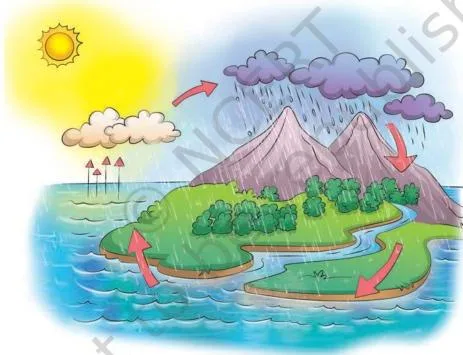
Nature does the same thing on a giant scale. The sun’s heat turns water from oceans and rivers into vapour; the vapour forms clouds; and the clouds come down as rain, snow and hail, returning water to rivers, lakes and oceans (NCERT, p. 7). This constant circular movement of water in nature is called the water cycle (NCERT, p. 7).
Groundwater: rain stored underground
What happens to rainwater? In Activity 4, you pour water onto soil in a glass and watch it sink. In nature, rain soaks into the soil and sinks through layers of soil and rock, and the water stored deep underground is called groundwater (NCERT, p. 9). We draw it back up with wells, borewells, tube wells and handpumps.
But groundwater only returns if the ground lets rain in (NCERT, p. 9). Concrete roads and paved areas stop rainwater from soaking in, so groundwater is not recharged. Open ground, green lawns, soak pits, ponds, human-made lakes and planting more trees all help rainwater return underground (NCERT, p. 9).
Surface water and how rivers flow
Rivers, ponds and lakes are the natural sources of freshwater on the surface, alongside groundwater (NCERT, p. 10). A river usually begins up in the mountains and flows down across the land — and Activity 6, the mustard-seed experiment, shows why.
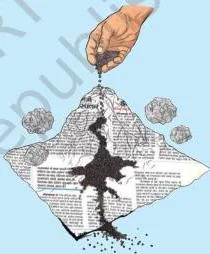
Crumple a newspaper, lay a flat sheet over it, and pour mustard seeds onto the highest point. The seeds curve, stop and gather in the folds — exactly how water behaves.
Water flows, stops or curves according to the shape of the land (NCERT, p. 10). Moving water can even change the shape of the land. This is why some Indian rivers reach the Arabian Sea and some reach the Bay of Bengal: the slope and shape of the land decide.
The map of India on page 12 and the Follow the Flow! table on page 13 ask you to trace the Godavari, the Narmada and the Ganga and record which sea each one reaches.
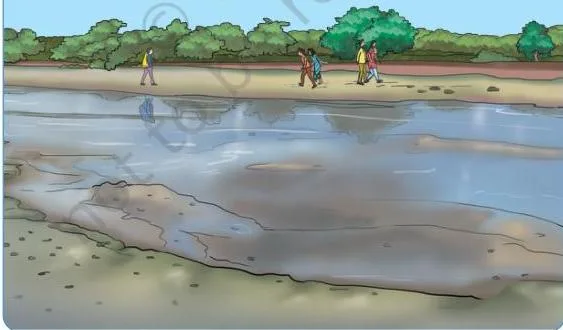
One river breaks the pattern: the Luni, starting in the Aravalli Range in Rajasthan, is the only major Indian river that does not drain into a sea — it ends in the marshy Rann of Kutch in Gujarat (NCERT, p. 11).
Life in and around water
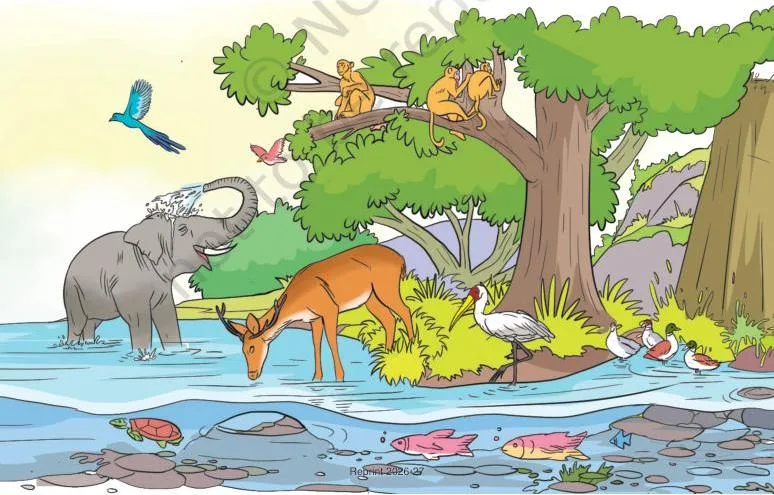
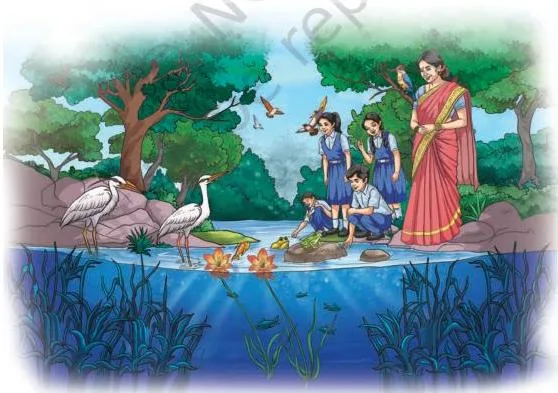
After the rain, the pond near Afreen and Jyoti’s school fills up, and suddenly it is full of life — tiny fish swimming and a small frog sitting on a lotus leaf (NCERT, p. 14). Comparing animals on land with animals in water is the chapter’s way of getting you to look at special features.
The pond community on page 16 reads like a list of adaptations:
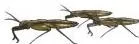
- Dragonfly — flies fast, lays eggs near water, eats mosquitoes.
- Water scorpion — an insect with pincers that lives underwater and breathes through a tail tube.
- Pond heron — a bird with long legs that stands still to catch fish.
- Freshwater turtle — a soft-shelled turtle that lives in ponds and rivers.
- Water snake — harmless, eats fish and frogs.
- Reeds — edge plants, tall and grass-like.
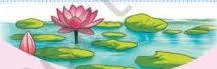
- Lotus and water lily — rooted floating plants; flowers float, roots stay in the pond bed.
- Water hyacinth — free-floating and fast-growing.
Activity 9 tests a leaf’s secret: a drop of water sits on wax-crayon paper just as it sits on a water plant’s leaf. The waxy coating makes the leaf waterproof and keeps too much water from getting inside, so the plant stays healthy (NCERT, p. 18).
Then the “Who Eats Whom?” food chain game on page 19 ties the community together. Every pond creature depends on others for food, so if one animal disappears, the rest are affected too (NCERT, p. 19).
Figure Walkthrough: Reading the Chapter’s Key Pictures




The pictures in this chapter are not decoration — each one carries an idea the words depend on. Here is how to read the important ones.
How rare freshwater is: the glass, the teaspoon and the salt pans (page 4)
The glass picture does the chapter’s hardest job in one glance: the glass stands for all the water on Earth, and the teaspoon beside it is every drop of freshwater. The pair even carries its measurements — 200 ml in the glass and 5 ml in the teaspoon — so the comparison is concrete, not vague.
The salt-pans picture answers the “Discuss” question on page 4 — what can ocean water be used for? Seawater dried in the flatlands of Gujarat gives India one of its largest salt-producing areas (NCERT, p. 4).
Condensation on a steel glass (page 6)
The droplets forming outside the cold steel glass are the chapter’s proof that there is water vapour in the air. The ice inside only cools the glass; the droplets come from air moisture condensing on the cold surface (NCERT, p. 6). Look at the outside of the glass — that is the clue that the droplets did not come through it.
Evaporation and condensation in a bag (page 7)
Trace the three steps in this picture: sunlight warms the coloured water, vapour rises inside the sealed bag, and droplets collect on the inner surface and fall back down. The bag holds a whole water cycle in miniature — the “I Observe | I Wonder” table on page 7 asks you to name what caused each change.
The water cycle at a glance (page 8)
This diagram pulls the whole cycle into one circle. The sun’s heat raises vapour from oceans and rivers, vapour forms clouds, and water returns as rain, snow and hail. Follow the arrows with your finger — every arrow is a step you saw in the sealed bag, scaled up to the sky.
Rain soaking into the ground (page 9)
This is the groundwater picture. Rain falls on open ground, soaks into the soil, and sinks through layers of soil and rock to be stored deep underground (NCERT, p. 9). Compare it with the “tick the image” activity on the same page: a green lawn lets water in; a concrete road and a paved area do not.
Rivers follow the land: seeds and the Luni (pages 10–11)
The mustard-seed picture shows water’s rule in miniature: seeds curve around folds, stop in hollows, and gather in low spots — the same way rivers bend, pool and form lakes. Whatever path they take, water follows the shape of the land.
The Luni picture is the exception that proves the rule. It starts in the Aravalli Range, but instead of reaching a sea it ends in the marshlands of the Rann of Kutch — the only major Indian river that does not drain into a sea (NCERT, p. 11).
Reading the pond community (page 16)
Each pond creature’s picture is a clue to how it lives. Read the features, not just the animal:
The dragonfly is built for speed: it flies fast, eats mosquitoes, and lays its eggs near water.
The water scorpion lives underwater and breathes through a tube at the end of its tail, catching prey with its pincers.
The tall, grass-like reeds are edge plants — they grow along the edges of ponds, not in deep water.
Lotus and water lily are rooted floating plants: their flowers float on the surface while their roots stay anchored in the pond bed. The water hyacinth, in contrast, is free-floating and spreads fast.
Definitions: Words You Need for This Chapter
The book does not print a glossary, so here is the chapter’s working vocabulary in plain words, with the page that shows each idea.
| Term | What it means | Where the idea appears |
|---|---|---|
| Freshwater | Water that is not salty; the water living beings drink and use | NCERT, p. 3 |
| Saltwater / ocean water | Salty water that covers most of the Earth; not fit for drinking | NCERT, p. 3 |
| Source of water | A place where freshwater is found — rivers, ponds, lakes, groundwater | NCERT, pp. 5, 10 |
| Solid, liquid, vapour | The three forms of water: ice and snow, liquid rain, and steam or vapour | NCERT, p. 5 |
| Evaporation | Water turning into vapour when it is heated | NCERT, p. 7 |
| Condensation | Vapour cooling and turning back into droplets | NCERT, p. 7 |
| Water cycle | The constant circular movement of water in nature | NCERT, p. 7 |
| Groundwater | Water stored deep underground after sinking through soil and rock | NCERT, p. 9 |
| Groundwater recharge | Rainwater returning underground; open ground allows it, paved ground blocks it | NCERT, p. 9 |
| Surface water | Freshwater on the surface — rivers, ponds, lakes | NCERT, p. 10 |
| Food chain | The who-eats-whom connection between living things | NCERT, p. 19 |
Common Mistakes Students Make in This Chapter
This chapter is built around small observations, and nearly every mistake comes from guessing before observing. The table names each wrong idea, the correct rule, and a quick way to check yourself.
| Mistake | Correct rule | How to check your answer |
|---|---|---|
| “The droplets on the cold glass seep through the glass” | They form from water vapour in the air condensing on the cold surface (NCERT, p. 6) | Dry the outside of the glass first — the droplets still reappear |
| “Ocean water is useless” | The salt pans of Gujarat dry seawater to make salt (NCERT, p. 4) | Name one use of ocean water before answering “Discuss” on page 4 |
| “Groundwater is an underground river” | It is rainwater that sank through soil and rock and got stored deep (NCERT, p. 9) | Repeat Activity 4 — water sinks through soil in a glass |
| “Paved and cemented areas help groundwater” | They block rainwater from soaking in, so groundwater is not recharged (NCERT, p. 9) | Tick the green lawn, not the concrete road, in Activity 5 |
| “The water cycle only makes rain” | It also brings snow and hail (NCERT, p. 7) | List the three ways clouds come down: rain, snow, hail |
| “Rivers flow in straight lines” | Water flows, stops or curves according to the shape of the land (NCERT, p. 10) | Replay the mustard-seed activity and watch the seeds curve |
| “Waxy leaves are a flaw” | The waxy coating is a protection — it keeps excess water out so the plant stays healthy (NCERT, p. 18) | Drop water on wax-crayon paper and watch it sit on top |
| “Removing one pond animal does not matter” | Every creature depends on others for food, so losing one affects the rest (NCERT, p. 19) | Play the food chain game — the strings connect everyone |
Exam Notes: How to Use the “Let Us Reflect” Questions
This chapter has no long block of end-of-chapter exercises. Its self-check is the seven “Let us reflect” questions on page 20, and each one tests a specific idea from the chapter.
| Question (p. 20) | What it tests | Where the answer lives |
|---|---|---|
| 1. Match ocean water, snow, steam and rainwater to their forms | The three forms of water, and freshwater vs saltwater | NCERT, pp. 3–5 |
| 2. Why most Earth water cannot be used for drinking or farming | The limited share of freshwater | NCERT, pp. 3–4 |
| 3. Why so many living beings live near water bodies | Freshwater habitats support life | NCERT, pp. 14–19 |
| 4. What two years without rain would do | No recharge, no water for drinking and crops | NCERT, pp. 3, 8–9 |
| 5. Rainwater in a forest vs a city | Open ground vs cemented surfaces and recharge | NCERT, p. 9 |
| 6. Design a water-conserving house or school | Soak pits, rainwater harvesting, real examples | NCERT, pp. 9, 11 |
| 7. Fold a paper fish | Hands-on follow-through | NCERT, p. 20 |
For questions 2 to 6, a complete answer gives the reason, not just a one-word reply — saltwater cannot be drunk, cemented surfaces stop recharge, and every living thing depends on fresh water. Where a question asks for a design or an example, naming a real one, such as Hivare Bazar’s rainwater harvesting (NCERT, p. 11), shows you have read the chapter.
One honest caution: textbook contents and the examinable syllabus are not always identical — check the current official syllabus for what is examinable this year.
Revision Summary
If you have one minute, this is the whole chapter. The closing summary on page 19 gives the backbone, and a conservation thread runs through it.
- Water exists as ice, water and vapour — the same water, different forms.
- Water keeps moving through the water cycle, changing its form as it travels through air, land and sky (NCERT, p. 19).
- Aquatic plants and animals live in and around water and depend on it for survival (NCERT, p. 19).
- Freshwater is limited — most of Earth’s water is salty (NCERT, p. 3).
- Groundwater needs open ground to recharge; soak pits, ponds, lakes and trees help (NCERT, p. 9).
- Communities such as Hivare Bazar show that water can be saved through careful planning (NCERT, p. 11).
Related Resources
This listing is maintained for the 2026-27 academic session using the NCERT textbook information available to us. NCERT remains the authority for confirming the latest edition.
Chapter 1 is the first half of the unit. Its companion, Chapter 2, “Journey of a River”, follows the Godavari from its origin to its delta (NCERT, p. 2). Browse every chapter on the NCERT Class 5 Environmental Studies book page, find notes for all subjects on the NCERT Class 5 hub, and see all NCERT Class 5 study resources here.
The official current edition of Our Wondrous World is published by NCERT. Check and download any chapter from the official NCERT textbook portal, which hosts every class’s books in the languages NCERT publishes them.
| What the chapter holds | Count | Where it is used |
|---|---|---|
| Printed pages | 20 | |
| Figures with NCERT captions | 16 | |
| Tables | 6 | |
| Activities | 10 | |
| Official NCERT PDF | Download the chapter PDF | the chapter exactly as NCERT publishes it |
Reference: NCERT Class 5 Environmental Studies textbook, chapter 1, official edition on ncert.nic.in.
Sources and Data Verification
Four facts about this page, stated plainly:
- What this page describes: the NCERT Class 5 Environmental Studies textbook Our Wondrous World (English), Chapter 1, “Water—The Essence of Life”, printed pages 3–20.
- What it covers: Chapter 1 only. The unit also contains Chapter 2, “Journey of a River” (NCERT, p. 2), which has its own page.
- How current it is: maintained for the current academic session using the NCERT information available to us.
- Who settles what: NCERT settles textbooks, editions and PDFs; CBSE settles the curriculum, syllabus and examinations.
Frequently Asked Questions
Why can’t we drink ocean water when most of the Earth is covered with water?
Because ocean water is salty, and saltwater is not fit for drinking or farming. Page 4’s picture makes the point unforgettable: if all the water on Earth were in one glass, freshwater would fill only a teaspoon. All living beings depend on that small share of freshwater to survive (NCERT, p. 3).
Where do the water droplets on a cold glass come from?
From the air, not through the glass. Air always holds invisible water vapour; when the vapour touches the cold steel glass it cools and turns into tiny droplets (NCERT, pp. 6–7). The ice inside only cools the glass — it does not leak.
What is groundwater and how does rainwater reach it?
Groundwater is water stored deep underground. When it rains, some water soaks into the soil and sinks through layers of soil and rock (NCERT, p. 9). Open ground lets this happen, while concrete roads and paved areas block it and stop recharge — which is why soak pits, ponds and trees help (NCERT, p. 9).
Which rivers in India flow into the Arabian Sea and which into the Bay of Bengal?
Look at the map of India on page 12 and trace each river with your finger — the map shows the direction each river flows and where it ends. The mustard-seed activity on page 10 explains why: water flows, stops or curves according to the shape of the land, so the slope decides a river’s path. The “Follow the Flow!”
table on page 13 names the rivers to check — the Godavari, the Narmada and the Ganga. The Luni is the exception: it reaches no sea at all and ends in the Rann of Kutch (NCERT, p. 11).
Why do water plants have a waxy coating on their leaves?
To stay waterproof (NCERT, p. 18). The waxy coating stops too much water from getting inside the plant, so the plant stays healthy and is not damaged. Activity 9 shows the same idea: a drop of water sits on wax-crayon paper the way it sits on a lotus leaf.
What would happen if it did not rain in our region for two years?
In a word: shortage. With no rain, groundwater would not be recharged, so wells, borewells and handpumps would slowly run dry (NCERT, p. 9). There would be little water for drinking, growing crops or daily life — the very things freshwater provides (NCERT, p. 3).
This is why the chapter ends by showing villages like Hivare Bazar that save water through careful planning (NCERT, p. 11).
Explore Class 5 Environmental Studies Books
- Next: A Snake Charmer's Story
Related chapters:
- Super Senses
- Journey of a River
- From Tasting to Digesting