
This is the official Paper Boats Class 3 NCERT chapter page. Paper Boats is Chapter 6 of the NCERT Santoor English textbook for Class 3. The official Paper Boats Class 3 PDF is right below, and underneath it every part of the chapter — story, new words and exercises — is explained with answers.
Download the Paper Boats Class 3 NCERT PDF
The official Paper Boats Class 3 PDF (Santoor Chapter 6) is published on the NCERT textbook portal, where you can open, download or print the complete chapter — story, new words, exercises and self-assessment sheet — at no cost.
Chapter 6 at a glance
The table below lists what the chapter holds — its sections, pictures and activities — so you can see the size and shape of the file before you open it.
What this Santoor chapter contains
A Santoor unit works like this: a story or poem first, then language work and activities that build on it. Paper Boats follows that pattern, and the table below names each section and what it asks the student to do.
| Section | What it asks the student to do | Skill it builds |
|---|---|---|
| Let us read | Reads the story of Meena and her paper boats | Reading |
| New words | Learns the meanings of five words from the story | Vocabulary |
| Let us think | Answers questions on the story and marks statements true or false | Comprehension |
| Let us speak | Tells the picture story of Manish and the ant to the class | Speaking |
| Let us learn | Fills blanks using ‘he’ or ‘she’ | Grammar |
| B. Look at the picture | Writes where each thing is, choosing in, on or under | Prepositions |
| Let us do | Follows six steps to draw a rangoli | Following instructions |
| Let us write | Writes a few lines about a park picture using clue words | Writing |
| B. Solve the crossword puzzle | Fits toy and game words into the grid | Vocabulary |
| Let us explore | Asks elders about the games they played when young | Collecting information |
| SELF ASSESSMENT | Ticks how well the student can do each skill | Self-reflection |
The story: Meena, the paper boats and the boy at the stream
If the printed story felt confusing, here is the sequence in plain words. Meena walks to the stream near the bamboo bridge carrying a paper boat. She bends, puts the boat into the water, and watches it sail off swiftly (story, Let us read). Delighted, she launches several more.
A naughty boy spoils the game. As her boats float down the stream, he pushes them into the water. Meena stares at him angrily and shouts ‘Stop!’, but he carries on. When she asks why he is overturning her boats, his answer is simple: ‘Because it is fun.’ She tells him to stop — they are her boats.
The boy thinks for a minute. He promises not to do it again, but he wants to play too. Meena has enough paper, so she tells him he can make boats for himself.
When he says he does not know how to fold, Meena shows him step by step. The boy watches carefully, then folds his own boat. Soon both children are launching boats and watching them sail together.
That is the resolution: a quarrel becomes a game. Meena could have stayed angry and chased the boy away. Instead she shares her paper, teaches him, and both enjoy the stream together.
The pictures in Paper Boats and what they show
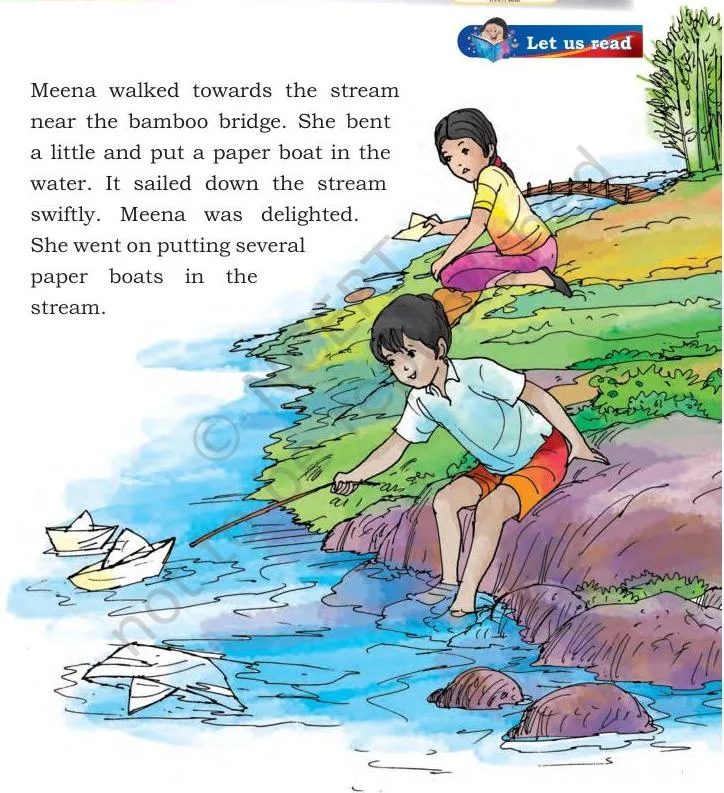
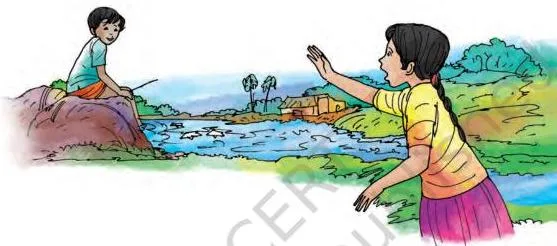
The chapter opens with two illustrations that carry the story’s setting and its conflict. Read them along with the text and the plot becomes easier to follow.
The first picture sets the scene: it shows Meena walking towards the stream with her paper boat, with the bamboo bridge beside the water. This is exactly where the story begins.
The second picture introduces the conflict: the naughty boy pushes the floating boats into the water while Meena watches. It is the moment the story’s problem starts.
New words in the chapter: what they mean
The New words box lists five words from the story. Knowing them before you read makes the text much easier.
| Word | Meaning | Where it appears in the story |
|---|---|---|
| delighted | very happy | Meena felt this when her first boat sailed down the stream |
| several | more than two | Meena put several paper boats into the stream |
| overturning | turning upside down | the boy kept overturning Meena’s boats in the water |
| stream | a narrow natural flow of water | the stream near the bamboo bridge where Meena plays |
| watched | looked carefully | the boy watched Meena fold the paper before trying himself |
Two of the words in fresh sentences: delighted — “Riya was delighted when her kite rose higher than the trees.” watched — “The boy watched the paper carefully before folding his own boat.”
He or she: the pronoun exercise, answered
Pronouns let us avoid repeating a name. The chapter’s Let us learn section shows two examples: ‘she’ replaces Meena, and ‘he’ replaces the boy. So the rule is simple — she for girls, he for boys.
The book does not print an answer key for this exercise, so the four blanks are worked out below. The note to the teacher connects the exercise to the use of ‘he’ and ‘she’ in Units 1 and 2 of the book.
| Sentence | Answer | Why |
|---|---|---|
| Rani likes playing outside. ___ likes flying kites. | she | Rani is a girl’s name, so we use ‘she’. |
| Sahil has a top. ___ plays with it every day. | he | Sahil is a boy’s name, so we use ‘he’. |
| Durga is five years old. ___ is going to school. | she | Durga is a girl’s name. |
| Ranjit goes to school regularly. ___ likes reading stories. | he | Ranjit is a boy’s name. |
Two fresh examples to practise on: “Priya has a new doll. ___ loves it” — she. “Arjun has a bat. ___ plays with it every evening” — he.
On, in and under: the picture exercise, answered
A position word tells where one thing is in relation to another. In means inside, on means on top of, and under means below. The picture in the chapter shows a room, and the word in brackets is the only choice for each sentence.
| Sentence | Word chosen | Why |
|---|---|---|
| The bat is ___ the bed. | under | The bat lies below the bed. |
| The bag is ___ the chair. | on | The bag sits on top of the chair. |
| The ball is ___ the box. | in | The ball is inside the box. |
| The car is ___ the table. | under | The car is below the table. |
| The books are ___ the shelves. | on | The books rest on top of the shelves. |
Make your own “Where is it?” sentences: “Where is the cup? It is on the table.” “Where is the cat? It is under the chair.” “Where is the pencil? It is in the box.”
True or false: what the story proves
Two statements are traps — they sound close to the story but are actually reversed. Check each one against the text before you tick.
| Statement | Answer | Proof from the story |
|---|---|---|
| The boy thought it was fun to overturn paper boats. | True | Asked why he overturns the boats, the boy replies, “Because it is fun.” |
| Meena ran home to complain about the boy. | False | Meena stays at the stream. She stares at the boy angrily and shouts “Stop!” — she never runs home. |
| The boy did not know how to make paper boats. | True | The boy says plainly, “I don’t know how to fold the paper to make boats.” |
| Meena had only white paper. | False | The story says Meena took out coloured paper of different sizes. |
The toys and games crossword, solved
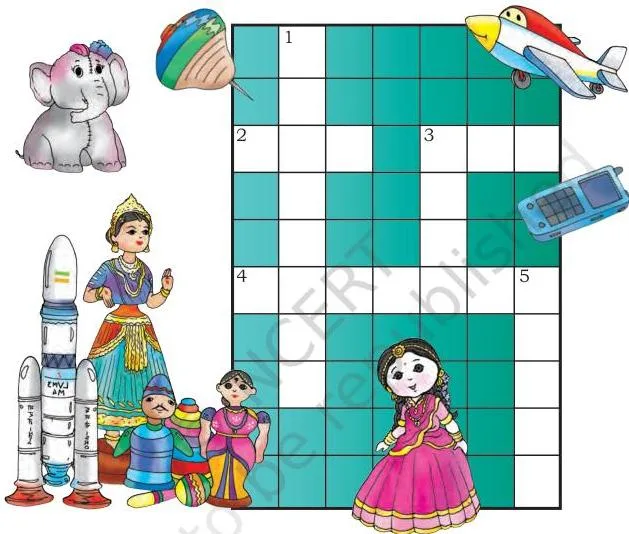
Every answer in this crossword is a toy or a game, as the hint on the picture says. Match each clue to its word; the puzzle grid tells you whether the word goes across or down.
The book does not print a key for the crossword, so the full solution is worked out below.
| Clue | Answer |
|---|---|
| Across 2: A round object that spins on a needle | top |
| Across 3: An object used to hit a ball | bat |
| Across 4: A round glass ball used for playing | marble |
| Down 1: A game played using a ball and your foot | football |
| Down 3: A round object used to play | ball |
| Down 5: A seat tied by ropes and which moves front and back | swing |
Speaking: telling the story of Manish and the ant
Speaking tasks build confidence with words the student already knows. This one asks for an oral story from a picture strip, told to the class.
The strip gives the pictures but no words, so the story is made by describing each frame in order. A simple method: name the character — Manish — then say what happens first, what happens next, and how the rescue ends. One or two sentences per frame is enough.
The note to the teacher suggests giving a help box of clue words and supporting learners as needed — a parent can do the same at home.
The hands-on parts: rangoli, picture writing and games from elders
Three activity sections ask the student to do something rather than just read. Each one builds a different habit.
The Let us do section gives six numbered steps for drawing a rangoli. Following the steps in order is the skill here — each one builds on the last. The note to the teacher points back to the rangoli activity from Mridang, Class 2, so some students may already know the pattern.
The Let us write task gives clue words — park, children, playing, see-saw, swings, slide, enjoying, happy — and asks for a few lines about a park picture using them. A good answer uses every clue word in short sentences.
The Let us explore task sends the student home to ask elders which games they played when young. The student learns one game and shares it with friends in small groups.
Common mistakes students make in this chapter
These are the errors Class 3 students actually make in this chapter, named before they happen.
| Mistake | Correct rule | How to check your answer |
|---|---|---|
| Choosing ‘he’ or ‘she’ from the way a name sounds instead of the person’s gender. | ‘She’ is for girls, ‘he’ is for boys — the sound of the name does not decide it. | Ask: is the person a girl or a boy? |
| Picking a preposition by sound instead of looking at the picture. | The picture’s geometry decides: in = inside, on = on top, under = below. | Say where the thing really is, then choose the word that matches. |
| Marking true or false from memory of the story’s mood. | Two statements reverse the story — Meena does not run home, and her paper is coloured, not white. | Find the exact sentence in the story before ticking. |
| Reading ‘overturning’ as simply ‘breaking’. | In the story it means turning the boats upside down in the water. | Check the meaning, then find the boat scene in the story. |
| Missing why ‘watched’ matters. | ‘Watched’ means looked carefully — that is how the boy learns to fold. | Ask: what did the boy do just before he made his own boat? |
How this chapter is assessed
The chapter ends with a SELF ASSESSMENT sheet — a checklist of the student’s own skills, not a test with marks.
The sheet lists five skills: reciting poems, reading stories, writing, telling stories, and doing the exercise questions. For each skill the student ticks the level that is true — for example, reading by myself, with my classmates, or with the help of my teacher; and for the exercises, all, most or a few.
The note to the teacher in the book says the sheet can be filled by the student under the guidance of parents and teachers. What do the levels mean? Roughly: in a group, in pairs, with help, or by myself. The aim is an honest tick, so the student knows what to practise.
One boundary is worth noting: textbook contents and the examinable syllabus are not always identical — check the current official syllabus for what is assessed this session.
Paper Boats in 60 seconds
The chapter has no printed summary section, so here is one to revise from tonight.
- Story: Meena’s anger at the boy overturning her boats turns into teaching — she shares her paper, shows him how to fold, and both sail boats together.
- New words: delighted, several, overturning, stream, watched.
- Grammar: ‘she’ for girls, ‘he’ for boys; in, on and under for where things are.
- Activities: tell the picture story, draw the rangoli in six steps, write about the park, ask elders about their games, and tick the self-assessment.
If you can say the story in two sentences and use ‘she’, ‘he’, ‘in’, ‘on’ and ‘under’ correctly, you have the chapter.
Sources and data verification
This listing is maintained for the 2026-27 academic session using the NCERT textbook information available to us. NCERT remains the authority for confirming the latest edition.
- The chapter described on this page is Chapter 6, “Paper Boats”, of the NCERT Santoor Class 3 English textbook, official edition on ncert.nic.in.
- This page covers this chapter only, not the other chapters of Santoor.
- The page is maintained for the current academic session using the NCERT information available to us.
- NCERT publishes the textbook and its PDFs; CBSE settles the curriculum and examinations.
| What the chapter holds | Count | Where it is used |
|---|---|---|
| Printed pages | 12 | |
| Figures with NCERT captions | 4 | |
| Tables | 1 | |
| Activities | 1 | |
| Official NCERT PDF | Download the chapter PDF | the chapter exactly as NCERT publishes it |
Reference: NCERT Class 3 English textbook (Santoor), chapter 6, official edition on ncert.nic.in.
Related Santoor chapters and resources
Paper Boats sits in the middle of Santoor. The Class 3 English book page lists the chapters of Santoor, and the Class 3 subjects page gathers the other NCERT books for the class. The previous chapter, Talking Toys, and the next Santoor chapter (chapter 7) are its nearest neighbours.
For revision help, our Class 3 English notes cover the same chapters with exercises worked out, and the Class 3 notes hub holds the other subjects. Notes for Talking Toys and The Big Laddoo are already live in the notes library.
Frequently asked questions about Paper Boats
What is the Paper Boats story about?
A girl named Meena sails paper boats on a stream near a bamboo bridge. A boy overturns them for fun, but Meena teaches him to fold his own boats instead, and both play together at the end.
Why was Meena angry with the boy?
Because the boy kept overturning her paper boats in the stream and did not stop even when she shouted “Stop!”. His reason was simple: he thought it was fun.
What are the answers to the he and she fill in the blanks?
Rani gets ‘she’, Sahil gets ‘he’, Durga gets ‘she’, and Ranjit gets ‘he’. Use ‘she’ for a girl and ‘he’ for a boy.
What are the answers to the true or false questions?
True, False, True, False — in that order. The boy calls overturning fun, Meena stays at the stream instead of running home, the boy cannot fold paper, and Meena’s paper is coloured, not white.
How do I solve the toys and games crossword?
Match each clue to a toy or game word: top, bat and marble run across; football, ball and swing go down. Every answer is a toy or a game, as the hint says.
What is the self assessment sheet at the end of the chapter for?
It is a checklist for the student to tick how confidently they can recite poems, read stories, write, tell stories and do the exercises — in a group, with help, or by themselves. The book says it can be filled under the guidance of parents and teachers.
Explore Class 3 English Books
- Previous: Talking Toys
- Next: The Big Laddoo
Related chapters:
- Fun with Friends
- Badal and Moti
- Best Friends