
This page carries Chapter 1 of the NCERT Class 8 Mathematics book Ganita Prakash Part I — the chapter titled A Square and a Cube, 22 printed pages long. It moves from square numbers, their patterns and square roots to cubes, cube roots and the Hardy–Ramanujan number 1729.
The official NCERT PDF of the chapter is right below, and this page is maintained for the current academic session.
Download the NCERT Class 8 Maths Chapter 1 A Square and a Cube PDF
The official file on ncert.nic.in holds the complete chapter exactly as printed, so open NCERT Class 8 Maths Chapter 1 A Square and a Cube PDF to read or save the full chapter — sections, figures, in-text questions and the answer pages at the end.
Chapter at a glance
The overview table on this page lists what the chapter holds — sections, figures, worked examples and in-text questions — so you can judge its size before opening the file. The teaching itself runs through three numbered sections:
- 1.1 Square Numbers (NCERT, pp. 3–10): squares as areas, patterns in last digits and zeros, squares from odd numbers and triangular numbers, then square roots.
- 1.2 Cubic Numbers (NCERT, pp. 11–15): cubes from unit-cube layers, taxicab numbers, cube roots, prime-factor triplets and successive differences.
- 1.3 A Pinch of History (NCERT, pp. 15–16): where the words square, cube and root came from.
There are no separate exercise blocks. Teaching happens through short in-text questions and the two “Figure it Out” sets on pages 10 and 16, with the printed answers collected at the end of the PDF (pages 19–22).
What this chapter covers: squares first, then cubes
The chapter opens with a puzzle: a queen’s will, 100 relatives and 100 lockers. Solving which lockers stay open teaches the factor idea that the whole chapter builds on.
From there, one idea leads to the next:
- Squares as areas — why 1, 4, 9, 16… are called square numbers, and what the notation \(n^2\) means (NCERT, p. 3).
- Patterns — which units digits a perfect square can end in, and the rule about zeros (NCERT, p. 4).
- Squares from odd numbers — the sum of the first \(n\) odd numbers is \(n^2\), with a visual proof (NCERT, pp. 5–6).
- Square roots — the definition, then four different ways to find one (NCERT, pp. 7–9).
- Cubes — \(2^3\) and \(3^3\) from unit cubes, cube roots, and prime-factor triplets (NCERT, pp. 11–15).
- The Hardy–Ramanujan number and the history of the words varga and ghana (NCERT, pp. 13, 15–16).
The chapter closes with a summary on page 17 and a challenge: arrange the numbers 1 to 17 so every adjacent pair adds to a square, then try 1 to 32 in a circle.
Key concepts in this chapter: from the locker puzzle to cube roots
These six ideas carry the whole chapter. Each builds on the previous one, so read them in order — the locker puzzle first, the quick tests second, the root methods third, then cubes.
Why the open lockers are exactly the square numbers
This puzzle sets up the chapter’s key idea: numbers are best understood through their factors.
Each locker is toggled once for every factor its number has. Person 1 opens all lockers, person 2 toggles 2, 4, 6…, and so on. A locker ends open if it is toggled an odd number of times and closed if even (NCERT, p. 1).
Factor counts are usually even because every factor has a partner — 6 pairs as \(1 \times 6\) and \(2 \times 3\). The exception is a square, where one pair is the number with itself, like \(2 \times 2\) for 4 or \(6 \times 6\) for 36. That self-pair gives an odd number of factors (NCERT, p. 2).
So the open lockers are exactly the square numbers: 1, 4, 9, 16, 25, 36, 49, 64, 81, 100 (answer to the puzzle, NCERT, p. 19). The word clues from these lockers give the passcode — the first five lockers touched exactly twice. Those are the prime numbers, with only 1 and themselves as factors, so the code is 2-3-5-7-11 (NCERT, p. 2).
The units-digit test: when a number is definitely not a square
This is the fastest tool in the chapter: in one glance it lets you reject a number as a square.
Looking at the squares of the first 30 natural numbers, every perfect square ends in 0, 1, 4, 5, 6 or 9 — never in 2, 3, 7 or 8 (NCERT, p. 4). So 2032, 2048 and 1027 fail immediately, while 1089 passes the first check.
The test is one-way. A number ending in 6 need not be a square — 26 ends in 6 but is not. The units digit can only rule numbers out, never rule them in (NCERT, p. 4).
Add the zero rule: zeros at the end of a number double when it is squared — three zeros become six — so a perfect square has an even number of zeros at the end, never 1, 3 or 5 (NCERT, p. 4; answer on p. 19).
Squares as sums of consecutive odd numbers
This pattern makes squares visible: each square is a running total of odd numbers.
Subtract consecutive squares and the differences are exactly the odd numbers: \(4 – 1 = 3\), \(9 – 4 = 5\), \(16 – 9 = 7\), \(25 – 16 = 9\) (NCERT, p. 5). Reading it forward, \(1 = 1^2\), \(1 + 3 = 2^2\), \(1 + 3 + 5 = 3^2\), and in general the sum of the first \(n\) odd numbers is \(n^2\).
The \(n\)th odd number is \(2n – 1\) (NCERT, p. 6). The chapter uses this to extend a known square: since \(40^2 = 1600\), the next square is 1600 plus the 41st odd number, \(2 \times 41 – 1 = 81\), giving \(41^2 = 1681\).
The same pattern works as a test. Subtract 1, 3, 5, … from a number and see what happens: reach exactly 0 and it is a perfect square; drop below 0 and it is not. The number 38 fails this way, so it is not a square (NCERT, p. 6).
Four ways to find a square root
Square root is the inverse of squaring: if \(y = x^2\), then \(x\) is a square root of \(y\) (NCERT, p. 7).
Every perfect square has two integer roots: \(8^2 = 64\) and \((-8)^2 = 64\), so \(\sqrt{64} = \pm 8\). This chapter works only with the positive root (NCERT, p. 8).
Method 1 — list the squares until you pass the number. From \(20^2 = 400\), the squares 21², 22², 23²… reach \(24^2 = 576\) (NCERT, p. 8). It works, but only for small numbers.
Method 2 — subtract odd numbers. For \(\sqrt{81}\), keep subtracting 1, 3, 5, … until you hit 0; it takes nine subtractions, so \(\sqrt{81} = 9\) (NCERT, p. 8).
Method 3 — prime factorisation into two equal groups (NCERT, p. 9). Here is the method with a fresh number:
Step 1: Factorise 1764 by dividing by the smallest primes in order:
\[ 1764 = 2 \times 2 \times 3 \times 3 \times 7 \times 7. \]
Step 2: Split the factors into two identical groups — each group gets one 2, one 3 and one 7:
\[ 1764 = (2 \times 3 \times 7) \times (2 \times 3 \times 7) = 42 \times 42 = 42^2. \]
Conclusion: 1764 is a perfect square and \(\sqrt{1764} = 42\).
Method 4 — estimate by bracketing (NCERT, p. 9). The book brackets \(\sqrt{1936}\) between \(40^2\) and \(50^2\), uses the last digit to narrow the root to 44 or 46, splits the interval with \(45^2 = 2025\), and lands on 44. Same recipe with new numbers:
Step 1 — bracket: \(2500 = 50^2\) and \(3600 = 60^2\), so \(50 \lt \sqrt{2916} \lt 60\).
Step 2 — units digit: 2916 ends in 6, so the root ends in 4 or 6.
The candidates are 54 and 56.
Step 3 — midpoint: \(55^2 = 3025 \gt 2916\), so the root is smaller than 55.
Try 54.
\[ 54^2 = (50 + 4)^2 = 2500 + 400 + 16 = 2916 \]
Conclusion: \(\sqrt{2916} = 54\).
Cubes and cube roots: triplets, not pairs
Everything from the square half repeats in three dimensions. The numbers 1, 8, 27, 64… are called cubes because each is a number used as a factor three times (NCERT, p. 11).
Build them from unit cubes: a cube of edge 2 needs \(2 \times 2 \times 2 = 8\) unit cubes, and edge 3 needs \(3 \times 3 \times 3 = 27\). A 4 by 4 square layer repeated 4 times gives \(4 \times 4 \times 4 = 64\) (NCERT, p. 11). In general, \(n^3 = n \times n \times n\) (NCERT, p. 12).
The cube root is the inverse: if \(y = x^3\), then \(x = \sqrt[3]{y}\), so \(\sqrt[3]{8} = 2\) (NCERT, p. 14).
The perfect-cube test mirrors the square test: a number is a perfect cube when its prime factors split into three identical groups. The book shows \(3375 = (3 \times 5)^3\), while \(500 = 2 \times 2 \times 5 \times 5 \times 5\) cannot be grouped into three equal lots, so it is not a perfect cube (NCERT, p. 14).
- Step 1: 4096 is a power of 2 — divide by 2 repeatedly to get \(4096 = 2^{12}\), the number 2 used as a factor twelve times.
- Step 2: Split the twelve 2s into three equal groups of four:
\[ 4096 = (2 \times 2 \times 2 \times 2) \times (2 \times 2 \times 2 \times 2) \times (2 \times 2 \times 2 \times 2) = 16 \times 16 \times 16 = 16^3. \]
Conclusion: 4096 is a perfect cube and \(\sqrt[3]{4096} = 16\).
Odd numbers build cubes too: the \(k\)th cube is a sum of \(k\) consecutive odd numbers — \(3 + 5 = 2^3\), \(7 + 9 + 11 = 3^3\), and so on (NCERT, p. 14). The ten consecutive odds 91 through 109 therefore add to \(10^3 = 1000\).
The part ends with successive differences: differences of squares settle to a constant at the second level, and the book asks you to check that cubes settle at the third (NCERT, p. 15).
The Hardy–Ramanujan taxicab number and the history of the words
Two short stories close the chapter — one about a famous number, one about where the mathematical words came from.
Hardy once visited the ill Ramanujan and remarked that his taxicab’s number, 1729, was “rather a dull number”. Ramanujan replied that 1729 is the smallest number expressible as the sum of two positive cubes in two different ways (NCERT, p. 13):
\[ 1729 = 1^3 + 12^3 = 9^3 + 10^3. \]
Numbers expressible as a sum of two cubes in two different ways are called taxicab numbers; the next two are 4104 and 13832 (NCERT, p. 13).
History: Babylonians recorded lists of squares and cubes on clay tablets around 1700 BCE for land and building problems (NCERT, p. 15). In Sanskrit, varga meant both the square figure and the square power, and ghana meant both the solid cube and a number cubed; the fourth power was varga-varga.
Aryabhata (499 CE) used varga for the product of two equal quantities (NCERT, p. 16).
The word “root” comes from Sanskrit mula — root of a plant, basis, cause or origin — used in varga-mula (square root) and ghana-mula (cube root). The idea passed into Arabic as jidhr and Latin as radix, both meaning root, and Brahmagupta (628 CE) used pada for the same idea (NCERT, p. 16).
Figure walkthrough: what the NCERT diagrams show
Each diagram below is a real figure from the printed chapter. Follow along in your copy of the book — the captions and the notes here explain what each one is telling you.
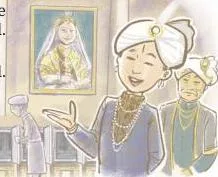
The hint figure (NCERT, p. 1) stops you from acting out all 100 rounds. Count toggles instead: locker 6 is toggled by persons 1, 2, 3 and 6 — exactly its four factors — so it ends closed. The whole puzzle reduces to counting factors.
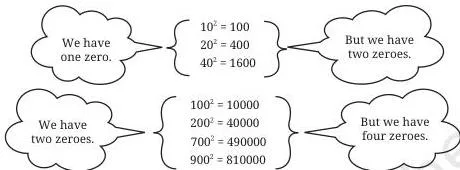
This table (NCERT, p. 5) pairs numbers with their squares so you can compare final digits at a glance. Every square lands on 0, 1, 4, 5, 6 or 9 — proof by inspection that 2, 3, 7 and 8 can never be a square’s last digit.
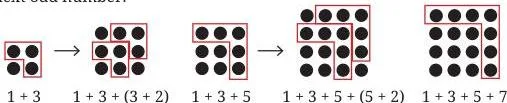
Watch one square grow into the next (NCERT, p. 6). Going from \(2^2\) to \(3^2\) adds an inverted-L strip of 5 unit squares; going from \(3^2\) to \(4^2\) adds 7. The strip added at step \(k\) always holds exactly \(2k – 1\) unit squares — the next odd number.

This is the visual proof of the chapter’s workhorse result (NCERT, p. 6): the first \(n\) odd numbers stack into an \(n\) by \(n\) square, so their sum is \(n^2\). A picture can be a complete proof.
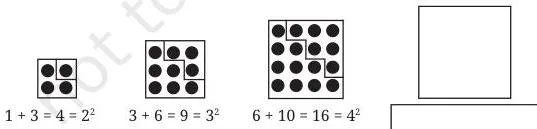
The dots (NCERT, p. 7) set two triangular numbers beside each other. Extend the pattern and each pair merges into a square — \(1 + 3 = 4\), \(3 + 6 = 9\), \(6 + 10 = 16\). That is the triangular–square link the caption asks you to find.
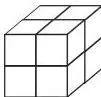
The diagram (NCERT, p. 11) reuses the geometry word cube: a solid whose equal edges meet at right angles. The question under it — how many 1 cm cubes fill a 2 cm cube — sets up \(2^3 = 8\).
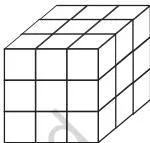
Read the stacks (NCERT, p. 12): \(2 \times 2 \times 2\) unit cubes makes the eight-cube solid, and \(3 \times 3 \times 3\) makes the twenty-seven-cube solid. The solid cubes literally are the numbers 8 and 27.
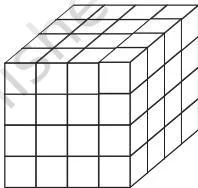
The general cube (NCERT, p. 12) labels each edge \(n\): \(n\) layers, each an \(n\) by \(n\) square layer, so the count of unit cubes is \(n \times n \times n = n^3\). This is the definition of the cube of a number.
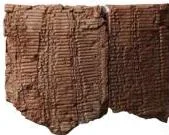
The clay tablet (NCERT, p. 15) is the chapter’s historical anchor: Babylonians around 1700 BCE kept lists of squares and cubes for land measurement and building. It is context rather than exam material, but it explains why the section exists.
Key definitions from the chapter
Here is a quick lookup table of every term the chapter introduces. Each meaning is in plain words, with the page where the chapter first uses the term.
| Term | Meaning in your own words | NCERT page |
|---|---|---|
| Square number / square | A number that equals some number multiplied by itself, e.g. \(9 = 3 \times 3\) | p. 2 |
| Perfect square | The square of a natural number, e.g. 1, 4, 9, 16, 25 | p. 3 |
| Square root | The number that produces a given number when squared; if \(y = x^2\), then \(x\) is a square root of \(y\) | p. 7 |
| Cube | A number obtained by multiplying a number by itself three times, e.g. \(27 = 3 \times 3 \times 3\) | p. 11 |
| Perfect cube | The cube of a natural number, e.g. 1, 8, 27, 64 | p. 11 |
| Cube root | The number that produces a given number when cubed; if \(y = x^3\), then \(x\) is the cube root of \(y\) | p. 14 |
| Taxicab number | A number expressible as a sum of two positive cubes in two different ways | p. 13 |
| Hardy–Ramanujan number | 1729, the smallest taxicab number | p. 13 |
| varga | Sanskrit term for square — both the square figure and the square power | p. 15 |
| ghana | Sanskrit term for cube — both the solid and a number used as a factor three times | p. 15 |
| mula | Sanskrit for root of a plant, basis, cause or origin — the origin of the word “root” | p. 16 |
| varga-mula / ghana-mula | Sanskrit terms for square root and cube root | p. 16 |
Common mistakes in squares and cubes, and how to avoid them
Every wrong idea below comes from the chapter’s own true/false questions and in-text checks. Read the correction before you make the mistake.
| Mistake | Correct rule | How to check your answer |
|---|---|---|
| Any number ending in 6 is a square | A square can end in 0, 1, 4, 5, 6 or 9, but the units digit only rules numbers out, never in — 26 ends in 6 and is not a square (NCERT, p. 4) | Bracket the number between consecutive known squares: 26 lies between \(5^2 = 25\) and \(6^2 = 36\) |
| A square can end in an odd number of zeros | Zeros double when you square: a number with 3 zeros gives a square with 6 zeros (NCERT, p. 19) | Count the trailing zeros; an odd count means not a square |
| The cube of an odd number is even | Odd \( \times \) odd \( \times \) odd is odd, so the cube of an odd number is odd (NCERT, p. 21, answer: False) | Test a small case: \(7^3 = 343\), which is odd |
| No perfect cube ends in 8 | \(2^3 = 8\) and \(12^3 = 1728\) both end in 8 (NCERT, p. 21, answer: False) | Cube any number with units digit 2 and check the last digit |
| The cube of a 2-digit number may be a 3-digit number | The smallest 2-digit number is 10, and \(10^3 = 1000\) already has 4 digits (NCERT, p. 21, answer: False) | Cube 10 and count the digits |
| The cube of a 2-digit number may have seven or more digits | The largest 2-digit cube is \(99^3 = 970299\), which has 6 digits (NCERT, p. 21, answer: False) | Cube 99 and count the digits |
| Cube numbers have an odd number of factors | Only squares have an odd number of factors; 8 has factors 1, 2, 4, 8 — four of them (NCERT, p. 21, answer: False) | List the factors of 8 and count them |
| Confusing the open lockers with the passcode lockers | Open lockers are the squares (odd factor count); passcode lockers are the primes, toggled exactly twice (NCERT, p. 2) | Count the factors of a locker number: odd count = open, exactly two = passcode |
How to use this chapter when preparing for a test
This chapter has no separate exercise set, so your revision should lean on its built-in checks. Work through it in this order:
- Master the two quick tests first — the units-digit rule and the zero rule — since they reject most non-squares instantly (NCERT, p. 4).
- Practise prime-factor grouping until it is automatic: two identical groups for squares, three for cubes.
- Learn the bracket-and-midpoint estimation method for square roots (NCERT, p. 9); it is the fastest way to check a guess.
- Treat “Figure it Out” on page 10 as a square-numbers test and the set on page 16 as a cube-numbers test, then check against the answers at the end of the PDF (pages 19–22).
- Finish with the chapter summary on page 17 as a checklist of what you must know.
Here is what each type of question is really testing:
- Direct concept checks — page 10 Q1–Q3 and Q7, page 16 Q1 and Q4: units digits, last digits and making good guesses.
- Numerical problems — page 10 Q4–Q6 and page 16 Q2: these need a calculation, and factorisation is the route.
- Reasoning — page 16 Q3 and Q5: true/false with explanation, and a greatest-value comparison.
One honest caution: textbook contents and the examinable syllabus are not always identical — check the current official syllabus before assuming every part is testable. For a quicker second pass, the Class 8 Mathematics revision notes on this site and the Power Play chapter notes pair well with this chapter.
Last-minute recap: what to remember from this chapter
Everything below comes from the chapter’s own summary on page 17, put into shorter words. If you remember only this list, you have the chapter’s core.
- A square is a number multiplied by itself; the squares of natural numbers are perfect squares.
- Perfect squares end only in 0, 1, 4, 5, 6 or 9, and end in an even number of zeros.
- Square root is the inverse of square; every perfect square has two integer roots, and this chapter takes the positive one. The symbol is \(\sqrt{}\).
- A cube is a number multiplied by itself three times; the cube-root symbol is \(\sqrt[3]{}\).
- A number is a perfect square when its prime factors split into two identical groups, and a perfect cube when they split into three identical groups.
| Idea | Square | Cube |
|---|---|---|
| Meaning of \(n^2\) / \(n^3\) | \(n \times n\) | \(n \times n \times n\) |
| Root symbol | \(\sqrt{}\) | \(\sqrt[3]{}\) |
| Prime-factor test | two identical groups | three identical groups |
| Possible last digits | 0, 1, 4, 5, 6, 9 only | all digits occur |
| Trailing zeros | even number | multiple of three |
| Odd number \(n\) | \(n^2\) is odd | \(n^3\) is odd |
Related resources: continue with Class 8 Mathematics
This listing is maintained for the 2026-27 academic session using the NCERT textbook information available to us. NCERT remains the authority for confirming the latest edition.
Because A Square and a Cube is Chapter 1, the whole book is the natural next step: the NCERT Class 8 Mathematics book page lists every chapter of Ganita Prakash Part I. For the full year across every subject, use the Class 8 NCERT books page. If you want quick summaries after reading, the CBSE revision notes hub is the starting point.
Sources and data verification
This page describes Chapter 1, “A Square and a Cube”, of the NCERT Class 8 Mathematics textbook Ganita Prakash Part I, official edition published on ncert.nic.in.
The page is maintained for the current academic session using the NCERT information available to us.
NCERT settles textbook editions and official PDFs; CBSE settles the curriculum, syllabus and examinations. Figure and page references come from the printed chapter, and the PDF link above is the official file.
| What the chapter holds | Count | Where it is used |
|---|---|---|
| Printed pages | 22 | |
| Sections in the chapter | 3 | |
| Figures with NCERT captions | 9 | |
| Tables | 5 | |
| In-text questions | 25 | |
| Official NCERT PDF | Download the chapter PDF | the chapter exactly as NCERT publishes it |
Frequently asked questions about squares and cubes
Why do only the square-number lockers stay open in the opening puzzle?
Each locker is toggled once for every factor of its number, and factors come in partner pairs. A square has one pair where both numbers are the same, like \(6 \times 6\) for 36, so it has an odd number of factors and an odd number of toggles. The open lockers are 1, 4, 9, 16, 25, 36, 49, 64, 81 and 100 (NCERT, pp. 1–2).
How can I tell if a number is a perfect square without calculating?
Eliminate first: it must not end in 2, 3, 7 or 8, and it must not end in an odd number of zeros (NCERT, p. 4). These tests can only prove a number is not a square. To prove it is one, factorise it and check that the prime factors split into two identical groups (NCERT, p. 9).
How do you estimate the square root of a number like 1936?
Bracket it between known squares, then narrow with the units digit and a midpoint. For 1936: it lies between \(40^2 = 1600\) and \(50^2 = 2500\), so the root lies between 40 and 50. Its last digit 6 means the root ends in 4 or 6 — so 44 or 46. Then \(45^2 = 2025\) is more than 1936, so the root is below 45, and \(44^2 = 1936\) (NCERT, p. 9).
Why is 1729 called the Hardy–Ramanujan number?
Because of Ramanujan’s famous reply to Hardy: 1729 is the smallest number expressible as the sum of two positive cubes in two different ways — \(1729 = 1^3 + 12^3 = 9^3 + 10^3\) (NCERT, p. 13).
How many numbers lie between the squares of 99 and 100?
Between two consecutive squares \(p^2\) and \(q^2\) there are \(q^2 – p^2 – 1\) numbers (NCERT, p. 20). Between \(99^2\) and \(100^2\): \(10000 – 9801 – 1 = 198\) numbers. For comparison, between \(16^2\) and \(17^2\) there are \(289 – 256 – 1 = 32\) numbers.
Can a cube end in exactly two zeros?
No. Every zero at the end of a number produces three zeros in its cube — \(10^3 = 1000\) and \(100^3 = 1000000\) — so a perfect cube ends in 3, 6, 9… zeros, never exactly two (answers, NCERT, p. 21).
Reference: NCERT Class 8 Mathematics textbook, Chapter 1 (A Square and a Cube), official edition on ncert.nic.in.
Explore Class 8 Mathematics Books
- Next: Power Play
Related chapters:
- Rational Numbers
- Linear Equations in One Variable
- A Story of Numbers