
Exploring the Investigative World of Science Class 8 is Chapter 1 of the NCERT Science textbook Curiosity. It is a short opening chapter of about seven printed pages that sets up how science works and previews every major topic the year will cover.
Published for the 2026-27 academic session, this chapter teaches a method more than a list of facts. It builds the habit of systematic investigation you will use all year, and the official PDF is right below.
Download the Official Chapter PDF
The official file is published free on the NCERT portal. You can open the exploring the investigative world of science class 8 PDF directly from the NCERT textbook collection, where every chapter of the Curiosity book for Grade 8 is kept in one place for download.
| What the chapter holds | Count | Where it is used |
|---|---|---|
| Printed pages | 7 | |
| Figures with NCERT captions | 8 | |
| Tables | 1 | |
| Official NCERT PDF | Download the chapter PDF | the chapter exactly as NCERT publishes it |

Reference: NCERT Class 8 Science textbook (Curiosity), chapter 1, official edition on ncert.nic.in.
The book’s own footer names it Curiosity — Textbook of Science for Grade 8, a reprint issued for the current session.
Chapter at a Glance: What the File Contains
This is a short, mostly text-based opening chapter. It carries no exercise block and no numerical problems — instead it opens with curiosity questions, previews the year’s topics, and closes with a kitchen investigation you can run yourself.
The chapter table in this section lists how much of it there is — sections, figures, worked examples and exercise questions — so the notes below can focus on what the chapter teaches rather than how long it is.
What This Chapter Covers, Part by Part
This chapter has four clear parts. Knowing where each one sits makes the PDF easy to flip through and shows why the book arranged them this way.
- “Probe and ponder” opening questions (p. 1). The chapter opens with a letter to “Dear Young Scientists” carrying questions — why one side of a puri is thinner than the other, whether there are more grains of sand than stars, why nature has such variety. The book says plainly these are not meant for any exam; they are invitations to be curious.
- The year’s journey preview (pp. 2–5). Most of the chapter walks through every topic Grade 8 will visit, in order, from microbes to climate. This preview doubles as the year’s road map.
- The Chaitra calendar page (p. 5). The preview ends with a calendar for Chaitra (March 22 – April 20, 2025), linking the Moon’s phases to how humans first made calendars.
- The puri investigation (pp. 6–7). The chapter closes by turning an everyday kitchen observation into a worked model of systematic investigation — the idea that science is everywhere, even in hot oil.
The page design introduced on page 2 matters all year: a root at the bottom of left-hand pages and a kite in the top corner of right-hand pages. Their meaning is explained in the next section.
Key Ideas: How the Chapter Teaches Scientific Investigation
This section is the real lesson of the chapter. It explains what investigation means, why the book chose a kitchen to teach it, and how the root-and-kite design on every page backs it up.
From wonder to investigation
The book builds a three-year progression before it ever states a method:
- Grade 6: science begins with wonder — simple “Why?” and “How?” questions about the world around us (p. 1).
- Grade 7: science is always evolving — each answer opens new questions, and ideas slowly change as we explore deeper (p. 1).
- Grade 8: investigation — ask more focused questions, design simple experiments to answer them, and use observations to improve understanding (p. 1).
The investigation cycle, in the chapter’s own kitchen
The book then shows the method working through a puri. The cycle runs like this (pp. 6–7):
- Ask a scientific question. For example, what changes how a puri puffs up when fried?
- List what you can change or control. The chapter lists dough thickness and size, the type of flour, the temperature of the oil, and the way the dough is dropped into the oil.
- List what you can observe or measure. Some answers are yes/no — does it puff at all — and some give numbers, like the seconds it takes to puff.
- Change only one thing at a time. Keep every other condition identical, or you cannot tell which change caused the result.
- Keep notes of everything you see and sense. Did the oil splatter, smell or smoke?
- Let one round raise new questions. Do puris puff better fresh or from stored dough? What happens if you prick a hole before frying?
The chapter’s closing point is worth pausing on: even this simple everyday observation — a puri puffing in oil — is not really completely understood by scientists today (p. 7). The lesson is that everyday life is full of genuine open questions.
Root, kite, and the first calendars
The page design carries the same lesson. The root at the bottom of left-hand pages symbolises the deep, solid foundation of knowledge that keeps us connected to our environment, traditions, and cultural and natural heritage. The kite soaring in the top corner of right-hand pages reminds us that curiosity must take flight to explore the unknown (p. 2).
Investigation works best when both are balanced: the solid ground of careful observation joined with the freedom of creative thinking (p. 2).
The preview closes with one more idea: watching the periodic cycles of the Moon’s phases allowed humans to come up with the first calendars (p. 5). The Chaitra calendar page is the book’s concrete example — our routines on Earth are linked to the motions of objects far beyond our planet.
A worked kitchen investigation plan
Here is a model plan built on the chapter’s own example, with only one thing changed at a time. You can run it at home and fill the table below as you go.
Question: Does the temperature of the oil change how long a puri takes to puff up?
- Change one thing: the oil temperature — try 170°C, 190°C and 210°C.
- Keep the same: dough thickness (all circles rolled to 2 mm), dough size (8 cm circles), the same flour (atta), and the same way of dropping (slid in gently at an angle).
- Observe or measure: does the puri puff (yes/no), how many seconds it takes to puff, and how evenly it puffs.
| Trial | Oil temperature | Time to puff (seconds) | Puffed? | Notes — what you see and sense |
|---|---|---|---|---|
| 1 | 170°C | 45 | Yes | Puffed slowly; little splatter |
| 2 | 190°C | 28 | Yes | Puffed evenly |
| 3 | 210°C | 18 | Yes | Oil smoked slightly |
With only the temperature changing, a shorter puffing time can be linked to hotter oil. The round then raises new questions, exactly as the chapter promises — does fresh dough puff better than stored dough, and what happens if the puri is pricked before frying?
Reading the Chapter’s Pictures: The Year in Frames
Every picture in this chapter is a preview frame: each one marks a topic the year will return to. Reading the pictures is the fastest way to read the year’s plan.
First, the design detail on page 2. The patterned lines along the bottom of the page are not random decoration — the book says they conceal scientific thoughts and exist mainly to make the page a little less boring.
The remaining frames map the year’s topics in order.
This frame belongs to the force-and-pressure stop of the year. Its caption states the core idea of pressure — how a force is distributed over an object — which the chapter later uses to explain breezes, strong winds and cyclones (p. 3).
Forces lead straight to weather. This picture previews storms and cyclones, and the book ties them to daily life, agriculture and safety (p. 4).
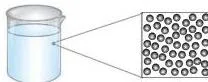
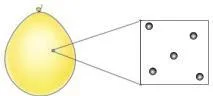
Next the chapter zooms into materials themselves (p. 4). Understanding why air exerts pressure or why water boils at a set temperature means seeing what particles materials are made of and how they move — barely at all in solids, freely in gases.
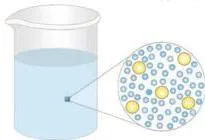
Then solutions (p. 4). Once we know how particles combine or mix, we can understand why sugar dissolves in tea and makes it sweet.
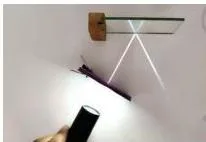
Then light (p. 4). The year will study how light rays reflect off flat and curved mirrors and bend through lenses — the science behind an image in a shiny spoon and behind corrective glasses.
And the Moon (p. 4). Rough surfaces reflect light too, not just polished mirrors — and so does the Moon. Depending on the positions of Earth, Moon and Sun, a different part of the Moon is lit each night, which is what we see as its phases.
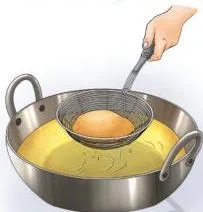
The last frame belongs to the puri investigation (p. 6). It sits exactly where the chapter stops listing what we can control and starts listing what we can observe or measure — puffing yes/no, time in seconds.
Terms the Chapter Builds, in Plain Words
The chapter has no glossary, yet it quietly builds working terms you will use all year. Here they are, defined plainly, with the page where each appears.
What you control versus what you observe
The investigation method rests on two lists. Everything in the first column is decided by you; everything in the second column tells you whether the change mattered.
| Things you can change or control (p. 6) | Things you can observe or measure (pp. 6–7) |
|---|---|
| Thickness of the rolled dough | Whether the puri puffs up (yes/no) |
| Size of the rolled dough | Time it takes to puff up (seconds) |
| Type of flour — atta, maida, others | Whether a very thick dough still gives a thin side |
| Temperature of the hot oil | Notes on what you see and sense — splatter, smell, smoke |
| Way the dough drops into the oil — vertically, at an angle, slowly |
The working terms, defined
- Scientific question (p. 6): a question you can explore by changing something and watching what happens — “What changes how a puri puffs up?” is one.
- Things we can change or control (p. 6): the conditions an investigator gets to decide — dough thickness, dough size, flour type, oil temperature and how the dough is dropped.
- Things we can observe or measure (pp. 6–7): the outcomes that show whether a change made a difference; some give yes/no answers, some give a number.
- Changing only one thing at a time (pp. 6–7): the rule that keeps every other condition identical so you know which change caused the result.
- Keeping notes (p. 7): recording everything you see and sense during the experiment — whether the oil splattered, smelled or smoked.
- Systematic investigation (p. 7): the full cycle of asking, controlling, observing, measuring, noting and concluding. The book says all experiments, from the simplest to the most complicated, are done this way.
Mistakes Students Make With This Chapter
This chapter looks easy, but it sets traps that catch students later in the year. The table names the mistakes before you make them.
| Mistake | Correct rule | How to check your answer |
|---|---|---|
| Treating the “Probe and ponder” questions as exam questions | The book says on page 1 they are not meant for any exam — they exist to spark curiosity | Re-read the opening letter on page 1, which says this in its first lines |
| Changing two things at once | Change only one thing at a time, keeping the other conditions the same (pp. 6–7) | Ask: if the result changed, which of my changes caused it? Two changes make the cause unknowable |
| Judging from the end result alone, with no notes | Keep notes of everything you see and sense (p. 7) | Ask: did the oil splatter, smell or smoke? Written notes capture what memory drops |
| Thinking investigation needs a laboratory | The kitchen is a wonderful place to observe and ask questions (p. 6) | Check the chapter’s own example — a puri in hot oil, no lab needed |
| Dismissing the chapter because it has no exercise block | Its habits — ask, control, observe, measure, note — reappear in every later chapter | Notice the preview on pages 2–5: every later topic builds on this method |
An Honest Note on Exams and This Chapter
Straight talk, with no invented claims. This chapter has no exercise questions at the end, and the opening “Probe and ponder” questions are explicitly not meant for any exam (p. 1).
What the chapter does carry is a method and a preview. The habits it builds — asking a scientific question, controlling conditions, observing and measuring, keeping notes — are the same habits the year’s investigations will use, and the preview tells you exactly which topics are coming.
One caution applies to every chapter in this book: textbook contents and the examinable syllabus are not always identical. Check the current official CBSE syllabus on cbse.gov.in to see how this material is assessed in your session.
- No exercise block, so nothing in this chapter is a set-piece question.
- The “Probe and ponder” questions are invitations to curiosity, not exam material.
- The method and the preview matter — they tell you what the year’s chapters will ask you to do.
- Weightage, if any, is decided by the official syllabus, not by this textbook alone.
Five-Minute Revision Summary
If you have five minutes before class or an assessment, read only this list. Everything the chapter teaches, condensed.
- The investigation cycle (pp. 6–7): ask a scientific question, decide what to control, decide what to observe or measure, change one thing at a time, keep notes, and let results raise new questions.
- The root and the kite (p. 2): the root is the solid foundation of observation; the kite is curiosity taking flight. Investigation needs both.
- The year’s topic order (pp. 2–5): microbes, health and vaccines, electric current, forces, pressure and cyclones, particles and materials, elements, compounds and mixtures, solutions, light and the Moon, calendars, ecosystems, climate.
- The Chaitra calendar (p. 5): watching the Moon’s phases gave humans their first calendars.
- The puri model (pp. 6–7): even an everyday observation can become a scientific investigation — and even the puri question is not fully understood by scientists today.
Related Resources and Sources
The year starts with microbes, and the very next chapter applies this investigative approach to the invisible living world. Notes for the invisible living world beyond our naked eye are already available, along with the broader Class 8 Science notes for the Curiosity book.
For everything in the grade, use the Class 8 hub, and for other classes the CBSE notes index.
Sources and data verification
- This page describes Chapter 1 of the NCERT Class 8 Science textbook Curiosity, in the current edition published on the NCERT portal.
- The book’s own footer names it Curiosity — Textbook of Science for Grade 8, a reprint issued for the current academic session; page references here follow that book.
- NCERT is the authority for the textbook, its editions and its official PDFs; CBSE is the authority for the syllabus and examinations.
- Because textbook contents and the examinable syllabus are not always identical, check the current official CBSE syllabus before planning what to study.
Frequently Asked Questions
Why is one side of a puri thinner than the other?
The chapter asks this as an open scientific question on page 1 and returns to it on pages 6–7, noting that even the puffing of a puri is not really completely understood by scientists today (p. 7).
The point is the investigation path, not a final answer. Control dough thickness, size, flour, oil temperature and how the dough is dropped; observe whether it puffs and how many seconds it takes; change one thing at a time; keep notes; and let one round raise new questions.
Is Chapter 1 of Class 8 Science Curiosity important for exams?
It has no exercise questions, and its opening “Probe and ponder” questions are explicitly not meant for any exam (p. 1). Its real value is the investigation method — asking scientific questions, controlling conditions, observing and measuring — which later chapters build on, plus its preview of the whole year. For what is actually assessed, check the current official CBSE syllabus.
What do the root and kite symbols in the Curiosity textbook mean?
The root, at the bottom of left-hand pages, stands for the deep, solid foundation of knowledge that keeps us connected to our environment, traditions, and cultural and natural heritage.
The kite, in the top corner of right-hand pages, stands for curiosity taking flight into the unknown. Investigation works best when you balance the solid ground of careful observation with the freedom of creative thinking (p. 2).
Why does a science book have a Chaitra calendar page?
Because the chapter makes a science point with it: watching the periodic cycles of the Moon’s phases allowed humans to come up with the first calendars (p. 5).
The Chaitra page sits at the end of the year preview as a concrete example that the calendars which set our routines on Earth are linked to the motions of objects far beyond our planet.
Where can I download the official Class 8 Science Chapter 1 PDF?
The Download section at the top of this page links to the official NCERT portal, where every chapter of the Curiosity book for Grade 8 is published free of charge.
Reference: NCERT Class 8 Science textbook (Curiosity), chapter 1, official edition on ncert.nic.in.
Explore Class 8 Science Books
- Next: The Invisible Living World: Beyond Our Naked Eye
Related chapters:
- Crop Production and Management
- Microorganisms : Friend and Foe
- Bulletin Board