
This page offers the official NCERT Visual Arts Class 5 Chapter 1 PDF from the Bansuri — Grade 5 textbook, plus a guided tour of what the chapter holds: every activity, each figure, the key terms, and how the work is assessed.
The chapter is called “Objects on the Move” and it is entirely activity-based — you observe real vehicles, draw them, build models, and design a better bus stop. In the book it runs 12 printed pages, and the official PDF below is the same edition NCERT publishes on ncert.nic.in.
Download the Visual Arts Class 5 Chapter PDF (Bansuri)
Whether you have lost your copy of the book or simply want the pages on a phone, the file below is the official NCERT edition — the same text, figures and activities as the printed textbook.
NCERT Class 5 Visual Arts Chapter 1 PDF (Bansuri) is hosted on NCERT’s own textbooks portal, where you can read it online, save it, or print the activity pages for class.
Visual Arts Class 5 at a Glance: What the Chapter Holds
The table below lists what the chapter holds, so you know at a glance how much ground it covers before you start.
| Sections | Figures | Activities | Questions |
|---|---|---|---|
| 10 | 5 | 4 | 0 |
Here is where each block of the chapter sits in the book, so you can jump straight to the page you need.
| Chapter block | NCERT pages | What you will find there |
|---|---|---|
| Dear Teacher — classroom requirements, pedagogy, assessment | 1–2 | Guidance for the teacher: how the art classroom should work and how learning is assessed |
| Competencies for the Preparatory Stage | 3 | Competencies C-1.1 to C-4.2, a learning-outcomes table, and the ★ note for limited-resource schools |
| Objects on the Move | 4–5 | The wheel’s history, questions about transport, and the step-by-step vehicle-observation activity |
| Activity 1.2 Creating Patterns from Parts | 6 | The visual elements, and making a pattern from two or three vehicle parts |
| Activity 1.3 Solve This Puzzle | 7 | Identifying a vehicle from its parts and drawing it whole |
| Activity 1.4 My Dream Vehicle | 8–9 | Sketching and building a model of a dream vehicle, then decorating it |
| Activity 1.5 Halting Places | 10–11 | Observing a real bus stop, designing a better one, building a 3D model, narrating a busy scene |
| Chapter 1 — Objects on the Move outcomes | 12 | The chapter’s learning outcomes, with space for teacher observations |
What This Chapter Covers: Objects on the Move
This section walks through the chapter in the order you will meet it. Each activity builds on the one before it, so the flow matters as much as the individual tasks.
- Teacher guidance (NCERT, p. 1–2): the chapter opens with “Dear Teacher”, classroom requirements, ten points of art pedagogy, and the assessment note. One pedagogy point shapes everything after it: encourage keen observation of everyday life and discourage copying images from other sources.
- The wheel’s story (NCERT, p. 4): the theme is set with the wheel — one of humankind’s most important inventions, created more than 5,000 years ago as a potter’s wheel and later used in carts and chariots to carry people and goods. The opening question, “Can you imagine a life without wheels?”, sends you hunting for wheels around you.
- Observe a vehicle (NCERT, p. 4–5): first, talk about the transport you have used — which ride did you enjoy most and why? Then choose any vehicle you like and follow the book’s sequence: draw its geometrical shapes, add details, draw its shadow, colour and decorate it in your own style, and finish with a written road-safety message inside the artwork.
- Activity 1.2 — Creating Patterns from Parts (NCERT, p. 6): just as mechanics remove and repair vehicle parts, pictures are built from parts called visual elements. Pick two or three parts — a seat, bell, pedal, mirror, handlebar or steering wheel — and arrange them into a colourful pattern.
- Activity 1.3 — Solve This Puzzle (NCERT, p. 7): the page shows the parts of one vehicle scattered around. Guess which vehicle they belong to, then put all the parts together in a drawing to complete it.
- Activity 1.4 — My Dream Vehicle (NCERT, p. 8–9): sketch the vehicle you would design — would it fly, sail or roll; carry many people or just you; suit children, older people or even animals?
- Build and decorate your model: make it from old cardboard, matchboxes, bottle caps, discarded containers, sticks, scissors, glue and tape, then decorate it as per your taste, the way cycles, auto rickshaws and trucks are decorated to show the owner’s identity. Keep the book’s safety rule: ask an adult for help when using sharp tools.
- Activity 1.5 — Halting Places (NCERT, p. 10): in small groups, talk about waiting at a real bus stop: where it is, who waits there, whether anyone finds boarding difficult, whether there is enough space, and whether it has a roof, a ramp, benches or shade.
- Design a better bus stop (NCERT, p. 10–11): ask what facilities would make waiting comfortable and what older people, children or people with disabilities would need. Draw your idea, merge the group’s ideas into one shared sketch, build a 3D model from cardboard, ice-cream sticks, broomsticks, waste fabric and old newspapers, then narrate a short scene from a busy day at the stop.
Activities marked with a star ★ can be facilitated by any teacher, even in schools with limited resources (NCERT, p. 3).
Key Concepts: Observation, Visual Elements, and Design
These are the transferable ideas behind every activity in the chapter. Understand these four, and the activities stop being separate tasks — they become one way of making art.
Observation comes before drawing
The book’s pedagogy is direct: teachers should encourage keen observation of everyday life and discourage copying images from other sources, including photos (NCERT, p. 2). Every activity starts with watching a real vehicle or scene — its shapes, its shadow, its details — so the artwork you produce is genuinely yours.
Visual elements are the parts of a picture
The chapter’s key sentence is that pictures and artworks have parts, just as vehicles do, and those parts are called visual elements (NCERT, p. 6). Competency C-2.1 names five of them: line, form, colour, space and texture (NCERT, p. 3).
Take the bicycle in Activity 1.2: the curve of the handlebar is line, the frame’s shape is form, the bell’s brightness is colour, the space around the bike is space, and the tread of the tyres is texture. Try naming each element in the figure before you draw.
Parts combine into wholes
The same “parts” idea drives three activities in a row. Activity 1.2 combines two or three parts into a pattern; Activity 1.3 reassembles scattered parts into a complete vehicle; Activity 1.4 invents an entirely new vehicle from known parts. Together they build the chapter’s outcome C-2.1 — combining parts of objects imaginatively to create patterns, new forms and other objects (NCERT, p. 12).
Design is a process, not a single drawing
Both big activities run the same loop: plan, build, improve, present. The dream-vehicle activity goes from sketch to model to decoration; the bus-stop activity turns your individual idea into a group sketch, then a shared 3D model (NCERT, p. 8–11).
The book also asks each student to keep a portfolio of artwork so the teacher and student can track learning and progress (NCERT, p. 2).
The Figures in This Chapter, Explained
The chapter uses five pictures, each attached to one activity. Here is what each one shows and what to look for as you work through the book.

This is the chapter’s opener, and it sets the theme before any activity begins. The chapter is all about things in motion, so the picture invites you to start noticing the transport around you. Before turning the page, make your own list: which vehicles are on the move near your home, and which wheels make them work?
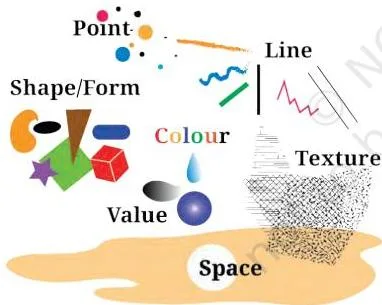
This picture sits at the heart of Activity 1.2. Its job is to show you the parts of a bicycle — a seat, bell, pedal, mirror and handlebar — and then to make the leap: a picture is built the same way a bicycle is, from parts the book calls visual elements.
Use the figure to find line, form, colour, space and texture before you make your own pattern.
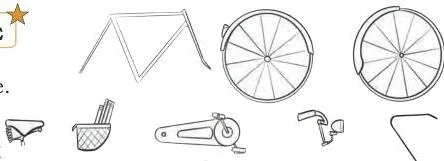
This is the picture for Activity 1.3, Solve This Puzzle. The page shows many parts of one vehicle scattered around, and your task is to guess which vehicle they belong to, then reassemble them in a drawing. Work part by part — which vehicle has that seat, that handlebar, that wheel? — and the whole becomes recognisable.
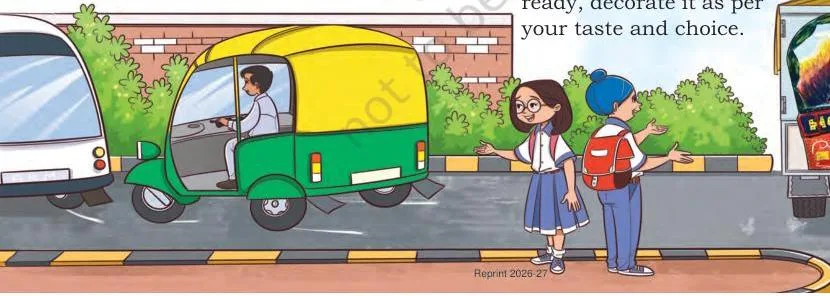
This picture belongs to Activity 1.4, after the building is done. The book reminds you that real cycles, auto rickshaws and trucks are often decorated to represent the identity of their driver or owner, and your model can do the same. Choose colours and patterns that make the vehicle unmistakably yours.
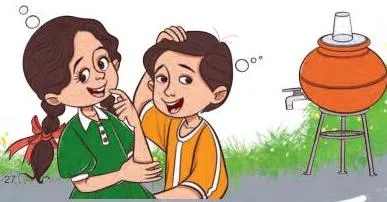
This is the prompt for the end of Activity 1.5. Once your group has built its bus-stop model, the picture invites you to bring it to life: gather toy vehicles, imagine a busy day, and narrate a short scene.
Use it to notice who waits, who struggles to board, and what would make the wait comfortable — those observations feed your better bus-stop design.
Key Terms in Visual Arts Class 5
A short glossary to reuse in class and when writing about your own portfolio. Each term is defined the way the chapter uses it.
- Visual elements — the parts a picture is made of: line, form, colour, space and texture (NCERT, p. 6; the five are named in competency C-2.1, p. 3).
- Potter’s wheel — the original wheel, invented more than 5,000 years ago and later used in carts and chariots to transport people and goods (NCERT, p. 4).
- Vehicle parts — the named parts used in the activities: seat, bell, pedal, mirror, handlebar and steering wheel, among others (NCERT, p. 6).
- Bus-stop facilities — the details that make waiting comfortable: a roof, a ramp, benches and shade (NCERT, p. 10).
- Portfolio — your own collection of artwork, kept so you and your teacher can track learning and progress (NCERT, p. 2).
Common Mistakes in These Activities (and How to Avoid Them)
These mistakes come straight from how the chapter is designed. Each is paired with the book’s own rule and a quick check.
| Mistake | Correct rule | How to check your answer |
|---|---|---|
| Copying pictures from a book or photo instead of observing real objects | Draw the real vehicle or scene first — the book explicitly discourages copying images from other sources (NCERT, p. 2) | Can you name three details you saw on the real object that a photo would not show? |
| Jumping straight to the finished drawing | Follow the book’s sequence: geometrical shapes, details, shadow, colour, road-safety message (NCERT, p. 4–5) | Does your artwork include the shadow and end with the safety message? |
| Stopping after one version instead of acting on peer feedback | The learning outcome expects more than one iteration after feedback from peers (NCERT, p. 12) | Did you change anything after a classmate’s feedback? |
| Handling sharp tools without an adult | Ask an adult for help when using sharp tools (NCERT, p. 8) | Was an adult with you while you cut? |
| Skipping cleanup and leaving materials out | Put materials back and clean up after each activity — a habit the book lists among its pedagogy points (NCERT, p. 2) | Is the workspace as tidy as you found it? |
| Teachers: saving assessment for a separate test day | Formative assessment belongs inside classroom activities — feedback, participation records and field-trip tasks (NCERT, p. 2) | Is feedback being given during the activity, not after a test? |
How This Chapter Is Assessed in Class 5
The honest answer first: this chapter has no written question paper and no numbered exercises to score. The work you do in the activities is the assessment.
NCERT’s assessment note for all art forms sets out how this works (NCERT, p. 2–3).
| What is assessed | How it is assessed | Where the book says so |
|---|---|---|
| Learning outcomes aligned to the Competencies of the Preparatory Stage | Formative assessment inside classroom activities: qualitative feedback naming strengths and areas to improve, participation records, and simple observation tasks on field trips — not a separate test day | NCERT, p. 2–3 |
| Progress across the term | A portfolio of artwork the student builds and maintains, so learning and progress can be tracked | NCERT, p. 2 |
| End-of-semester understanding | Summative assessment through project work or a practical activity at the end of a semester | NCERT, p. 2 |
| This chapter’s outcomes — C-1.1 (depicts objects in 2D and 3D), C-2.1 (combines parts into patterns and new forms), C-3.2 (attempts more than one iteration after peer feedback) and overall participation | The teacher records observations and comments on the chapter’s closing page | NCERT, p. 12 |
No official marks or weightage for art appear in the chapter, so none are stated here. Textbook contents and the examinable syllabus are not always identical — check the current official syllabus, and remember that your school decides how art is scheduled and reported.
Quick Revision Summary: What to Take Away
These are the chapter’s own learning outcomes, turned into “after this chapter you can…” statements. If you can do all five, you have done exactly what the chapter asks.
- Depict objects and their arrangement in two-dimensional and three-dimensional artworks (competency C-1.1, NCERT, p. 12).
- Combine parts of objects imaginatively to create patterns, new forms and other objects (C-2.1, NCERT, p. 12).
- Attempt more than one version of an artwork after feedback from peers (C-3.2, NCERT, p. 12).
- Use and combine the visual elements — line, form, colour, space, texture — while drawing everyday observations (C-2.1, NCERT, p. 3).
- Recognise visual elements in nature and show curiosity about local artforms and culture (C-4.1 and C-4.2, NCERT, p. 3).
The whole chapter reduces to one working line: observe, draw, build, decorate, present, improve.
Sources and Data Verification
This listing is maintained for the 2026-27 academic session using the NCERT textbook information available to us. NCERT remains the authority for confirming the latest edition.
This page describes Chapter 1, “Visual Arts”, of the NCERT Bansuri — Grade 5 textbook — the official NCERT edition published on ncert.nic.in.
- It covers that single chapter only, not the rest of the Bansuri volume and no other Class 5 books.
- This page is maintained for the current academic session using the NCERT textbook information published on the NCERT portal.
- NCERT settles textbook editions and PDFs; CBSE settles the curriculum and syllabus. Textbook contents and the examinable syllabus are not always identical.
Related Resources for Class 5
If you are moving through the whole year’s material, the NCERT Class 5 books hub lists every Class 5 textbook, and the Class 5 Arts book page holds everything from the Bansuri volume.
For quick study support between classes, use the Class 5 Arts notes, the Class 5 notes hub, or the main CBSE notes directory.
When you finish this chapter, the next one in the Bansuri book is Peeping Out of the Window. The authoritative source for all editions and downloads is the official NCERT textbooks portal.
| What the chapter holds | Count | Where it is used |
|---|---|---|
| Printed pages | 12 | |
| Figures with NCERT captions | 5 | |
| Tables | 2 | |
| Official NCERT PDF | Download the chapter PDF | the chapter exactly as NCERT publishes it |
Chapter-wise notes for this subject are not published yet. The unit-wise syllabus on this page is complete and verified against the official CBSE curriculum document.
Visual Arts Class 5: Frequently Asked Questions
What is the Visual Arts chapter in Class 5 Bansuri about?
It is the activity-based chapter “Objects on the Move” (NCERT, p. 4). You observe real vehicles and draw them from their geometrical shapes, make patterns from vehicle parts (Activity 1.2), solve a parts-to-whole vehicle puzzle (1.3), sketch and build a dream vehicle model (1.4), and redesign a bus stop in a group (1.5).
What are the visual elements in the Class 5 Visual Arts chapter?
The five visual elements are line, form, colour, space and texture (NCERT, p. 3, p. 6). The chapter introduces them by comparing a picture to a vehicle: both are built from parts.
Does Class 5 Visual Arts have an exam?
No written paper. Assessment is formative — feedback, participation records and field-trip observation tasks inside the activities — plus a term portfolio and a semester-end project or practical activity (NCERT, p. 2, p. 12).
What materials do I need for the dream vehicle and bus stop activities?
For the dream vehicle: old cardboard, matchboxes, bottle caps, discarded containers, sticks, scissors, glue and tape (NCERT, p. 8). For the bus stop: cardboard, ice-cream sticks, broomsticks, waste fabric, old newspapers, glue, scissors and colours (NCERT, p. 10). For both, the book’s rule is the same: ask an adult for help with sharp tools (NCERT, p. 8).
Why should I draw from observation instead of copying a picture?
Because the chapter is built on it: its pedagogy tells teachers to encourage keen observation of everyday life and to discourage copying images from other sources, including photos (NCERT, p. 2). Watching the real object shows you its true shapes, shadow and details — which is what makes the artwork your own.
Reference: NCERT Class 5 Bansuri textbook, chapter 1, official edition on ncert.nic.in.
Explore Class 5 Arts Books
- Next: Peeping Out of the Window
Related chapters:
- Picturing Stories
- Imaginary Beings
- Spreading the Message