
Time Goes On Class 3 is the thirteenth chapter of the NCERT Maths Mela textbook for Class 3, printed on pages 164-176 of the book. It is the chapter where children learn to measure time with calendars, clocks, ages and durations — and the official chapter PDF for the current academic session is right below.
Download the Time Goes On Class 3 chapter PDF
The official NCERT Class 3 Maths Mela Chapter 13 Time Goes On PDF is published on the NCERT textbooks portal, which hosts the current Maths Mela edition for Class 3; open it there to read, save or print the chapter exactly as it appears in the book.
This page walks through what the PDF contains — every section, figure and activity — so you know exactly where to look when you open it.
Chapter 13 Time Goes On at a glance
This is a measurement chapter built around time. It opens with a poem about a new calendar that is missing July — the hint in the poem is that July and January look the same — and the first activity is to build the July 2024 calendar yourself.
From there the chapter moves to comparing two years of calendars and the dates of festivals, learning month, week and day facts, solving an age puzzle, reading a real birth certificate, reading the analog clock at quarter past and half past, following a day in Hetal’s life, estimating how long things take, and finally making a sand clock at home.
It is an activity-based chapter: most sections are marked Let us Do, Let us Explore or Let us Play, and each one is meant to be done. The chapter facts table below lists how much of each kind of content the chapter holds.
What Time Goes On covers, section by section
Use this map to open the PDF at the exact part you need. The section names are the ones printed in the book, in the order they appear.
| Printed section | Page | What it asks the child to do |
|---|---|---|
| Time Goes On (opening poem) | 164-165 | Read the poem about a new calendar with July missing, and look at the year laid out month by month. |
| Let us Do — July | 166 | Fill the blank July 2024 calendar, then answer four questions: the number of Sundays, the dates that are Thursdays, a date three days after July 22, and the school-opening date after a 15-day closure from July 7. |
| Let us Explore | 167 | Collect calendars from the last two years and compare what stays the same and what changes; note festival dates and circle the ones that fall on the same date. |
| Let us Do | 167 | Write the names of the 12 months, name the months with fewer than 30 days, write the number of days in a year, and test Hetal’s claim of 53 weeks. |
| Age Fun | 168 | Ask an adult about ages, then solve the puzzle: Hetal is twice as old as her brother and also 10 years older. |
| BIRTH CERTIFICATE | 169 | Read Bincy’s birth certificate and answer six questions about her date of birth, her age, and when the certificate was issued. |
| Let us Do | 170 | Make your own birth certificate and write the dates you were admitted to school, to Class 1 and to Class 3. |
| Let us Play / Let us Do | 171 | Observe a working analog clock, work out how many minutes Hetal’s breakfast took (7:00 to 7:15), and draw quarter past 8 and half past 8. |
| A Day in the life of Hetal | 172 | Match each part of Hetal’s day to a clock time and draw the minute and hour hands where needed. |
| Let us Think | 173-175 | Fill duration tables — what takes months, weeks, days, hours and minutes — estimate minutes for school activities, and read the time passed from hand movements. |
| Let us Explore | 176 | Compare digital and analog clocks, then build a sand clock from two bottles with adult help. |
Key concepts: what the chapter teaches
The chapter builds five ideas: the calendar year, counting days forward, the clock face, age from dates, and choosing the right unit for a duration. Each is explained below with a fresh example, so the child can practise beyond the book’s own numbers.
The calendar: 12 months, a short February, and 365 days
A year is divided into 12 months, and the chapter asks the child to name all of them (NCERT, p. 167). One month — February — has fewer than 30 days, and the activity asks children to spot it. A normal year has 365 days.
Why 365 days means “52 weeks and one day”: a week is 7 days, and \(52 \times 7 = 364\). That leaves \(365 – 364 = 1\) day over. Written as division, \(365 \div 7 = 52\) with remainder 1. So a normal year is 52 full weeks plus one extra day — which is why Hetal’s guess of 53 weeks is not right.
These are the calendar facts this activity leads to:
| Months with 31 days | Months with 30 days | The month with fewer than 30 days |
|---|---|---|
| January, March, May, July, August, October, December | April, June, September, November | February |
Counting days forward: the “days after” rule
When a question says “N days after a date”, the starting date is not counted as day one — the very next day is. The book’s own example is “three days after July 22”: day 1 is July 23, day 2 is July 24, day 3 is July 25 (NCERT, p. 166).
Fresh example: a school closes on 10 May for 18 days. Count 10 May as day 1 of the closure, so the 18 closed days run from 10 May to 27 May, and school reopens on 28 May. To check: \(28 – 10 = 18\) days of closure, and the reopening day itself is not counted.
The clock: hour hand, minute hand, quarter past and half past
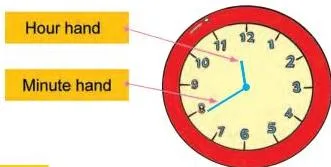
The chapter uses an analog clock with two hands: the short hour hand and the long minute hand (NCERT, p. 171). Around the face are 12 numbers, and the minute hand travels from one number to the next in 5 minutes, so a full round is \(12 \times 5 = 60\) minutes.
Quarter past means 15 minutes after the hour — the minute hand points at 3. Half past means 30 minutes after the hour — the minute hand points at 6. At half past 8, the long hand is on 6 and the short hand sits between 8 and 9, because the hour is halfway through.
Why “quarter”: an hour has 60 minutes, and 15 of them is one quarter of 60, while 30 of them is half.
Age from dates: puzzles and birth certificates
Age puzzles work best by guessing a pair and checking it against both conditions. Hetal is twice as old as her brother and 10 years older (NCERT, p. 168). Try brother 10 and Hetal 20 — 20 is twice 10, and the difference is 10. Both conditions hold, so that is the answer.
A step-by-step approach:
- Pick a guess for the younger person’s age.
- Double it for the older person’s age.
- Check that the difference between the two equals the gap stated in the question.
- If it does not match, adjust the guess and try again.
Fresh example: Ravi is twice as old as his sister Meera and 6 years older than her. Try Meera 6 and Ravi 12: 12 is twice 6, and \(12 – 6 = 6\). Meera is 6 and Ravi is 12. This guessing method works because the difference between a number and its double is always the number itself.
Birth certificates record a date of birth in day/month/year order — Bincy’s 02/05/2015 means 2 May 2015 (NCERT, p. 169). To find how many days after birth a certificate was issued, count the days in between: Bincy was born on 2 May and her certificate is dated 18 May, so it was issued 16 days later.
Fresh example: a baby born on 10 June with a certificate dated 25 June — \(25 – 10 = 15\) days.
Choosing the right unit for a duration
A duration is how long something takes, and it can be measured in minutes, hours, days, weeks or months (NCERT, p. 173). The unit has to match the activity: the book’s examples are a shower taking minutes, stitching a shirt taking hours, knitting a sweater taking days, completing a chapter taking weeks, and the seasons changing taking months.
Fresh examples: a school term takes months, a railway journey across India takes days, and brushing teeth takes minutes. The simple test is to read the sentence aloud — “brushing my teeth takes 2 weeks” sounds wrong, and that is the signal to change the unit.
Time words in the chapter, explained
These are the terms the chapter introduces. Keep the list handy while the child works; page references are to the NCERT edition.
| Term | What it means | Page |
|---|---|---|
| Analog clock | A clock that shows time with moving hands — the hour, minute and second hands. | 176 |
| Digital clock | A clock or watch that shows time using digits, like 07:15, rather than with hands. | 176 |
| Hour hand | The short hand, which shows the hour. | 171 |
| Minute hand | The long hand, which shows the minutes. | 171 |
| Quarter past | 15 minutes after the hour, when the minute hand points at 3. | 171 |
| Half past | 30 minutes after the hour, when the minute hand points at 6. | 171 |
| Duration | How long something takes — in minutes, hours, days, weeks or months. | 173 |
| Birth certificate | The official record of when and where a child was born, and who the parents are. | 169 |
Reading the pictures in Time Goes On


Every picture in this chapter is a prompt for an activity. Here is what each one shows and what to do with it.
The calendar game — page 165
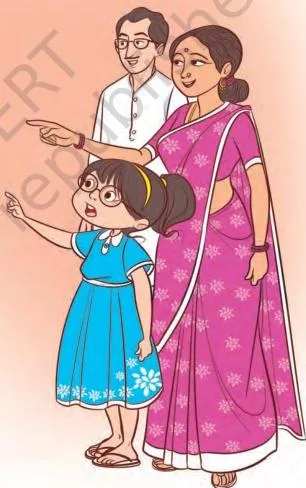
The chapter opens with this picture of the calendar game. It follows the poem in which Amma notices July is missing from the new calendar, and the game is to put July back — which is exactly what the child does next by building the July 2024 calendar.
One thing to notice before moving on: the picture sets up the idea that a month’s layout comes from how its days fall, which is why the book then hands over a blank July grid.
Age Fun — page 168
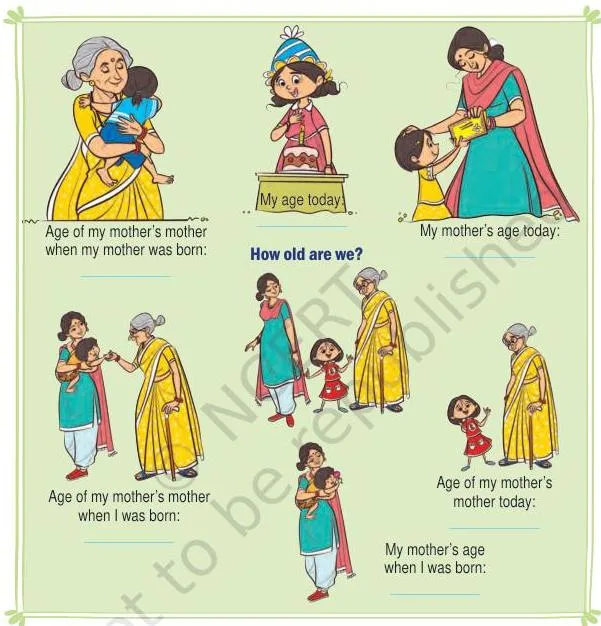
This picture is the warm-up for Age Fun: the child is meant to ask an adult at home about ages, the way the picture shows. It connects the maths of age to real people the child knows.
The second Age Fun picture states the puzzle itself: Hetal is twice as old as her brother and is also 10 years older. The book’s Teacher’s Note adds that adults should discuss the guessing strategies children use — the try-a-pair-and-check method works best.
Before moving on, notice that the two numbers work together: for “twice” to hold, the age gap of 10 has to equal the brother’s age.
The analog clock — page 171
This figure instructs the child to hold a real clock or watch and observe the face and the movement of the hands before drawing any time. What to notice: one hand is short and one is long, and the long hand moves faster. That observation is the whole basis for drawing quarter past 8 and half past 8 in the next activity.
Digital clocks — page 176
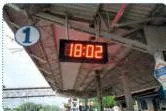
This picture introduces the digital clock — a clock that shows time using digits — and contrasts it with the analog clock’s hands (NCERT, p. 176). The questions that follow are observation questions: which kind is on the school wall, and what is the difference between the two. The difference to say aloud: analog uses hands, digital uses digits.
The sand clock — page 176
This figure shows the last craft step of the chapter: after gluing the two caps together, making a small hole, and filling one bottle with sand, the second bottle is attached on the other side of the joined caps. The child then tips the bottles and times how long the sand takes to pass from one into the other.
One thing to notice is the order — the sand goes in first, then the second bottle is attached.
Common mistakes in Time Goes On, and how to fix them
The predictable slips in this chapter come from counting, clock hands and units. Name them before the child makes them.
| Mistake | Correct rule | How to check your answer |
|---|---|---|
| “Three days after July 22” answered as July 26, by counting July 22 as day one | The starting date is day zero; day 1 is the next day. Three days after July 22 is July 25 (NCERT, p. 166). | Write the dates on the calendar grid and tick them off: 23, 24, 25. |
| Accepting Hetal’s guess of 53 weeks in a year | A normal 365-day year is 52 weeks plus one day, not 53 weeks (NCERT, p. 167). | \(52 \times 7 = 364\), so one day remains. |
| Swapping the hands when drawing half past 8 | The long minute hand points at 6; the short hour hand is between 8 and 9 (NCERT, p. 171). | The short hand always names the hour that has already begun. |
| Guessing an age without checking both conditions | In Age Fun, try a pair, then test it against both statements in the question (NCERT, p. 168). | Is one age exactly twice the other, and is the difference exactly the stated gap? |
| Mixing duration units — saying a shower takes 40 days | Match the unit to the activity: showers take minutes, stitching a shirt takes hours (NCERT, p. 173). | Read the sentence aloud; if it sounds absurd, pick a smaller or larger unit. |
| The school-closure count that forgets the closing day | 15 days from July 7 ends on July 21, so school opens on July 22 (NCERT, p. 166). | Check \(22 – 7 = 15\) — the gap equals the number of closed days. |
How Time Goes On is used in class and homework
This is an activity-based chapter, not a read-and-recall one. The book’s own Teacher’s Notes tell the adult what to discuss: the clock face and how minutes are measured (p. 171), the strategies children used to guess ages (p. 168), and the right units for different durations (p. 173).
By the end of the chapter a child should be able to: complete a calendar month and answer date questions, read ages from dates and from a birth certificate, read an analog clock at quarter past and half past, compare digital and analog clocks, and estimate how long everyday activities take.
Each Let us block is meant to be done — the sand clock in particular is a make-at-home craft with bottles, glue and a needle, and the book says to build it in the presence of an adult (p. 176).
One honest note: textbook contents and the examinable syllabus are not always identical — check the current official CBSE syllabus for what is assessable this session.
Time Goes On in quick points
- A year has 12 months, and February is the month with fewer than 30 days (p. 167).
- A normal year of 365 days is 52 weeks plus one day, so Hetal’s guess of 53 is not right (p. 167).
- Three days after July 22 is July 25 — the starting date is not counted (p. 166).
- A school that closes on July 7 for 15 days reopens on July 22 (p. 166).
- Hetal’s breakfast took 15 minutes, from 7:00 to 7:15 (p. 171).
- Hetal is twice as old as her brother and 10 years older: her brother is 10 and Hetal is 20 (p. 168).
- Bincy’s birth certificate records her birth on 2 May 2015; she turns 10 on 2 May 2025 (p. 169).
- The minute hand is the long hand — at quarter past it points at 3, at half past at 6 (p. 171).
- Durations are measured in months, weeks, days, hours and minutes (p. 173).
- Digital clocks show digits, analog clocks use hands, and sand clocks measure time by sand passing between bottles (p. 176).
Related pages on this site
Time Goes On sits near the end of Maths Mela, on printed pages 164-176. For the rest of the book, open the Class 3 Mathematics hub, which collects the Maths Mela chapter pages — including earlier chapters such as Give and Take and The Suraj Kund Fair. The Class 3 hub gathers the textbook pages for every subject in this class.
Sources and data verification
This listing is maintained for the 2026-27 academic session using the NCERT textbook information available to us. NCERT remains the authority for confirming the latest edition.
- This page describes the NCERT Class 3 Mathematics textbook Maths Mela, Chapter 13 Time Goes On, printed pages 164-176, in the official NCERT edition.
- It covers this one chapter — not the whole book, and not the whole CBSE syllabus.
- It is maintained for the current academic session from the NCERT information available to us.
- NCERT settles textbooks, editions and PDFs; CBSE settles curriculum, syllabus and examinations.
| What the chapter holds | Count | Where it is used |
|---|---|---|
| Printed pages | 12 | |
| Figures with NCERT captions | 6 | |
| Tables | 9 | |
| Activities | 7 | |
| Official NCERT PDF | Download the chapter PDF | the chapter exactly as NCERT publishes it |
Reference: NCERT Class 3 Mathematics (Maths Mela) textbook, chapter 13, official edition on ncert.nic.in.
Time Goes On Class 3: common questions
How many weeks are there in a year, and is Hetal right about 53 weeks?
A normal year has 365 days, and \(365 = 52 \times 7 + 1\). That gives 52 full weeks and one extra day, so Hetal is not right — a normal year has 52 weeks plus one day, not 53 weeks (NCERT, p. 167).
If a school closes on July 7 for 15 days, how do we find the opening date?
Count July 7 as the first closed day. The 15 closed days run from July 7 to July 21, so school reopens on July 22. A quick check: \(22 – 7 = 15\) closed days (NCERT, p. 166).
What is the difference between an analog clock and a digital clock?
An analog clock shows time with moving hands — the hour, minute and second hands — while a digital clock shows time using digits (NCERT, p. 176). The chapter also introduces a third kind: the sand clock, which measures time by sand passing from one bottle into another.
What does half past 8 look like on a clock face?
At half past 8, the long minute hand points at 6 and the short hour hand sits between 8 and 9, because the hour is halfway through (NCERT, p. 171). At quarter past 8, the minute hand points at 3 instead.
How old will Bincy be on 2 May 2025, and what do we read off her birth certificate?
Bincy was born on 2 May 2015 — 02/05/2015 is written in day/month/year order — so she turns 10 on 2 May 2025 and will be 15 in 2030 (NCERT, p. 169). The certificate also records her sex, place of birth (Kadampuzha Hospital), father’s and mother’s names, the registration number, and the date the certificate was issued.
Why do festival dates like Deepawali change from year to year while Republic Day stays the same?
Some festivals such as Deepawali follow a different calendar, so they land on different dates each year, while fixed-date days like Republic Day are tied to a specific date and stay put. The chapter asks children only to observe and circle the festivals that match across two years’ calendars — the why is left for discussion (NCERT, p. 167).
Explore Class 3 Mathematics Books
- Previous: Give and Take
- Next: The Surajkund Fair
Related chapters:
- What's in a Name?
- Toy Joy
- Double Century