
This is the official NCERT Class 9 Mathematics Chapter 3, “The World of Numbers”, from the Ganita Manjari Grade 9 Part I textbook — 27 pages that trace how numbers grew from tally marks on bone to the real number line.
If you searched for the world of numbers class 9, the official PDF is right here, and below it is a plain-English walkthrough of the chapter, section by section.
Download the World of Numbers Class 9 PDF
The World of Numbers Class 9 PDF is the official chapter file, hosted on ncert.nic.in, and it opens in any browser or PDF reader. Keep it open while you work through the sections below — the chapter’s exercise sets, figures and CHAPTER SUMMARY are all inside it, and this page explains each idea in the order the book presents it.
What the Chapter Contains at a Glance
The table below shows how much this chapter holds — its sections, figures, exercise questions, tables and equations — so you can see the size of the task before you start. The chapter’s final pages also carry a one-page recap titled “The Evolution of Our World of Numbers” and close with a CHAPTER SUMMARY.
How the Chapter Builds the Number Line
This chapter is a historical journey in seven main sections, and each one adds a new kind of number. Read them in order: section 3.5’s irrational numbers only make sense after section 3.4’s rationals.
Section 3.1 — counting before numerals. Herders matched one pebble to each cow leaving the settlement, and that one-to-one correspondence became the natural numbers \( \mathbb{N} = \{1, 2, 3, \dots\} \). The oldest surviving evidence is carved bone, and Fig. 3.1 shows the groupings found on the Ishango bone.
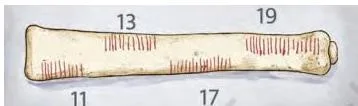
The Lebombo bone (about 35,000 years old) carries 29 notches, most likely a lunar-phase or calendar counter. The Ishango bone (about 20,000 BCE) is more striking: one column groups notches as 11, 13, 17, 19 — the prime numbers between 10 and 20 — and another column shows doubling. These are the oldest number patterns we have.
Section 3.1 also sets the Indian stage. Vedic texts gave names to powers of 10 up to \( 10^{12} \) (parārdha), the Lalitavistara (4th century BCE) reached \( 10^{53} \) (tallakṣaṇa), and the Rigveda used powers of 10 — the foundation on which the place-value system, and later zero, could stand.
Section 3.2 — śhūnya becomes zero. Indian philosophy treated śhūnyatā (emptiness) as a reachable state of stillness, so “nothing” had a positive meaning before it had a symbol. The Bakhshālī manuscript wrote zero as a bold dot (bindu), and Brahmagupta’s Brāhmasphuṭasiddhānta (7th century CE) gave it rules: \( a – a = 0 \), \( a + 0 = a \), \( a – 0 = a \), \( a \times 0 = 0 \).
Section 3.3 — integers as fortunes and debts. Brahmagupta called positive numbers fortunes (dhana) and negative numbers debts (ṛiṇa), and placed the debts to the left of zero. Naturals, zero and their negatives form the integers \( \mathbb{Z} \) — the symbol comes from the German Zahlen, “numbers”. His five rules of signed arithmetic are the ones we still use.
Section 3.4 — fractions to rationals. A rational number is any \( \frac{p}{q} \) with integers \( p \), \( q \) and \( q \neq 0 \). Since \( 5 = \frac{5}{1} \), every integer is itself rational; since \( -\frac{1}{3} = -\frac{2}{6} = -\frac{3}{9} \), a rational has many equivalent fractions, so we agree on the co-prime form. The section’s arithmetic laws — equality, addition, subtraction, multiplication, division — govern all of them.
Section 3.5 — the irrationals arrive. The diagonal of a unit square is \( \sqrt{2} \) by the Baudhāyana–Pythagoras theorem, and \( \sqrt{2} \) can never be written as \( \frac{p}{q} \). Section 3.5.1 proves this by contradiction.
The section also tells the story of \( \pi \): Āryabhaṭa’s \( \frac{3927}{1250} = 3.1416 \) was an asanna (approximation), and the first exact formula came from Mādhava of Sangamagrama’s infinite series.
Section 3.6 — reals and their decimals. Rational and irrational numbers together form the real numbers \( \mathbb{R} \). Their decimals separate them cleanly: rationals terminate or repeat, while irrationals never end and never repeat. The section explains why repeats happen — long division has only finitely many possible remainders — and uncovers the cyclic number inside \( \frac{1}{7} \).
Section 3.7 — the journey continues. The chapter closes with \( \sqrt{-1} \), a number no real value can equal. Mathematicians stepped off the line and invented the imaginary unit \( i \), a story kept for a later class.
The Number Sets in This Chapter: N, Z, Q, Irrational, R
Your first job is to keep five sets straight, because Class 9 builds on them from here. Each set is a box inside a bigger box, and a number’s decimal tells you which box it belongs to.
| Set | Symbol | What it contains | Example | Type of decimal |
|---|---|---|---|---|
| Natural numbers | \( \mathbb{N} \) | Counting numbers \( \{1, 2, 3, \dots\} \) | \( 7 \) | Terminating |
| Integers | \( \mathbb{Z} \) | Natural numbers, zero, negatives | \( -3 \) | Terminating |
| Rational numbers | \( \mathbb{Q} \) | All \( \frac{p}{q} \), \( q \neq 0 \) | \( \frac{3}{4} \) | Terminating or repeating |
| Irrational numbers | \( I \) (as the chapter prints it) | Numbers that cannot equal \( \frac{p}{q} \) | \( \sqrt{2}, \pi \) | Non-terminating, non-repeating |
| Real numbers | \( \mathbb{R} \) | Every rational plus every irrational | \( -\frac{7}{3} \), \( \sqrt{2} \) | Either kind |
The nesting is worth memorising: \( \mathbb{N} \subset \mathbb{Z} \subset \mathbb{Q} \), and \( \mathbb{Q} \) together with the irrationals gives \( \mathbb{R} \). A simple memory aid is the phrase “Nice Zeros, Quite Real” — natural numbers, integers (which add zero), rationals (quotients), then reals, the union that completes the line. The irrationals are exactly the gaps that \( \mathbb{Q} \) leaves.

Fig. 3.2 is the moment the line grows leftwards: negatives appear to the left of zero, and Brahmagupta’s fortunes and debts give those positions meaning.

Fig. 3.3 shows why integers are easy to place: each integer lies at an equal distance from the next, so the line behaves like a regular ruler.
Zero’s rules and the debt rule. Brahmagupta defined zero as the result of subtracting a number from itself, \( a – a = 0 \), and laid down \( a + 0 = a \), \( a – 0 = a \) and \( a \times 0 = 0 \). For negatives: a debt plus a debt is a debt, a debt times a fortune is a debt, and the product of two debts is a fortune — \( (-3) \times (-4) = 12 \).
Removing four debts of ₹3 each cancels ₹12 that you owed.
Density, and the gap it leaves. Rationals are dense: between any two of them another always exists, for instance \( \frac{3}{2} \) between 1 and 2, and \( \frac{5}{4} \) between 1 and \( \frac{3}{2} \). Yet section 3.4.2 asks the question head-on — the rationals feel as though they must completely fill the line, but do they? Section 3.5 answers: no.
Decimals reveal the set. Write a rational in lowest terms and factor the denominator. If its prime factors are only 2, only 5, or both 2 and 5, the decimal terminates; any other prime factor makes it repeat.
For example, \( \frac{9}{16} \) terminates because \( 16 = 2^4 \), while \( \frac{11}{24} \) repeats because \( 24 = 2^3 \times 3 \). The number of decimal places is the larger of the two exponents — \( \frac{17}{125} \) ends after 3 places since \( 125 = 5^3 \).
This denominator rule is the chapter’s most reusable tool for the question “is the decimal terminating or repeating?”. Exercise Set 3.5 and the end-of-chapter questions return to it repeatedly, so practise applying it before you reach for long division.
Worked example — convert a repeating decimal to \( \frac{p}{q} \). Take \( 0.2\overline{7} \): the 2 does not repeat, the 7 does.
- Step 1: Let \( x = 0.2\overline{7} \).
- Step 2: Shift the non-repeating digit: multiply by 10 to get \( 10x = 2.\overline{7} \).
- Step 3: Shift a full repeating cycle: multiply by 100 to get \( 100x = 27.\overline{7} \).
- Step 4: Subtract the two shifted equations:
\[ 100x – 10x = 27.\overline{7} – 2.\overline{7} \]
\[ 90x = 25 \quad\Rightarrow\quad x = \frac{25}{90} = \frac{5}{18} \]
Final answer: \( 0.2\overline{7} = \frac{5}{18} \). Check with long division: \( 5 \div 18 = 0.2777\dots \).
The cyclic number of \( \frac{1}{7} \). Long division gives \( \frac{1}{7} = 0.\overline{142857} \). The repeating block 142857 is a cyclic number: multiply it by 2, 3, 4, 5 or 6 and the same six digits reappear, simply rotated.
\( 142857 \times 2 = 285714 \), \( \times 3 = 428571 \), up to \( \times 6 = 857142 \). It happens because the only possible remainders when dividing by 7 are 1 through 6 — once they cycle, the quotient digits must cycle with them.
Reading the Chapter’s Figures
The figures in this chapter are not decoration — each one shows a number being placed on the line. If you can read them, you can reproduce every construction yourself.
Figures That Show the Number Line Growing
One rule from section 3.4.1 does all the work: to place \( \frac{p}{q} \), divide the unit interval into q equal parts, then move p parts to the right if the number is positive, or to the left if it is negative.

Fig. 3.4 is the point of it all — unlike integers, fractions live between integers: \( \frac{1}{2} \) sits halfway between 0 and 1, and \( -\frac{3}{4} \) lies between −1 and 0.


Fig. 3.5 applies the rule to \( \frac{3}{4} \): divide 0 to 1 into four parts and move three. Fig. 3.6 handles a fraction bigger than 1: \( \frac{9}{4} = 2\frac{1}{4} \), so start at 2, divide the interval 2 to 3 into four parts, and move one part right of 2.

Fig. 3.7 is the mixed drawing the book’s Think and Reflect asks you to extend by placing \( \frac{8}{5} \) and \( -\frac{7}{4} \) yourself.
Try one with original numbers: to locate \( \frac{7}{3} \), write it as \( 2\frac{1}{3} \). It lies between 2 and 3; divide that interval into three equal parts and move one part right of 2.

Fig. 3.8 introduces absolute value as distance. The distance between two numbers \( a \) and \( b \) is \( |a – b| \), and the figure measures the distance between −4 and 3: \( |-4 – 3| = 7 \). Absolute value is distance from zero, so it is never negative — \( |-\frac{5}{3}| = \frac{5}{3} \) and \( |0| = 0 \).
Figures Behind the Irrational Numbers
Two figures explain why \( \sqrt{2} \) exists and why no fraction can equal it. Fig. 3.10 is a unit square: by the Baudhāyana–Pythagoras theorem, its diagonal \( d \) satisfies \( 1^2 + 1^2 = d^2 \), so \( d = \sqrt{2} \).
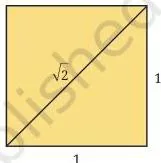
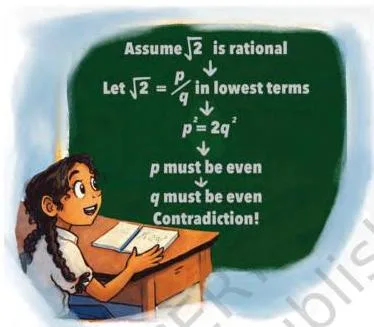
The proof that this length is irrational is the chapter’s centrepiece. Here is the full walkthrough of the proof by contradiction that \sqrt{2} is irrational.
Step 1 — Assume the opposite.
Suppose \( \sqrt{2} = \frac{p}{q} \) with integers \( p, q \), \( q \neq 0 \), in lowest terms, so \( p \) and \( q \) are co-prime.
Step 2 — Square both sides.
\( 2 = \frac{p^2}{q^2} \), hence \( 2q^2 = p^2 \).
Step 3 — Deduce something about p. \( p^2 \) is twice an integer, so \( p^2 \) is even.
A square is even only when the number itself is even, so \( p = 2k \) for some integer \( k \).
Step 4 — Substitute.
\( 2q^2 = (2k)^2 = 4k^2 \), so \( q^2 = 2k^2 \).
Step 5 — Deduce something about q.
\( q^2 \) is even, so \( q \) is also even.
Step 6 — The contradiction.
Both \( p \) and \( q \) are even, so they share the factor 2, which contradicts the lowest-terms assumption.
The assumption must be false.
Conclusion: \( \sqrt{2} \) cannot equal any fraction \( \frac{p}{q} \); it is irrational.
This technique is called proof by contradiction: assume the opposite, follow the logic, and watch it collide with itself. It is credited to Hippasus of the Pythagorean school (c. 400 BCE), and section 3.5.1 challenges you to repeat it for \( \sqrt{3} \).
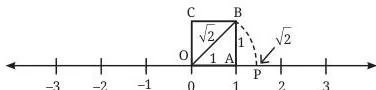
Fig. 3.11 turns the proof into a ruler-and-compass construction: measure OA = 1, raise a perpendicular at A, mark AB = 1, join O to B (so OB = \( \sqrt{2} \)), then swing an arc from O down to the number line. The landing point P is \( \sqrt{2} \).
As an original worked extension of Fig. 3.11, here is how to locate \( \sqrt{3} \) on the number line with compass and ruler.
- Step 1: Start from the point already marked \( \sqrt{2} \) on the number line; call it B.
- Step 2: At B, draw a perpendicular upward and mark C on it so that \( BC = 1 \).
- Step 3: Join O to C.
Triangle OBC is right-angled at B, so \[ OC^2 = OB^2 + BC^2 = (\sqrt{2})^2 + 1^2 = 2 + 1 = 3 \]
Step 4: Hence \( OC = \sqrt{3} \).
With centre O and radius OC, swing a compass arc down to the number line; the point where it lands is \( \sqrt{3} \).
Final answer: \( \sqrt{3} \) is constructed as the hypotenuse of a right triangle whose legs are \( \sqrt{2} \) and 1, and lands on the number line by a compass arc.
The book’s Think and Reflect asks you to continue to \( \sqrt{5} \) — build a perpendicular of length 1 on top of \( \sqrt{4} = 2 \), and the new hypotenuse is \( \sqrt{4 + 1} = \sqrt{5} \).

Fig. 3.12 states where these lengths live: the number line is not filled by rationals alone; the irrationals occupy the gaps.
Section 3.5.3 adds that \( \pi \) is one of them — Lambert proved it irrational in 1761, and Mādhava’s infinite series \( \pi = 4 \times \left( 1 – \frac{1}{3} + \frac{1}{5} – \frac{1}{7} + \dots \right) \) was the first exact way to capture it with infinitely many terms instead of one fraction.
Two Figures for the Journey’s End
Fig. 3.13 is the picture the whole chapter has been building: rationals and irrationals together form the continuous real number line, so every length, temperature and physical measurement has a home on it. The book calls the rationals a dense web and the irrationals the gaps that keep it from being complete.
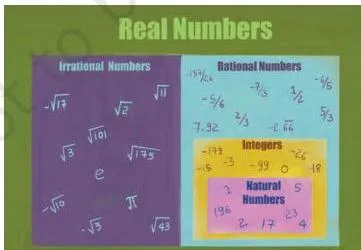
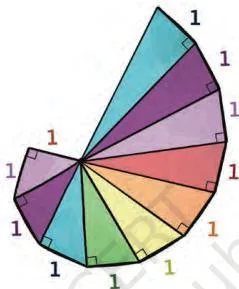
Fig. 3.14, the square root spiral, is the chapter’s last construction. Each new right triangle adds a leg of length 1 to the previous hypotenuse, so the hypotenuses run \( \sqrt{2}, \sqrt{3}, \sqrt{4}, \dots \) — exactly the lengths end-of-chapter exercise 16 asks you to find for every triangle in the spiral.
Key Terms and Symbols, Plainly Defined
These are the terms the chapter keeps using, in the order the book introduces them. Each example is the book’s own.
| Term | Introduced in | Plain meaning | Example |
|---|---|---|---|
| Natural numbers | Section 3.1 | The counting numbers, born from one-to-one correspondence | \( \mathbb{N} = \{1, 2, 3, \dots\} \) |
| Śhūnya (zero) | Section 3.2 | “Nothing” turned into a number with its own arithmetic rules | \( 7 – 7 = 0 \) |
| Integers | Section 3.3 | Naturals, zero and negatives — Brahmagupta’s fortunes (dhana) and debts (ṛiṇa) | \( \mathbb{Z} = \{\dots, -2, -1, 0, 1, 2, \dots\} \) |
| Rational number | Section 3.4 | Any number of the form \( \frac{p}{q} \) with integers \( p, q \) and \( q \neq 0 \) | \( \frac{3}{4} \) |
| Equivalent fractions | Section 3.4 | Different \( p \) and \( q \) that name the same value | \( -\frac{1}{3} = -\frac{2}{6} = -\frac{3}{9} \) |
| Co-prime | Section 3.4 | Numerator and denominator share no common factor except 1 | \( \frac{2}{5} \), not \( \frac{4}{10} \) |
| Absolute value | Section 3.4.1 | Distance from 0 on the number line — never negative | \( |-\frac{5}{3}| = \frac{5}{3} \) |
| Density | Section 3.4.2 | A rational always exists between any two rationals | \( \frac{5}{4} \) between 1 and \( \frac{3}{2} \) |
| Irrational number | Section 3.5 | Cannot be written as \( \frac{p}{q} \); decimal never ends or repeats | \( \sqrt{2}, \pi \) |
| Terminating decimal | Section 3.6.1 | Long division ends with a remainder of 0 | \( \frac{3}{8} = 0.375 \) |
| Pure repeating decimal | Section 3.6.1 | Repeating block starts immediately after the decimal point | \( 0.\overline{45} \) |
| General repeating decimal | Section 3.6.1 | Non-repeating digits first, then a repeating block | \( 0.1\overline{6} \) |
| Cyclic number | Section 3.6.2 | A repeating block whose multiples are the same digits rotated | 142857 |
| Real numbers | Section 3.6 | Union of rationals and irrationals — the whole number line | \( \mathbb{R} \) |
| Imaginary number | Section 3.7 | \( \sqrt{-1} = i \), a number that lives off the real line | \( i \) |
Mistakes the Chapter Warns You About
The chapter hides its best warnings inside “Think and Reflect” boxes — the traps it expects you to fall into. Each row below names the error, the correction, and a way to check yourself.
| Mistake | Correct rule | How to check your answer |
|---|---|---|
| “0.999… is slightly less than 1” | 0.999… equals 1 exactly. Any terminating decimal has an alternative form ending in repeating 9s, so 1.000… = 0.999… | Run the algebra: \( x = 0.\overline{9} \), \( 10x = 9.\overline{9} \), \( 9x = 9 \), \( x = 1 \) |
| Miswriting a negative fraction | The minus sign sits with either numerator or denominator: \( -\frac{1}{5} = \frac{-1}{5} = \frac{1}{-5} \) | Divide each form — all three give the same quotient |
| Any number with a visible pattern is rational | A pattern is not a repeating block. \( 1.010010001\dots \) has a pattern but no block that repeats forever, so it is irrational (Exercise Set 3.5, Q3(v)) | Ask: does one fixed block repeat from some point onward, or does the gap keep growing? |
| Forgetting \( q \neq 0 \) or leaving a fraction unreduced | A rational is \( \frac{p}{q} \) with \( q \neq 0 \), and the standard form has \( p, q \) co-prime | Reduce before classifying; if \( q = 0 \) the expression is not a number |
| Treating every square root as irrational | Only non-perfect roots are irrational. \( \sqrt{81} = 9 \) is rational (Exercise Set 3.5, Q3(i)) | Simplify the root first, then classify the number you actually have |
| Not seeing why \( (-3) \times (-4) = 12 \) | Multiplying by a negative is the removal of debt; removing four debts of ₹3 makes you ₹12 richer | Test the debt story: does the sign fit the action of removing debt? |
| Believing density means rationals fill the line | Density says a rational exists between any two rationals; it does not say every point is rational | Try to write \( \sqrt{2} \) as \( \frac{p}{q} \) — no fraction works |
How to Practise This Chapter
This chapter is best learned in the order it is written, because every section builds the next number set. A sensible sequence:
- Master the definition first: \( \frac{p}{q} \), \( q \neq 0 \), co-prime. Most errors in this chapter trace back to one of these three conditions.
- Practise the four rational arithmetic laws from section 3.4 until they are automatic — Exercise Set 3.3 tests exactly equality, sums, differences, products, quotients and the distributive law.
- Learn the \( \sqrt{2} \) proof by contradiction as a six-step routine, then take up the book’s own challenge (section 3.5.1, Think and Reflect): prove \( \sqrt{3} \) irrational the same way.
- Use the denominator rule for decimals (prime factors only 2, only 5, or both → terminating) — Exercise Set 3.5 Q1 and end-of-chapter questions 11 and 12 keep returning to it.
- Treat the starred questions as extension work: finger-joint base-12 counting (Exercise Set 3.1 Q4) and the hunt for other cyclic reciprocals (Exercise Set 3.5 Q5*) are the chapter’s open challenges.
Mapping the exercise sets to skills helps you use them deliberately: Exercise Set 3.1 tests counting and the bone evidence; Exercise Set 3.2 tests integer arithmetic inside debt stories; Exercise Set 3.3 tests the rational arithmetic laws; Exercise Set 3.4 tests number-line placement and density; Exercise Set 3.5 tests decimal classification and conversion.
The end-of-chapter exercises mix long-division conversions, a proof that \( \sqrt{5} \) is irrational, \( \frac{p}{q} \) conversions, locating decimals on the line, and finding rationals between two numbers — question 16 closes with the square root spiral.
For any decimal question, work two independent checks: classify first using the denominator’s prime factors, then confirm by long division. If the two answers disagree, the mistake is usually in the lowest-terms step.
Textbook contents and the examinable syllabus are not always identical — check the current official CBSE syllabus.
The Chapter’s Ideas in One Page
This mirrors the chapter’s own closing summary, reworded for a quick scan. The number system grew in layers over thousands of years:
- Natural numbers — counting, born tens of thousands of years ago from the human need to tally.
- Zero — philosophical śhūnyatā became mathematical zero via the Bakhshālī bindu and Brahmagupta’s rules in the 7th century CE.
- Integers — Brahmagupta’s fortunes and debts extended the line left of zero; his signed arithmetic made negatives calculable.
- Rationals — \( \frac{p}{q} \) with \( q \neq 0 \), closed under the four operations (except division by zero) and dense on the line.
- Irrationals — \( \sqrt{2} \) (proof by contradiction, c. 400 BCE) and \( \pi \) (Āryabhaṭa’s approximation, Lambert’s proof, Mādhava’s series) have decimals that never end or repeat.
- Reals — the union of rationals and irrationals, a continuous line where every physical measurement has a point.
- Cyclic numbers — the hidden order inside \( \frac{1}{7} \): 142857 rotates through its own multiples.
- Imaginary numbers — \( \sqrt{-1} = i \), the chapter’s closing teaser and the next frontier.
The chapter ends with its own question: is the journey over, or is there a world of numbers waiting beyond the real line?
Related Resources
This listing is maintained for the 2026-27 academic session using the NCERT textbook information available to us. NCERT remains the authority for confirming the latest edition.
Continue with the rest of the Class 9 course through the NCERT Class 9 Mathematics notes hub, the Class 9 study hub and the full notes library. The skills this chapter feeds are used in the notes on introductory linear polynomials and algebraic identities.
| What the chapter holds | Count | Where it is used |
|---|---|---|
| Printed pages | 27 | |
| Sections in the chapter | 19 | |
| Figures with NCERT captions | 14 | |
| Tables | 2 | |
| Exercise questions | 24 | answered in our NCERT Solutions |
| Official NCERT PDF | Download the chapter PDF | the chapter exactly as NCERT publishes it |
Reference: NCERT Class 9 Mathematics (Ganita Manjari) textbook, chapter 3, official edition on ncert.nic.in.
Sources and Data Verification
- The section and figure references on this page describe the NCERT Ganita Manjari, Grade 9, Part I Mathematics textbook, official edition — the same Class 9 Mathematics Chapter 3 whose PDF is linked at the top of this page.
- This page covers Chapter 3, “The World of Numbers”, only; other books and editions are not described here.
- The page is maintained for the current academic session using the NCERT information available to us.
- NCERT settles textbooks, editions and PDFs, which are published on ncert.nic.in; CBSE settles the curriculum, syllabus and examinations. Textbook contents and the examinable syllabus are not always identical.
Frequently Asked Questions
Why is 0.999… exactly equal to 1?
Because no number can fit between them, and the algebra forces equality. Let \( x = 0.\overline{9} \). Then \( 10x = 9.\overline{9} \), and subtracting gives \( 10x – x = 9.\overline{9} – 0.\overline{9} = 9 \), so \( 9x = 9 \) and \( x = 1 \). The chapter’s non-uniqueness note makes the same point: 1.000… and 0.999… are two names for one number.
How can I tell whether a rational number’s decimal expansion terminates without doing long division?
Write the fraction in lowest terms and factor the denominator. If its prime factors are only 2, only 5, or both 2 and 5, the decimal terminates; any other prime factor makes it repeat. The number of decimal places is the larger of the two exponents. Example: \( \frac{17}{125} \) terminates with 3 places because \( 125 = 5^3 \), giving 0.136, while \( \frac{11}{24} \) repeats because \( 24 = 2^3 \times 3 \).
What is the difference between a rational number and an irrational number?
A rational number can be written as \( \frac{p}{q} \) with integers \( p \), \( q \) and \( q \neq 0 \), and its decimal either terminates or repeats. An irrational number cannot be written that way, and its decimal never ends and never repeats. Examples: \( \frac{5}{11} = 0.\overline{45} \) is rational; \( \sqrt{2} = 1.41421356\dots \) and \( \pi = 3.14159265\dots \) are irrational.
How do I convert a general repeating decimal like 0.16-repeating into a fraction p/q?
Use two shifts: one to clear the non-repeating digits, one to move a full repeating cycle. For \( x = 0.1\overline{6} \): \( 10x = 1.\overline{6} \) and \( 100x = 16.\overline{6} \). Subtract: \( 100x – 10x = 16.\overline{6} – 1.\overline{6} \), so \( 90x = 15 \) and \( x = \frac{15}{90} = \frac{1}{6} \). In general, multiply by \( 10^m \) where m is the number of non-repeating digits, then by \( 10^n \) for the repeating block, subtract, and solve.
Why can’t the denominator q be zero in the definition of a rational number?
Because division by zero has no value. \( \frac{p}{0} \) would ask for a number that, multiplied by 0, gives p — when \( p \neq 0 \) no such number exists, and when \( p = 0 \) every number would qualify. The numerator may be zero: \( \frac{0}{5} = 0 \) is a valid rational number. This is exactly the question the Think and Reflect box in section 3.4 asks you to answer.
Explore Class 9 Mathematics Books
- Previous: Introduction to Linear Polynomials
- Next: Exploring Algebraic Identities
Related chapters:
- Orienting Yourself: The Use of Coordinates
- I'm Up and Down, and Round and Round
- Measuring Space: Perimeter and Area